Mushrooms and ALS
0 ALS-specific studies
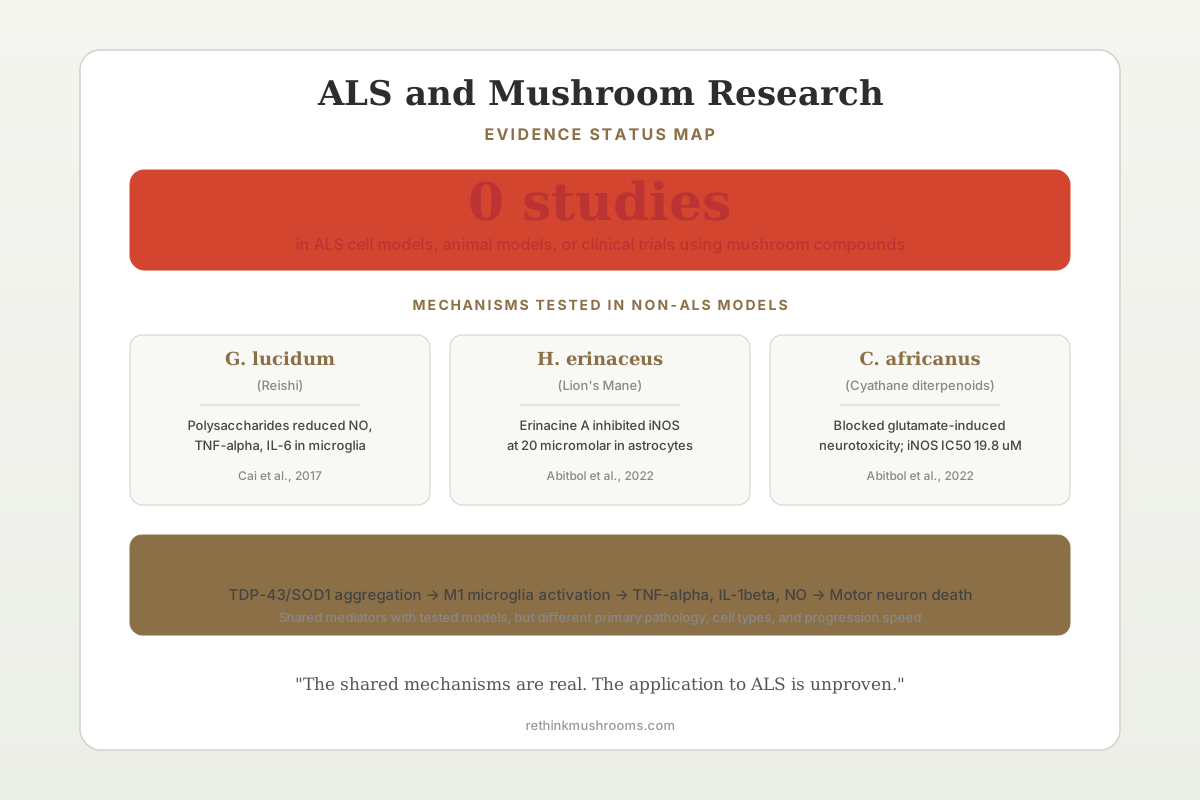
No mushroom compound has been tested in ALS cell models, ALS animal models, or ALS clinical trials. The neuroinflammation research is real, but the ALS application is entirely hypothetical.
ALSUntangled #73, Amyotrophic Lateral Sclerosis & Frontotemporal Degeneration, 2024
Zero
mushroom studies in SOD1 or TDP-43 ALS models
Microglia
shift from neuroprotective M2 to neurotoxic M1 in ALS
Erinacine A
inhibited iNOS and NO in LPS-induced astrocytes at 20 μM
ALSUntangled #73, Amyotrophic Lateral Sclerosis & Frontotemporal Degeneration, 2024
 View as image ↗
This article begins with a disclaimer that shapes everything that follows: no mushroom compound has been tested in an ALS-specific experimental model. Not in SOD1-mutant mice. Not in TDP-43 cell cultures. Not in a clinical trial with ALS patients. The ALSUntangled review group, which systematically evaluates alternative therapies on behalf of people with ALS, confirmed this gap in their 2024 assessment of lion's mane (Hericium erinaceus): "There have been no studies in ALS cell or animal models or in humans with ALS."[1]
What does exist is a body of research on mushroom-derived compounds and neuroinflammation in other contexts: Alzheimer's disease models, Parkinson's models, general microglial activation assays, and nerve growth factor studies. Some of these mechanisms overlap with ALS pathology. This article maps that overlap honestly, without pretending the research is further along than it is.
Key Takeaways
- No mushroom compound has been tested in ALS cell models, animal models, or clinical trials (ALSUntangled #73, 2024)
- ALS involves a shift from neuroprotective M2 microglia to neurotoxic M1 microglia, with elevated TNF-alpha, IL-1beta, and IL-6 driving motor neuron death
- Ganoderma lucidum polysaccharides attenuated microglia-mediated neuroinflammation in vitro, reducing NO, TNF-alpha, and IL-1beta via NF-kB pathway modulation (Cai et al., 2017)
- Erinacine A from Hericium erinaceus inhibited iNOS and NO production at 20 micromolar in LPS-induced astrocytes with no cytotoxicity at 1 mg/mL (Abitbol et al., 2022)
- Mushroom cyathane diterpenoids inhibited glutamate-induced neurotoxicity, a mechanism directly relevant to ALS excitotoxicity (Abitbol et al., 2022)
- The gap between anti-neuroinflammatory activity in general assays and therapeutic relevance in ALS is enormous, and no one has attempted to bridge it experimentally
How neuroinflammation drives ALS progression
ALS (amyotrophic lateral sclerosis) is a progressive motor neuron disease that kills upper and lower motor neurons in the brain and spinal cord. Most cases involve aggregation of misfolded proteins, primarily TDP-43 (in ~97% of cases) or SOD1 (in familial cases with SOD1 mutations). These aggregates trigger a cascade of cellular damage that includes mitochondrial dysfunction, oxidative stress, glutamate excitotoxicity, and neuroinflammation.
Neuroinflammation in ALS follows a two-phase pattern. In early disease, microglia (the brain's resident immune cells) adopt a neuroprotective M2 phenotype, supported by anti-inflammatory T helper 2 cells and regulatory T cells. As the disease progresses, microglia shift to a neurotoxic M1 phenotype, releasing pro-inflammatory cytokines: TNF-alpha, IL-1beta, IL-6, and nitric oxide (NO). This shift is accompanied by a decline in regulatory T cells and an increase in pro-inflammatory T cells.[2]
Astrocytes undergo a parallel transformation. Reactive astrocytes in ALS lose their supportive functions and become toxic to motor neurons, releasing factors that directly kill them. The NF-kB signaling pathway is a central driver of this pro-inflammatory cascade in both microglia and astrocytes.
This is important context because every mushroom compound discussed below targets some part of this inflammatory machinery. The question is whether targeting it in a general assay translates to protecting motor neurons in ALS specifically.
What mushroom research exists on neuroinflammation
Mechanism Demonstrated · ALS Relevance Unproven
Every Compound Has a Mechanism. None Has an ALS Study.
Six mushroom-derived compounds have documented anti-neuroinflammatory or anti-excitotoxic activity. Reading left to right, the map fills in — species, compound, demonstrated mechanism — until the last column, which is empty for every row. Not one has been tested in an ALS cell model, an ALS animal model, or a human with ALS. The ALSUntangled #73 review confirmed this gap in 2024.
Ganoderma lucidum (reishi)
Polysaccharides
- Mechanism
- ↓ NO, TNF-α, IL-6 in activated microglia; modulates phagocytosis
- Source
- [3]
Ganoderma lucidum (reishi)
Triterpenoids (deacetyl ganoderic acid F, ganoderterpene A)
- Mechanism
- ↓ NF-κB & MAPK signaling; ↓ NO, TNF-α, IL-6
- Source
- [4]
Hericium erinaceus (lion’s mane)
Erinacine A
- Mechanism
- ↓ iNOS & NO at 20 μM in LPS astrocytes; ↓ TNF-α
- Source
- [2]
Cyathus africanus
Cyathane diterpenoids
- Mechanism
- ↓ glutamate-induced neurotoxicity; iNOS IC₅₀ 19.8 μM
- Source
- [2]
Inonotus obliquus (chaga)
Lanostanoids
- Mechanism
- ↓ NO in microglia, IC₅₀ 2.32–9.17 μM
- Source
- [2]
Grifola frondosa (maitake)
Polysaccharides
- Mechanism
- ↑ Aβ clearance, cognition in APP/PS1 mice (5–10 mg/kg)
- Source
- [2]
The mechanisms are real and, in the case of the cyathane diterpenoids, directly relevant to ALS excitotoxicity. But relevance is not evidence. Every result above was generated in a general neuronal or non-ALS disease model, and motor neurons differ from the cortical and hippocampal neurons used in these assays. Bridging the gap requires ALS-specific experiments that have not been done.
Evidence synthesis; cells from refs [2][3][4]; ALS gap per ALSUntangled #73 [1]
Ganoderma lucidum (reishi)
The strongest neuroinflammation data from any mushroom species comes from Ganoderma lucidum polysaccharides. Cai et al. (2017) demonstrated that G. lucidum polysaccharides attenuated microglia-mediated neuroinflammation in vitro.[3] The polysaccharides reduced production of NO and pro-inflammatory cytokines (TNF-alpha and IL-6) in activated microglia and modulated microglial phagocytosis. In behavioral tests, they also improved outcomes in an LPS-induced neuroinflammation model.
Cai et al. (2017) · Journal of Neuroinflammation
- Population
- Cultured microglia (in vitro) plus an LPS-induced neuroinflammation model
- Intervention
- Ganoderma lucidum polysaccharides
- Comparator
- LPS-activated microglia without treatment
- Finding
- Reduced nitric oxide, TNF-alpha, and IL-6 production in activated microglia and modulated microglial phagocytosis; improved outcomes in the LPS behavioral model.
narrow-scope A genuine, well-characterized anti-neuroinflammatory effect — but generated in general microglia and an LPS challenge, not in any ALS model. The primary ALS drivers (TDP-43/SOD1 aggregation, motor-neuron excitotoxicity) were never present in this system.
Cai et al. (2017), Journal of Neuroinflammation
A separate line of research has identified triterpenoids from G. lucidum with anti-neuroinflammatory properties. Deacetyl ganoderic acid F inhibited microglia and astrocyte activation by decreasing NO production and suppressing TNF-alpha and IL-6, with the mechanism linked to interruption of the NF-kB pathway.[4] Ganoderterpene A suppressed both the MAPK and TLR-4/NF-kB signaling pathways in activated microglia.
Chen et al. (2024) reviewed the therapeutic potential of G. lucidum against Alzheimer's disease, documenting mechanisms that include inhibiting tau hyperphosphorylation, reducing amyloid-beta formation, modulating activated microglia, and regulating the NF-kB/MAPK signaling pathway.[4] These mechanisms are relevant to general neuroprotection, but none have been tested in ALS-specific models where the primary pathology is motor neuron loss from protein aggregation and excitotoxicity, not amyloid plaques.
Hericium erinaceus (lion's mane)
Lion's mane contains two classes of compounds with neuroprotective activity: erinacines (from mycelium) and hericenones (from fruiting bodies). Both stimulate nerve growth factor (NGF) synthesis, which is relevant to neuronal survival and repair.
Abitbol et al. (2022) reviewed mushroom natural products in neurodegenerative disease drug discovery and highlighted erinacine A as inhibiting iNOS and NO production at 20 micromolar in LPS-induced astrocytes, with no cytotoxicity at 1 mg/mL.[2] Erinacine A also reduced TNF-alpha expression in neuronal cell lines and improved motor and cognitive function in animal models of non-ALS neurodegeneration.
The ALSUntangled team reviewed all available evidence on lion's mane in 2024 and concluded: "Currently, we do not have enough information to support the use of Lion's Mane for treating ALS."[1] They noted that lion's mane appears safe and inexpensive, but that the complete absence of ALS-specific research makes any therapeutic claim unsupported.
Other mushroom compounds
The Abitbol et al. (2022) review catalogued additional mushroom-derived compounds with anti-neuroinflammatory activity:[2]
Cyathane diterpenoids from Cyathus africanus inhibited glutamate-induced neurotoxicity. This is mechanistically relevant to ALS because excitotoxicity from excess glutamate is a recognized driver of motor neuron death in the disease. Compound 14 in the series demonstrated iNOS inhibition with an IC50 of 19.8 micromolar.
Inonotus obliquus (chaga) lanostanoids showed NO inhibition in activated microglia with IC50 values of 2.32-9.17 micromolar, among the most potent natural product NO inhibitors reported.
Grifola frondosa (maitake) polysaccharides improved cognition in APP/PS1 Alzheimer's mice at 5-10 mg/kg and enhanced microglial-mediated clearance of amyloid-beta plaques.
None of these have been tested in ALS models.
The glutamate excitotoxicity connection
One mechanism where mushroom research and ALS pathology overlap more directly is glutamate excitotoxicity. Motor neurons in ALS are killed partly by excessive glutamate signaling, which overstimulates NMDA and AMPA receptors and floods neurons with calcium. This excitotoxic death pathway is so central to ALS that riluzole, one of only two FDA-approved drugs for the disease, works by reducing glutamate release.
The cyathane diterpenoids from Cyathus africanus reported by Abitbol et al. (2022) inhibited glutamate-induced neurotoxicity in cell culture.[2] This is a more mechanistically relevant finding for ALS than general anti-inflammatory data, because it targets the specific cell death pathway that kills motor neurons. Compound 14 in the series showed iNOS inhibition with an IC50 of 19.8 micromolar, and the neocyathins K-R series demonstrated protection against glutamate-induced cell death.
However, these compounds were tested in general neuronal cell lines, not motor neurons. Motor neurons have different glutamate receptor expression patterns, calcium buffering capacity, and survival signaling requirements than cortical or hippocampal neurons. Activity in a general excitotoxicity assay does not guarantee activity in motor neuron-specific models.
The only FDA-approved glutamate-targeting ALS drug, riluzole, extends median survival by approximately 2-3 months. This provides a sobering benchmark for any new anti-excitotoxic compound: even a drug with proven mechanism and clinical evidence produces modest benefit. Whether mushroom-derived anti-excitotoxic compounds could match or exceed this is entirely unknown.
The gap between mechanism and disease
The disconnect between mushroom neuroinflammation research and ALS is not just a matter of incomplete data. It reflects fundamental differences between ALS and the neurodegenerative diseases where mushroom compounds have been tested.
Different primary pathology. In Alzheimer's disease, extracellular amyloid plaques and intracellular tau tangles drive neuroinflammation. In ALS, cytoplasmic TDP-43 or SOD1 aggregates in motor neurons are the primary trigger. The downstream inflammatory cascades share some mediators (TNF-alpha, NF-kB, microglial activation), but the upstream causes are different, and treatments that work in Alzheimer's models have historically failed in ALS.
Different vulnerable cell populations. Alzheimer's primarily affects hippocampal and cortical neurons. ALS primarily affects motor neurons in the spinal cord and motor cortex. Motor neurons have unique vulnerability profiles, including high sensitivity to glutamate excitotoxicity and heavy metabolic demands. A compound that protects hippocampal neurons from amyloid toxicity may not protect motor neurons from TDP-43 aggregation.
Blood-brain barrier and delivery. Many mushroom polysaccharides are large molecules with poor CNS penetration. Even compounds that show potent anti-inflammatory activity in cell culture may not reach motor neurons in the spinal cord at therapeutic concentrations. The smaller triterpenoids and diterpenoids have better theoretical bioavailability, but CNS pharmacokinetics have not been established for most mushroom-derived compounds.
ALS progression speed. ALS progresses rapidly, with median survival of 2-5 years from diagnosis. Anti-inflammatory interventions that might slow chronic neurodegenerative processes over decades (as in Alzheimer's) may not produce meaningful benefit in a disease that kills within years. The therapeutic window for neuroinflammation modulation in ALS is narrow and poorly defined.
What would bridge the gap
For mushroom compounds to move from general neuroinflammation research toward ALS relevance, specific experiments are needed:
- Testing in SOD1-G93A transgenic mice, the standard ALS animal model, measuring motor function, motor neuron survival, microglial activation, and survival time
- Testing in TDP-43 cell culture models, assessing whether mushroom compounds reduce TDP-43 aggregation-induced cytotoxicity
- Pharmacokinetic studies demonstrating that active compounds reach the spinal cord at concentrations matching their in vitro IC50 values
- Phase I safety and bioavailability studies in ALS patients
Research Gaps
What would move mushrooms from 'plausible' to 'evidence-based' for ALS?
Four experiments, run in sequence, would tell us whether any mushroom compound belongs anywhere near ALS. None has been done.
SOD1-G93A transgenic mouse testing
The standard ALS animal model — measure motor function, motor neuron survival, microglial activation, and survival time.
TDP-43 cell-culture models
Test whether mushroom compounds reduce TDP-43 aggregation-induced cytotoxicity, the pathology in ~97% of ALS cases.
CNS pharmacokinetics
Show that active compounds actually reach the spinal cord at concentrations matching their in vitro IC50 values.
Phase I safety/bioavailability in ALS patients
Establish tolerability and exposure before any efficacy claim is possible.
Evidence synthesis; ALS-model requirements per ALSUntangled #73 (2024)
Until at least the first two experiments are completed, the connection between mushroom anti-neuroinflammatory research and ALS remains theoretical. The shared mechanisms are real. The application to ALS is unproven.
Why people with ALS try mushroom supplements anyway
Despite the absence of evidence, mushroom supplements are widely used by people with ALS. Online ALS communities frequently discuss lion's mane, reishi, cordyceps, and turkey tail. The ALSUntangled team reviewed lion's mane specifically because of patient demand for evidence-based assessment.[1]
Reader Question
Does lion's mane treat ALS?
The claim
“Lion's mane is neuroprotective and boosts nerve growth factor, so it should help slow ALS.”
Extrapolation from lion's mane NGF and cognition research in non-ALS settings, amplified in online ALS communities.
What research shows
UnsupportedThe ALSUntangled #73 review evaluated all available evidence in 2024 and concluded: "Currently, we do not have enough information to support the use of Lion's Mane for treating ALS." There are no studies in ALS cell models, ALS animal models, or humans with ALS.
Lion's mane genuinely stimulates nerve growth factor and shows neuroprotection in other models — the mechanism is real. But NGF support and anti-inflammation in a petri dish or an Alzheimer's mouse do not establish any effect on motor neuron death in ALS. The therapeutic claim is unsupported, not disproven.
ALSUntangled #73, Muhanna et al. (2024)
The reasons are understandable. ALS has only two approved drugs (riluzole and edaravone), both with modest efficacy. Riluzole extends median survival by 2-3 months. Edaravone's benefit is debated. People facing a fatal disease with limited treatment options look for anything with biological plausibility and a safety profile that allows self-experimentation.
Lion's mane appears safe in the doses typically consumed. The ALSUntangled review noted only one reported adverse event (an anaphylactic reaction to fresh mushroom consumption) across all available safety data.[1] Reishi has a longer safety track record from traditional use, though hepatotoxicity cases have been reported at high doses. The low cost and wide availability of mushroom supplements make them accessible.
Safety Context
LowGenerally low-risk, but not risk-free — and not a treatment
Concern
Because mushroom supplements are widely available and inexpensive, people with ALS often self-experiment with lion's mane, reishi, cordyceps, and turkey tail without medical oversight.
What the research says
Lion's mane appears safe at commonly consumed doses: the ALSUntangled #73 review found only one reported adverse event (an anaphylactic reaction to fresh mushroom consumption) across the available safety data. Reishi has a long traditional-use record, but hepatotoxicity has been reported at high doses.
Particularly relevant for: People with ALS considering mushroom supplements
What to do
Discuss any supplement with your neurologist first, especially alongside riluzole or edaravone. This article is educational and is not medical advice; nothing here should replace guidance from your care team.
ALSUntangled #73, Muhanna et al. (2024)
The problem is not safety. The problem is the cognitive leap from "this compound reduces microglial activation in a petri dish" to "this compound will slow motor neuron death in a living human with ALS." That leap has defeated hundreds of compounds that looked promising in preclinical studies. The history of ALS drug development is littered with anti-inflammatory, antioxidant, and neuroprotective agents that worked in cell culture and animal models but failed in human trials. Mushroom compounds have not even reached the animal model stage for ALS.
For related research on mushroom compounds and motor neuron protection and lion's mane for motor neuron disease, see our companion articles. For research on adaptogenic mushrooms and stress pathways, see our article on the HPA axis.
The Bottom Line
No mushroom compound has been tested in any ALS-specific experimental model. The anti-neuroinflammatory properties of Ganoderma lucidum polysaccharides, Hericium erinaceus erinacines, and various mushroom diterpenoids are documented in cell culture and non-ALS animal models. These mechanisms overlap with ALS pathology, particularly microglial activation and NF-kB-driven inflammation, but the diseases differ in primary pathology, vulnerable cell types, and progression speed. Bridging the gap requires ALS-specific experiments that have not been conducted.
Frequently Asked Questions
Sources & References
- 1RTHM-00896·Muhanna, Maya et al. (2024). “ALSUntangled #73: Lion's Mane..” Amyotrophic lateral sclerosis & frontotemporal degeneration.Study breakdown →PubMed →↩
- 2RTHM-00737·Abitbol, Arjuna et al. (2022). “Mushroom Natural Products in Neurodegenerative Disease Drug Discovery..” Cells.Study breakdown →PubMed →↩
- 3RTHM-00462·Cai, Qing et al. (2017). “Polysaccharides from Ganoderma lucidum attenuate microglia-mediated neuroinflammation and modulate microglial phagocytosis and behavioural response..” Journal of neuroinflammation.Study breakdown →PubMed →↩
- 4RTHM-00871·Chen, Xu-Jia et al. (2024). “Therapeutic potential of the medicinal mushroom Ganoderma lucidum against Alzheimer's disease..” Biomedicine & pharmacotherapy = Biomedecine & pharmacotherapie.Study breakdown →PubMed →↩