Psilocybin Microdosing & Neuroplasticity
~10% spine density increase
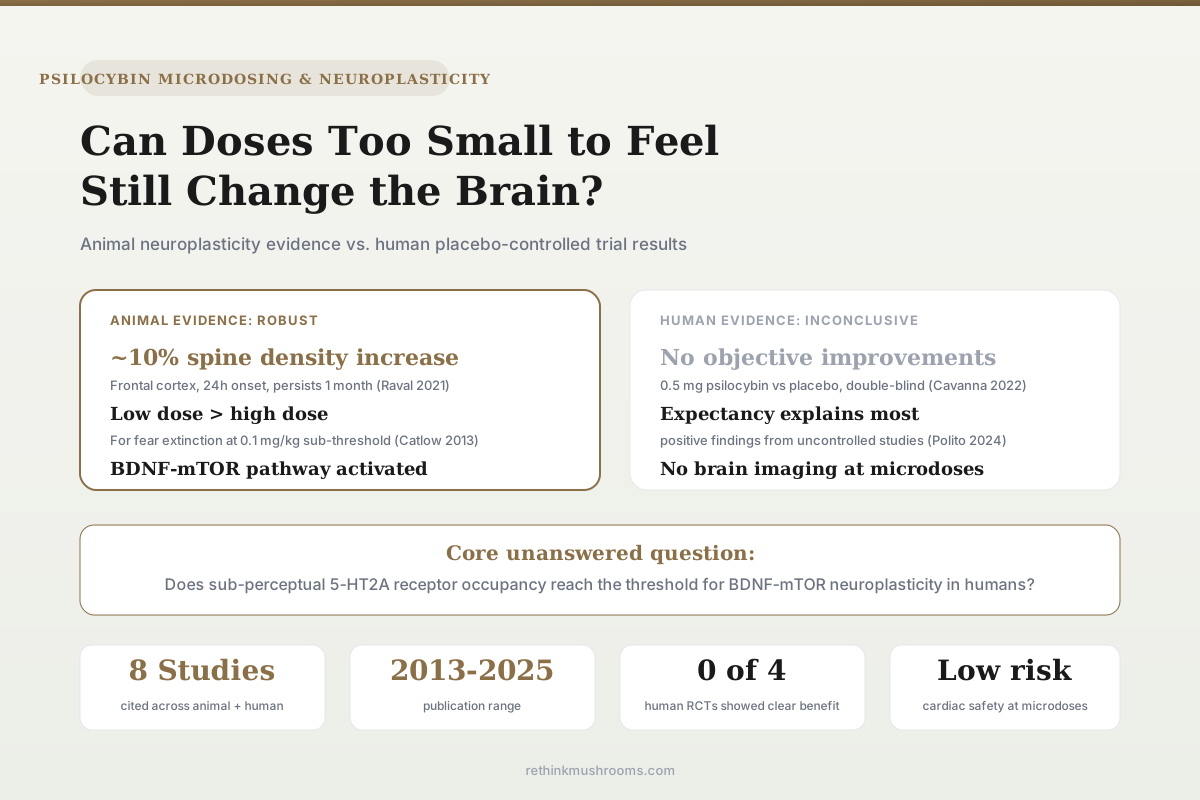
A single dose of psilocybin increased dendritic spine size and density by approximately 10% in mouse frontal cortex within 24 hours, with structural changes persisting one month later.
Raval et al., Neuron, 2021
Low dose
psilocybin enhanced fear extinction more than high dose
0 of 4
placebo-controlled human microdosing RCTs found clear benefit
TrkB
direct receptor binding proposed for psychedelic neuroplasticity
Raval et al., Neuron, 2021
 View as image ↗
The central question in psilocybin microdosing is whether doses too small to produce conscious psychedelic effects can still alter brain structure and function. If sub-perceptual doses (typically 0.1-0.3 g of dried Psilocybe cubensis, or roughly 1-3 mg of psilocybin) can promote neuroplasticity, dendritic growth, or neurotrophic factor expression, then the therapeutic mechanism would operate below the threshold of awareness. This would separate the biological effects from the subjective psychedelic experience, opening a pathway to therapeutic benefits without altered consciousness.
The animal evidence for psilocybin-induced neuroplasticity is substantial: dendritic spine growth in frontal cortex, increased hippocampal neurogenesis, BDNF pathway activation, and enhanced fear extinction learning. The problem is that most of this evidence comes from doses that would be perceptible to humans, and the few studies using genuinely sub-perceptual doses in rodents show inconsistent results. The human placebo-controlled microdosing trials have been even less convincing. For the broader argument connecting neuroplasticity to microdosing, see the neuroplasticity argument for microdosing.
Key Takeaways
- A single psilocybin dose (1 mg/kg in mice) increased dendritic spine size and density by approximately 10% in frontal cortex within 24 hours, with changes persisting at least one month; the dose was not sub-perceptual at this level (Raval et al., 2021)
- Low-dose psilocybin (0.1 mg/kg, sub-threshold in mice) enhanced extinction of conditioned fear more effectively than high-dose psilocybin (1.0 mg/kg), with hippocampal neurogenesis trending upward at the low dose (Catlow et al., 2013)
- In a double-blind placebo-controlled human trial, psilocybin microdosing (0.5 mg) produced no objective cognitive or emotional processing improvements over placebo, though participants could not reliably distinguish microdose from placebo (Cavanna et al., 2022)
- A 2024 review of all placebo-controlled microdosing studies concluded that most positive findings in uncontrolled studies are attributable to expectancy effects (Polito & Liknaitzky, 2024)
- Psilocybin promoted neuroplasticity in chronically stressed mice by increasing BDNF-mTOR signaling, synaptic proteins, and dendritic complexity in prefrontal cortex and hippocampus (Zhao et al., 2024)
- Microdosing psilocybin activates 5-HT2A receptors at low occupancy; whether this low-level activation is sufficient to trigger downstream TrkB/BDNF neuroplasticity cascades in humans is undemonstrated (Savides & Outhoff, 2024)
Dendritic Spine Growth: The Strongest Neuroplasticity Evidence
Raval et al. (2021) provided the most direct evidence that psilocybin changes brain structure. Using two-photon imaging in live mice, they tracked individual dendritic spines in frontal cortex layer V pyramidal neurons before and after a single psilocybin dose (1 mg/kg). Within 24 hours, spine formation rate increased, producing approximately 10% increases in both spine size and density. These structural changes persisted for at least one month after the single dose.[1]
The finding is striking because it demonstrates lasting structural remodeling from a single exposure. Dendritic spines are the postsynaptic structures where excitatory synapses form; increased spine density typically correlates with enhanced synaptic connectivity and learning capacity. Chronic stress reduces dendritic spine density in frontal cortex, and this reduction correlates with depression-like behavior in animal models. Psilocybin's ability to reverse this structural deficit within 24 hours could explain its rapid antidepressant effects.
The critical limitation for microdosing: the dose used (1 mg/kg) is not sub-perceptual. In mice, this dose produces head-twitch responses (the rodent behavioral marker of 5-HT2A activation), indicating a pharmacologically active, perception-altering dose. Whether doses 5-10 times lower (the rodent equivalent of human microdoses) produce the same dendritic spine changes has not been tested with two-photon imaging. For the specific dendritic growth data in animal models, see microdosing and dendritic growth: animal model evidence.
Low-Dose Psilocybin and Hippocampal Neurogenesis
Catlow et al. (2013) directly compared low and high psilocybin doses for their effects on hippocampal neurogenesis and fear learning. Mice received either 0.1 mg/kg (sub-threshold, no head-twitch response), 1.0 mg/kg (supra-threshold), or saline, then were tested on trace fear conditioning and extinction.[2]
The low-dose group extinguished conditioned fear more rapidly than both the high-dose and saline groups. This is one of the few studies showing that a sub-perceptual psilocybin dose produces a superior behavioral outcome compared to a full dose. At the neurobiological level, neurogenesis in the dentate gyrus of the hippocampus tended to increase at the low dose but was not statistically significant. The high dose produced a non-significant trend toward decreased neurogenesis.
This finding suggests a possible inverted U-shaped dose-response curve for psilocybin and neuroplasticity: too little does nothing, a low dose may be optimal for certain forms of neural remodeling, and a high dose may paradoxically impair the same processes it enhances at lower levels. This hypothesis has not been systematically tested across a full dose range in a single study. For the BDNF-specific evidence, see sub-perceptual psilocybin and BDNF expression: rodent neuroplasticity evidence.
BDNF-mTOR Signaling: The Proposed Molecular Pathway
Zhao et al. (2024) demonstrated that psilocybin promoted neuroplasticity in chronically stressed mice through BDNF-mTOR signaling. The treatment restored stress-induced deficits in dendritic complexity, synaptic protein expression, and BDNF levels in both prefrontal cortex and hippocampus. The antidepressant-like behavioral effects were rapid (within 24 hours) and sustained (lasting at least 35 days after a single dose).[3]
Kinderlehrer (2025) reviewed the neurotransmitter, neuroinflammation, and neuroplasticity pathways through which psilocybin affects the brain. The review identified BDNF upregulation, TrkB receptor activation, mTOR signaling, and increased expression of synaptic proteins (PSD-95, synaptophysin) as convergent mechanisms. Psilocybin also reduced neuroinflammatory markers (TNF-alpha, IL-6) and microglial activation in animal models of depression.[4]
The molecular logic is compelling: psilocybin binds 5-HT2A receptors on cortical pyramidal neurons, triggering intracellular signaling cascades that converge on BDNF release and TrkB activation, which in turn promotes dendritic spine formation, synaptic plasticity, and neuronal survival. Recent research has also shown that psychedelics may promote plasticity by binding directly to the BDNF receptor TrkB, independent of serotonin receptor activation, suggesting a second neuroplasticity pathway that could operate at different dose thresholds.
The open question is the threshold: how much 5-HT2A receptor occupancy is required to initiate these cascades? Microdoses achieve low receptor occupancy. Whether that low occupancy is sufficient to meaningfully activate the BDNF-mTOR pathway in humans has not been measured directly. PET imaging studies that could quantify 5-HT2A occupancy at microdose levels have not been published for psilocybin.
Human Placebo-Controlled Evidence: Where It Falls Apart
Cavanna et al. (2022) conducted a double-blind, placebo-controlled study of psilocybin microdosing (0.5 mg psilocybin) in healthy adults. Participants completed cognitive tasks, emotional processing assessments, and subjective wellbeing measures. The microdose produced no objective improvements in any measured domain compared to placebo. Participants could not reliably distinguish the microdose from placebo at above-chance levels, confirming the dose was genuinely sub-perceptual.[5]
Polito and Liknaitzky (2024) conducted a rapid review of all placebo-controlled low-dose LSD and psilocybin studies published through 2024. Their conclusion was direct: most positive findings from uncontrolled microdosing studies are attributable to expectancy effects. When the placebo condition is properly implemented and participants cannot determine whether they received an active substance, the differences between microdose and placebo groups largely disappear.[6]
Savides and Outhoff (2024) reached similar conclusions in their comprehensive review. While acknowledging the preclinical neuroplasticity evidence, they noted that "definitive conclusions regarding the efficacy of psilocybin microdosing remain elusive" and emphasized that most human evidence relies on self-report data from unblinded or poorly blinded studies.[7] For a broader discussion of whether sub-perceptual doses affect brain plasticity, see sub-perceptual psilocybin and brain plasticity: does it work?.
Safety at Sub-Perceptual Doses
Rouaud et al. (2024) addressed a specific safety concern: whether repeated microdosing of serotonergic psychedelics could cause cardiac valvulopathy through chronic 5-HT2B receptor activation. Their analysis compared microdosing exposure to known valvulopathic drugs and concluded that the risk at sub-perceptual doses is low but not zero, particularly with protocols involving daily or near-daily dosing over months.[8]
The safety profile of occasional sub-perceptual psilocybin use appears benign based on available evidence, but long-term repeated dosing data is sparse. Most microdosing protocols recommend intermittent schedules (one day on, two days off, or similar patterns) partly to reduce tolerance and partly to minimize cumulative 5-HT2B exposure. The Stamets protocol (four days on, three days off), the Fadiman protocol (one day on, two days off), and other popular schedules have not been compared in controlled trials for either efficacy or safety.
A separate safety consideration is the unregulated nature of most microdosing supplies. Without pharmaceutical-grade dosing, the actual psilocybin content per dose can vary substantially between preparations. A nominally "sub-perceptual" dose from one batch may be perceptual from another. This variability affects both safety assessment and the interpretation of trial results, since dose consistency is a prerequisite for reproducible pharmacological effects.
The Gap Between Animal and Human Evidence
The disconnect between robust animal neuroplasticity data and null human behavioral findings has several possible explanations.
Dose translation. The rodent doses that produced dendritic spine growth and neurogenesis effects (0.1-1.0 mg/kg) may not translate cleanly to human microdoses. Allometric scaling between species is imprecise for CNS-active compounds, and the human sub-perceptual threshold may fall below the neuroplasticity threshold.
Measurement sensitivity. Animal studies measure structural changes directly (two-photon imaging of spines, BrdU-labeled neurogenesis). Human studies measure behavioral outcomes (cognitive tests, mood questionnaires). Subtle structural changes in human cortex may be occurring but producing behavioral effects too small to detect with current psychometric tools in small sample sizes.
Duration. Most human microdosing trials last 4-8 weeks. If neuroplastic structural changes from sub-perceptual doses accumulate slowly and produce behavioral benefits only after months of regular exposure, short trials would miss the effect.
Expectancy contamination. Even in "placebo-controlled" trials, participants who believe they are microdosing may exhibit enhanced mood and cognition through placebo mechanisms. If the true effect of microdosing is small, it could be masked by or confused with placebo response in both directions.
None of these explanations has been conclusively demonstrated. The most parsimonious interpretation of current evidence is that psilocybin has genuine neuroplasticity-promoting effects at pharmacologically active doses, and it remains unclear whether those effects extend to sub-perceptual doses in humans.
The Catlow et al. (2013) low-dose fear extinction data remains the strongest piece of evidence that sub-threshold psilocybin doses can produce neurobiological effects. That study used a dose confirmed to be sub-behavioral in mice and showed a functional outcome (faster fear extinction) that was superior to both saline and the full dose. If this finding replicates, it would provide a biological anchor for the microdosing hypothesis independent of human self-report data. To date, no replication has been published.
The Bottom Line
Psilocybin produces structural brain changes at pharmacologically active doses: dendritic spine growth in frontal cortex (persisting one month), hippocampal neurogenesis at low doses in mice, and BDNF-mTOR pathway activation that reverses stress-induced neural deficits. At genuinely sub-perceptual doses in humans, the evidence is weaker. Placebo-controlled human microdosing trials have not demonstrated objective cognitive or emotional benefits beyond placebo, and reviews conclude that most positive findings from uncontrolled studies reflect expectancy effects. Whether sub-perceptual psilocybin doses achieve sufficient 5-HT2A receptor occupancy to trigger neuroplasticity cascades in humans is the core unanswered question.
Frequently Asked Questions
Sources & References
- 1RTHM-00714·Raval, Nakul Ravi et al. (2021). “A Single Dose of Psilocybin Increases Synaptic Density and Decreases 5-HT2A Receptor Density in the Pig Brain..” International journal of molecular sciences.Study breakdown →PubMed →↩
- 2RTHM-00279·Catlow, Briony J et al. (2013). “Effects of psilocybin on hippocampal neurogenesis and extinction of trace fear conditioning..” Experimental brain research.Study breakdown →PubMed →↩
- 3RTHM-00920·Zhao, Xiangting et al. (2024). “Psilocybin promotes neuroplasticity and induces rapid and sustained antidepressant-like effects in mice..” Journal of psychopharmacology (Oxford.Study breakdown →PubMed →↩
- 4RTHM-00929·Kinderlehrer, Daniel A (2025). “Mushrooms, Microdosing, and Mental Illness: The Effect of Psilocybin on Neurotransmitters, Neuroinflammation, and Neuroplasticity..” Neuropsychiatric disease and treatment.Study breakdown →PubMed →↩
- 5RTHM-00748·Cavanna, Federico et al. (2022). “Microdosing with psilocybin mushrooms: a double-blind placebo-controlled study..” Translational psychiatry.Study breakdown →PubMed →↩
- 6RTHM-00900·Polito, Vince et al. (2024). “Is microdosing a placebo? A rapid review of low-dose LSD and psilocybin research..” Journal of psychopharmacology (Oxford.Study breakdown →PubMed →↩
- 7RTHM-00905·Savides, Isabella A et al. (2024). “Less is more? A review of psilocybin microdosing..” Journal of psychopharmacology (Oxford.Study breakdown →PubMed →↩
- 8RTHM-00903·Rouaud, Antonin et al. (2024). “Microdosing psychedelics and the risk of cardiac fibrosis and valvulopathy: Comparison to known cardiotoxins..” Journal of psychopharmacology (Oxford.Study breakdown →PubMed →↩