Mushroom Supplement Contamination & Purity
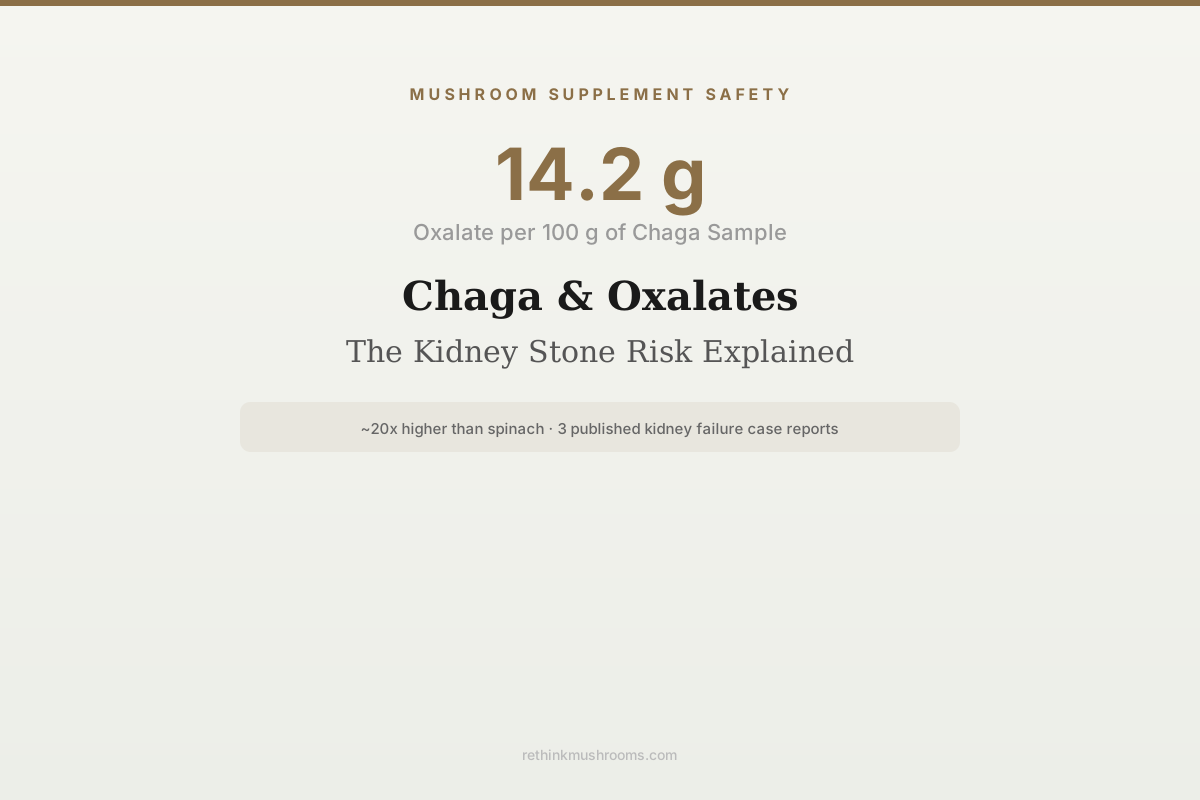
14.2 g/100 g
One analysed chaga sample contained 14.2 grams of oxalate per 100 grams of dry material, roughly 20 times the oxalate content of spinach per gram. Three published case reports link long-term high-dose chaga consumption to calcium oxalate nephropathy and kidney failure.
Kwon et al., Medicine, 2022
3 case reports
published chaga-induced oxalate nephropathy cases in peer-reviewed literature
ESRD + hemodialysis
two of three cases required long-term dialysis or transplant
6 months
shortest reported duration of chaga use before kidney failure onset
Kwon et al., Medicine, 2022
 View as image ↗
Calcium oxalate kidney stones are the most common type of kidney stone in humans, accounting for approximately 75% of all renal stones. Oxalate nephropathy, a more severe condition, involves calcium oxalate crystal deposition in the renal tubules with progressive tubular damage, interstitial inflammation, and potentially end-stage renal disease. Chaga (Inonotus obliquus) has produced three published case reports of oxalate nephropathy from long-term high-dose consumption. In one analysed sample, chaga contained 14.2 grams of oxalate per 100 grams of product, a concentration approximately 20 times higher than raw spinach (one of the highest-oxalate foods in a typical diet).[1] This article explains the mechanism, reviews the three cases, and places chaga's oxalate content in dietary context. For the broader long-term safety picture, see can you take chaga long-term? safety considerations.
Key Takeaways
- Kwon et al. (2022) reported acute kidney injury with nephrotic syndrome presentation in a 69-year-old man consuming 10–15 g of chaga powder and 500 mg vitamin C daily for 3 months; chemical analysis of the chaga sample showed 14.2 g oxalate per 100 g of product (Kwon et al., 2022)
- Kikuchi et al. (2014) reported chaga-induced oxalate nephropathy in a 72-year-old woman consuming 4–5 teaspoons of chaga powder daily for 6 months after hepatectomy; renal biopsy confirmed calcium oxalate crystal deposition requiring hemodialysis (Kikuchi et al., 2014)
- Lee et al. (2020) reported end-stage renal disease in a 49-year-old man after long-term chaga ingestion; kidney biopsy showed chronic tubulointerstitial nephritis with oxalate crystal deposits; daily oxalate intake was estimated at 2–5× a typical diet (Lee et al., 2020)
- Calcium oxalate forms when dietary oxalate absorbed from the gut is excreted through the kidneys and binds calcium in the renal tubules; chronic excessive oxalate intake can exceed the kidneys' excretory capacity
- Raw spinach (roughly 0.6–0.8 g oxalate per 100 g) is the highest-oxalate common food; chaga's measured 14.2 g per 100 g is approximately 18–24 times higher
- Product variability is extensive; commercial chaga oxalate content has not been systematically measured across the US or EU market
The Oxalate Problem in Chronic Consumption
Oxalic acid is a naturally occurring dicarboxylic acid found in many plant foods: spinach, rhubarb, beets, Swiss chard, nuts (almonds, cashews), chocolate, tea, and certain berries. At normal dietary intakes (typically 50–200 mg/day in a mixed Western diet), the body excretes oxalate primarily through the kidneys, where it binds calcium to form calcium oxalate crystals. Most people eliminate this load without issue because the total oxalate excreted is below the calcium oxalate supersaturation threshold of urine.
Problems begin when oxalate intake chronically exceeds the kidneys' excretory capacity. Three mechanisms lead to pathology: (1) calcium oxalate stones form in the urinary tract when urine becomes supersaturated with calcium oxalate; (2) oxalate nephropathy develops when calcium oxalate crystals deposit in renal tubular epithelium, causing tubular injury, interstitial inflammation, and progressive nephron loss; (3) systemic oxalosis occurs in severe cases when oxalate accumulates in multiple tissues. Dietary oxalate absorption also depends on calcium intake (calcium in the gut binds oxalate and reduces absorption), gut microbiota composition (Oxalobacter formigenes degrades oxalate in the colon), and small intestinal health (fat malabsorption increases oxalate absorption).
Chaga's oxalate content, at the concentrations measured by Kwon et al. (2022), is an order of magnitude higher than any common dietary source and delivers chronic oxalate loads that can overwhelm these compensatory mechanisms in susceptible individuals.
Case 1: Kikuchi 2014, the Index Report
Kikuchi et al. (2014) described a 72-year-old Japanese woman who developed oxalate nephropathy after consuming 4–5 teaspoons of chaga mushroom powder daily for 6 months following a hepatectomy for liver cancer.[2] She had been using chaga as an adjunct to oncological care. Renal function progressively declined during this period, ultimately requiring hemodialysis.
Renal biopsy revealed extensive calcium oxalate crystal deposition in the tubules, confirming the diagnosis of chaga-induced oxalate nephropathy. Several features of the case reflect increased vulnerability: advanced age (reduced renal reserve capacity), recent major surgery (hepatectomy with potential metabolic disruption), and likely concurrent medications. This was the index case that alerted the medical community to chaga's oxalate risk, and it established the basic clinical profile: elderly or otherwise vulnerable patient, multi-month use at multiple teaspoons per day, progressive renal decline, tubular oxalate crystal deposition on biopsy.
Case 2: Lee 2020, End-Stage Renal Disease
Lee et al. (2020) reported a 49-year-old Korean man who developed end-stage renal disease (ESRD) after long-term chaga ingestion.[3] He was transferred to hospital with ESRD, and review of his kidney biopsy showed chronic tubulointerstitial nephritis with calcium oxalate crystal deposits. His daily oxalate intake from chaga was estimated at 2–5 times higher than a typical diet. The diagnosis of ESRD means irreversible kidney damage requiring lifelong hemodialysis or renal transplant.
This case is more concerning than Kikuchi's for two reasons. First, the patient was substantially younger (49 vs. 72) and without the elderly, post-surgical, oncology-treated comorbidities of the index case. Second, the outcome was ESRD rather than acute kidney injury with potential recovery. The authors reviewed the literature on chaga-induced nephropathy and concluded that chaga consumption should be recognised as a potential cause of oxalate nephropathy in the differential diagnosis of unexplained renal failure.
Case 3: Kwon 2022, Nephrotic Syndrome Presentation
Kwon et al. (2022) documented the third published case, a 69-year-old man who developed acute kidney injury with clinical manifestations of nephrotic syndrome after ingesting 10–15 grams of chaga mushroom powder and 500 mg of vitamin C daily for 3 months.[1] The nephrotic syndrome presentation is unusual for oxalate nephropathy and initially complicated the diagnosis.
Pathological findings showed focal acute tubular injury with calcium oxalate crystal deposition in the tubules, interstitial fibrosis, tubular atrophy on light microscopy, and podocyte foot process effacement on electron microscopy. The final diagnosis was acute oxalate nephropathy with concurrent minimal change disease (MCD). Supportive care alone did not restore kidney function; the patient required hemodialysis and high-dose intravenous hydrocortisone (500 mg twice daily for 3 days) followed by oral prednisolone at 1 mg/kg. Kidney function recovered within one month of treatment initiation, and the MCD completely remitted.
Critically, this is the case in which chemical analysis of the actual chaga product consumed by the patient was published. The analysis reported 14.2 grams of oxalate per 100 grams of chaga, providing the first quantitative measurement of oxalate concentration in a product that had caused clinical oxalate nephropathy. The vitamin C co-administration at 500 mg/day is also relevant: vitamin C is metabolised in part to oxalate, and supplementation at this dose has been linked to increased oxalate excretion. The combined chaga + vitamin C exposure likely contributed to the nephropathy.
The Dietary Context: Spinach Comparison
Raw spinach, commonly cited as the highest-oxalate food in a typical Western diet, contains approximately 0.6–0.8 grams of oxalate per 100 grams fresh weight, or roughly 600–800 mg per 100 g dry equivalent after accounting for water content. Rhubarb is similar (500–800 mg per 100 g), and beet greens are in the same range. Chocolate, tea, and nuts contain lower oxalate per gram but can contribute substantial totals because of serving size.
Chaga's measured 14,200 mg per 100 g dry weight is approximately 18–24 times higher than fresh spinach per gram. A person consuming 10 grams of chaga powder per day (a typical high-dose regimen) would be ingesting approximately 1,420 mg of oxalate from that chaga alone. This exceeds the total daily dietary oxalate intake of most Western diets by a factor of 7–10x, sustained over months to years. No common food approaches this level of chronic oxalate exposure per gram of food consumed.
Why Case Reports Matter More Than Marketing
Three published case reports is not a large numerator. Against the estimated hundreds of thousands to millions of people using chaga globally, the rate of detected oxalate nephropathy appears to be rare. But "rare" is not the same as "acceptable." Three independent documented cases in peer-reviewed medical literature, with biopsy confirmation and mechanistic consistency, establish oxalate nephropathy as a genuine (if uncommon) adverse outcome of chronic high-dose chaga use.
Several factors likely cause under-detection: renal damage is often silent until advanced, clinicians may not ask about mushroom supplement use in the diagnostic workup of unexplained renal failure, and the mechanistic link to chaga requires specific recognition. As the case reports become more widely cited, detection rates are likely to rise. For manufacturing context that affects oxalate variability, see cGMP for mushroom supplements: manufacturing standards.
Factors That Modify Risk
Individual susceptibility to chaga-induced oxalate nephropathy depends on several factors:
Existing kidney function: Patients with chronic kidney disease, reduced nephron mass from prior damage, or conditions affecting renal reserve face elevated risk because the kidneys' capacity to excrete oxalate without tubular accumulation is diminished.
Calcium intake: Adequate dietary calcium (roughly 1,000–1,200 mg/day) binds oxalate in the gut and reduces absorption. Low-calcium diets increase oxalate absorption and urinary oxalate excretion.
Gut microbiota: Oxalobacter formigenes, a gut bacterium that metabolises oxalate, contributes to intestinal oxalate degradation. Antibiotic-induced loss of O. formigenes and some dysbiotic states increase oxalate absorption.
Fat malabsorption: Conditions including short bowel syndrome, chronic pancreatitis, and bariatric surgery increase oxalate absorption via enteric hyperoxaluria, substantially elevating risk.
Concurrent vitamin C supplementation: Vitamin C metabolism contributes to oxalate synthesis; high-dose vitamin C combined with high-oxalate intake (as in the Kwon 2022 case) multiplies exposure.
Hydration status: Inadequate fluid intake concentrates urinary oxalate and raises calcium oxalate supersaturation, favouring crystal formation.
Product Variability: The Unaddressed Measurement Gap
Kwon et al. (2022) is the only published case with quantitative chemical analysis of the chaga product consumed by the affected patient. The 14.2 g per 100 g figure is from a single sample and has not been systematically replicated across commercial chaga products. Windsor et al. (2025) characterised chaga supplements using multiple analytical techniques and documented compositional variability across wildcrafted canker, mycelium-on-grain, and fermented grain products, but did not specifically quantify oxalate content across the sample set.
This means: (1) the 14.2 g per 100 g figure cannot be assumed to apply to all chaga products, (2) some products may contain less oxalate, (3) some products may contain more, and (4) the absence of routine oxalate testing on batch certificates of analysis leaves consumers without the data needed to estimate their exposure. A reasonable compliance standard for mushroom supplement cGMP should include oxalate quantification for species with documented high-oxalate content, including chaga.
What the Evidence Supports and What It Does Not
| Question | Evidence | Confidence |
|---|---|---|
| Does chaga contain high oxalate concentrations? | Yes: 14.2 g oxalate per 100 g in one analysed sample (Kwon et al., 2022) | High (single sample) |
| Can chaga cause kidney failure through oxalate nephropathy? | Yes: 3 published biopsy-confirmed case reports (Kikuchi 2014; Lee 2020; Kwon 2022) | Moderate |
| Is the risk dose-dependent? | Likely: cases involved multiple grams daily over months | Moderate |
| Is the risk duration-dependent? | Likely: shortest reported case was 3 months; most involved 6+ months | Moderate |
| Does product variability affect risk? | Plausible but unmeasured systematically; only one published analysis exists | Low |
| Can reducing vitamin C co-supplementation reduce risk? | Plausible based on Kwon 2022 combined exposure and known vitamin C-oxalate metabolism | Low |
| Is there a safe long-term chaga dose? | No threshold has been established; no RCT has tested safety at any dose over any duration | None |
The Bottom Line
Chaga contains exceptionally high oxalate concentrations (14.2 g per 100 g in the one analysed product), approximately 18–24 times higher than spinach per gram. Three published case reports (Kikuchi et al., 2014; Lee et al., 2020; Kwon et al., 2022) document calcium oxalate nephropathy from long-term high-dose chaga consumption, with outcomes ranging from hemodialysis-dependent acute kidney injury to end-stage renal disease. Vulnerability factors include existing renal disease, low calcium intake, gut microbiota disruption, fat malabsorption, high-dose vitamin C co-supplementation, and inadequate hydration. Commercial chaga oxalate content has not been systematically measured across the market, leaving individual exposure unquantified for most consumers.
Frequently Asked Questions
Sources & References
- 1RTHM-00775·Kwon, Ohyun et al. (2022). “Chaga mushroom-induced oxalate nephropathy that clinically manifested as nephrotic syndrome: A case report..” Medicine.Study breakdown →PubMed →↩
- 2RTHM-00329·Kikuchi, Yuko et al. (2014). “Chaga mushroom-induced oxalate nephropathy..” Clinical nephrology.Study breakdown →PubMed →↩
- 3RTHM-00630·Lee, Sua et al. (2020). “Development of End Stage Renal Disease after Long-Term Ingestion of Chaga Mushroom: Case Report and Review of Literature..” Journal of Korean medical science.Study breakdown →PubMed →↩