Chaga Anti-Inflammatory Research
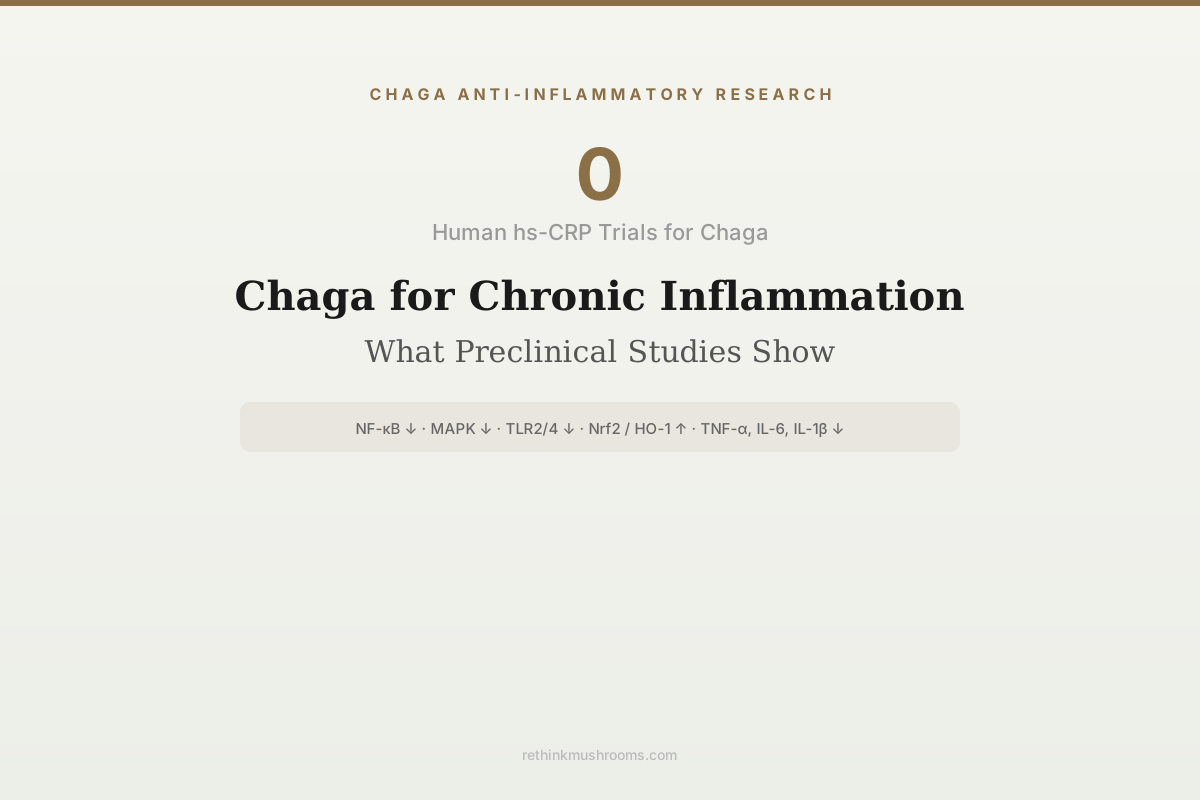
0 hs-CRP Trials
No published human study has measured chaga's effect on high-sensitivity C-reactive protein, interleukin-6, or other validated chronic inflammation biomarkers. The chronic inflammation claim rests on preclinical NF-κB, MAPK, and Nrf2 pathway data in acute and subchronic rodent models.
Fordjour et al., Frontiers in Pharmacology, 2023
NF-κB / MAPK
pathways inhibited by chaga polysaccharide in infected macrophages (Yan et al., 2021)
TNF-α, IL-6, IL-1β
chronic inflammation cytokines reduced in colitis and liver injury models
Nrf2 / HO-1
cell-stress response activated by chaga polysaccharide (Xu et al., 2019)
Fordjour et al., Frontiers in Pharmacology, 2023
 View as image ↗
Chronic low-grade inflammation is the shared pathological substrate of metabolic syndrome, cardiovascular disease, type 2 diabetes, neurodegenerative disease, several cancers, and accelerated biological ageing. Clinical measurement of chronic inflammation typically uses high-sensitivity C-reactive protein (hs-CRP), interleukin-6 (IL-6), tumour necrosis factor alpha (TNF-α), and related circulating biomarkers. Anti-inflammatory interventions are tested against these biomarkers in human trials, with clinically meaningful reductions providing the basis for chronic disease risk modification claims. Chaga (Inonotus obliquus) has not been tested against any of these human biomarkers in any published randomised trial.[1] What exists is a consistent preclinical dataset demonstrating that chaga extracts and polysaccharides suppress the cellular and tissue-level inflammatory responses that, over time, would contribute to elevated chronic inflammation biomarkers. For the compound-level background, see chaga beta-glucans and immune cell activation.
Key Takeaways
- No randomised controlled trial has measured chaga's effect on hs-CRP, IL-6, TNF-α, or other validated chronic inflammation biomarkers in humans
- Chaga ethanol extract inhibited NF-κB activation and suppressed LPS-induced iNOS, COX-2, TNF-α, IL-1β, and IL-6 in RAW 264.7 macrophages (Kim et al., 2007)
- I. obliquus polysaccharide in Toxoplasma gondii-infected macrophages inhibited phosphorylation of NF-κB p65 and MAPK family members (p38, JNK, ERK1/2) while downregulating TLR2/TLR4 expression (Yan et al., 2021)
- Chaga polysaccharide upregulated Nrf2 and HO-1 in mouse liver injury, providing the antioxidant arm of chronic inflammation resolution (Xu et al., 2019)
- Oral aqueous chaga extract in DSS-induced colitis suppressed iNOS, myeloperoxidase, TNF-α, IL-1β, IL-6, and IFN-γ at the mucosal level (Mishra et al., 2012)
- Chaga grown on germinated brown rice (IOGBR) suppressed LPS-induced NO, PGE2, iNOS, COX-2, TNF-α, IL-1β, and IL-6 in RAW 264.7 macrophages, replicating the anti-inflammatory signal with an alternative preparation (Debnath et al., 2013)
- Comprehensive reviews (Fordjour et al., 2023; Ern et al., 2024) identify anti-inflammatory activity as one of chaga's best-supported preclinical properties while flagging the absence of human trial data
What "Chronic Inflammation" Means for Biomarker-Based Research
Acute inflammation is a beneficial, localised response to injury or infection with defined onset, resolution, and return to homeostasis. Chronic inflammation is the failure of resolution: low-grade, systemic, sustained elevation of inflammatory mediators without the intense symptoms of acute inflammation. Hs-CRP (produced by the liver in response to IL-6 signalling) is the most widely used clinical biomarker, with concentrations <1 mg/L considered low risk, 1–3 mg/L intermediate, and >3 mg/L high for cardiovascular events. IL-6, TNF-α, fibrinogen, and specific acute phase reactants round out the biomarker panel.
Dietary and supplement interventions targeting chronic inflammation are typically tested against these biomarkers in intervention trials of 8–24 weeks duration. The Mediterranean diet, specific omega-3 fatty acids, curcumin, certain polyphenols, and targeted immunomodulators have reproducibly demonstrated hs-CRP reductions in this format. Chaga has not been tested this way.
The Preclinical Chronic Inflammation Models
The cell and animal models most relevant to chronic inflammation include: LPS-stimulated macrophage cultures (with readouts over 24–72 hours representing sustained activation), DSS-induced colitis in mice (chronic mucosal inflammation over 7–14 days), TNBS-induced IBD (chronic colonic inflammation), high-fat-diet-induced metabolic inflammation (adipose tissue macrophage polarisation over 8–16 weeks), and chronic parasitic infection models (T. gondii-induced hepatic inflammation). Chaga has been tested across several of these models with consistent directional findings.
Kim et al. (2007) demonstrated the macrophage-level anti-inflammatory signal. Ethanol extract of I. obliquus inhibited LPS-induced NF-κB activation in RAW 264.7 murine macrophages, reducing the downstream iNOS, COX-2, TNF-α, IL-1β, and IL-6 expression that characterises sustained macrophage activation.[2] This is the cellular readout that would, at scale and over time, contribute to elevated hs-CRP and IL-6 in the circulating blood.
Yan et al. (2021) provided the signalling-level detail. I. obliquus polysaccharide in T. gondii-infected RAW 264.7 cells decreased excessive secretion of TNF-α, IFN-γ, IL-1β, IL-4, and IL-6, suppressed chemokine expression (MCP-1, MIP-1α), inhibited phosphorylation of IKKα/β, IκBα, p65, p38, JNK, and ERK1/2, and downregulated TLR2 and TLR4 expression.[3] The signalling-level detail establishes that the cytokine reduction is mechanistic (receptor-to-transcription-factor axis) rather than downstream scavenging.
The Tissue-Level Translation
Mishra et al. (2012) translated the macrophage signalling finding to intestinal mucosal inflammation. Oral aqueous I. obliquus extract at 50 and 100 mg/kg in DSS-induced colitis mice produced reductions in histological damage indices, iNOS expression, myeloperoxidase activity, and the mRNA expression of TNF-α, IL-1β, IL-6, and IFN-γ in colonic tissue.[4] This is the tissue-level readout that links cellular anti-inflammatory effects to clinically measurable mucosal outcomes.
Xu et al. (2019) extended the pattern to hepatic tissue. I. obliquus polysaccharide in T. gondii-induced liver injury mice reduced serum TNF-α, IL-6, IL-1β, IFN-γ, and IL-4; increased Nrf2 and HO-1 expression; and downregulated TLR2/TLR4 and NF-κB phosphorylation in liver tissue.[5] The combination of NF-κB suppression (reducing pro-inflammatory gene expression) and Nrf2 activation (inducing antioxidant and resolution-phase gene expression) represents the mechanistic pattern expected from a genuine chronic-inflammation modifier.
Why Acute Models Do and Do Not Predict Chronic Outcomes
Preclinical models of chronic inflammation have limitations. LPS-stimulated macrophage cultures over 24–72 hours capture the pattern recognition receptor-to-cytokine axis that drives chronic inflammation but do not capture the metabolic and epigenetic reprogramming that distinguishes chronic from acute. DSS colitis over 7 days is acute-on-background mucosal inflammation rather than primary chronic IBD. Chronic high-fat-diet inflammation over 16+ weeks is closer to the human chronic inflammation phenotype but has not been used as a chaga anti-inflammatory endpoint specifically.
The honest scientific position is that chaga's preclinical anti-inflammatory evidence predicts plausible activity against chronic inflammation mechanisms, but the specific translation to sustained hs-CRP reduction in humans requires direct clinical measurement. A phase 2 trial measuring hs-CRP at baseline and 12 weeks in adults with elevated hs-CRP (>3 mg/L) taking 2–4 g/day of a defined chaga preparation would be the appropriate translational design. No such trial has been registered or published.
The Resolution-of-Inflammation Framework
Modern inflammation biology distinguishes initiation from resolution phases. Resolution is an active, programmed process involving specialised pro-resolving mediators (resolvins, protectins, maresins) that are synthesised from omega-3 fatty acids by immune cells during the resolution window. Chronic inflammation represents failed or inadequate resolution rather than excessive initiation.
Chaga's published preclinical profile addresses initiation-phase mechanisms (NF-κB inhibition, cytokine suppression, TLR downregulation) but has not been tested against resolution-phase biomarkers (lipoxin A4, resolvin D series, protectin D1). Whether chaga modulates the lipid mediator class switching that drives resolution is a specific experimental question that has not been addressed. For an anti-inflammatory supplement to be clinically relevant to chronic inflammation, resolution enhancement is at least as important as initiation suppression. The chaga literature currently covers only half of this axis.
For comprehensive background on the related antioxidant arm, see chaga and liver detoxification enzymes.
The Antioxidant Contribution
Chronic inflammation and chronic oxidative stress reinforce each other. Pro-inflammatory cytokines stimulate NADPH oxidase and iNOS activity, generating superoxide, peroxynitrite, and nitric oxide that feed forward into mitochondrial dysfunction, lipid peroxidation, and additional inflammatory signalling. Antioxidant activity that breaks this cycle is part of the chronic inflammation modification toolkit.
Chaga's antioxidant profile is extensively documented. Lee et al. (2007) identified novel polyphenols (inonoblins A, B, C) and phelligridins (D, E, G) with antioxidant activity against ABTS, DPPH, and superoxide radicals.[6] Debnath et al. (2013) showed chaga-induced enhancement of antioxidant enzyme activity in H2O2-stimulated mouse liver, alongside anti-inflammatory activity in LPS-stimulated macrophages.[7] The combined mechanism (free radical scavenging + antioxidant enzyme induction + inflammatory signalling suppression) is the profile expected of a compound that could, if clinically translated, modify chronic inflammation markers.
Comparator Evidence from Other Mushroom Anti-Inflammatory Trials
Whether chaga's preclinical anti-inflammatory signal translates to human chronic inflammation reduction is unstudied, but comparator data exist for related medicinal mushrooms. Turkey tail (Trametes versicolor) at 3–9 g/day has been tested in breast cancer patients and measured immune cell population changes but not hs-CRP specifically. Ganoderma lucidum at 3 g/day for 16 weeks in type 2 diabetes with metabolic syndrome has been tested in a Cochrane-included trial and did not demonstrate statistically meaningful hs-CRP reduction at the doses studied. These comparator trials establish that mushroom supplementation at realistic doses for medium-duration intervention produces measurable but modest biomarker effects when tested rigorously.
The implication for chaga-specific chronic inflammation research is two-fold. First, a human trial is feasible at 2–4 g/day of a standardised chaga preparation over 12–24 weeks, using hs-CRP, IL-6, and TNF-α as primary endpoints. Second, realistic expectations for biomarker effect size would be modest rather than dramatic, and the trial would need adequate statistical power to detect clinically meaningful reductions. The absence of this evidence infrastructure is not unique to chaga; mushroom supplement research as a whole has not penetrated the chronic inflammation biomarker space despite substantial preclinical promise across multiple species.
What the Comprehensive Reviews Conclude
Fordjour et al. (2023) and Ern et al. (2024) both identify anti-inflammatory activity among chaga's best-supported preclinical properties, drawing on the cytokine suppression, NF-κB/MAPK inhibition, and antioxidant enzyme data reviewed above.[1][8] Both reviews acknowledge the absence of human trial data in chronic inflammation contexts. Neither review cites an hs-CRP, IL-6, or inflammation biomarker-based human trial for chaga, because none exists.
The reviews also flag the oxalate nephropathy case report signal (Kikuchi 2014; Lee 2020; Kwon 2022) as a consideration for chronic use, which is particularly relevant to chronic inflammation as a use case because chronic inflammation modification is by definition a long-term intervention. A short-term trial might document a biomarker reduction, but chronic inflammation populations would be expected to use any confirmed intervention for years rather than months. The safety data required to support multi-year chronic use are absent, and the existing adverse event data suggest caution.
What the Evidence Supports and What It Does Not
| Question | Evidence | Confidence |
|---|---|---|
| Does chaga suppress pro-inflammatory cytokine expression at the cell level? | Yes: TNF-α, IL-1β, IL-6 reduction in macrophages across multiple studies | Moderate (preclinical) |
| Does chaga inhibit NF-κB and MAPK signalling? | Yes: documented at the phosphorylation level (Yan et al., 2021) and transcription factor level (Kim et al., 2007) | Moderate (preclinical) |
| Does chaga activate Nrf2/HO-1 (resolution-relevant)? | Yes in mouse liver injury (Xu et al., 2019) | Moderate (preclinical) |
| Has chaga been tested in human chronic inflammation? | No: no trial has measured hs-CRP, IL-6, TNF-α in humans taking chaga | None |
| Does chaga modify specialised pro-resolving mediator (SPM) biosynthesis? | Not studied: no lipidomic analysis of chaga effects on resolvins or protectins published | None |
| Is chaga safe for long-term chronic inflammation use? | Unquantified: three oxalate nephropathy cases complicate multi-year use | Precautionary |
The Bottom Line
Chaga's anti-inflammatory preclinical profile is well-characterised across macrophage models (Kim 2007; Yan 2021; Debnath 2013), colitis tissue (Mishra 2012), and hepatic injury (Xu 2019), with consistent suppression of NF-κB signalling, MAPK phosphorylation, TLR2/TLR4 expression, and pro-inflammatory cytokine output (TNF-α, IL-1β, IL-6, IFN-γ). The antioxidant arm is supported by Nrf2/HO-1 upregulation and polyphenol free-radical scavenging activity (Lee 2007; Debnath 2013). No randomised controlled trial has tested chaga against validated human chronic inflammation biomarkers (hs-CRP, IL-6, TNF-α), which leaves the clinical translation unverified. The specialised pro-resolving mediator arm of inflammation resolution has not been characterised for chaga. Long-term use concerns include the three published case reports of oxalate nephropathy.
Frequently Asked Questions
Sources & References
- 1RTHM-01694·Fordjour, Eric et al. (2023). “Chaga mushroom: a super-fungus with countless facets and untapped potential..” Frontiers in pharmacology.Study breakdown →PubMed →↩
- 2RTHM-00117·Kim, Ho-Gyoung et al. (2007). “Ethanol extract of Inonotus obliquus inhibits lipopolysaccharide-induced inflammation in RAW 264.7 macrophage cells..” Journal of medicinal food.Study breakdown →PubMed →↩
- 3RTHM-00730·Yan, Kexin et al. (2021). “Inhibitory Effects of Inonotus obliquus Polysaccharide on Inflammatory Response in Toxoplasma gondii-Infected RAW264.7 Macrophages..” Evidence-based complementary and alternative medicine : eCAM.Study breakdown →PubMed →↩
- 4RTHM-00258·Mishra, Siddhartha Kumar et al. (2012). “Orally administered aqueous extract of Inonotus obliquus ameliorates acute inflammation in dextran sulfate sodium (DSS)-induced colitis in mice..” Journal of ethnopharmacology.Study breakdown →PubMed →↩
- 5RTHM-00601·Xu, Lu et al. (2019). “The polysaccharide from Inonotus obliquus protects mice from Toxoplasma gondii-induced liver injury..” International journal of biological macromolecules.Study breakdown →PubMed →↩
- 6RTHM-00118·Lee, In-Kyoung et al. (2007). “New antioxidant polyphenols from the medicinal mushroom Inonotus obliquus..” Bioorganic & medicinal chemistry letters.Study breakdown →PubMed →↩
- 7RTHM-00283·Debnath, Trishna et al. (2013). “Anti-oxidant and anti-inflammatory activities of Inonotus obliquus and germinated brown rice extracts..” Molecules (Basel.Study breakdown →PubMed →↩
- 8RTHM-01886·Ern, Phoebe Tee Yon et al. (2024). “Chaga Therapeutic Properties: What This 2024 Review Actually Shows.” Mycology.Study breakdown →PubMed →↩