Regulatory notice: Psilocybin-containing mushrooms are classified as Schedule I controlled substances in the United States and are similarly restricted in most countries. This article discusses the chemistry and biology of blue bruising from a scientific perspective. It is not a foraging guide and should not be used as a basis for mushroom identification for consumption or collection. Misidentification of wild mushrooms can cause serious harm or death.
Psilocybin Research
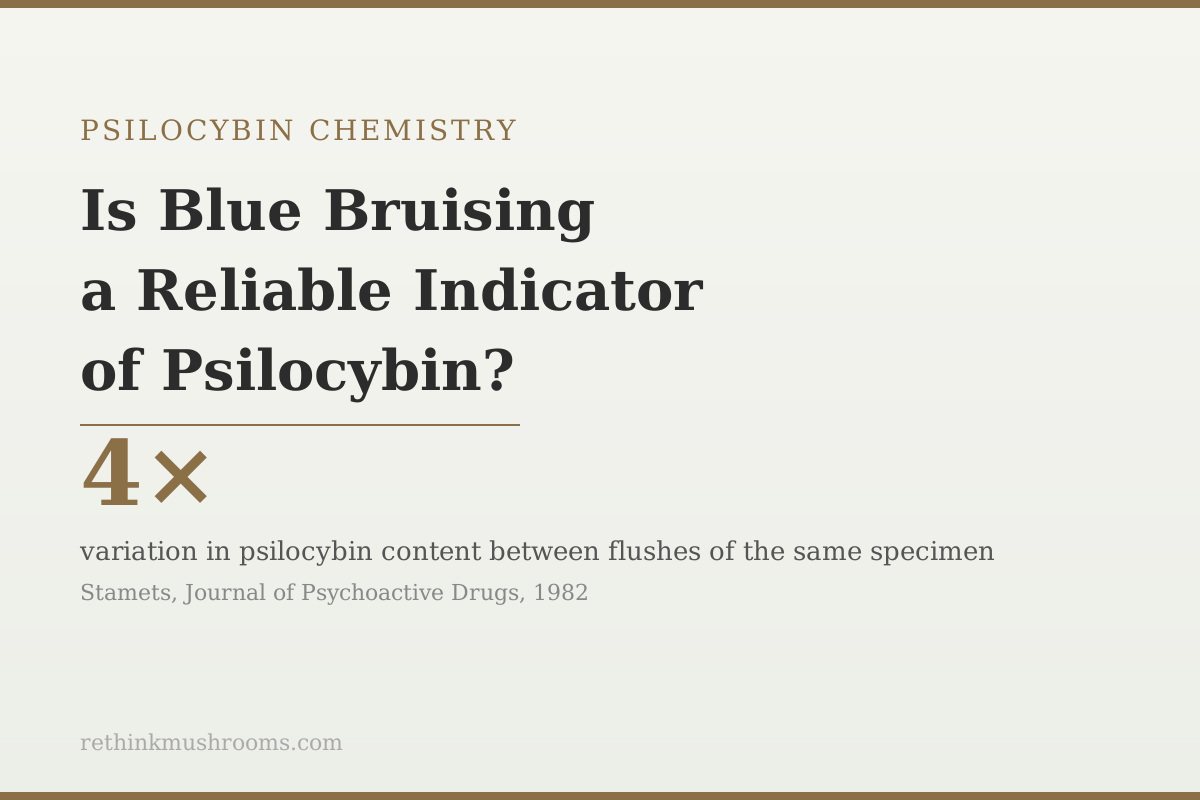
4× variation in psilocybin content between flushes of the same specimen
Psilocybin content in Psilocybe cubensis varied approximately four-fold across successive harvests from the same organism under identical conditions. Two mushrooms that look identical and come from the same culture can have substantially different psilocin content, and therefore substantially different bruising behavior.
Stamets, Journal of Psychoactive Drugs, 1982
PsiP + PsiL
the two enzymes required for the blue bruising reaction; absent or impaired enzymes mean no bruising even when psilocin is present (Lenz et al., 2020)
Boletes
family of non-psilocybin mushrooms that also bruise blue through a completely different mechanism (tyrosinase-mediated oxidation of variegatic acid)
Horizontal transfer
the psilocybin biosynthesis gene cluster spread between fungal genera via horizontal gene transfer, explaining why multiple unrelated species bruise blue (Reynolds et al., 2018)
Stamets, Journal of Psychoactive Drugs, 1982
 View as image ↗
Blue bruising is one of the most visually striking characteristics of psilocybin-containing mushrooms: the blue-green staining that appears when the flesh is damaged, cut, or handled roughly. It is also one of the most misunderstood as an identification tool. The relationship between blue bruising and psilocybin is real at a chemical level but unreliable as a standalone field indicator, for three distinct reasons that the research illuminates.
The simplest version: bruising requires psilocin to be present AND the right enzymes to be functional. Either can be absent. Psilocin content varies enormously between specimens and degrades with storage. And some mushrooms that bruise unmistakably blue contain no psilocybin at all, through a completely different biochemical pathway.
For context on psilocybin's basic chemistry and cultivation, see Psilocybe cubensis: the world's most cultivated magic mushroom.
Key Takeaways
- Blue bruising in psilocybin mushrooms requires both psilocin (the dephosphorylated form of psilocybin) and two functional enzymes (PsiP and PsiL); absence of either means no bruising even when psilocybin is present in the tissue (Lenz et al., 2020)
- Psilocybin content varied approximately four-fold across successive harvests (flushes) from the same Psilocybe cubensis organism, meaning two mushrooms from identical cultures can bruise very differently (Stamets, 1982)
- Storage and drying degrade psilocin stability; dried or old specimens may fail to bruise blue not because they lack psilocybin but because psilocin has degraded or the enzymatic reaction can no longer occur (Pellegrini et al., 2021)
- Bluing boletes (including Gyroporus cyanescens and several Boletus species) bruise intensely blue through a completely different mechanism: tyrosinase-mediated oxidation of variegatic acid, which has nothing to do with psilocybin
- The psilocybin biosynthesis gene cluster spread across multiple fungal genera via horizontal gene transfer, explaining why blue bruising appears in phylogenetically distant species (Reynolds et al., 2018)
- Chemical reagent testing (Ehrlich or Hofmann reagents) provides more reliable confirmation of psilocybin presence than visual bruising, though reagent testing is for harm reduction purposes, not foraging guidance
What Blue Bruising Actually Is at the Chemical Level
The blue color that appears when psilocybin mushroom tissue is damaged is the end product of an enzymatic oxidation cascade. Lenz and colleagues investigated this reaction in detail in a 2020 study and identified the specific molecular pathway.[1]
When the mushroom's cells are damaged (by handling, cutting, or physical stress), psilocin (the active form of psilocybin after dephosphorylation) is released and comes into contact with two enzymes: PsiP (a psilocybin phosphatase) and PsiL (a laccase-type enzyme). PsiL catalyzes the oxidative coupling of psilocin molecules into polymeric pigments. These polymers are blue-green in color and deposit in the damaged tissue.
The key point for understanding blue bruising as an identification tool: the reaction requires both psilocin present in the tissue AND functional PsiP and PsiL enzymes. If psilocin is absent, bruising does not occur. If the enzymes are non-functional or absent (due to genetic variation, damage, or developmental stage), bruising does not occur even when psilocin is present.
This means blue bruising is specifically a signal of psilocin availability and enzymatic activity at the moment of damage, not a universal indicator of psilocybin content.
Limitation 1: Not All Psilocybin Mushrooms Always Bruise Blue
The assumption that all psilocybin mushrooms bruise blue reliably is incorrect. Several factors prevent the reaction:
Psilocin depletion: Psilocybin in the mushroom's tissue must be converted to psilocin for the bruising reaction to proceed. In some developmental stages, at some environmental conditions, or in some genetic variants, the psilocin available for enzymatic oxidation may be insufficient to produce visible blue coloration.
Enzymatic variation: The PsiL laccase enzyme responsible for blue polymer formation shows activity variation across individuals and species. Lower enzyme activity produces lighter or no bruising.
Drying and processing: The blueing reaction is an enzymatic process that requires intact cell structure and active enzymes. Dried specimens may not bruise because the enzymes have been denatured by heat or have lost activity with time.
The practical consequence: a psilocybin-containing mushroom that is dried, old, poorly stored, or that happens to have lower psilocin at the time of damage may not bruise blue. Absence of bruising does not indicate absence of psilocybin.
Limitation 2: Psilocin Content Varies Four-Fold
Even within a single genetic individual (the same mushroom organism), psilocybin content varies substantially over time.
Stamets measured psilocybin and psilocin levels across successive flushes (harvests) of Psilocybe cubensis specimens in 1982 and found approximately four-fold variation between flushes.[2] First flushes tended to have higher psilocybin content than subsequent flushes from the same organism. Environmental conditions during fruiting affected compound levels. Two visually identical mushrooms from the same culture, harvested at different times, could have very different psilocin availability.
For bruising specifically, this four-fold variation in psilocin content directly translates to varying bruising intensity. A specimen from a late flush with lower psilocin may produce faint bruising; a specimen from an early flush with higher psilocin may produce intense bruising. Neither the presence nor the intensity of bruising is a reliable guide to psilocin content across individuals, flushes, or developmental stages.
Limitation 3: Storage Degrades Psilocin
Even specimens that contained psilocin at the time of harvest may fail to bruise if the psilocin has degraded during storage.
Pellegrini and colleagues studied the stability of psilocybin, psilocin, and related compounds in Psilocybe cubensis biomass under various storage conditions in 2021.[3] Psilocin is less chemically stable than psilocybin. It is susceptible to oxidation, temperature, light exposure, and humidity. Under improper storage conditions, psilocin degrades while psilocybin (the phosphorylated, less reactive form) is better preserved.
Older dried specimens may have lost most of their psilocin through degradation even if psilocybin remains. Because bruising requires psilocin specifically (as the direct substrate for the enzymatic reaction), such specimens would bruise poorly or not at all despite containing intact psilocybin. The psilocybin would still convert to psilocin after consumption, but the enzymatic indicators in the tissue are no longer functional.
The False Positive Problem: Bluing Boletes
The most important safety consideration about blue bruising as an identification tool is the existence of mushrooms that bruise intensely blue with no connection to psilocybin.
Several species in the Boletus family (and related genera) produce vivid blue staining when damaged. Gyroporus cyanescens, Boletus erythropus, and related species are often called "bluing boletes" precisely because of this reaction. The staining they produce can be as rapid and intense as any psilocybin mushroom.
But the mechanism is entirely different. Bluing in boletes is caused by tyrosinase-mediated oxidation of variegatic acid (a compound in the bolete's tissue) to create a quinone polymer. This reaction has nothing to do with psilocin, PsiL laccase, or the psilocybin biosynthesis pathway.
The practical risk: someone using blue bruising as a primary identification tool could observe a bluing bolete turning blue and incorrectly conclude it is a psilocybin-containing mushroom. Most bluing boletes are not edible to toxic rather than dangerous, but some related species in genera with bluing members are seriously toxic. The broader point is that blue bruising alone, without other identification characteristics, cannot distinguish between psilocybin-related bruising and tyrosinase-mediated bruising from a different chemical pathway.
This is why the brief statement "it bruises blue, therefore it's a magic mushroom" is both chemically inaccurate and potentially dangerous as a foraging heuristic.
Why Blue Bruising Appears Across Many Unrelated Genera
One scientifically interesting aspect of blue bruising in psilocybin mushrooms is how widespread it is across phylogenetically distant species. Psilocybin-containing mushrooms are found in at least a dozen genera. This is unusual because the biosynthesis of a complex compound like psilocybin requires multiple enzymes working in concert; it would seem unlikely to have evolved independently many times.
Reynolds and colleagues solved this puzzle in a 2018 study examining the genetics of psilocybin biosynthesis across multiple fungal genera.[4] They found that the psilocybin biosynthesis gene cluster (the set of genes encoding the enzymes that produce psilocybin) was transferred between distantly related fungal lineages via horizontal gene transfer. Fungi, unlike animals, can exchange genetic material between individuals and even across species boundaries. The psilocybin cluster apparently moved between ancestors of several different genera, spreading the capacity to produce psilocybin (and to bruise blue) to groups that did not originally possess it.
This finding explains why blue bruising appears in multiple genera that share no recent common ancestor. They share the gene cluster, acquired at different points in fungal evolutionary history, not a shared lineage. For mushrooms producing the bluing reaction through other mechanisms (like boletes), these represent independent evolutionary paths to similar visual outcomes.
What Chemical Testing Offers That Bruising Cannot
Given the limitations of visual bruising as an indicator, chemical reagent testing provides more reliable confirmation of psilocybin presence.
The Ehrlich reagent (p-dimethylaminobenzaldehyde) reacts with the indole ring structure common to psilocybin, psilocin, and related tryptamine compounds, producing a visible purple color change. The Hofmann reagent (a modified Ehrlich formulation) performs similarly. These reagents are used in harm reduction contexts for testing purposes.
Chemical testing has its own limitations: it detects indole compounds broadly, not specifically psilocybin; it requires sample preparation; and it cannot substitute for proper species identification. But it is more mechanistically reliable than visual bruising because it reacts with the chemical structure of interest rather than depending on enzymatic activity that varies with condition and time.
Chemical testing is a harm reduction tool, not a foraging verification system. It can provide information about what is present in a sample, not whether a wild mushroom is safe to consume.
The Bottom Line
Blue bruising is a real indicator of psilocin activity in mushroom tissue but is unreliable as a standalone identification tool for three documented reasons: psilocin content varies approximately four-fold between flushes of the same organism (Stamets 1982); psilocin degrades with storage, eliminating bruising from specimens that still contain psilocybin (Pellegrini et al. 2021); and the enzymatic reaction requires both psilocin and functional PsiL laccase enzymes (Lenz et al. 2020). A false positive problem exists because bluing boletes bruise through a tyrosinase/variegatic acid mechanism entirely unrelated to psilocybin. The psilocybin gene cluster's presence across multiple genera reflects horizontal gene transfer rather than shared lineage, per Reynolds et al. (2018).
Frequently Asked Questions
Sources & References
- 1RTHM-01232·Lenz, Claudius et al. (2020). “Injury-Triggered Blueing Reactions of Psilocybe "Magic" Mushrooms..” Angewandte Chemie (International ed. in English).Study breakdown →PubMed →↩
- 2. Source details for this reference are not yet available.
- 3. Source details for this reference are not yet available.
- 4RTHM-01000·Reynolds, Hannah T et al. (2018). “Horizontal gene cluster transfer increased hallucinogenic mushroom diversity..” Evolution letters.Study breakdown →PubMed →↩