King Oyster Mushroom
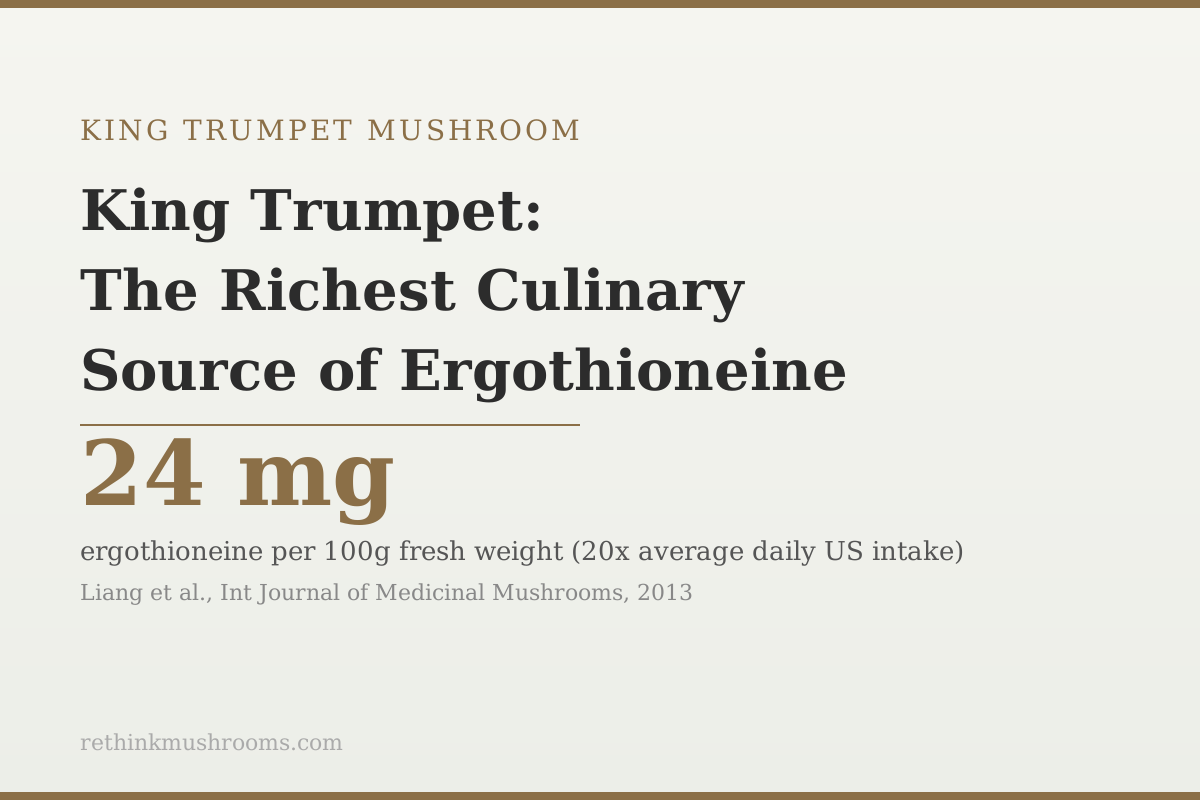
24 mg ergothioneine per 100g fresh weight of king trumpet mushroom
Liang and colleagues measured approximately 24 mg ergothioneine per 100g fresh weight of Pleurotus eryngii fruiting bodies. The average American consumes roughly 1.1 mg of ergothioneine per day from all food sources combined. A single 100g serving of king trumpet provides more than 20 times that daily average.
Liang et al., International Journal of Medicinal Mushrooms, 2013
95% from mushrooms
of total dietary ergothioneine in the US comes from mushrooms; no other food category comes close (Beelman et al., 2020)
Heat stable
ergothioneine survives normal cooking temperatures and does not significantly degrade during sautéing, roasting, or boiling (Liu et al., 2020)
2 RCTs confirm
two randomized controlled trials showed P. eryngii consumption raised plasma ergothioneine and improved metabolic markers in humans (Kleftaki et al., 2022)
Liang et al., International Journal of Medicinal Mushrooms, 2013
 View as image ↗
If you are trying to increase your ergothioneine intake through food, king trumpet mushroom is your most efficient option by a large margin. No other commonly available food comes close to king trumpet's ergothioneine density among real-world dietary options. The question for most people is not whether king trumpet is the right choice for ergothioneine but how much to eat and how often.
Liang and colleagues quantified the ergothioneine content of Pleurotus eryngii fruiting bodies, mycelia, and fermented products in a 2013 study and found concentrations in the fruiting body of approximately 24 mg per 100g fresh weight.[1] For context on why ergothioneine matters for longevity and health, see king trumpet for longevity: the ergothioneine connection. For the broader king trumpet overview, see what is king trumpet mushroom: the meaty mushroom with health benefits.
Key Takeaways
- King trumpet mushroom (Pleurotus eryngii) contains approximately 24 mg ergothioneine per 100g fresh weight, making it one of the most ergothioneine-dense foods available in Western markets (Liang et al., 2013)
- The average American consumes approximately 1.1 mg ergothioneine per day from all sources; a single 100g serving of king trumpet provides roughly 20 times this daily average (Beelman et al., 2020)
- Mushrooms provide approximately 95% of total ergothioneine in the US diet; people who eat few or no mushrooms have substantially lower plasma ergothioneine levels than mushroom consumers
- Ergothioneine is heat-stable and survives normal cooking temperatures; sautéing, roasting, boiling, and other standard cooking methods do not significantly degrade its content (Liu et al., 2020)
- Two randomized controlled trials in 2022 demonstrated that consuming Pleurotus eryngii mushrooms raises plasma ergothioneine and improves metabolic markers including antioxidant status and postprandial blood sugar response (Kleftaki et al., 2022)
- P. eryngii mycelium produced by submerged fermentation also contains high ergothioneine (Liang et al., 2013), opening a potential supplement production pathway beyond whole mushroom consumption
The Numbers: How Much Ergothioneine Is in King Trumpet
Liang and colleagues conducted comprehensive ergothioneine measurements across three forms of Pleurotus eryngii in 2013: fruiting bodies (the mushroom cap and stem), mycelia, and fermented products.[1]
Fruiting body ergothioneine content: approximately 24 mg per 100g fresh weight (based on reported 2.05 mg/g dry weight and typical ~90% moisture content of fresh king trumpet).
A companion Liang 2013 study specifically examined submerged cultivation of P. eryngii mycelium for ergothioneine production and found that the mycelium produced under optimized fermentation conditions had high ergothioneine content comparable to or exceeding the fruiting body.[2] This finding is relevant for supplement production: mycelium can be grown in large quantities through liquid fermentation, making high-ergothioneine king oyster mycelium a potential industrial ergothioneine source.
Chen and colleagues (2012) explored fermented king oyster mushroom products specifically optimized for ergothioneine content, demonstrating that fermentation conditions can be adjusted to increase ergothioneine output beyond what whole mushroom cultivation produces.[3]
How King Trumpet Compares to Other Food Sources
Ergothioneine is found in several foods beyond mushrooms, but at much lower concentrations:
- Chicken liver: approximately 0.1-0.5 mg/100g (roughly 50-240x less than king trumpet)
- Beef: approximately 0.01-0.15 mg/100g (much lower)
- Black beans, oat bran: trace amounts
- Other mushrooms: shiitake (4-7 mg/100g), oyster mushroom (5-10 mg/100g), button mushroom (0.3-0.6 mg/100g)
King trumpet's 24 mg/100g is substantially higher than other commonly eaten mushrooms. This is why Liang specifically highlighted king trumpet as a "high ergothioneine content" species in the title of their research. Among foods available in Western grocery stores, king trumpet stands out as the most ergothioneine-efficient option.
The species difference across mushrooms is meaningful: eating button mushrooms for ergothioneine would require roughly 30-80x more by weight to match king trumpet. For someone incorporating mushrooms specifically for ergothioneine intake, king trumpet is the most efficient choice.
The Average US Intake: The Context That Makes These Numbers Matter
Beelman and colleagues (2020) analyzed ergothioneine across the entire US food supply and calculated the average American's daily ergothioneine intake.[5] The result: approximately 1.1 mg per day for the average American.
This number is strikingly low relative to what a single king trumpet serving provides. One 100g serving of king trumpet delivers roughly 24 mg ergothioneine. The average American consumes 1.1 mg across an entire day of eating from all foods combined.
The gap exists because most Americans eat few mushrooms. Beelman's analysis found that approximately 95% of US dietary ergothioneine comes from mushrooms. People who don't eat mushrooms are consuming effectively zero ergothioneine from their diet. Their plasma ergothioneine levels reflect this absence.
What "optimal" intake looks like biologically is not established. Clinical trials have not determined the dose of dietary ergothioneine that maximizes health outcomes. What is known is that the population level associated with better health outcomes in the Smith 2020 metabolomics study had higher plasma ergothioneine, and that higher plasma levels are achievable through king trumpet consumption.
Cooking Stability: What Happens When You Cook King Trumpet
A practical question for anyone incorporating king trumpet specifically for ergothioneine is whether cooking reduces its content.
Liu and colleagues (2020) studied the stability of ergothioneine in culinary mushrooms across different preparation conditions.[4] Ergothioneine is heat-stable. Normal cooking temperatures during sautéing, roasting, boiling, and grilling do not significantly degrade ergothioneine content in mushrooms.
This is practically important because it means you do not need to eat raw king trumpet to benefit from its ergothioneine. Cooked king trumpet in stir-fries, soups, pastas, or roasted as a side retains its ergothioneine largely intact. This distinguishes ergothioneine from some other food compounds (like vitamin C) that are sensitive to heat.
The exception is very prolonged boiling in excess water: some ergothioneine may leach into the cooking water if the mushrooms are boiled for extended periods. For soup preparation where you consume the broth, this is not a concern. For preparations where the cooking water is discarded, brief cooking is preferable to extended boiling.
What Eating King Trumpet Does: The Human RCT Evidence
Kleftaki and colleagues published two relevant randomized controlled trials from 2022 that directly tested what happens when people eat Pleurotus eryngii mushrooms.
The first trial (RTHM-01064) tested UV-B irradiated P. eryngii in adults with metabolic disorders and found that consuming the mushrooms raised plasma ergothioneine levels and improved antioxidant status.[6] This is the direct confirmation that eating king trumpet raises circulating ergothioneine in people, not just in theory but in a controlled experiment.
The second trial (RTHM-01065) by the same group tested P. eryngii's effects on postprandial glycaemia (blood sugar after eating), hunger, and satiety hormones in people with metabolically unhealthy obesity.[7] Participants who consumed king trumpet mushrooms had lower postprandial blood sugar responses, felt fuller, and showed reduced ghrelin (the hunger hormone) compared to controls.
This second finding extends king trumpet's practical dietary benefits beyond the ergothioneine-longevity story into the immediate realm of blood sugar management and satiety, which are relevant to anyone trying to improve metabolic health.
Beyond Ergothioneine: The Obesity and Metabolic Data
Du and colleagues (2024) fed whole king oyster mushroom to obese mice and found that it attenuated obesity, improved lipid metabolism, and restored gut microbiota dysbiosis.[8]
This animal study complements the Kleftaki human data: both suggest that regular king trumpet consumption affects metabolic function beyond the antioxidant properties of ergothioneine alone. The prebiotic fiber effects, the β-glucan immune modulation, and the ergothioneine antioxidant activity may each contribute separately to the metabolic improvements observed.
Practical Guide: How Much and How Often
Based on the available research, practical dietary guidance for maximizing ergothioneine intake through king trumpet:
Amount per serving: 100g (3.5 oz) of king trumpet delivers approximately 24 mg ergothioneine, representing about 20 times the average daily US intake from all sources. This is a standard culinary serving size.
Frequency: The Kleftaki RCTs used regular consumption protocols. Daily or near-daily inclusion in the diet is supported by the RCT evidence for raising plasma ergothioneine. Less frequent consumption will produce smaller increases in plasma levels.
Preparation: Any standard cooking method (sautéing, roasting, grilling, soups) preserves ergothioneine content. Brief cooking in dry heat (sautéing) is optimal for ergothioneine retention and also produces the best texture. See king oyster mushroom as a meat substitute: texture and nutrition for the cooking science behind optimal preparation.
Dried vs. fresh: Dried king trumpet has lower water content but similar ergothioneine per gram of dry weight. A small amount of dried king trumpet (10-15g rehydrated) provides comparable ergothioneine to 100g fresh.
Tian and colleagues (2023) proposed that ergothioneine should be recognized as an essential micronutrient required for healthy aging.[9] If that proposal gains scientific consensus, the recommended daily intake will need to be established through clinical dose-response research. For now, regular king trumpet consumption is the most efficient dietary approach to raising plasma ergothioneine toward the levels associated with health benefits in population research.
The Bottom Line
King trumpet mushroom (Pleurotus eryngii) contains approximately 24 mg ergothioneine per 100g fresh weight, roughly 20 times the average daily US intake of 1.1 mg (Beelman et al., 2020). Mushrooms provide 95% of US dietary ergothioneine, and people who eat few mushrooms have near-zero ergothioneine intake. Ergothioneine is heat-stable and survives normal cooking (Liu et al., 2020). Two Kleftaki 2022 RCTs confirmed that eating P. eryngii raises plasma ergothioneine, improves antioxidant status, lowers postprandial blood sugar, and improves satiety. Tian et al. (2023) proposed ergothioneine as an essential micronutrient for healthy aging, making king trumpet's dietary contribution uniquely significant among culinary mushrooms.
Frequently Asked Questions
Sources & References
- 1. Source details for this reference are not yet available.
- 2. Source details for this reference are not yet available.
- 3. Source details for this reference are not yet available.
- 4. Source details for this reference are not yet available.
- 5. Source details for this reference are not yet available.
- 6. Source details for this reference are not yet available.
- 7. Source details for this reference are not yet available.
- 8. Source details for this reference are not yet available.
- 9. Source details for this reference are not yet available.