Mushrooms & Sustainability
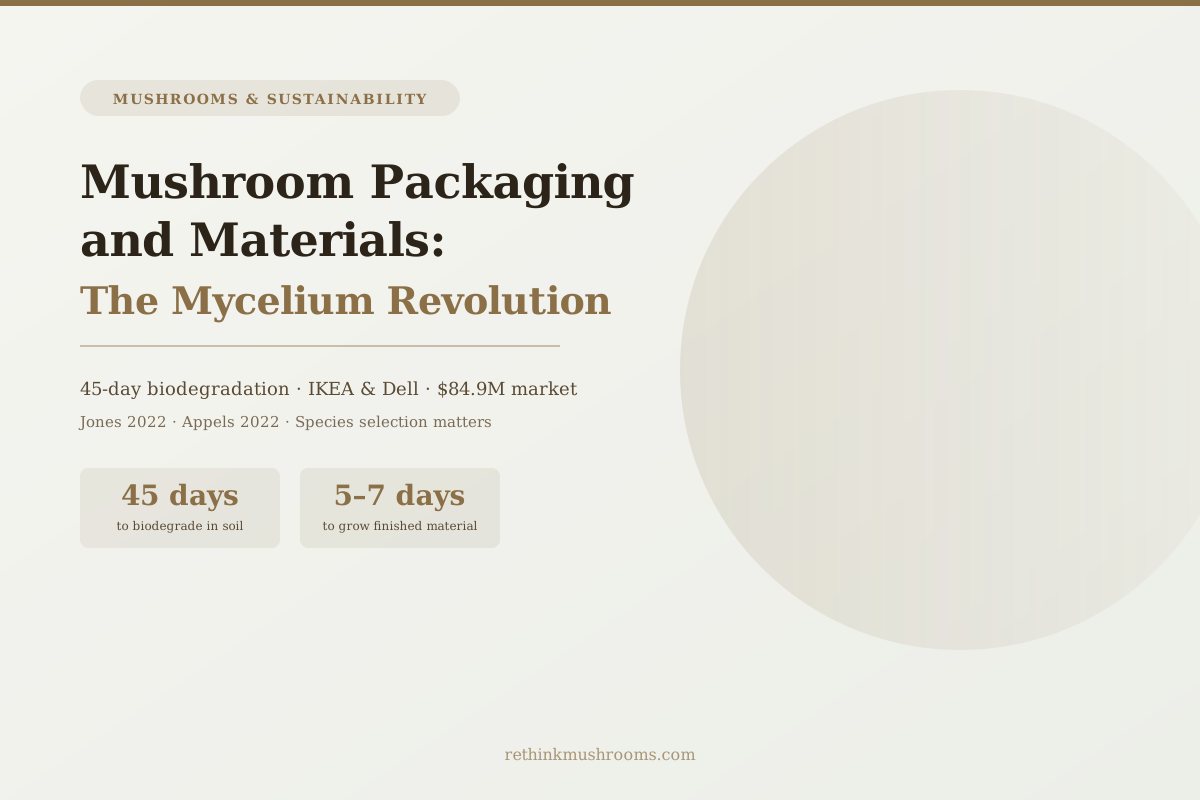
45 days to biodegrade
Mycelium composite packaging biodegrades in soil within 45 days, compared to hundreds of years for expanded polystyrene foam. It also achieves comparable tensile strength and thermal insulation properties to EPS, using one-tenth the energy to produce.
Jones et al., Sustainability, 2022
5–7 days
time to grow a finished mycelium composite from substrate and spores
90–95% substrate
agricultural waste makes up nearly all of the final material by weight
Species-specific
Ganoderma, Pleurotus, and Trametes each produce different material properties
Jones et al., Sustainability, 2022
 View as image ↗
Every year, approximately 14 million tons of expanded polystyrene (EPS) foam are produced globally. EPS takes several hundred years to decompose in landfill conditions, and because it breaks into microplastics rather than biodegrading, it accumulates in soil and waterways indefinitely. Mycelium composites, materials made from the same fungal root networks that produce edible mushrooms, biodegrade in soil within 45 days, achieve comparable structural performance to EPS foam, and are now used commercially by companies including IKEA and Dell. This article covers how mycelium packaging mushroom materials are made, what the material science says about their properties, which fungal species produce which material characteristics, and where the technology is heading beyond packaging.
For context on the full environmental impact of mushroom production, Mushroom Farming and Carbon Footprint: Environmental Analysis covers the sustainability picture across the production chain. For the broader market context where these materials are growing, The Functional Mushroom Market: Size, Growth, and Projections provides the market overview.
Key Takeaways
- Mycelium composites biodegrade in soil within 45 days, compared to the hundreds of years required for EPS foam; they achieve comparable compressive strength (0.1–0.5 MPa) and thermal conductivity (0.03–0.06 W/m·K) to conventional foam packaging
- A mycelium composite grows from agricultural substrate and fungal spores in 5–7 days with no external energy input; the mycelium uses the substrate's own nutrition to self-assemble into a solid structure
- Agricultural waste makes up 90–95% of the final material by weight; hemp hurd, corn stalks, and cotton burrs are common substrates, each affecting the final material properties
- Fungal species selection significantly affects material properties: Ganoderma lucidum produces denser, harder composites suited for protective packaging; Pleurotus ostreatus grows fastest; Trametes versicolor produces the highest tensile strength
- The mycelium composites market was valued at approximately $84.9 million in 2024 and is projected to reach $208.8 million by 2034 at a 9.4% CAGR
- Applications extend well beyond packaging: mycelium composites are used for leather alternatives (Bolt Threads' Mylo), acoustic and thermal insulation panels (Mogu), and structural construction materials
The Problem with Polystyrene and Why Fungi Offer a Structural Solution
EPS foam is cheap, lightweight, thermally insulating, and excellent at absorbing impact. It is also one of the most persistent materials humans have ever manufactured. It does not biodegrade in any meaningful timeframe; it photodegrades into progressively smaller fragments that enter soil, waterways, and the food chain as microplastics. The global production of 14 million tons per year generates a waste stream that current recycling infrastructure handles poorly, since EPS contaminated with food or other materials is generally not recyclable.
The structural properties that make EPS appealing (low density, thermal insulation, compressive resistance) are achievable through fundamentally different means when fungal mycelium is the building material.
Mycelium is the vegetative body of a fungus: a dense, interconnected network of hyphal threads, each measuring 2–10 micrometers in diameter. When mycelium grows through and between particles of agricultural substrate, the hyphae physically bind the substrate particles together into a solid, integrated composite. The same biological property that allows fungi to decompose complex wood structure allows them to construct complex material structure. The fungus that breaks down a log in a forest uses the same hyphal-binding mechanism to consolidate substrate particles into packaging material in a mold.
How Mycelium Packaging Is Made: The 5-Step Process
The manufacturing process for mycelium composites is straightforward and scalable:
-
Substrate preparation. Agricultural waste (hemp hurd, corn stalks, cotton burrs, wood chips, or similar lignocellulosic material) is sterilized or pasteurized to remove competing organisms, then rehydrated to the moisture level optimal for mycelial growth.
-
Inoculation. Fungal mycelium spawn (colonized grain or sawdust carrying the target fungal species) is mixed thoroughly with the prepared substrate. The initial mycelium population establishes itself within the substrate during this phase.
-
Growth and molding. The inoculated substrate mixture is packed into molds of the desired shape and placed in a climate-controlled environment. Mycelium grows through and between substrate particles over 5–7 days, binding them together. No external energy is added during this phase; the fungus uses the substrate's own nutrition.
-
Heat treatment. When the desired material density and structure are achieved, the mold contents are heat-treated (typically at 65–75°C for 30–60 minutes). Heat stops mycelial growth, kills the fungus, and sets the final material properties. This step also ensures the product is shelf-stable and will not continue growing.
-
Demolding and finishing. The finished composite is removed from the mold, dried to final moisture content, and inspected. The surface can be left natural (beige, textured) or coated for specific applications.
The entire process from substrate to finished product takes 7–14 days total, with 5–7 of those days as passive mycelial growth requiring only temperature and humidity monitoring.
Material Properties: How Mycelium Composites Compare to EPS Foam
Jones and colleagues published a systematic review in Sustainability in 2022 documenting the material properties and environmental advantages of mycelium composites, consolidating data across research groups and manufacturing approaches.[1]
The structural benchmarks across published formulations:
- Compressive strength: 0.1–0.5 MPa, depending on species and substrate. EPS foam used in protective packaging typically operates in the 0.07–0.35 MPa range. Mycelium composites match or exceed this.
- Tensile strength: Comparable to EPS foam for most formulations; highly species- and substrate-dependent.
- Thermal conductivity: 0.03–0.06 W/m·K (watts per meter-kelvin, the measure of how readily heat passes through a material). Polystyrene foam falls in the 0.033–0.040 W/m·K range. Mycelium composites overlap substantially with EPS in this critical insulation property.
- Density: 20–220 kg/m³ depending on formulation, broadly comparable to the 10–35 kg/m³ range of EPS.
The environmental comparison is starker. EPS foam production uses petroleum feedstocks and energy-intensive manufacturing processes. Jones documented that mycelium composite manufacturing uses approximately one-tenth the energy of EPS production, generates one-eighth the greenhouse gas emissions, and produces a material that fully biodegrades in soil within 45 days versus the indefinite persistence of polystyrene.[1]
A key advantage that the energy comparison does not capture: mycelium self-assembles using only the nutrition already present in the substrate. The fungus does the structural work without external energy input during the growth phase. No molds require heating; no presses or curing ovens are needed. Energy input is primarily in the sterilization/pasteurization step and the final heat treatment.
Species Selection Changes the Material: Which Fungus to Use and Why
Not all fungi produce the same material properties, and the species choice is one of the two primary variables that determine what a mycelium composite can do. The other is substrate choice.
Appels and colleagues published a systematic review in Polymers in 2022 analyzing species performance for mycelium composite applications across published formulations.[2]
Ganoderma lucidum (reishi): Produces denser, harder composites with a smoother surface finish. The dense hyphal network typical of Ganoderma's wood-decomposing strategy translates into tighter substrate binding, making it preferred for applications requiring impact resistance or rigid protective packaging.
Pleurotus ostreatus (oyster mushroom): Colonizes substrate faster than other species (5–7 days versus 10–14 days for slower-growing species), making it preferred for high-volume production runs where throughput matters. The faster colonization slightly compromises density compared to Ganoderma, but the speed advantage is significant at commercial scale.
Trametes versicolor (turkey tail): Produces the highest tensile strength values of the commonly tested species, making it preferred for applications requiring resistance to tearing or bending forces. Its white-rot decomposition enzymes create particularly dense inter-particle bonding.
Substrate composition is the second major variable, comprising 90–95% of the final material by weight. Hemp hurd produces different stiffness profiles than corn stalks; cotton burrs produce different surface textures than wood chips. The substrate determines what the mycelium has to work with, and different structural outcomes emerge depending on particle size, moisture absorption, and how densely the substrate can be packed into the mold.
Appels noted that substrate-species combinations are still being systematically explored, with the field lacking standardized characterization protocols that would allow direct comparison across research groups. The data is directionally clear on species ranking for specific properties, but precise engineering-grade specifications vary by formulation.
How Mycelium Packaging Went Commercial: Ecovative, IKEA, and Dell
The transition from research material to commercial product is primarily the story of Ecovative Design, founded in 2007 by Eben Bayer and Gavin McIntyre at Rensselaer Polytechnic Institute.
Ecovative's core innovation was developing the manufacturing infrastructure to grow mycelium composites at commercial scale and in customer-specified shapes. The company's AirMycelium platform licenses the material and process to manufacturers rather than selling finished packaging, enabling rapid scaling without Ecovative needing to manufacture every piece of packaging itself.
Several significant commercial deployments established market credibility:
Dell adopted mycelium packaging for server computer packaging, replacing EPS foam in product lines where size and weight allow. Server components are high-value items with significant impact protection requirements, making the choice of mycelium for this application a meaningful technical validation.
IKEA announced in September 2024 a major transition from EPS foam to mycelium composites for product packaging, representing the highest-volume adoption of mycelium materials in consumer retail. IKEA's packaging volume makes this the most significant market signal yet for the technology's commercial viability.
The mycelium composites market was valued at approximately $84.9 million in 2024. Market projections estimate growth to $208.8 million by 2034 at a 9.4% compound annual growth rate, driven primarily by packaging substitution and regulatory pressure on single-use plastics in Europe and growing demand for sustainable alternatives in North America.
Beyond Packaging: Leather, Insulation, and Construction
Mycelium packaging is the most visible current application, but the same material science extends into several other product categories where conventional materials have significant environmental liabilities.
Mycelium leather alternatives. Bolt Threads produces Mylo, a mycelium-derived leather substitute made from mycelium grown on corn and hemp agricultural waste. Mylo has been used by Stella McCartney, Adidas, and Lululemon in limited product releases. Unlike synthetic leather (typically polyurethane on a textile backing, with microplastic shedding concerns) or conventional animal leather, Mylo biodegrades at end of life. The material properties achieved are genuinely close to bovine leather for many apparel applications.
Insulation boards. Mogu, an Italian company, produces acoustic and thermal insulation panels from mycelium composites. The panels are used in interior construction and have received European product certification. Mycelium's hyphal network structure naturally creates irregular void spaces that both absorb sound and resist heat transfer, making it suited for insulation applications without additional processing.
Structural construction materials. Research groups in Europe and the United States have explored load-bearing mycelium composites for temporary structures and structural panels. These applications are more technically demanding than packaging and require more precise specification of material properties, but prototype structures have been built and displayed at architectural events.
The same biological property underlying all of these applications is what also makes mushrooms nutritious: the dense, interconnected hyphal network that stores beta-glucans, polysaccharides, and metabolites when the mushroom fruits is the same network that creates structural integrity in a composite material when the fungus colonizes substrate in a mold.
For readers interested in the broader market and commercial trends across functional mushroom applications, Mycelium-Based Materials: Beyond Supplements covers the full materials landscape, and Mushrooms and Sustainability: The Environmental Case for Fungi frames the environmental advantages across applications.
The Bottom Line
Mycelium composites are grown materials: agricultural waste inoculated with fungal mycelium self-assembles into solid composites in 5–7 days without external energy, biodegrades in soil within 45 days, and achieves structural properties comparable to EPS foam at one-tenth the energy cost. Species selection significantly affects properties, with Ganoderma producing denser material, Pleurotus growing fastest, and Trametes producing the highest tensile strength. The technology is commercially deployed by Ecovative for clients including IKEA and Dell, and extends into leather alternatives, insulation boards, and construction materials.
Frequently Asked Questions
Sources & References
- 1. Source details for this reference are not yet available.
- 2. Source details for this reference are not yet available.