Psilocybin Industry & Investment
$3.4B invested
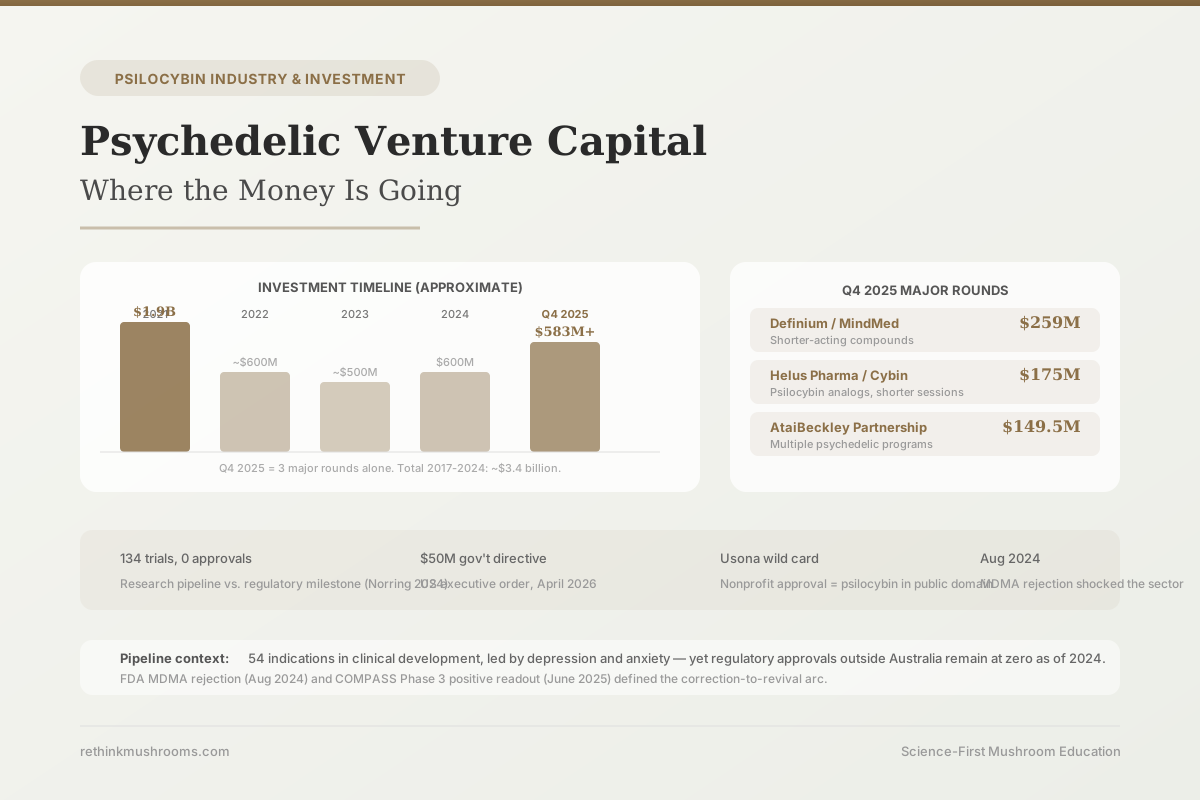
The global psychedelic investment market attracted over $3.4 billion between 2017 and 2024, with a single-year peak of $1.9 billion in 2021, followed by a deep correction and a notable financing revival in Q4 2025.
Industry investment data; Norring et al., Drug Design Development and Therapy, 2024
134
clinical trials registered on ClinicalTrials.gov as of 2024 — with 0 marketing approvals
$583M+
raised in three major Q4 2025 rounds alone, signaling sector revival
$50M
directed toward psychedelic therapy research by executive order in April 2026
Industry investment data; Norring et al., Drug Design Development and Therapy, 2024
 View as image ↗
In 2021, venture capital poured $1.9 billion into psychedelic companies in a single year. By 2023, the same sector was contracting: public market companies had lost 70-90% of their peak values, early-stage rounds dried up, and MDMA's high-profile FDA rejection in August 2024 spooked investors across the entire space, regardless of which compound individual companies were working on. Then Q4 2025 produced three major financing rounds totaling over $583 million, a signal that institutional money had not written the sector off.
Understanding what drove each phase matters for anyone trying to read the current state of psychedelic venture capital — not as an investment guide, but as context for who will bring psilocybin therapy to market, how quickly, and whether it will be accessible or expensive. The business story and the patient access story are the same story. For the broader mushroom market context, see The Functional Mushroom Market: Size, Growth, and Projections and the overview of The Psilocybin Industry: Investment, Companies, and Future Outlook.
Key Takeaways
- Global psychedelic investment peaked at $1.9 billion in 2021, fueled by COVID-era mental health urgency, Oregon's Measure 109 passing, and compelling early clinical data from Johns Hopkins and NYU; total investment 2022-2024 was approximately $1.5 billion combined
- The August 2024 FDA rejection of MDMA-assisted therapy for PTSD acted as a sector-wide shock, driving public market psychedelic stocks down and pausing early-stage fundraising across all compounds, including psilocybin
- Q4 2025 saw a financing revival: Helus Pharma/Cybin raised $175M, Definium/MindMed raised $259M, and Atai Life Sciences partnered with Beckley Psytech for $149.5M — totaling over $583M in three rounds
- As of 2024, there are 134 clinical trials registered on ClinicalTrials.gov for psilocybin across 54 potential indications, yet 0 marketing approvals anywhere except Australia — documenting the gap between research pipeline and regulatory milestone (Norring et al., 2024)
- Government funding has entered the space: NIH/NIDA committed a $14M psychedelic drug trial and a $15M NYU psilocybin trial in 2024; a US executive order in April 2026 directed $50 million toward psychedelic therapy research
- The nonprofit wild card: Usona Institute's open-science approach (published synthesis methods, no broad patents) could undercut commercial IP strategies if it achieves FDA approval first, leaving natural psilocybin effectively in the public domain
The 2021 Boom: What Drove $1.9 Billion Into Psychedelics in a Single Year
The 2021 investment surge was not random. Three forces converged.
First, the COVID-19 pandemic produced a documented mental health crisis at scale: elevated rates of depression, anxiety, and PTSD, combined with widespread awareness that the existing treatment toolkit was leaving a large fraction of patients behind. Institutional investors noticed that psilocybin and other psychedelics had clinical trial data suggesting efficacy in exactly the populations that SSRIs and talk therapy had failed most consistently.
Second, Oregon passed Measure 109 in November 2020, the first US state law creating a regulated framework for psilocybin therapy services. Colorado followed in 2022. These were signals that legal, regulated markets were not science fiction but near-term realities, creating investable commercial opportunities that hadn't existed a year earlier.
Third, the clinical data coming out of Johns Hopkins, NYU, and Imperial College was being published in journals like JAMA and the New England Journal of Medicine, not fringe publications. Institutional investors who track science publication velocity recognized the shift from "interesting pilot studies" to "rigorous Phase 2 randomized trials."
L.E.K. Consulting's analysis of that period showed the investment breaking down roughly as: 59% toward clinical development, 25% toward business development and commercialization, and 16% toward research and education. The capital was primarily betting on pharmaceutical development timelines, not supplement markets.
At peak, this meant public market listings for companies including COMPASS Pathways, Atai Life Sciences, MindMed, and others on major exchanges, bringing retail investors into a sector that had previously been institutional and family office territory.
The Correction: How One MDMA Rejection Hit Every Psychedelic Investor
The 2022-2024 period produced a correction that erased much of the boom's gains. The cumulative investment in those three years combined ($1.5 billion) was less than the 2021 single-year peak.
Multiple factors contributed. Clinical trials take longer and cost more than early projections suggested. Regulatory pathways remained unclear. And public market multiples that had been driven by narrative rather than revenue contracted as interest rates rose.
The single most damaging event was not a psilocybin setback. It was MDMA. In August 2024, the FDA declined to approve MDMA-assisted therapy for PTSD, citing concerns about trial design, data integrity, and inability to adequately blind participants in a study of a drug that produces such distinctive effects. The committee had voted against approval 9-2 in June 2024.
The MDMA rejection was not directly about psilocybin. But investor psychology does not always make clean distinctions between compounds. The rejection was widely read as evidence that the FDA was not going to give psychedelic medicines an easy path, which affected confidence in the entire sector regardless of compound-specific data quality. Psychedelic public market stocks that had already declined 50-70% from their 2021 peaks fell further.
The collapse was informative: the 2021 investment surge had overpriced many companies relative to where their pipelines actually were. The correction, while painful, reset valuations to a more realistic basis for companies with genuine Phase 2 or Phase 3 data.
Q4 2025: Three Major Rounds and the Signs of a Revival
The Q4 2025 financing activity is the clearest evidence that institutional investors had not abandoned the sector, only waited for better pricing and clearer data.
Three major rounds defined the quarter. Helus Pharma, which merged with Cybin and develops novel psilocybin analogs designed for shorter therapy sessions, raised $175 million. Definium Therapeutics, the clinical-stage spinout of MindMed focused on shorter-acting psychedelic compounds, raised $259 million. Atai Life Sciences, a biotech holding company operating multiple psychedelic programs, partnered with Beckley Psytech for a $149.5 million round.
Combined: over $583 million in three deals. This is not a return to 2021 conditions. The broader investment volume remains more disciplined, and public market enthusiasm has not recovered to peak levels. But the scale of these rounds indicates that institutional investors with long time horizons have not exited the thesis.
What changed between the MDMA rejection and Q4 2025? Several things: the COMPASS Phase 3 (COMP005) positive readout announced in June 2025 with psilocybin for TRD provided a direct compound-specific positive signal (unlike MDMA, psilocybin had never failed in a major controlled trial). NIH/NIDA committed significant new grants. And an April 2026 US executive order directing $50 million toward psychedelic therapy research signaled federal government interest that investors read as a potential regulatory tailwind.
Where the Smart Money Is Specifically Going: Analogs Over Natural Psilocybin
A notable feature of the major Q4 2025 rounds is what the funded companies are building: synthetic analogs of psilocybin and shorter-acting psychedelic compounds, not natural psilocybin itself.
Cybin/Helus is developing CYB003, a deuterated psilocybin analog designed to produce a shorter session duration of two to three hours versus the four to eight hours of natural psilocybin. MindMed/Definium is similarly focused on shorter-acting compounds rather than the naturally-occurring molecule. AtaiBeckley's programs include novel synthesis approaches.
The commercial reason is straightforward: natural psilocybin is a molecule that exists in nature and has been used for decades in research. Any company that achieves FDA approval for natural psilocybin is approving a molecule that any licensed generic manufacturer could then produce once patent protection expires. IP protection is limited.
Analogs and derivatives can be patented more broadly. Companies that develop a novel psilocybin compound with measurably better characteristics (shorter session = more patients treated per clinic per day, lower labor cost, potentially better insurance coverage) can build a more defensible commercial position than companies trying to patent therapy protocols around a natural compound.
This is the commercial logic that explains COMPASS's controversial patent strategy, which sought broad protection for aspects of psilocybin therapy delivery rather than the compound itself. The psychedelic medicine community's pushback against COMPASS's patents reflects real concern about whether IP-protected therapy models can coexist with patient access at reasonable prices. For the Oregon program's real-world data on session pricing and accessibility, see Oregon Psilocybin Services: How the World's First Legal Program Works.
Government Funding Arrives: $50 Million and Two Large NIH Grants
One structural change in the psychedelic investment landscape is the arrival of government funding at meaningful scale.
In 2024, the National Institutes of Health and the National Institute on Drug Abuse committed two significant grants: a $14 million psychedelic drug clinical trial and a $15 million NYU psilocybin trial. Government-funded research is not venture capital — it doesn't take equity, it publishes results publicly, and it is explicitly designed to produce knowledge rather than commercial returns. But its presence signals federal scientific legitimacy that institutional investors track.
More significant was the April 2026 executive order directing $50 million toward psychedelic therapy research. The political framing of the order emphasized mental health treatment access, veterans' PTSD, and reducing dependence on current psychiatric medications. Whatever the politics, the practical effect is additional publicly funded clinical data that would support — or undermine — commercial applications.
Government funding also provides capital for nonprofit research entities like Usona Institute that do not seek commercial returns, strengthening the open-science pathway through FDA review. This has complex implications for commercial investors who are betting on IP-protected compounds: more public-domain data makes it harder to justify premium pricing.
The Nonprofit Wild Card: Why Usona's Open-Science Bet Could Undercut Commercial IP
Most coverage of the psychedelic investment landscape focuses on the publicly traded companies. The entity that may have the most significant long-term impact on the industry's commercial dynamics is a Wisconsin-based nonprofit.
Usona Institute operates as a medical research organization without commercial investors or profit motive. It ran the PSIL201 trial, a Phase 2 study of single-dose psilocybin for major depressive disorder whose results were published in JAMA in 2023 — the Usona trial cited as independent replication of the COMPASS psilocybin effect. Usona has FDA Breakthrough Therapy designation for psilocybin in MDD. And critically: Usona has published its psilocybin synthesis methods in an open-access journal and made its Investigator's Brochure available under Creative Commons.
If Usona achieves FDA approval for natural psilocybin, the compound enters the public domain as an approved drug. Any licensed pharmaceutical manufacturer could produce it. There would be no patent moat around natural psilocybin as a therapeutic compound. Pricing pressure from generic competition would begin almost immediately.
This is why the commercial investors have moved toward analogs and novel derivatives: they are explicitly hedging against the scenario where Usona succeeds first. It is also why COMPASS's patent controversy was more than a public relations problem. The community concern was that broad therapy protocol patents could still limit access even if the compound itself was unpatentable. For more on Usona specifically, see Usona Institute: The Nonprofit Driving Psilocybin Research.
The competitive dynamics here are unusual for a pharmaceutical sector: one of the most important actors is a nonprofit explicitly working to prevent the monopoly pricing that typically accompanies new drug approvals. Investors in commercial psilocybin companies have priced this risk in to varying degrees. For FDA regulatory context, see The FDA Breakthrough Therapy Designation for Psilocybin.
The Risks That Make This Sector Different From Any Other VC Bet
A realistic accounting of the psychedelic investment landscape requires naming three categories of risk that are sector-specific rather than generic startup risk.
Regulatory fragmentation. Psilocybin remains Schedule I federally. Oregon and Colorado have created state-level service frameworks, but federal Schedule I status means that federally chartered banks cannot serve the industry, insurance companies face reimbursement uncertainty, and a federal enforcement action could theoretically disrupt state-legal operations. Research tracking US state legislative reform (Siegel et al., JAMA Psychiatry, 2023) notes that this patchwork creates both opportunity and genuine risk for industry participants. A federal rescheduling of psilocybin (which the DEA has declined to do so far) would resolve this uncertainty. It has not happened.
IP disputes. The COMPASS patent controversy is not resolved. Community organizations and researchers have filed challenges to COMPASS's patents. If broad therapy protocol patents were invalidated, that would affect COMPASS's commercial position significantly. If they held, they would affect competition and access. The outcome of these disputes will shape which business models are viable.
The therapy model reimbursement gap. Psilocybin therapy as delivered in trials requires substantial professional support: preparation sessions, an all-day therapeutic session, integration sessions. Oregon's real-world data shows individual sessions pricing at $1,000 or more. The average Oregon program client earns $164,000 per year — approximately double the state median household income. Without insurance coverage, psilocybin therapy reaches a narrow demographic. Whether US insurers and Medicare/Medicaid eventually cover psilocybin therapy depends on FDA approval, on healthcare provider lobbying, and on negotiated rates that have not yet been established. The entire commercial investment thesis for psilocybin therapy assumes that reimbursement eventually follows approval. That assumption is not guaranteed.
Beyond the FDA context, the Oregon program's economics illustrate the access challenge that any investor needs to understand. See The Oregon Psilocybin Service Industry: Licensing, Centers, and Revenue for the operational detail.
As of 2024, 134 clinical trials are registered and 0 marketing approvals have been issued anywhere except Australia.[1] The research pipeline is arguably the most active it has ever been. The distance between a promising pipeline and a commercially accessible treatment has, historically, surprised everyone.
The Bottom Line
The psychedelic investment story is not a straight line. A $1.9 billion boom in 2021 was followed by a painful correction, accelerated by MDMA's FDA rejection in 2024 and the broader market's reassessment of regulatory timelines. Q4 2025's $583M+ in major rounds shows institutional money has not left, only repriced. The sector's specific risks — Schedule I regulatory fragmentation, unresolved IP disputes, and a therapy model that currently prices out most patients — remain real constraints on the commercial thesis. The wildcard is Usona: a nonprofit that, if it wins FDA approval first, would put natural psilocybin in the public domain and make the IP strategies of commercial investors moot.
Frequently Asked Questions
Sources & References
- 1. Source details for this reference are not yet available.