Turkey Tail (Trametes versicolor)
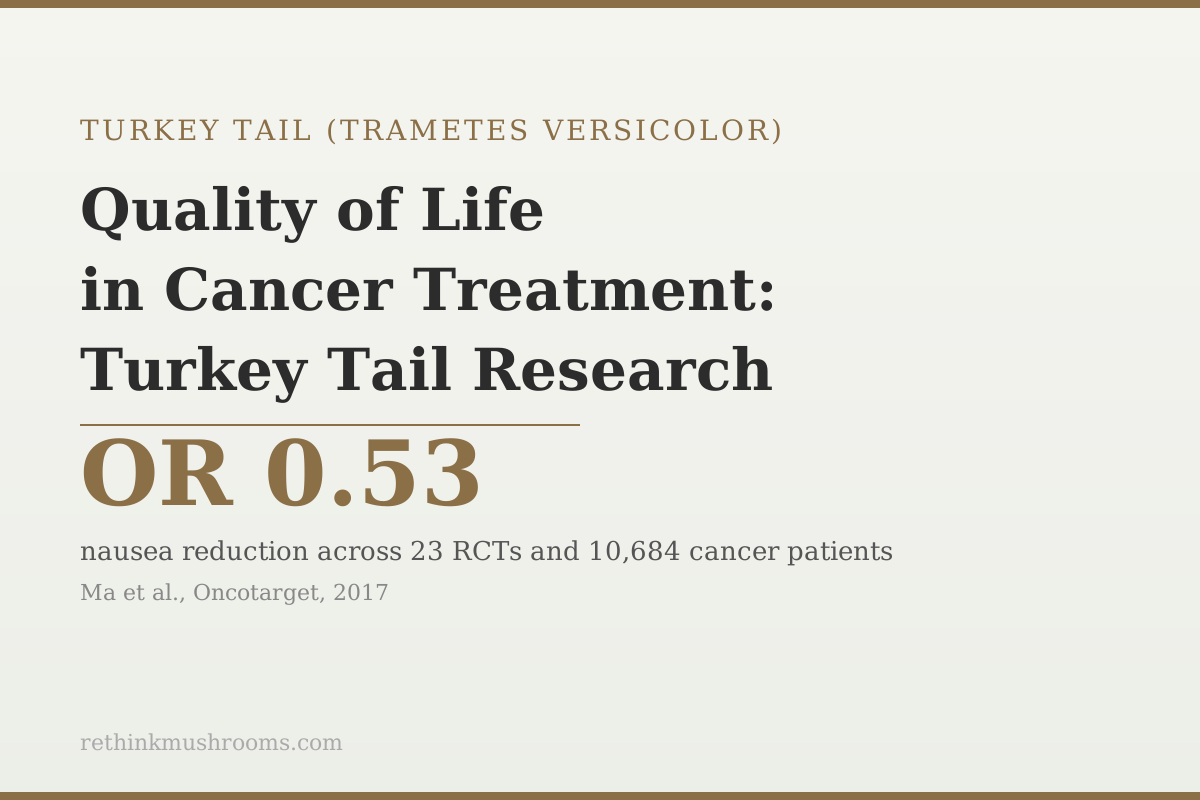
OR 0.53 for nausea and vomiting in cancer patients, from a network meta-analysis of 23 trials
A network meta-analysis combining data from 23 randomized controlled trials and 10,684 patients found that PSK from turkey tail reduced nausea and vomiting risk by 47% compared to chemotherapy alone, and reduced low white blood cell counts by 40%.
Ma et al., Oncotarget, 2017
23 RCTs
included in the Ma 2017 network meta-analysis of PSK in GI cancer
10,684
patients in that meta-analysis
40+ years
of PSK (Krestin) use as a cancer adjuvant in Japan
Ma et al., Oncotarget, 2017
 View as image ↗
Cancer treatment often produces side effects that are nearly as hard to live with as the disease itself. Chemotherapy can cause relentless nausea, wipe out appetite, trigger waves of fatigue, and suppress immune function to dangerous levels. These are not minor inconveniences: they disrupt sleep, work, relationships, and the ability to complete treatment. In clinical research on turkey tail's active compound PSK, quality of life outcomes show up consistently, and a 2017 meta-analysis of 23 randomized trials gives us specific numbers for some of the most important ones.[1]
Turkey tail quality of life research sits within a broader body of evidence that has been building in Japan since the 1970s. For the foundational science of what turkey tail is and how it was developed into a pharmaceutical product, see What Is Turkey Tail Mushroom?.
Key Takeaways
- A network meta-analysis of 23 RCTs and 10,684 patients found PSK (turkey tail's active compound) reduced nausea and vomiting risk by 47% compared to chemotherapy alone (OR 0.53) and reduced low white blood cell counts by 40% (OR 0.60).
- A comprehensive 40-year clinical review of PSK found improved appetite, better body weight maintenance, improved physical and mental competency, and reduced tumor-related symptoms in cancer patients receiving PSK alongside standard treatment.
- A 2023 systematic review of clinical mushroom studies found quality-of-life improvement reported in 14 separate studies, with turkey tail having the most clinical evidence of any medicinal mushroom for cancer support.
- A Phase 1 trial in breast cancer patients found doses up to 9 grams per day of whole Trametes versicolor were well tolerated after radiotherapy, with mostly mild adverse events.
- PSK is a pharmaceutical-grade purified extract approved as a cancer adjuvant in Japan since 1977. Over-the-counter turkey tail supplements are not the same compound and do not have the same regulatory history.
- The Cochrane systematic review of PSK in colorectal cancer found low-certainty evidence for a small survival benefit, providing an honest counterweight to more optimistic findings.
Turkey Tail QoL Benefits Documented in Clinical Research
The following quality-of-life outcomes appear consistently across PSK clinical studies. Each is drawn from published research, not manufacturer claims.
- Reduced nausea and vomiting: OR 0.53 (47% risk reduction), 23 RCTs, 10,684 patients[1]
- Reduced low white blood cell counts (leukopenia/neutropenia): OR 0.60 (40% risk reduction), same meta-analysis[1]
- Improved appetite and food tolerance in gastric and colorectal cancer patients receiving PSK[2]
- Better body weight maintenance during treatment[2]
- Improved physical and mental competency (performance status scores)[2]
- Reduced tumor-related symptoms including pain and fatigue[2]
- Quality-of-life improvement reported across 14 clinical studies of medicinal mushroom supplements, with turkey tail having the most evidence[3]
Nausea and Vomiting: The OR 0.53 Number Across 10,684 Patients
Chemotherapy-induced nausea is one of the most feared side effects of cancer treatment. Modern antiemetic drugs have improved this substantially, but nausea and vomiting remain significant problems for many patients, particularly those on combination chemotherapy regimens.
The Ma 2017 network meta-analysis, published in Oncotarget, is the most comprehensive synthesis of PSK evidence in gastrointestinal cancer patients.[1] It pooled data from 23 randomized controlled trials involving 10,684 patients. The analysis found that patients receiving PSK alongside chemotherapy had an odds ratio of 0.53 for nausea and vomiting compared to patients receiving chemotherapy alone. An odds ratio of 0.53 means roughly a 47% lower odds of experiencing nausea and vomiting.[1]
The evidence quality was rated as moderate-to-high by GRADE assessment, a standard tool for evaluating the strength of clinical evidence.
The same analysis found an odds ratio of 0.60 for leukopenia, which is low white blood cell count. Leukopenia and neutropenia (specifically low neutrophil counts, the white blood cells most responsible for fighting bacterial infection) are the most dangerous acute side effect of chemotherapy. A 40% lower odds of leukopenia means a meaningful reduction in treatment-related infection risk, which in turn allows patients to complete their treatment schedules with fewer delays and dose reductions.
For a focused look at turkey tail and neutropenia specifically, see Turkey Tail for Chemotherapy-Induced Neutropenia.
Appetite, Weight, and Physical Function: What PSK Did in Practice
The nausea numbers from the meta-analysis are important, but they don't capture the full picture of how PSK affected patients' daily experience. A comprehensive 2012 review by Torisu et al. in Surgery Today, written by oncological surgeons who used PSK in clinical practice over four decades, describes the quality-of-life changes observed in patients receiving Krestin.[2]
The review documents improved appetite in patients who would otherwise experience the anorexia that accompanies both cancer progression and chemotherapy side effects. Body weight declined less in PSK-treated patients, which matters because weight loss during cancer treatment is both a quality-of-life issue and a prognostic factor. Patients who maintain weight are better able to tolerate and complete treatment courses.
Physical competency, measured by performance status scales used in oncology, improved in PSK-treated patients. Mental competency showed improvement as well, which the review attributes partly to reduced treatment-related side effect burden and partly to patients feeling more capable of continuing with daily life during treatment.
Tumor-related symptoms, including pain and general disease-related symptoms separate from treatment side effects, were reduced in patients receiving PSK over the 40-year period covered by the review. The symptom reduction likely reflects both direct immune effects on tumor activity and the indirect benefit of better overall condition during treatment.[2]
The review also documents shortened bone marrow suppression duration, improved hemoglobin and platelet counts alongside WBC, and increased IgG and IgM antibody levels. Together these physiological improvements describe patients who are immunologically healthier during and after treatment: a condition that translates directly into fewer infections, fewer hospitalizations, and more time feeling functional.
Cancer Fatigue: The Most Consistent Finding Across Mushroom Studies
Cancer-related fatigue is distinct from ordinary tiredness. It is not fully relieved by rest, can persist long after treatment ends, and is reported by 60-90% of patients undergoing chemotherapy or radiation. It is also one of the most difficult outcomes to measure cleanly in clinical trials because it is subjective and affected by many variables.
A 2023 systematic review in Nutrients by Vetvicka et al. reviewed clinical studies of medicinal mushroom supplements in cancer patients across multiple mushroom species, including turkey tail.[3] Quality-of-life improvement, including fatigue reduction, was reported in 14 separate studies. Across the mushroom species reviewed, turkey tail (PSK and PSP) had the most clinical evidence for cancer support of any species examined.
The fatigue finding is not as precisely quantified as the nausea OR 0.53 number. Clinical trials of PSK used different fatigue measurement tools, and fatigue was not always the primary endpoint. What the evidence shows is consistent directional improvement, not a single large-scale fatigue-specific trial with tight confidence intervals.
This is an important distinction. The evidence on nausea and leukopenia is high-quality: large meta-analysis, randomized trials, specific odds ratios, GRADE-rated moderate-to-high. The evidence on fatigue improvement is consistent but more diffuse: reported across 14 studies using varying methods.
Tumor-Related Symptoms and Overall Wellbeing
The Chong 2023 scoping review in Nutrients examined therapeutic effects of medicinal mushrooms, including turkey tail, in gastric, breast, and colorectal cancer.[4] The review found that PSK plays a role in prolonging overall survival in gastric cancer and showed slightly better 5-year survival for breast cancer patients receiving PSK plus chemotherapy versus chemotherapy alone across three randomized trials.
Survival improvement is the ultimate quality-of-life outcome. Patients who survive longer have more time with their families, more treatment options, and more life. But the connection between PSK and survival in these cancer types likely also operates through QoL pathways: patients who tolerate treatment better, maintain their weight, avoid dangerous infections from neutropenia, and complete their chemotherapy schedules are more likely to have better outcomes. The QoL improvements and the survival data in PSK research are probably not independent of each other.
Safety: What Clinical Trials Show About Tolerability
A 2012 Phase 1 dose-escalation trial by Torkelson et al., published in ISRN Oncology, enrolled 11 women with breast cancer who had recently completed radiotherapy.[5] Participants received whole Trametes versicolor preparation at 3, 6, or 9 grams per day for six weeks. Nine participants completed the study.
At doses up to 9 grams per day, the preparation was well tolerated. Nine adverse events were recorded across the trial: seven mild, one moderate, one severe. No serious safety signal emerged. The trial was designed to establish safety and optimal dosing, not efficacy, so it does not provide quality-of-life outcome data, but it establishes an important safety context for whole-mushroom preparations specifically at clinically relevant doses.
This is distinct from the PSK clinical trial data (which uses purified pharmaceutical PSK). Torkelson's trial is the foundational human safety evidence for whole turkey tail mushroom preparations in cancer patients, and its results support the view that Trametes versicolor is well tolerated in this population.
What the Evidence Is and Isn't: Honest Assessment
The Cochrane Collaboration published a systematic review in 2022 specifically examining Coriolus versicolor (turkey tail) preparations in colorectal cancer patients receiving chemotherapy or radiotherapy.[6] The review covered 7 randomized trials involving 1,569 participants (6 Japanese, 1 Chinese). Its conclusion was measured: low-certainty evidence of a small survival benefit at 5 years, and very low-certainty evidence of little-to-no effect on treatment withdrawal due to adverse events.
The Cochrane review's "low certainty" rating does not mean the evidence is weak. It means the available trials had methodological limitations, primarily older trial designs from Japan that predated modern CONSORT reporting standards, and that replicating the effect in large, modern, double-blind trials is still pending.
A 2012 review by Standish et al. in Integrative Cancer Therapies examined why PSK's 40-year evidence base has not translated into FDA approval in the US.[7] The answer is not lack of efficacy data. It is the economic reality that pharmaceutical companies have no incentive to fund expensive clinical trials for a compound that cannot be patented, and that the regulatory pathway for natural products under FDA rules is different from the pathway used in Japan.
PSK as a pharmaceutical compound approved in Japan represents decades of clinical use in a regulated medical context. Over-the-counter turkey tail supplements represent a different product category: not regulated as drugs, not manufactured to pharmaceutical standards, and not equivalent to PSK even if they are derived from the same mushroom species. This distinction is consistently underemphasized in supplement marketing and consistently relevant for patients trying to evaluate the evidence.
For a detailed look at turkey tail used during chemotherapy more broadly, including the survival and immune outcome data, see Turkey Tail During Chemotherapy: Evidence for Better Outcomes. For the radiation therapy evidence specifically, see Turkey Tail and Radiation Therapy: Can It Reduce Side Effects?.
For comparative context on how turkey tail evidence compares to another major cancer-adjunct mushroom, see Ganoderma lucidum as a Cancer Adjunct: Clinical Evidence.
The Bottom Line
Turkey tail's active compound PSK has the most extensive quality-of-life evidence base of any medicinal mushroom in cancer treatment. A 23-RCT meta-analysis found a 47% reduction in nausea risk and a 40% reduction in leukopenia risk compared to chemotherapy alone. A 40-year clinical review documents improved appetite, weight maintenance, performance status, and reduced tumor-related symptoms. A 2023 systematic review found QoL improvement in 14 separate mushroom supplement studies, with turkey tail having the strongest evidence. The Cochrane review rates the colorectal cancer survival evidence as low-certainty, reflecting older trial methodology rather than absence of effect. Pharmaceutical PSK is not equivalent to over-the-counter turkey tail supplements.
Frequently Asked Questions
Sources & References
- 1. Source details for this reference are not yet available.
- 2. Source details for this reference are not yet available.
- 3. Source details for this reference are not yet available.
- 4. Source details for this reference are not yet available.
- 5. Source details for this reference are not yet available.
- 6. Source details for this reference are not yet available.
- 7. Source details for this reference are not yet available.