Agaricus blazei Basics
4 names, 1 species
The mushroom sold as Agaricus blazei, A. brasiliensis, A. rufotegulis, and himematsutake is actually Agaricus subrufescens, a species first described in 1893.
Kerrigan, Mycologia, 2005
1893
Peck first described A. subrufescens
1967
Heinemann misidentified Brazilian specimens as A. blazei
2005
DNA and mating studies confirmed synonymy
Kerrigan, Mycologia, 2005
 View as image ↗
The mushroom that launched a billion-dollar supplement industry in Brazil and Japan has been called at least four different scientific names over the past 130 years. Agaricus blazei Murrill. Agaricus brasiliensis. Agaricus rufotegulis. Agaricus subrufescens. All refer to the same organism.[1] The naming confusion traces back to a single misidentification in 1967, and the resolution did not arrive until 2005, when DNA analysis and mating studies proved what morphology alone could not.[1] For anyone reading research on this mushroom, understanding its bioactive compounds or evaluating a supplement label, knowing which name is correct (and why the others persist) is foundational.
Key Takeaways
- DNA sequence analysis of the ITS region and mating studies confirmed that A. blazei, A. brasiliensis, and A. rufotegulis are all the same species as A. subrufescens (Kerrigan, 2005)
- A. subrufescens was first described by Charles Horton Peck in 1893 from specimens in New York and Connecticut, making it the oldest valid name
- The Brazilian mushroom was misidentified as A. blazei by Belgian mycologist Paul Heinemann in 1967, launching decades of incorrect nomenclature
- Strains from Brazil, France, and Thailand are interfertile and produce viable hybrid offspring, confirming a single biological species (Thongklang et al., 2014)
- ITS sequences show high polymorphism with evidence of introgression between geographically distant populations (Chen et al., 2016)
- Over 1,000 published studies use the name A. blazei, creating a citation record that cannot be retroactively corrected
The original species: Peck, 1893
Charles Horton Peck, the state botanist of New York, first described Agaricus subrufescens in 1893. His description drew on two collections: cultivated specimens grown in a garden in Brooklyn, New York, and wild specimens gathered in Stamford, Connecticut.[1] The species name, from the Latin subrufescens ("somewhat reddish"), referred to the tendency of the cap to develop reddish-brown tones when bruised or with age.
The mushroom was commercially cultivated in the eastern United States during the late 19th and early 20th centuries.[1] It was a popular market mushroom, valued for its distinct almond-like aroma. Then it faded from commerce, and both the name and the cultivation tradition fell into obscurity. That gap of several decades is what made the later misidentification possible.
The Florida species: Murrill, 1945
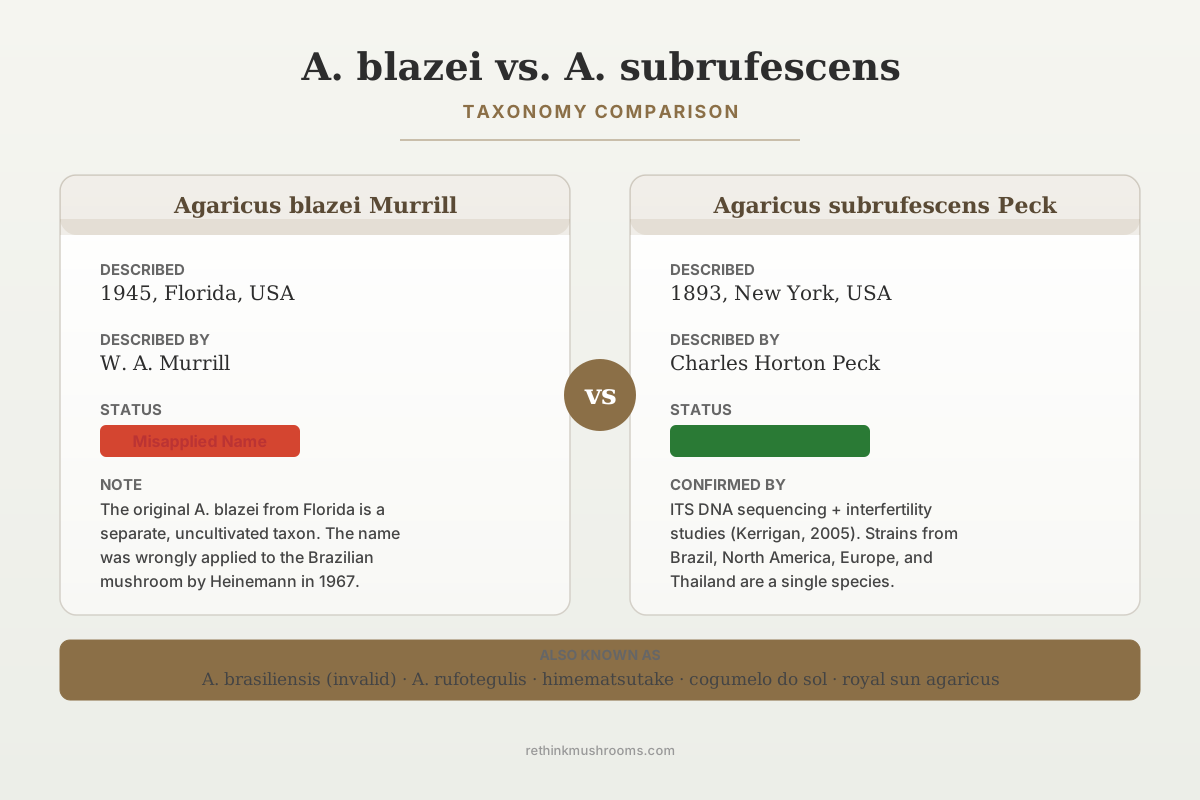
In 1945, American mycologist William Alphonso Murrill described a different Agaricus species from a lawn in Florida belonging to a Mr. R. W. Blaze. He named it Agaricus blazei after the property owner.[3] This was a distinct collection from a subtropical region, and the original A. blazei sensu Murrill is considered a separate taxon native to Florida.
The distinction matters. The mushroom Murrill described in Florida and the mushroom that later became a global health product are not the same organism, even though they share a name in thousands of published papers.[2]
The misidentification: Heinemann, 1967
In the 1960s, a wild mushroom growing near Piedade, in the Atlantic Forest region of São Paulo state, Brazil, attracted attention for its traditional use among local communities. Belgian mycologist Paul Heinemann examined specimens of this Brazilian mushroom in 1967 and identified it as Agaricus blazei Murrill.[3]
This identification was based on morphological similarity. No molecular tools were available at the time. The Brazilian mushroom shared superficial features with Murrill's Florida collection: both were large, fleshy Agaricus species with a pleasant odor. But Heinemann's identification proved wrong.
The name stuck. Japanese researchers imported the Brazilian mushroom in the 1970s, calling it himematsutake. Commercial cultivation expanded through the 1980s and 1990s in Brazil and Japan. Hundreds of studies were published under the name Agaricus blazei Murrill (abbreviated ABM). By the time anyone questioned the identification, the name was embedded in the scientific literature, commercial supply chains, and regulatory filings across multiple countries.[2]
The attempted correction: Wasser, 2002
In 2002, mycologists Solomon Wasser and Marina Didukh recognized that the commercially cultivated mushroom was not the same as Murrill's Florida species. They proposed a new species name: Agaricus brasiliensis.[3] Their reasoning was sound in principle. The cultivated mushroom differed from A. blazei sensu Murrill in pileus size, shape, type of covering, presence of cheilocystidia, and spore dimensions.[3]
There was a problem. The name Agaricus brasiliensis had already been used by Elias Magnus Fries in 1830 for a completely different fungus. Under the International Code of Nomenclature for algae, fungi, and plants, a species name cannot be used twice within the same genus. A. brasiliensis Wasser was therefore an illegitimate later homonym.[1]
Despite being nomenclaturally invalid, A. brasiliensis gained traction in the literature, particularly in Brazilian publications. This added a third name to an already confusing situation.
The DNA resolution: Kerrigan, 2005
Richard W. Kerrigan, a geneticist who had first cultivated A. subrufescens in 1981 and studied Brazilian isolates since 1992, published the definitive resolution in Mycologia in 2005.[1]
His approach combined two lines of evidence:
Molecular data. DNA sequence analysis of the rDNA internal transcribed spacer (ITS) region showed that Brazilian strains called A. blazei and A. brasiliensis were genetically equivalent to North American populations of A. subrufescens. European specimens previously classified as A. rufotegulis Nauta also fell within the same genetic cluster.[1]
Mating studies. Kerrigan crossed strains from different geographical origins and produced fertile hybrid progeny. Interfertility between populations from North America, South America, and Europe established biological species identity, a stronger criterion than DNA similarity alone.[1]
Because Peck's name A. subrufescens (1893) predates both A. blazei (1945) and A. brasiliensis (2002), it holds nomenclatural priority. MycoBank, Index Fungorum, and other authoritative databases now list A. subrufescens as the accepted name, with all others as synonyms.[2]
Genetic diversity across continents
The taxonomy story did not end with Kerrigan's 2005 paper. Subsequent genetic studies revealed that A. subrufescens harbors unusual levels of diversity for a cultivated species.
Thongklang et al. (2014) tested mating compatibility among strains from Brazil, France, and Thailand. All three populations were interfertile, confirming a single biological species with a broad geographical range.[5] The species exhibits amphithallism, meaning it can reproduce both by self-fertilization (homothallism) and by outcrossing (heterothallism). The percentage of heterokaryotic single-spore progenies varied: 75% in the Thai strain and approximately 40% in Brazilian and French strains.[5]
Chen et al. (2016) analyzed ITS sequences from a wider collection and found evidence of both introgression (gene flow between distinct populations) and duplication events within the ITS region.[4] This high level of ITS polymorphism, unusual for a single species, may have contributed to earlier taxonomic confusion. When different researchers sequenced different isolates, they sometimes found enough variation to suspect multiple species.
Foulongne-Oriol et al. (2016) constructed the first genetic linkage map for A. subrufescens and found highly conserved macrosynteny with the common button mushroom, A. bisporus.[6] The two species share large-scale chromosomal organization despite diverging millions of years ago, placing A. subrufescens firmly within the Agaricus genus framework.
Why the wrong name persists
More than two decades after Kerrigan's resolution, the name "Agaricus blazei" still appears on supplement bottles, in marketing materials, and in new research publications. Several forces maintain it:
Citation inertia. Over 1,000 published studies use A. blazei. Researchers cite earlier work using the same name those studies used, creating a self-reinforcing loop.[7]
Commercial recognition. "ABM" (Agaricus blazei Murrill) is a recognized brand in the Japanese and Brazilian supplement markets. Changing a product name risks customer confusion and rebranding costs.[8]
Database lag. PubMed MeSH terms, ClinicalTrials.gov entries, and some national pharmacopoeias have been slow to update. A researcher searching PubMed for "Agaricus subrufescens" will miss the majority of relevant studies indexed under A. blazei.[2]
Regulatory anchoring. Once a species name enters regulatory filings (novel food applications, GRAS determinations, pharmacopoeia monographs), changing it requires formal petition processes. In some jurisdictions, the regulatory name is frozen regardless of taxonomic updates.
This matters for anyone reading the research literature. A comprehensive search for studies on this mushroom requires checking at least four names: A. subrufescens, A. blazei, A. brasiliensis, and himematsutake. Missing any one of these will miss relevant data.
The many common names
The taxonomy confusion is compounded by a sprawling list of common names in multiple languages:
- Himematsutake (Japanese: "princess matsutake"), the dominant commercial name in Japan
- Cogumelo do sol (Portuguese: "mushroom of the sun"), widely used in Brazil
- Cogumelo de Deus (Portuguese: "God's mushroom"), another Brazilian name
- Royal sun agaricus, used in English-language supplement marketing
- Almond mushroom, referring to the distinctive almond-like aroma
- Mandelpilz (German: "almond mushroom")
- ABM, the abbreviation for Agaricus blazei Murrill, common in clinical literature
Each name reflects a different cultural or commercial context. None is wrong in casual use, but in scientific communication, the correct binomial is Agaricus subrufescens Peck (1893).[1]
What this means for research quality
The naming confusion has practical consequences beyond taxonomy. When a 2022 critical review catalogued the chemical composition of "Agaricus blazei Murill," it drew on studies that may have used genetically different strains, all grouped under one incorrect name.[7] A 2017 review of bioactive compounds and health effects similarly noted that commercial A. blazei spawns in Brazil may be genetically identical clones, potentially originating from a single Japanese import.[8]
This genetic bottleneck means that many studies testing "A. blazei" are testing a narrow subset of the species' actual diversity. Wild populations from North America, Europe, and Southeast Asia, which Kerrigan and Thongklang showed are interfertile with cultivated strains, remain largely untested for bioactive compound profiles.[5]
For the immune modulation research that drives most commercial interest in this species, strain identity matters. Beta-glucan content, ergosterol levels, and polysaccharide structure vary between isolates.[9] Studies that do not specify the exact strain used, many do not, limit the ability to compare results across laboratories.
The current state
The taxonomy of Agaricus subrufescens is now settled among professional mycologists. The species belongs to section Arvenses of the genus Agaricus, family Agaricaceae, order Agaricales.[2] Its relationship to A. bisporus (the common button mushroom) is well mapped at the genomic level.[6]
But the gap between the scientific consensus and the commercial/popular literature remains wide. The supplement industry largely uses A. blazei. PubMed still indexes most relevant studies under the old name. And new research papers continue to appear using A. blazei, A. brasiliensis, or both.
This article uses "A. blazei" when referencing historical events or studies that used that name, and "A. subrufescens" when referring to the species as currently understood. Both names point to the same organism.
The Bottom Line
DNA sequence analysis and interfertility studies conclusively demonstrated that the commercially cultivated mushroom known as Agaricus blazei, A. brasiliensis, and himematsutake is actually Agaricus subrufescens, a species first described in 1893. The misidentification persisted for nearly four decades and left a legacy of naming confusion in more than 1,000 published studies. The taxonomy is resolved, but the commercial and indexing systems have not fully caught up.
Frequently Asked Questions
Sources & References
- 1RTHM-00081·Kerrigan, Richard W (2005). “Agaricus subrufescens, a cultivated edible and medicinal mushroom, and its synonyms..” Mycologia.Study breakdown →PubMed →↩
- 2RTHM-00271·Wisitrassameewong, Komsit et al. (2012). “Agaricus subrufescens: A review..” Saudi journal of biological sciences.Study breakdown →PubMed →↩
- 3RTHM-00131·Firenzuoli, F et al. (2008). “The Medicinal Mushroom Agaricus blazei Murrill: Review of Literature and Pharmaco-Toxicological Problems..” Evidence-based complementary and alternative medicine : eCAM.Study breakdown →PubMed →↩
- 4RTHM-00421·Chen, Jie et al. (2016). “Genetic Analyses of the Internal Transcribed Spacer Sequences Suggest Introgression and Duplication in the Medicinal Mushroom Agaricus subrufescens..” PloS one.Study breakdown →PubMed →↩
- 5RTHM-00351·Thongklang, Naritsada et al. (2014). “Evidence for amphithallism and broad geographical hybridization potential among Agaricus subrufescens isolates from Brazil, France, and Thailand..” Fungal biology.Study breakdown →PubMed →↩
- 6RTHM-00425·Foulongne-Oriol, Marie et al. (2016). “The Genetic Linkage Map of the Medicinal Mushroom Agaricus subrufescens Reveals Highly Conserved Macrosynteny with the Congeneric Species Agaricus bisporus..” G3 (Bethesda.Study breakdown →PubMed →↩
- 7RTHM-00765·Huang, Kaiyuan et al. (2022). “Critical review on chemical compositions and health-promoting effects of mushroom Agaricus blazei Murill..” Current research in food science.Study breakdown →PubMed →↩
- 8RTHM-00468·da Silva de Souza, Aline Cristine et al. (2017). “Agaricus blazei Bioactive Compounds and their Effects on Human Health: Benefits and Controversies..” Current pharmaceutical design.Study breakdown →PubMed →↩
- 9RTHM-00215·Hetland, Geir et al. (2011). “The Mushroom Agaricus blazei Murill Elicits Medicinal Effects on Tumor, Infection, Allergy, and Inflammation through Its Modulation of Innate Immunity and Amelioration of Th1/Th2 Imbalance and Inflammation..” Advances in pharmacological sciences.Study breakdown →PubMed →↩