Agaricus blazei Basics
6+ compound classes
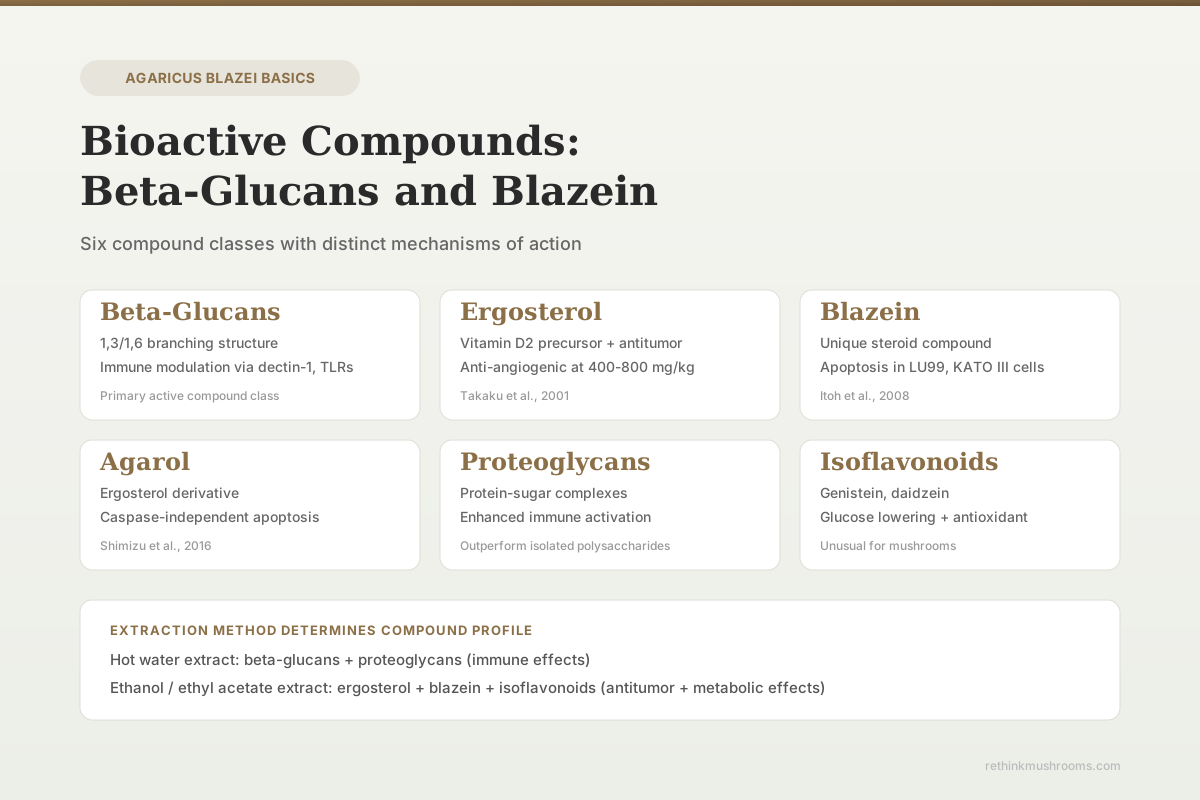
Agaricus blazei contains at least six distinct classes of bioactive compounds: beta-glucans, ergosterol derivatives, blazein, agaritine, isoflavonoids, and proteoglycans.
Da Silva de Souza et al., Current Pharmaceutical Design, 2017
Beta-glucans
primary immunomodulating polysaccharides
Ergosterol
inhibited tumor growth 400-800 mg/kg in mice
Blazein
steroid inducing apoptosis in cancer cell lines
Da Silva de Souza et al., Current Pharmaceutical Design, 2017
 View as image ↗
Agaricus blazei bioactive compounds extend well beyond the beta-glucans that dominate most discussions of medicinal mushrooms. The fruiting body and mycelium contain polysaccharides, ergosterol and its derivatives, a unique steroid called blazein, proteoglycans, phenolic compounds, and unusually for a mushroom, isoflavonoids typically associated with soybeans.[1] Each compound class has its own research base, mechanism of action, and level of evidence.
Understanding which compounds drive which effects matters for practical reasons. Different extraction methods pull out different compounds. Hot water extracts are rich in beta-glucans and water-soluble polysaccharides. Ethanol and ethyl acetate extracts concentrate sterols, phenolics, and isoflavonoids. A consumer taking a beta-glucan-standardized supplement is getting a fundamentally different compound profile than someone taking an ethanol extract. For more on what Agaricus blazei is and its history, see our introductory article.
Key Takeaways
- Beta-glucans with a characteristic 1,3/1,6 branching structure are ABM's primary immunomodulatory compounds, activating macrophages and natural killer cells (Da Silva de Souza et al., 2017)
- Ergosterol from ABM inhibited tumor growth at 400-800 mg/kg in sarcoma 180-bearing mice through anti-angiogenic mechanisms (Takaku et al., 2001)
- Blazein, a steroid unique to ABM, induced apoptotic chromatin condensation in human lung and stomach cancer cell lines (Itoh et al., 2008)
- Agarol, an ergosterol derivative, induced caspase-independent apoptosis in cancer cells through mitochondrial membrane disruption (Shimizu et al., 2016)
- Beta-glucan oligosaccharides showed approximately twice the antidiabetic activity of intact beta-glucans in diabetic mice (Kim et al., 2005)
- ABM ergosterol-rich extracts demonstrated antioxidant and antimicrobial properties with no hepatotoxicity in cell models (Correa et al., 2018)
Beta-Glucans: The Immunomodulatory Core
Beta-glucans are polysaccharides built from glucose molecules linked in specific branching patterns. ABM's beta-glucans have a primary chain connected by beta-1,3 glycosidic bonds with side branches attached at beta-1,6 positions.[2] This branching pattern determines biological activity: it fits receptors on immune cells (dectin-1, complement receptor 3, and toll-like receptors) like a key fits a lock.
When beta-glucans bind these receptors, they trigger a cascade of immune responses. Macrophages increase their phagocytic activity. Natural killer (NK) cells become more cytotoxic. Dendritic cells mature and present antigens more effectively. The net effect is broad-spectrum immune activation without targeting a specific pathogen, which is why beta-glucans are classified as biological response modifiers rather than antimicrobials.
ABM's beta-glucan content varies by cultivation conditions, harvest timing, and preparation method. Da Silva de Souza et al. (2017) noted that the fruiting body typically contains higher beta-glucan concentrations than mycelium, though mycelium-on-grain products are common in the supplement market.[1] The distinction matters: mycelium-on-grain products dilute fungal compounds with substrate starch, sometimes containing 35 to 40% residual grain starch that registers falsely as "polysaccharide" content on supplement labels but has no immune-modulating activity.
ABM beta-glucans also appear in combination with other immune-active compounds in whole extracts. The polysaccharide-protein complexes (proteoglycans) may be more active than isolated beta-glucans, meaning aggressive purification could actually reduce biological potency. The optimal preparation balances removing inactive filler material while retaining the synergistic compound matrix.
Beta-Glucan Oligosaccharides
Kim et al. (2005) made an important discovery about beta-glucan processing.[8] When ABM beta-glucans were enzymatically hydrolyzed into shorter oligosaccharide fragments, the resulting compounds showed roughly twice the antidiabetic activity of the intact parent beta-glucans in STZ-induced diabetic mice. The oligosaccharides also demonstrated anti-hypertriglyceridemic and anti-hypercholesterolemic effects.
This finding has two implications. First, the bioactive form of beta-glucans may not be the large polysaccharide molecules themselves but rather the fragments generated during digestion or processing. Second, different preparation methods, including enzymatic hydrolysis versus hot water extraction, may produce extracts with significantly different potencies. For the full picture of how these compounds affect blood sugar, see our dedicated article.
Ergosterol: The Vitamin D Precursor with Antitumor Properties
Ergosterol is a fungal sterol analogous to cholesterol in animals. It serves as the precursor to vitamin D2 when exposed to ultraviolet light, a property shared across all mushroom species. But ABM ergosterol research has focused on a different property: direct antitumor activity.
Tumor Growth Inhibition
Takaku et al. (2001) isolated ergosterol from ABM and tested it in sarcoma 180-bearing mice.[3] Oral administration at 400 and 800 mg/kg daily for 20 days significantly reduced tumor growth without observable side effects. The mechanism appeared to be anti-angiogenic: ergosterol inhibited the formation of new blood vessels that tumors need to grow beyond a few millimeters in diameter.
This anti-angiogenic mechanism was confirmed by Kimura et al. (2004), who isolated an anti-angiogenic substance from ABM and demonstrated both antitumor and antimetastatic actions in animal models.[4] The compound inhibited the formation of new capillary networks that supply nutrients to growing tumors, effectively starving them.
Agarol: The Ergosterol Derivative
Shimizu et al. (2016) identified agarol, a specific ergosterol derivative found in ABM, and demonstrated that it induces apoptosis (programmed cell death) in human cancer cells.[5] The mechanism was unusual: agarol triggered caspase-independent apoptosis through mitochondrial membrane disruption. Most apoptosis pathways proceed through caspase enzymes, making caspase-independent pathways of particular interest because cancer cells that have evolved resistance to caspase-mediated death could theoretically still be killed through this alternative route.
Agarol was effective against multiple human cancer cell lines, but these are in vitro findings. No animal or human study has tested agarol as an isolated compound.
The ergosterol derivative research as a whole illustrates a recurring theme in ABM science: the same mushroom contains compounds that work through entirely different mechanisms. Ergosterol itself acts through anti-angiogenesis (cutting off blood supply). Agarol acts through mitochondrial membrane disruption (directly damaging cancer cell powerhouses). These are mechanistically independent, meaning an extract containing both could theoretically attack tumors from multiple angles simultaneously. Whether this actually happens at biologically relevant concentrations after oral consumption is unknown.
Ergosterol as a Food Ingredient
Correa et al. (2018) took a different approach, optimizing ergosterol extraction from ABM for food industry applications.[7] Using Soxhlet extraction, they achieved approximately 12% ergosterol yield from ABM. The ergosterol-rich extract demonstrated antioxidant and antimicrobial properties in cell models with no hepatotoxicity, and was successfully incorporated into yogurt as a functional food ingredient. This study bridges the gap between medicinal research and practical food science applications.
Blazein: The Unique Steroid
Blazein is a steroid compound that appears to be unique to Agaricus blazei among commonly studied medicinal mushrooms. Itoh et al. (2008) isolated blazein from ABM (himematsutake) and characterized its structure using mass spectrometry and NMR.[6]
In cell culture experiments, blazein induced cell death in human lung cancer (LU99) and stomach cancer (KATO III) cell lines. The mechanism showed characteristic signs of apoptosis: DNA fragmentation into oligonucleosomal-sized pieces and chromatin condensation, both hallmarks of programmed cell death rather than necrotic damage.
Blazein is distinct from the beta-glucans and ergosterol derivatives in that it is a relatively small, lipid-soluble molecule rather than a large polysaccharide. This means it would be concentrated in ethanol or lipid-based extracts rather than hot water extracts. A beta-glucan-standardized water extract might contain little to no blazein, while an ethanol extract could contain significant amounts.
The blazein research is limited to a single in vitro study. No animal or human data exists. Its mechanism of action, pharmacokinetics, and potential toxicity are all unknown. Whether it reaches relevant tissue concentrations after oral consumption of ABM mushrooms or supplements has not been tested. For the taxonomy and naming confusion surrounding this mushroom, see our dedicated explainer.
Proteoglycans: The Protein-Sugar Complexes
Proteoglycans are compounds where proteins are covalently linked to polysaccharide chains. ABM proteoglycans combine the immune-activating properties of beta-glucans with additional protein-mediated interactions. Da Silva de Souza et al. (2017) identified polysaccharide-protein complexes in ABM as powerful activators of macrophages and NK cells, often outperforming isolated polysaccharides in immune stimulation assays.[1]
The protein component may enhance beta-glucan activity by improving receptor binding affinity or by activating additional immune signaling pathways. This has practical implications for supplement selection: highly purified beta-glucan extracts may be less active than cruder extracts that retain the proteoglycan complexes. The extraction method determines whether these protein-sugar bonds remain intact.
ABM proteoglycans have also shown direct cytotoxic effects on tumor cells independent of immune activation. While beta-glucans primarily work by stimulating the immune system to attack cancer, the proteoglycan fraction has been observed to directly inhibit tumor cell growth in vitro. This dual mechanism, immune activation plus direct cytotoxicity, distinguishes ABM proteoglycans from purified beta-glucan preparations that rely solely on immune modulation.
Isoflavonoids: An Unexpected Find
ABM's isoflavonoid content is unusual among mushrooms. Oh et al. (2010) identified genistein, genistin, daidzein, and daidzin in the ethyl acetate fraction of ABM submerged-culture broth. These compounds are well-characterized soy isoflavonoids with established glucose-lowering, antioxidant, and phytoestrogenic properties in other research contexts.
Huang et al. (2022) confirmed the presence of isoflavonoids in their critical review of ABM chemical composition and noted that these compounds likely contribute to ABM's hypoglycemic effects.[2] The isoflavonoid content adds complexity to interpreting ABM research: some of the "mushroom" effects attributed to beta-glucans may actually be driven by these plant-like compounds.
Why Compound Identification Matters
The diversity of bioactive compounds in ABM creates a problem for research interpretation and supplement standardization. When a study reports that "ABM extract" has a particular effect, the result depends entirely on which compounds were extracted. Hot water extraction favors beta-glucans and proteoglycans. Ethanol extraction favors ergosterol, blazein, phenolics, and isoflavonoids. Ethyl acetate extraction concentrates the most lipophilic compounds.
Huang et al. (2022) found that basic preclinical research on ABM is abundant, but only 17 clinical studies existed at the time of their review.[2] Most of those clinical studies used poorly characterized extracts, making it difficult to determine which compounds were responsible for observed effects. Future clinical research would benefit from using standardized extracts with known compound profiles rather than crude preparations.
This standardization problem extends to the research literature. When one study uses a hot water extract and another uses an ethanol extract, they are testing fundamentally different mixtures of compounds. Comparing results across studies or meta-analyzing the literature is misleading when the "intervention" is chemically inconsistent. Da Silva de Souza et al. (2017) identified this as a major barrier to translating ABM research into clinical practice.[1]
For consumers, the compound diversity means that not all ABM supplements are equivalent. A product standardized to beta-glucan content may have a completely different compound profile than one standardized to polysaccharide content (which could include non-beta-glucan starch from mycelium-on-grain production). A product claiming "500 mg Agaricus blazei" tells you nothing about which bioactive compounds are present or at what concentrations. Understanding how ABM compares to the common button mushroom at the compound level helps explain why these related species are studied for different purposes, and why "himematsutake" commands a premium in Japan while button mushrooms cost dollars per pound.
The drug interaction profile of ABM also depends on compound composition. CYP enzyme inhibition may be driven by different compounds than immune activation or blood sugar lowering. Understanding which compounds a given product contains helps predict which interactions are relevant.
The Bottom Line
Agaricus blazei contains at least six classes of bioactive compounds with distinct mechanisms of action: beta-glucans (immune modulation), ergosterol (anti-angiogenic tumor inhibition), agarol (caspase-independent apoptosis), blazein (apoptotic chromatin condensation), proteoglycans (enhanced immune activation), and isoflavonoids (glucose lowering and antioxidant effects). Different extraction methods concentrate different compounds, making supplement composition highly variable and complicating research interpretation.
Frequently Asked Questions
Sources & References
- 1RTHM-00468·da Silva de Souza, Aline Cristine et al. (2017). “Agaricus blazei Bioactive Compounds and their Effects on Human Health: Benefits and Controversies..” Current pharmaceutical design.Study breakdown →PubMed →↩
- 2RTHM-00765·Huang, Kaiyuan et al. (2022). “Critical review on chemical compositions and health-promoting effects of mushroom Agaricus blazei Murill..” Current research in food science.Study breakdown →PubMed →↩
- 3RTHM-00039·Takaku, T et al. (2001). “Isolation of an antitumor compound from Agaricus blazei Murill and its mechanism of action..” The Journal of nutrition.Study breakdown →PubMed →↩
- 4RTHM-00073·Kimura, Yoshiyuki et al. (2004). “Isolation of an anti-angiogenic substance from Agaricus blazei Murill: its antitumor and antimetastatic actions..” Cancer science.Study breakdown →PubMed →↩
- 5RTHM-00447·Shimizu, Takamitsu et al. (2016). “Agarol, an ergosterol derivative from Agaricus blazei, induces caspase-independent apoptosis in human cancer cells..” International journal of oncology.Study breakdown →PubMed →↩
- 6RTHM-00138·Itoh, Hiroko et al. (2008). “Blazein of a new steroid isolated from Agaricus blazei Murrill (himematsutake) induces cell death and morphological change indicative of apoptotic chromatin condensation in human lung cancer LU99 and stomach cancer KATO III cells..” Oncology reports.Study breakdown →PubMed →↩
- 7RTHM-00506·Corrêa, Rúbia C G et al. (2018). “A natural food ingredient based on ergosterol: optimization of the extraction from Agaricus blazei, evaluation of bioactive properties and incorporation in yogurts..” Food & function.Study breakdown →PubMed →↩
- 8RTHM-00082·Kim, Yea-Woon et al. (2005). “Anti-diabetic activity of beta-glucans and their enzymatically hydrolyzed oligosaccharides from Agaricus blazei..” Biotechnology letters.Study breakdown →PubMed →↩