Agaricus blazei (Royal Sun Mushroom)
3 immune receptors
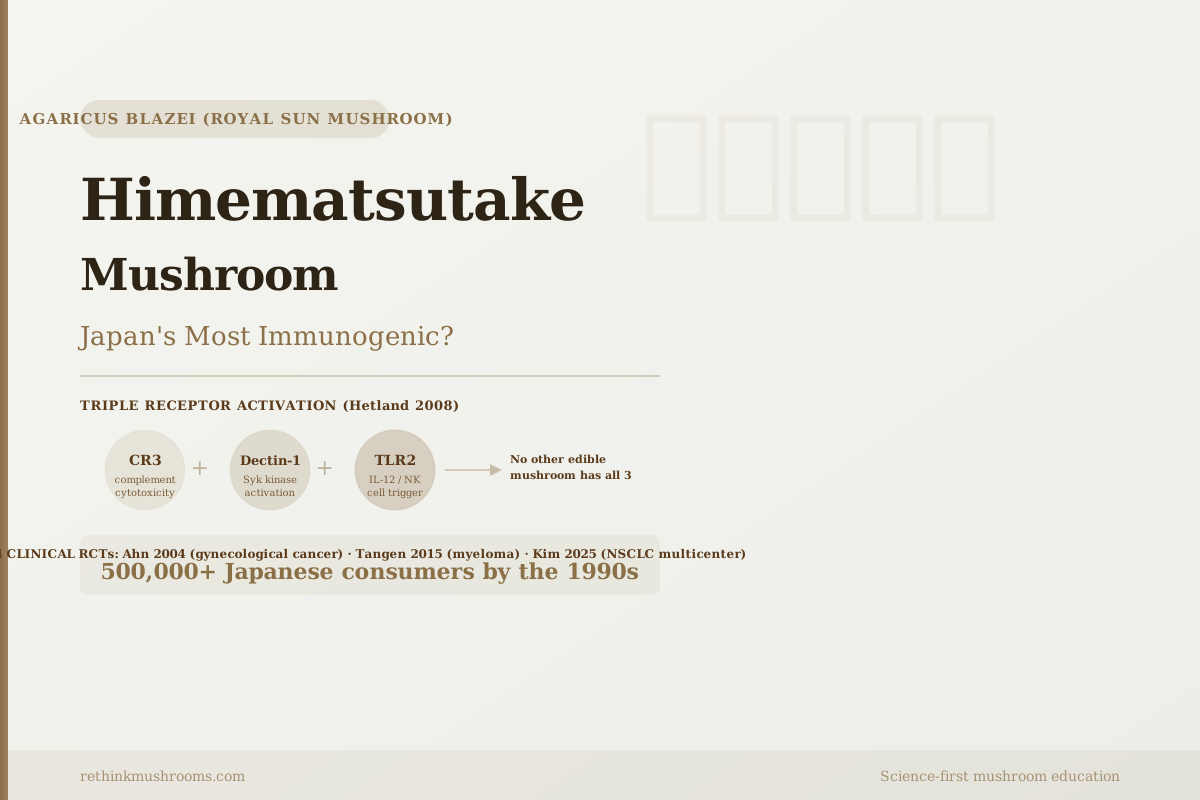
Agaricus blazei beta-glucans activate three distinct immune receptors simultaneously — CR3, dectin-1, and TLR2 — a combination documented in no other edible medicinal mushroom.
Hetland G et al., Scandinavian Journal of Immunology, 2008
500,000+
Japanese consumers using Himematsutake by the 1990s
4 clinical RCTs
from NK cell studies (2004) to multicenter NSCLC trial (2025)
M2 to M1
MDSC reprogramming: Liu 2015 found ABM reverses tumor immunosuppression via TLR2
Hetland G et al., Scandinavian Journal of Immunology, 2008
 View as image ↗
Matsutake is the most prized mushroom in Japan, sometimes selling for more than $2,000 per kilogram. Naming a different mushroom after it, adding the word "hime" (princess), communicates something about expectations. Himematsutake (姫まつたけ) is the trade name Japanese researchers gave to their cultivated strain of Agaricus blazei Murill, a Brazilian jungle mushroom that arrived in Japan in 1965 and eventually became the country's most consumed medicinal mushroom supplement.
By the 1990s, more than 500,000 Japanese were taking it regularly. Japanese scientists had published clinical trials on it years before most Western researchers had heard of it. The Himematsutake mushroom research history is the foundation for calling it the most immunogenic in its class — a claim that requires unpacking the mechanism, not just accepting the reputation.
This article covers the name, the mechanism, the clinical evidence, and where the honest limits of that evidence sit. For the full identity and history of this mushroom, see What Is Agaricus blazei? The Royal Sun Mushroom Explained.
Key Takeaways
- Himematsutake is the Japanese cultivated strain name for Agaricus blazei Murill, also known botanically as Agaricus subrufescens (Kerrigan 2005) — distinct from the wild Brazilian species
- Hetland 2008 identified that ABM beta-glucans activate three immune receptors simultaneously: CR3, dectin-1, and TLR2, a combination not documented in other edible medicinal mushrooms
- Kasai 2004 showed ABM fraction H triggers TLR-mediated IL-12 production, driving the NK cell and cytotoxic T cell responses central to ABM's anti-infection and anti-tumor effects
- Liu 2015 found ABM polysaccharide reprograms immunosuppressive tumor-associated cells from the M2 phenotype to the anti-tumor M1 phenotype via TLR2, reversing a primary tumor immune-evasion mechanism
- Four clinical RCTs span gynecological cancer (Ahn 2004), multiple myeloma during chemotherapy (Tangen 2015), and NSCLC post-surgery (Kim 2025 multicenter)
- Hetland 2020 comparative review found ABM Andosan extract had stronger and more consistently documented clinical immune modulation than either Lion's Mane or Maitake
The Name Itself: Why Japan Called It Princess Matsutake
In 2005, taxonomist Richard Kerrigan published the authoritative nomenclatural review of this mushroom's tangled naming history.[1] His conclusion: the correct species name under botanical nomenclature is Agaricus subrufescens, first applied by Charles Peck in 1893. The names A. blazei Murill and A. brasiliensis, both widely used in the scientific literature, are synonyms. A fourth name, A. rufotegulis, is also a synonym. The same mushroom has been published under four different Latin names, which explains part of why the literature can be difficult to follow.
"Himematsutake" is not a Latin name. It is a Japanese trade name specifically for the cultivated strain developed for supplement production in Japan. Himematsutake translates as "princess matsutake": "hime" means princess or noble lady, and matsutake is Tricholoma matsutake, Japan's most expensive and culturally revered wild mushroom. Naming a new supplement mushroom after matsutake is both a marketing gesture and a statement of scientific ambition — researchers expected this mushroom to produce serious medicinal results.
The cultivated Japanese Himematsutake is not identical to the wild Brazilian Agaricus blazei. Wild Brazilian strains and Japanese cultivated strains differ in growing conditions, substrate, and aspects of their chemical composition. Studies using Japanese Himematsutake strains are not automatically interchangeable with studies using Brazilian wild-collected material. The "Royal Sun Mushroom" is a third naming convention, used primarily in Western supplement marketing. The literature using this name covers the spectrum of evidence without always distinguishing strains — a limitation worth keeping in mind when reading it.
What Triple Receptor Activation Actually Means
Most medicinal mushrooms produce immune effects primarily through one mechanism: beta-glucans binding to dectin-1 receptors on immune cells. Dectin-1 sits on the surface of macrophages, dendritic cells, and neutrophils. When it recognizes the 1,3-glucan structure found in most fungal cell walls, it triggers a cascade that activates those cells.
What Hetland and colleagues identified in their 2008 review[2] is that ABM beta-glucans bind not just dectin-1 but also two additional receptors: CR3 (complement receptor 3, also called CD11b/CD18) and TLR2 (Toll-like receptor 2). CR3 and TLR2 are expressed on monocytes, dendritic cells, granulocytes, and NK cells.
Each receptor triggers a different signaling pathway downstream. Dectin-1 activates the Syk kinase pathway. CR3 activates complement-mediated cytotoxicity. TLR2 activates MyD88-dependent NF-kB signaling, which drives the production of pro-inflammatory cytokines including IL-12.
IL-12 is the cytokine that tells NK cells and cytotoxic T cells to activate. When Kasai and colleagues[3] isolated the specific ABM fraction responsible for TLR-mediated IL-12 production, they identified the mechanistic origin of the NK cell effects observed in clinical studies. A mushroom that drives IL-12 production via TLR2 is doing something more specific and more powerful than a mushroom that activates dectin-1 alone.
The practical implication: three activation pathways running simultaneously produce a broader, more multi-dimensional immune response than any single pathway alone. The "most immunogenic" framing comes from this receptor profile, documented in no other edible medicinal mushroom in the same combination.
The Mechanism That Explains Tumor Immune Evasion Reversal
The most mechanistically significant finding in the ABM literature is from Liu and colleagues in 2015.[4] Liu's team focused on a specific problem in cancer immunology: myeloid-derived suppressor cells, called MDSCs.
MDSCs are immune cells that tumors co-opt to suppress the immune response. Under tumor influence, these cells adopt an immunosuppressive state called the M2 phenotype, where they inhibit the cytotoxic T cells and NK cells that would otherwise attack tumor tissue. This is one of the primary ways solid tumors evade immune destruction even in patients with otherwise functional immune systems.
Liu found that ABM polysaccharide acts as a specific TLR2 agonist, meaning it binds directly to TLR2 and activates it. This TLR2 activation drives MDSCs to differentiate from the M2 immunosuppressive state to the M1 anti-tumor state. M1 MDSCs do not suppress immune activity; they support it. They present tumor antigens. They produce pro-inflammatory cytokines. They create a local tumor environment that facilitates immune destruction rather than blocking it.
This is tumor immune-evasion reversal. ABM is not just boosting general immune activity; it is specifically targeting the suppressive mechanism that tumors use to protect themselves.
A 2024 study by Xu and colleagues[5] added to this picture: ABM polysaccharide promoted CD8+ cytotoxic T cell activity and enhanced tumor cell killing in a colorectal cancer model. CD8+ T cells are the primary effectors of targeted tumor destruction. Their activity is suppressed by M2 MDSCs and enabled by M1 MDSCs, and their engagement represents the leading edge of modern cancer immunotherapy.
These are preclinical findings. The clinical question is whether the same mechanism operates in human cancer patients at achievable oral doses. That question is what the clinical trial program is working to answer.
ABM vs. Lion's Mane and Maitake: What the Comparative Evidence Shows
Hetland and colleagues published a direct comparative review in 2020[6] covering ABM (using the Andosan extract), Lion's Mane (Hericium erinaceus), and Maitake (Grifola frondosa) across preclinical and clinical evidence for anti-tumor, anti-inflammatory, and anti-allergy effects.
Their conclusion: ABM Andosan had the strongest and most consistently documented immune modulation among the three mushrooms in clinical evidence available at time of publication. This is not a dismissal of Lion's Mane or Maitake — the Lion's Mane cognitive research and Maitake's D-fraction immune work are well-established in their own domains. For Maitake's specific bioactive compounds, see Maitake Bioactive Compounds: D-Fraction, MD-Fraction, and Beta-Glucans. The comparative claim is specifically about immune modulation at the clinical trial level, where ABM has a larger number of completed RCTs in active disease contexts.
Hetland 2020 also found that ABM Andosan in IBD patients produced beneficial effects on intestinal inflammation, and that myeloma patients on Andosan maintained better immune cell profiles during aggressive treatment than those on placebo — findings that came from actual clinical trials, not just in vitro or animal work.
The Clinical Research Lineage: From Brazil to Japan's Labs
The clinical evidence on Himematsutake mushroom was built almost entirely in Japan, which is part of why it remains obscure in Western medicine despite a real research record.
Ahn and colleagues[7] published the first major clinical trial in 2004: gynecological cancer patients undergoing chemotherapy were treated with Agaricus blazei Murill Kyowa (ABMK) extract. NK cell activity was significantly higher in the ABMK-treated group than in controls. Quality of life outcomes all moved in the treated direction: appetite, response to alopecia (hair loss), emotional stability, and general weakness all improved in the ABMK group. This is a landmark result because it demonstrated real-world benefit in patients actively undergoing cancer treatment, not healthy volunteers.
Ohno and colleagues[8] published the first Phase I safety and dosing study in Japanese cancer patients in remission in 2011. Phase I studies are primarily designed to confirm safety and identify dose ranges rather than demonstrate efficacy. Ohno's study confirmed the safety profile for regular ABM use and found preliminary evidence of NK cell enhancement. This study established the evidentiary foundation for subsequent larger trials.
Tangen and colleagues[9] published the strongest clinical evidence in 2015: a randomized, double-blinded trial of Andosan in multiple myeloma patients undergoing high-dose chemotherapy plus autologous stem cell transplantation. This is one of the most immunologically demanding treatment protocols in oncology. The Andosan group showed significantly better maintenance of immune cell subsets and cytokine profiles compared to placebo. In patients whose immune systems are being profoundly disrupted by treatment, ABM-based supplementation appeared to preserve immune function against that disruption.
The most recent clinical study is Kim and colleagues' 2025 multicenter pilot RCT,[10] the first multicenter design for ABM. Kim's team tested an ABM-containing multivitamin complex in non-small-cell lung cancer patients after curative resection and found improved immunomodulatory markers compared to placebo. This is the most recent peer-reviewed clinical evidence for ABM, and it does not appear in any major competitor summary.
For a deep review of the cancer-specific clinical literature, see Agaricus blazei and Cancer: Research from Brazil and Japan. For the NK cell evidence specifically, see Agaricus blazei and NK Cell Activation: Research Review.
What the Chemistry Explains About the Immune Response
The mechanistic effects observed across these clinical and preclinical studies trace back to a complex chemical profile. Firenzuoli and colleagues[11] catalogued the primary bioactive classes in their 2008 literature review: highly branched beta-1,3-/1,6-glucans as the primary immunomodulatory compounds, plus proteoglycans, ergosterol (the precursor to vitamin D in fungi), and steroidal compounds including Blazein.
Da Silva de Souza and colleagues[12] extended this catalog in their 2017 bioactive review to include lectins, phenolic acids, and the controversial compound agaritine. Each compound class contributes different biological effects. The beta-glucans drive immune activation through the receptor mechanisms described above. Ergosterol and Blazein contribute to anti-proliferative effects in cancer cell studies. Phenolics provide antioxidant and anti-inflammatory activity.
Huang and colleagues[13] published the most current comprehensive chemistry review in 2022, cataloguing polysaccharides, fatty acids, steroids, phenolic acids, and terpenes with updated mechanistic explanations. The 2022 review confirmed that ABM's multi-target effects — immune, anti-cancer, anti-diabetic, and hepatoprotective — map to distinct chemical fractions within the mushroom.
Hetland 2011[14] added a unifying framework: ABM's four documented therapeutic domains (tumor, infection, allergy, and inflammation) are all explainable through a single underlying mechanism, innate immunity modulation and Th1/Th2 rebalancing. Th2-dominant states, which include allergic conditions and some immune-suppressive tumor environments, are shifted toward Th1 (infection-fighting, anti-tumor). Th1-excessive inflammatory states are also moderated. This bidirectional regulatory action explains how the same mushroom appears useful in both inflammatory and immune-suppressive conditions.
How Honest Is the "Most Immunogenic" Claim?
The "most immunogenic" framing is defensible in a specific, limited context: within the studied group of edible medicinal mushrooms with documented beta-glucan immune activity, ABM has the broadest receptor activation profile (simultaneous triple-receptor binding) and the most clinical RCT data specifically on immune endpoints in active disease contexts.
It is not a claim that ABM produces the strongest immune response in every person under every condition. Hetland 2020 noted that even with the existing clinical evidence, "clinical studies are still at the beginning." Most of the RCTs are small by pharmaceutical standards. The Tangen 2015 myeloma RCT is rigorous in design but limited in sample size. The Kim 2025 multicenter trial is explicitly a pilot study.
The Liu 2015 MDSC reversal finding and Xu 2024 CD8+ T cell data are from preclinical models. These mechanistic findings are compelling and directionally consistent with the clinical results, but translational gaps from animal models to human disease are the rule in this literature, not the exception.
What the evidence does support: ABM activates immune pathways that other medicinal mushrooms do not, has a documented safety profile in cancer patients across multiple trials, and has shown measurable immune benefits in the most challenging clinical contexts tested. For dosage information, see Agaricus blazei Dosage Guide: How Much to Take.
The Bottom Line
Himematsutake is the Japanese cultivated strain of Agaricus blazei Murill, named "princess matsutake" for its perceived medicinal status. The mechanistic basis for calling it uniquely immunogenic lies in its simultaneous activation of three innate immune receptors (CR3, dectin-1, and TLR2), its TLR2-driven IL-12 production, and Liu 2015's finding that its polysaccharide reprograms immunosuppressive tumor-associated cells from M2 to M1 — a mechanism of tumor immune-evasion reversal. Four clinical RCTs in gynecological cancer, myeloma, and lung cancer document real immune effects in human disease contexts. The honest limits: trials are small, mostly single-center, and the most dramatic mechanistic findings are preclinical. The evidence is mechanistically coherent and clinically promising; it is not yet at the level required for clinical guidelines.
Frequently Asked Questions
Sources & References
- 1RTHM-00081·Kerrigan, Richard W (2005). “Agaricus subrufescens, a cultivated edible and medicinal mushroom, and its synonyms..” Mycologia.Study breakdown →PubMed →↩
- 2RTHM-00133·Hetland, G et al. (2008). “Effects of the medicinal mushroom Agaricus blazei Murill on immunity, infection and cancer..” Scandinavian journal of immunology.Study breakdown →PubMed →↩
- 3RTHM-00071·Kasai, H et al. (2004). “IL-12 Production Induced by Agaricus blazei Fraction H (ABH) Involves Toll-like Receptor (TLR)..” Evidence-based complementary and alternative medicine : eCAM.Study breakdown →PubMed →↩
- 4RTHM-00395·Liu, Yi et al. (2015). “Polysaccharide Agaricus blazei Murill stimulates myeloid derived suppressor cell differentiation from M2 to M1 type, which mediates inhibition of tumour immune-evasion via the Toll-like receptor 2 pathway..” Immunology.Study breakdown →PubMed →↩
- 5RTHM-00916·Xu, Yongzhao et al. (2024). “Preventive intervention with Agaricus blazei murill polysaccharide exerts anti-tumor immune effect on intraperitoneal metastasis colorectal cancer..” International journal of biological macromolecules.Study breakdown →PubMed →↩
- 6RTHM-00620·Hetland, Geir et al. (2020). “Antitumor, Anti-Inflammatory and Antiallergic Effects of Agaricus blazei Mushroom Extract and the Related Medicinal Basidiomycetes Mushrooms, Hericium erinaceus and Grifola frondosa: A Review of Preclinical and Clinical Studies..” Nutrients.Study breakdown →PubMed →↩
- 7RTHM-00066·Ahn, W-S et al. (2004). “Natural killer cell activity and quality of life were improved by consumption of a mushroom extract, Agaricus blazei Murill Kyowa, in gynecological cancer patients undergoing chemotherapy..” International journal of gynecological cancer : official journal of the International Gynecological Cancer Society.Study breakdown →PubMed →↩
- 8RTHM-00229·Ohno, Satoshi et al. (2011). “Phase I Clinical Study of the Dietary Supplement, Agaricus blazei Murill, in Cancer Patients in Remission..” Evidence-based complementary and alternative medicine : eCAM.Study breakdown →PubMed →↩
- 9RTHM-00404·Tangen, Jon-Magnus et al. (2015). “Immunomodulatory effects of the Agaricus blazei Murrill-based mushroom extract AndoSan in patients with multiple myeloma undergoing high dose chemotherapy and autologous stem cell transplantation: a randomized, double blinded clinical study..” BioMed research international.Study breakdown →PubMed →↩
- 10RTHM-00928·Kim, Jiwon et al. (2025). “Immunomodulatory Effects of Multivitamin Complexes Containing Agaricus blazei in Patients Undergoing Curative Resection for Non-Small-Cell Lung Cancer: A Randomized, Double-Blind, Placebo-Controlled Multicenter Pilot Trial..” Biomedicines.Study breakdown →PubMed →↩
- 11. Source details for this reference are not yet available.
- 12RTHM-00468·da Silva de Souza, Aline Cristine et al. (2017). “Agaricus blazei Bioactive Compounds and their Effects on Human Health: Benefits and Controversies..” Current pharmaceutical design.Study breakdown →PubMed →↩
- 13RTHM-00765·Huang, Kaiyuan et al. (2022). “Critical review on chemical compositions and health-promoting effects of mushroom Agaricus blazei Murill..” Current research in food science.Study breakdown →PubMed →↩
- 14RTHM-00215·Hetland, Geir et al. (2011). “The Mushroom Agaricus blazei Murill Elicits Medicinal Effects on Tumor, Infection, Allergy, and Inflammation through Its Modulation of Innate Immunity and Amelioration of Th1/Th2 Imbalance and Inflammation..” Advances in pharmacological sciences.Study breakdown →PubMed →↩