Maitake Mushroom Overview & Pharmacology
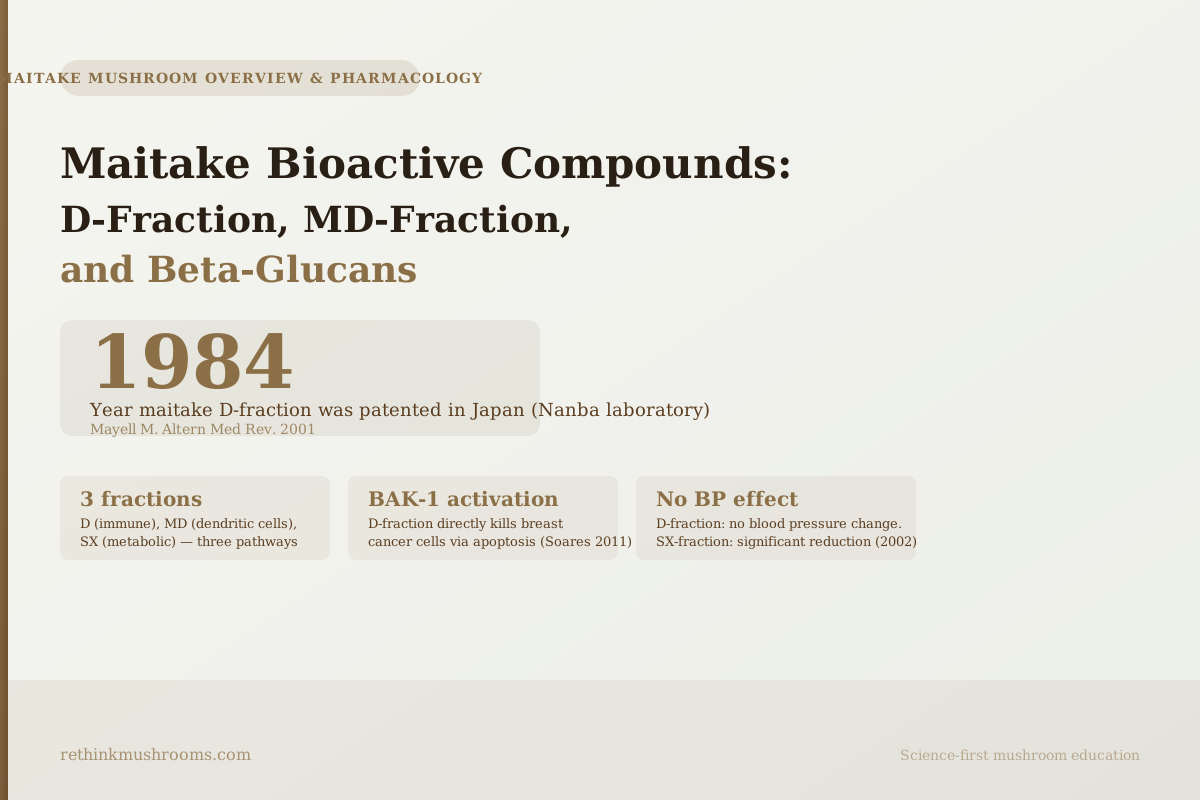
~1,000 kDa: molecular weight of maitake D-fraction — roughly twenty times the size of the fraction sold for blood sugar
D-fraction is a protein-bound beta-glucan complex of about 1,000 kilodaltons, roughly 30% protein, first isolated by Nanba's group in the late 1980s. SX-fraction, the maitake extract studied for metabolic effects, is a glycoprotein carrying an alpha-glucan at 40 to 45 kilodaltons. Same mushroom, different chemical class, different receptor, different evidence base.
Wu et al. Foods. 2021
3 fractions
D-fraction and MD-fraction are beta-glucans acting through the Dectin-1 receptor; SX-fraction is an alpha-glucan glycoprotein acting through the insulin receptor and IRS-1 (Wu 2021, Masuda 2013)
No BP effect
In Talpur 2002, fraction SX significantly lowered systolic blood pressure in Zucker fatty rats while fraction D, tested in the same experiment, had essentially no effect
BAK-1 apoptosis
D-fraction induced dose-dependent apoptosis in MCF7 breast cancer cells with BAK-1 and cytochrome c upregulation — in cell culture, with no immune cells present (Soares 2011)
Wu et al. Foods. 2021
 View as image ↗
When someone says "maitake beta-glucan," they are usually referring to one compound. That is not quite right. Maitake (Grifola frondosa) produces several distinct bioactive fractions that researchers have studied separately since the 1980s, and the three best known differ in molecular structure, in the receptor they engage, and in the biological effect that has actually been measured. D-fraction, the protein-bound beta-glucan complex isolated by Nanba's group in the late 1980s, activates dendritic cells through the Dectin-1 receptor. MD-fraction is a higher-purity preparation of the same beta-glucan. SX-fraction is structurally unrelated to both: a glycoprotein carrying an alpha-glucan, associated with insulin receptor signalling and with documented effects on blood pressure. For a broader introduction to what maitake is and where it fits among medicinal mushrooms, see What Is Maitake Mushroom? The "Dancing Mushroom" Explained.
Wu and colleagues' 2021 review of maitake's bioactive constituents organises the mushroom's chemistry by compound class: polysaccharides, including beta-glucans and heteroglycans, showing antitumour and immunomodulatory activity; proteins and glycoproteins showing antitumour, immunomodulatory and antioxidant activity; and small organic molecules such as sterols and phenolic compounds showing a range of further bioactivities.[1] This article focuses on the three extract fractions because they are the most commercially significant and the most commonly confused with one another. Understanding what each fraction is, structurally, is the starting point for understanding why studies on D-fraction do not automatically apply to SX-fraction, and why "maitake beta-glucan" on a supplement label can mean very different things.
Key Takeaways
- D-fraction is a protein-bound beta-glucan complex of roughly 1,000 kDa and about 30% protein. Its structure is genuinely unusual: unlike other mushroom beta-glucans, which carry a (1→3) main chain with (1→6) branches only, D-fraction carries both that arrangement and a (1→6) main chain with (1→3) branches (Wu 2021)
- MD-fraction is not a different compound. It is D-fraction purified further, with the glucan-to-protein ratio raised to between 80:20 and 99:1 at a similar molecular weight, and it outperformed D-fraction on tumour growth inhibition in mice (Wu 2021)
- SX-fraction is not a beta-glucan at all: it is a water-soluble glycoprotein carrying an alpha-glucan, associated with facilitated glucose uptake and activation of the insulin receptor and IRS-1 (Preuss 2007, Wu 2021)
- In Talpur 2002, fraction SX significantly lowered systolic blood pressure and fasting blood glucose in Zucker fatty rats over three to six weeks, while fraction D had essentially no effect on blood pressure under the same conditions — the clearest demonstration that these fractions are pharmacologically distinct
- Okazaki and colleagues (1995) found that macrophage TNF-α induction required high molecular weight combined with a lower branching ratio, not heavier branching. Chemically debranching an inactive glucan gave it activity it had not previously had
- Maitake's immune activity runs through at least two independent receptors: Dectin-1 for the beta-glucan fractions (Masuda 2013, Masuda 2015) and TLR4 for GFP, a nonglucan 83 kDa maitake protein (Tsao 2013). A beta-glucan percentage on a label measures only the first
- Human interventional evidence exists for exactly one of the three fractions: an open-label trial of SX-fraction in 80 women with PCOS, where the active comparator outperformed it on ovulation per cycle (Chen 2010)
Three Fractions, Three Targets: The Basic Map
Before getting into the structural details of each fraction, it helps to have the basic map.
D-fraction is the primary immunomodulatory extract: a protein-bound heteropolysaccharide built around beta-glucan chains. Its documented target is the immune system, where it drives dendritic cell maturation through the Dectin-1 receptor.
MD-fraction is the same beta-glucan, purified. It is not a new molecule with new properties; it is a preparation in which non-glucan material has been reduced, and its research record has concentrated on dendritic cell maturation and antitumour immunity.
SX-fraction is structurally unrelated to both. It is a glycoprotein carrying an alpha-glucan, not a beta-glucan. It is associated with insulin receptor signalling rather than immune receptor signalling, and its documented effects are metabolic: lower blood glucose and lower blood pressure.
One Mushroom, Three Molecules
What Separates D-Fraction, MD-Fraction and SX-Fraction
Read the rows down rather than across. Two of these fractions are the same beta-glucan at different purities. The third is a different chemical class entirely, roughly twenty times smaller, and engages a receptor that has nothing to do with immunity. That is why a result obtained on one fraction cannot be quoted in support of another.
α vs β
the single distinction that splits maitake’s fractions into two unrelated pharmacologies
Glucose can be joined into a chain at the alpha position or the beta position. Immune pattern-recognition receptors such as Dectin-1 evolved to detect beta-linked fungal glucans; they do not respond to alpha-linked ones. D-fraction and MD-fraction are beta. SX-fraction is alpha. Talpur and colleagues demonstrated the practical consequence directly: fraction SX significantly lowered systolic blood pressure in Zucker fatty rats while fraction D, tested in the same experiment, had essentially no effect.
Fraction
What it is chemically
Size
Receptor
What has been measured
D-fraction
Beta-glucanProtein-bound beta-glucan complex, roughly 30% protein. Carries both a (1→6) main chain with (1→3) branches and a (1→3) main chain with (1→6) branches, plus xylose, fucose, mannose, arabinose, uronic acid and galactose.
~1000 kDa
high-molecular-weight proteoglucan
Dectin-1[14]
Immune activation; separately, direct apoptosis in MCF7 breast cancer cells via BAK-1 upregulation
Evidence reach: Cell culture and mouse
MD-fraction
Beta-glucan (purified)The same beta-glucan, purified. Glucan-to-protein ratio raised to between 80:20 and 99:1, at a similar molecular weight — a preparation difference, not a different compound class.
~1000 kDa
purified D-fraction
Dectin-1[13]
Dendritic cell maturation and systemic antitumour response after oral dosing; NK activation and reduced metastasis
Evidence reach: Mouse
SX-fraction
Alpha-glucan glycoproteinA water-soluble glycoprotein carrying an alpha-glucan — glucose linked at the alpha position, not the beta position. A different chemical class, not a variant of D-fraction.
40–45 kDa
for the characterised maitake alpha-glucan
Insulin receptor / IRS-1[1]
Lower systolic blood pressure and fasting glucose; enhanced insulin sensitivity
Evidence reach: Rat, plus one open human trial
No potency ranking is shown across the three fractions because none is supportable. They were tested on different endpoints, in different models, by different laboratories. A label that says only “maitake beta-glucan” identifies at most the first two rows, and does not distinguish between them.
Refs [1], [5], [6], [12], [13], [14], [17]
The 2024 review by Camilleri and colleagues provides the compositional backdrop: carbohydrates and protein are the major constituents of G. frondosa dry weight, at approximately 70–80% and 13–21% respectively.[11] Those are the raw materials. Which fraction you end up with depends on how the mushroom is extracted, not on the mushroom alone.
| D-Fraction | MD-Fraction | SX-Fraction | |
|---|---|---|---|
| Chemical class | Protein-bound beta-glucan complex, ~30% protein | The same beta-glucan, purified | Glycoprotein carrying an alpha-glucan |
| Molecular weight | ~1,000 kDa | ~1,000 kDa | 40–45 kDa for the characterised maitake alpha-glucan |
| Structure | Both a (1→6) main chain with (1→3) branches and a (1→3) main chain with (1→6) branches | Same glucan; glucan-to-protein ratio 80:20 to 99:1 | Alpha-linked glucose, protein-conjugated |
| Receptor pathway | Dectin-1 | Dectin-1 | Insulin receptor / IRS-1 |
| Main research focus | Immune activation; direct tumour cell apoptosis | Dendritic cell maturation, antitumour immunity | Blood glucose, insulin sensitivity, blood pressure |
| Evidence reach | Cell culture and mouse | Mouse | Rat, plus one open-label human trial |
D-Fraction: What It Actually Is, Structurally
D-fraction was isolated by Nanba's group in the late 1980s, and the extraction process was later protected by patent — Nanba and Kubo's US patent for an antitumour substance extracted from Grifola was granted in 1998.[1] Mayell's 2001 review documented that founding research and the subsequent commercial development of maitake extracts as supplement ingredients.[3] The patent history matters for a practical reason: "D-fraction" refers to a specific extraction process and structural specification. Generic "maitake beta-glucan" on a supplement label does not necessarily reflect that specification.
Structurally, D-fraction is a proteoglucan rather than a pure polysaccharide. He and colleagues describe it as a protein-bound glucan whose beta-glucan component is either (1→6)-linked with (1→3) branches or (1→3)-linked with (1→6) glucosides, and which additionally contains xylose, fucose, mannose, arabinose, uronic acid and galactose with largely unknown linkages.[12] Wu and colleagues make the comparative point explicitly: where other mushroom-derived beta-glucans carry a (1→3) main chain with (1→6) branches only, the beta-glucan in D-fraction possesses both arrangements. Its molecular weight is approximately 1,000 kDa, and that high molecular weight is considered a contributing factor to its immunomodulatory activity.[1]
This is worth stating carefully, because it is frequently mangled. D-fraction is not simply "a beta-1,6 glucan with beta-1,3 branches." It is a heterogeneous, protein-bound complex containing more than one glucan architecture plus several other sugars — which is also why it resists the kind of clean structural summary a supplement label implies.
What the structure-activity data actually shows
The most-cited structural evidence in this area comes from a 1995 study by Okazaki and colleagues, who compared beta-D-glucans for their ability to induce cytokine production from macrophages.[2] It is routinely summarised as showing that elaborate branching makes maitake's glucan potent. It shows close to the opposite.
What Actually Drives Potency
Okazaki’s Structure-Activity Experiment, Read Correctly
Supplement writing often cites this 1995 paper for the idea that heavy branching makes maitake’s beta-glucan powerful. The paper reports the reverse. Four glucans were compared for their ability to induce TNF-α from macrophages, and the pattern that emerged was high molecular weight combined with a lower branching ratio.
0 → active
what happened when an inactive glucan had its branches chemically removed
Native SSG, at a molecular weight above 2,000,000, induced no cytokine production whatsoever. Stripping its side-chain glucosyl residues gave it TNF-α inducing activity. Nothing else about the molecule changed. If more branching drove potency, debranching should have made an inactive glucan more inactive still — instead it turned the molecule on.
Glucan tested
Fungal source
Molecular weight
Branching
Result
Grifolan (GRN)
Induced TNF-αGrifola frondosa — maitake
Mr ≥ 45,000
Native
Stimulated cytokine production from macrophages. Within GRN, TNF-α release tracked molecular weight — the highest-mass fraction was the strongest.
Sonifilan (SPG)
No inductionSchizophyllum commune
Gel-forming
Native
Did not induce cytokine production from macrophages, despite being the same broad class of gel-forming (1→3)-β-D-glucan.
SSG, native
No inductionSclerotinia sclerotiorum
Mr ≥ 2,000,000
Native — highly branched
No cytokine induction at all, at a molecular weight more than forty times that of the active grifolan fraction. Size alone did not confer activity.
SSG, debranched
Switched onThe same molecule, chemically modified
Mr ≥ 2,000,000
Side-chain glucosyl residues removed
Removing branches produced TNF-α inducing activity in a molecule that previously had none. This is the experiment that identifies branching ratio as causal rather than incidental.
Ruled out by the same experiment
Ultrastructure — whether the glucan adopts a triple helix or a single helix — did not affect cytokine-inducing activity. A structural feature that sounds decisive turned out not to be.
Scope caveat worth keeping
Grifolan is a Grifola frondosa beta-glucan, but it is not D-fraction. This paper establishes which structural variables matter for macrophage cytokine induction. It is not a direct measurement of the D-fraction preparation sold in supplements.
Ref [2] — Okazaki et al., Biological & Pharmaceutical Bulletin, 1995
Two things follow from reading that experiment properly. First, the determinants Okazaki identified were high molecular weight and a lower branching ratio — the authors state the conclusion in those terms directly. Second, and more often overlooked, the maitake glucan Okazaki tested was grifolan, not D-fraction. Grifolan is a Grifola frondosa beta-glucan and the paper is legitimate evidence about which structural variables govern macrophage cytokine induction. It is not a measurement of the commercial D-fraction preparation. Anyone citing it as proof that D-fraction specifically outperforms other beta-glucans is extending it past what it tested.
What survives that scrutiny is still substantive: molecular weight and branching architecture genuinely do determine whether a beta-glucan activates macrophages, structural ultrastructure does not, and a beta-glucan percentage on a certificate of analysis captures none of these variables.
MD-Fraction: The Same Molecule, Purified
MD-fraction is best understood as a manufacturing refinement rather than a discovery. Wu and colleagues describe it as purified D-fraction with the same main component, where the glucan-to-protein ratio has been raised to somewhere between 80:20 and 99:1 while the molecular weight stays near 1,000 kDa.[1] Mayell's review noted that its Japanese inventors considered it a notable advance on the preceding D-fraction[3] — an attribution worth preserving, because it locates that judgement with the developers. The independent support for the "advance" framing is that MD-fraction showed better results than D-fraction on inhibition of mouse tumour growth.[1]
Masuda and colleagues supplied the mechanistic detail in 2013, and their finding also resolved a longstanding puzzle about how an enormous polysaccharide could work when swallowed.[13] After oral administration, MD-Fraction did not appear in the blood in free form. It was captured by antigen-presenting cells — macrophages and dendritic cells — in the Peyer's patch of the gut wall, then transported to the spleen, where it induced a systemic response. MD-Fraction directly induced dendritic cell maturation via the C-type lectin receptor Dectin-1, and the therapeutic response in tumour-bearing mice was associated with Dectin-1-dependent dendritic cell activation, greater infiltration of activated T cells into tumour tissue, and reduced numbers of regulatory T cells and myeloid-derived suppressor cells.
Masuda et al. (2013) · Int J Cancer
- Population
- Murine tumour models, with oral and intraperitoneal dosing compared
- Intervention
- Oral administration of MD-Fraction, a highly purified soluble beta-glucan from Grifola frondosa
- Comparator
- Intraperitoneal injection of the same fraction
- Finding
- Oral MD-Fraction inhibited tumour growth as well as injection did. It was not transferred to blood in free form; instead it was captured by macrophages and dendritic cells in the Peyer's patch and transported to the spleen, inducing a systemic response. Dendritic cell maturation was induced directly through Dectin-1, and the effect included a tumour-antigen-specific T cell response, increased activated T cell infiltration into tumour, and fewer regulatory T cells and myeloid-derived suppressor cells.
positive A preclinical study in mice. It establishes a plausible and specific route by which an oral beta-glucan reaches the systemic immune system, but it does not establish a clinical effect in people.
Masuda et al., International Journal of Cancer, 2013 [13]
Masuda's group had earlier reported that MD-Fraction enhanced interleukin-12 production from antigen-presenting cells, activated natural killer cells, and inhibited lung metastasis in mice — and that depleting NK cells abolished that anti-metastatic effect, which is the kind of control that turns a correlation into a mechanism.[15] Work on D-fraction itself confirmed the same receptor dependency: D-fraction enhanced dendritic cell maturation and cytokine responses in a Dectin-1-dependent pathway, raising maturation markers and interleukin-12 without a matching rise in interleukin-10.[14]
For the detailed clinical evidence on D-fraction and MD-fraction in cancer research, see Maitake D-Fraction and Cancer: The Complete Research Review.
The Unexpected Finding: D-Fraction Kills Cancer Cells Without Immune Cells
One of the more surprising findings in D-fraction research came from Soares and colleagues in 2011, who tested D-fraction directly on breast cancer cells growing in culture.[6] The standard assumption is that D-fraction works by activating immune cells, which then target tumours. Soares found something different: with no immune cells in the dish at all, D-fraction induced programmed cell death directly.
Soares et al. (2011) · J Med Food
- Population
- Human MCF7 breast cancer cells in culture
- Intervention
- Isolated D-fraction at 18, 36, 91, 183 or 367 μg/mL for 24 hours
- Comparator
- Untreated control cells
- Finding
- Cell viability decreased in a dose-dependent manner, and apoptosis increased statistically significantly at every concentration tested. Microarray analysis showed upregulation of BAK-1 and cytochrome c transcripts, with BAK-1 among the most overexpressed genes; RT-PCR confirmed the findings. Cytoplasmic release of cytochrome c also rose dose-dependently, indicating mitochondrial involvement.
preliminary In vitro only. There were no immune cells, no animal model, and no human data — which is what makes the mechanism interesting, and also what limits how far it can be taken.
Soares et al., Journal of Medicinal Food, 2011 [6]
BAK-1 encodes a protein in the BCL-2 family that permeabilises the outer mitochondrial membrane when activated, triggering the mitochondrial apoptosis pathway. The accompanying rise in cytoplasmic cytochrome c is consistent with exactly that. So D-fraction may have two distinct antitumour modes: one indirect, through immune surveillance, and one direct. How relevant the direct mechanism is in a living organism, and at what concentrations, is entirely unestablished — the concentrations used here were applied straight onto cells in a dish, not achieved in anyone's bloodstream. The finding matters because it complicates a simple framing of D-fraction as only an immune activator, not because it demonstrates an anticancer effect in people.
SX-Fraction: A Different Molecule With a Different Job
SX-fraction is not a variant of D-fraction. It is a different compound class.
D-fraction and MD-fraction are beta-glucans. SX-fraction is a water-soluble glycoprotein carrying an alpha-glucan — glucose linked at the alpha position, conjugated to protein.[16] The maitake alpha-glucan that has been formally characterised, Hong's MT-α-glucan, has a molecular weight of 40–45 kDa,[1] putting it more than an order of magnitude below D-fraction's ~1,000 kDa. Alpha-glucans and beta-glucans engage different receptors and produce different downstream effects, which is the mechanistic reason results do not transfer between these fractions.
Wu and colleagues describe the metabolic mechanism as facilitated glucose uptake leading to activation of the insulin receptor and insulin receptor substrate 1.[1] Hong and colleagues provided direct supporting evidence: in KK-Ay mice, a genetic model of type 2 diabetes, MT-α-glucan at 150 or 450 mg/kg lowered fasting plasma glucose, glycosylated serum protein, serum insulin, triglycerides, cholesterol and free fatty acids, raised hepatic glycogen and antioxidant enzyme activity, and — the mechanistically decisive measurement — increased the binding capacity of insulin receptors on liver plasma membranes.[8] The authors attribute the anti-diabetic effect to increased insulin sensitivity and amelioration of insulin resistance in peripheral target tissues.
Preuss and colleagues showed the same functional result in a different model. In spontaneously hypertensive rats, glucose tolerance and insulin challenge testing indicated that SX-fraction, like the antidiabetic drug pioglitazone, enhanced insulin sensitivity: circulating glucose fell after challenge without any rise in circulating insulin.[16]
The experiment that separates the fractions
Talpur and colleagues (2002) provided the clearest evidence that these fractions are pharmacologically distinct, because they tested them side by side.[5]
Talpur et al. (2002) · Res Commun Mol Pathol Pharmacol
- Population
- Zucker fatty rats, a model of insulin resistance and type 2 diabetes
- Intervention
- Oral fraction SX, whole maitake powder, fraction ES and fraction D, given separately over three to six weeks
- Comparator
- Untreated controls, plus bitter melon, olive oil and sesame oil arms
- Finding
- Fraction SX significantly lowered both systolic blood pressure and fasting blood glucose. Whole maitake powder lowered blood pressure effectively but showed no apparent effect on fasting blood sugar under the study conditions. The ether-soluble fraction ES also lowered blood pressure. Fraction D — developed to enhance immunity and suppress tumour growth — had essentially no effect on systolic blood pressure.
positive An animal study, and the blood pressure comparison is the load-bearing result. Because all four preparations were tested under the same conditions in the same laboratory, the divergence between them cannot be explained by differences in model, dose schedule or measurement.
Talpur et al., Research Communications in Molecular Pathology and Pharmacology, 2002 [5]
Preuss and colleagues (2012) extended the SX-fraction work into a streptozotocin-induced model of type 1 diabetes, injecting 48 male Sprague-Dawley rats and dividing them into four groups: control, gliclazide, pioglitazone, and maitake SX at 2.5 g/kg.[4] The results need reading carefully, because they are more specific than they are often reported. All treatments generally decreased circulating glucose — that was not unique to SX-fraction. What distinguished SX-fraction was that only it consistently enhanced measured insulin sensitivity, only it significantly lowered systolic blood pressure among the effects examined, and only the SX group showed decreased renin-angiotensin system activity together with increased nitric oxide system activity. The two pharmaceutical comparators did not.
It is worth being precise about one thing this study did not do: it did not compare D-fraction against SX-fraction. Its comparators were drugs. The fraction-versus-fraction comparison belongs to Talpur alone.
Hong's KK-Ay work, Talpur's Zucker rats, Preuss's streptozotocin and spontaneously hypertensive rats — four rodent models converging on the same functional endpoint. What that stack does not include is much human data. The one interventional human study of a maitake fraction in this library is Chen and colleagues' 2010 open trial, which tested SX-fraction against clomiphene citrate for ovulation induction in polycystic ovary syndrome — a gynaecological endpoint chosen because insulin resistance is a prominent feature of PCOS, rather than the glucose or blood pressure outcomes the animal work points toward.[17]
Chen et al. (2010) · J Altern Complement Med
- Population
- 80 patients with polycystic ovary syndrome across three clinics in Japan
- Intervention
- Maitake SX-fraction (MSX) for up to 12 weeks, with ovulation assessed by ultrasonography
- Comparator
- Clomiphene citrate, the first-line ovulation induction drug
- Finding
- Ovulation rates by patient were 76.9% (20/26) for MSX and 93.5% (29/31) for clomiphene citrate, a difference that was not statistically significant. By cycle the gap was larger and did reach significance: 41.7% (30/72) for MSX versus 69.9% (58/83) for clomiphene citrate, p = 0.0006. In combination therapy, 7 of 7 patients who had failed MSX monotherapy and 6 of 8 who had failed clomiphene monotherapy went on to ovulate.
mixed An open trial — not blinded, not placebo-controlled, and with non-random assignment for part of the cohort. The active comparator outperformed SX-fraction on the per-cycle endpoint. The authors position MSX as a possible adjunct after first-line failure rather than a replacement.
Chen et al., Journal of Alternative and Complementary Medicine, 2010 [17]
- Molecular mechanismcompleted
Facilitated glucose uptake with activation of the insulin receptor and IRS-1 [1]; increased insulin binding capacity on liver plasma membranes [8]
- Rodent modelscompleted
Four independent models: KK-Ay mice [8], Zucker fatty rats [5], streptozotocin-diabetic Sprague-Dawley rats [4], spontaneously hypertensive rats [16]
- Independent observational datamissing
No case series or registry data specific to SX-fraction outside a trial setting
- Open-label human trialcurrent
80 PCOS patients across three Japanese clinics, active comparator, no blinding and no placebo arm [17]
- Randomised placebo-controlled trialmissing
No blinded, placebo-controlled trial of SX-fraction on glucose or blood pressure endpoints
- Pooled synthesismissing
Not possible with one open trial
The mechanism is well characterised and the animal replication is unusually consistent across four models and multiple laboratories. The gap is the one that matters most: a single unblinded human trial, on a gynaecological endpoint rather than on the glucose and blood pressure outcomes the animal work points to, in which the standard drug performed better per cycle.
Refs [1], [4], [5], [8], [16], [17]
For the full evidence base on maitake's blood glucose effects, see Maitake and Blood Sugar: Research on Glycemic Control.
Fact Check
Does a beta-glucan percentage tell you what you are buying?
The claim
“Maitake's active compound is its beta-glucan, so a higher beta-glucan percentage means a more effective maitake supplement.”
A reasonable shorthand that collapses three separately studied fractions into one number, reinforced by the fact that beta-glucan content is cheap to assay and easy to print on a label.
What research shows
MisleadingBeta-glucan percentage identifies D-fraction and MD-fraction only, does not distinguish between them, and says nothing about SX-fraction — which is an alpha-glucan glycoprotein and carries essentially all of maitake's metabolic evidence. Talpur tested fraction D and fraction SX in the same experiment: SX lowered systolic blood pressure, D had essentially no effect.
The number is also blind to structure and to non-glucan actives. Okazaki showed that molecular weight and branching ratio determine whether a beta-glucan induces macrophage cytokines at all, and neither is captured by a percentage. Tsao's GFP is a maitake protein that matured dendritic cells through TLR4 while contributing nothing to a beta-glucan assay. Two products with identical beta-glucan percentages can differ across all of these dimensions.
Refs [1], [2], [5], [7], [12]
The Rest of the Bioactive Picture: Ergosterol, a Maitake Protein, and Metabolomics
Beyond the three fractions, maitake contains other bioactive compounds with documented activity.
Ergosterol is the main sterol in maitake and serves as a precursor to vitamin D2 (ergocalciferol) under ultraviolet light. Phillips and colleagues measured vitamin D2 and sterols across ten types of mushroom from US retail suppliers to update the USDA nutrient database.[9] Maitake landed in the highest vitamin D2 group alongside morel and chanterelle, at 5.2–28.1 μg/100 g — and notably, that was in ordinary retail maitake, not UV-treated material. Ergosterol was highest in maitake and shiitake, at 79.2 and 84.9 mg/100 g respectively.
That detail is worth correcting where it circulates wrongly. It is often claimed that maitake needs UV exposure to be a meaningful vitamin D source. In Phillips's data, the UV-treatment comparison applies to portabella, which rose to 3.4–20.9 μg/100 g after treatment. Untreated maitake was already at or above that range. The practical implication runs the other way round from the usual claim: maitake is among the naturally richest mushroom sources of vitamin D2, though the authors also recorded significant variability between composites for some types, so any individual product may sit anywhere in that wide band.
Two Receptors, One Mushroom
Maitake Reaches the Immune System Through Two Independent Doors
Both columns end at the same place — a matured dendritic cell driving a Th1-type response. They get there through unrelated molecules binding unrelated receptors. A certificate of analysis reporting beta-glucan percentage describes the left column only.
Dectin-1
Ligand
D-fraction and MD-fraction
Protein-bound beta-glucan, ~1000 kDa
Taken orally, MD-Fraction did not appear in blood in free form. It was captured by macrophages and dendritic cells in the Peyer’s patch of the gut wall, then carried to the spleen, where it produced a systemic response. Maturation of the dendritic cell was induced directly through dectin-1.
What was measured
- Dendritic cell maturation markers raised
- Interleukin-12 production increased, without a matching rise in interleukin-10
- Tumour-antigen-specific T cell response, with more activated T cells entering the tumour
- Fewer regulatory T cells and myeloid-derived suppressor cells
- NK cell activation; depleting NK cells abolished the anti-metastatic effect
[13] [14] [15]
TLR4
Ligand
GFP (Grifola frondosa protein)
Nonglucan heterodimeric protein, 83 kDa — two 41 kDa subunits
A maitake protein carrying no glucan at all. It reached dendritic cells through an entirely separate receptor, which means a beta-glucan assay cannot detect it and a dectin-1 blockade cannot stop it.
What was measured
- Interferon-gamma secretion by splenocytes and natural killer cells
- Bone-marrow-derived dendritic cell maturation, TLR4-dependent
- Th1-skewed response from GFP-treated dendritic cells
- Antitumour activity when those dendritic cells were transferred into tumour-bearing mice
[7]
Why this matters for a label
A beta-glucan percentage is a measurement of the left column. GFP is a protein, so it contributes nothing to that number, yet it produced dendritic cell maturation and antitumour activity in its own right through TLR4. Two extracts with identical beta-glucan content could therefore differ in the protein-driven pathway entirely, and no routine specification on the market captures the difference.
Everything shown here is murine or ex vivo — splenocytes, bone-marrow-derived dendritic cells, and tumour-bearing mice. Neither pathway has been demonstrated in humans, and nothing in this figure establishes a clinical effect.
Refs [7], [13], [14], [15]
Tsao and colleagues characterised a novel maitake protein, GFP (Grifola frondosa protein), with immunomodulatory activity independent of the beta-glucan pathway.[7] GFP is a nonglucan heterodimeric protein of 83 kDa, built from two 41 kDa subunits. It induced interferon-γ secretion by murine splenocytes and natural killer cells and activated maturation of bone-marrow-derived dendritic cells through a TLR4-dependent mechanism, and those GFP-treated dendritic cells promoted a Th1 response and showed antitumour activity when transferred into tumour-bearing mice. The practical implication: maitake's immune activity arises from at least two separate molecular pathways, one polysaccharide-driven through Dectin-1 and one protein-driven through TLR4. An extract standardised only for beta-glucan content would miss the GFP contribution entirely.
Uffelman and colleagues applied untargeted LC/MS metabolomics to seven mushroom varieties — white button, crimini, portabella, lion's mane, maitake, oyster and shiitake — and detected more than 10,000 compounds in total.[10] Principal component analysis grouped the three Agaricus bisporus varieties together, as would be expected since they are the same species, while the other varieties each formed individual, distinct clusters. A total of 1,344 compounds (520 annotated) were common to all seven, and each variety carried its own unique compounds, ranging from 29 for crimini to 854 for lion's mane. Maitake's separation into its own cluster suggests a chemical signature distinct enough that metabolomic profiling could in principle support raw-material authentication — though the study was designed to characterise composition, not to validate an identity test, and no such method has been established. For more on how mushroom supplement quality is assessed, see Fruiting Body vs. Mycelium: Which Makes a Better Supplement?.
What These Fractions Look Like in Commercial Supplements
The three-fraction framework and the GFP finding have direct implications for reading maitake labels.
A supplement labelled "maitake extract" or "maitake beta-glucan" without specifying a fraction has not communicated which pharmacological target it addresses. A product standardised to D-fraction content sits with the immune activation and antitumour research. A product using the SX-fraction formula sits with the blood glucose and blood pressure research. A generic "maitake polysaccharide" may correspond to neither.
The extraction method is not a footnote here. He and colleagues note that G. frondosa polysaccharides with different molecular weights and different monosaccharide compositions can be obtained from the same fungus depending on whether hot water, acid, alkaline or microwave extraction is used, and on whether the starting material is fruiting body, mycelium or fermentation broth.[12] Given that Okazaki's work identified molecular weight as a determinant of macrophage activation, that is not a trivial source of variation between products — it is variation in precisely the parameter that governs activity.
One regulatory data point puts the commercial picture in perspective. A G. frondosa polysaccharide-based drug was developed in China and approved by the State Food and Drug Administration in 2010 as an adjunctive therapeutic for cancer treatment, administered orally or by injection.[12] That is a regulated pharmaceutical with a defined specification in one jurisdiction. It is a different category of product from a dietary supplement sold on beta-glucan percentage, and the evidence standards behind the two are not interchangeable.
Safety
ModerateThe metabolic fraction has real pharmacological effects — and real interaction potential
Concern
The evidence that makes SX-fraction interesting is also what makes it worth caution. Across four rodent models it lowered fasting glucose and systolic blood pressure and enhanced insulin sensitivity, and in Preuss 2012 it reduced renin-angiotensin system activity in a way the pharmaceutical comparators did not. In Chen 2010 it was pharmacologically active enough to induce ovulation in women with PCOS. A compound that reproduces the direction of effect of antidiabetic and antihypertensive drugs can in principle add to them.
What the research says
No study reviewed here tested SX-fraction alongside glucose-lowering or blood-pressure medication in humans, so the size of any additive effect is unknown rather than established as safe. The immune-active beta-glucan fractions raise a separate question in anyone on immunosuppressive therapy or undergoing cancer treatment, where the relevant human data also does not exist.
Particularly relevant for: Anyone taking medication for diabetes or hypertension, anyone on immunosuppressants or in active cancer treatment, and anyone pregnant or trying to conceive
What to do
This article is research explanation, not medical advice. Talk to your doctor or pharmacist before adding any maitake extract if you take prescription medication, and do not adjust prescribed medication on the basis of supplement use.
Refs [4], [5], [8], [16], [17]
The Bottom Line
Maitake produces three distinct bioactive fractions studied for separate applications: D-fraction (a protein-bound beta-glucan complex of roughly 1,000 kDa acting through Dectin-1), MD-fraction (the same beta-glucan purified to a glucan-to-protein ratio of 80:20 to 99:1), and SX-fraction (a glycoprotein carrying a 40–45 kDa alpha-glucan, associated with insulin receptor and IRS-1 signalling). Talpur 2002 established experimentally that fraction SX lowers blood pressure while fraction D does not, confirming the fractions are pharmacologically distinct despite coming from the same mushroom. D-fraction research also reveals a direct cytotoxic mechanism via BAK-1-mediated apoptosis in cell culture (Soares 2011), and Tsao 2013 identified a second immune pathway through TLR4 driven by a maitake protein rather than a glucan — meaning a beta-glucan percentage on a label captures neither the structural variables that govern activity nor a substantial part of maitake's chemistry. Human interventional evidence covers only SX-fraction, in a single open-label PCOS trial where the standard drug outperformed it per cycle.
Frequently Asked Questions
Sources & References
- 1RTHM-01455·Wu, Jian-Yong et al. (2021). “Bioactive Ingredients and Medicinal Values of Grifola frondosa (Maitake)..” Foods (Basel.Study breakdown →PubMed →↩
- 2RTHM-00017·Okazaki, M et al. (1995). “Structure-activity relationship of (1-->3)-beta-D-glucans in the induction of cytokine production from macrophages, in vitro..” Biological & pharmaceutical bulletin.Study breakdown →PubMed →↩
- 3RTHM-00080·Mayell, M (2001). “Maitake extracts and their therapeutic potential..” Alternative medicine review : a journal of clinical therapeutic.Study breakdown →PubMed →↩
- 4RTHM-00262·Preuss, Harry G et al. (2012). “Fraction SX of maitake mushroom favorably influences blood glucose levels and blood pressure in streptozotocin-induced diabetic rats..” Journal of medicinal food.Study breakdown →PubMed →↩
- 5RTHM-00052·Talpur, Nadeem et al. (2002). “Effects of Maitake mushroom fractions on blood pressure of Zucker fatty rats..” Research communications in molecular pathology and pharmacology.Study breakdown →PubMed →↩
- 6RTHM-00435·Soares, Raquel et al. (2011). “Maitake (D fraction) mushroom extract induces apoptosis in breast cancer cells by BAK-1 gene activation..” Journal of medicinal food.Study breakdown →PubMed →↩
- 7RTHM-00558·Tsao, Yao-Wei et al. (2013). “Characterization of a novel maitake (Grifola frondosa) protein that activates natural killer and dendritic cells and enhances antitumor immunity in mice..” Journal of agricultural and food chemistry.Study breakdown →PubMed →↩
- 8RTHM-00113·Hong, Lei et al. (2007). “Anti-diabetic effect of an alpha-glucan from fruit body of maitake (Grifola frondosa) on KK-Ay mice..” The Journal of pharmacy and pharmacology.Study breakdown →PubMed →↩
- 9RTHM-00230·Phillips, Katherine M et al. (2011). “Vitamin D and sterol composition of 10 types of mushrooms from retail suppliers in the United States..” Journal of agricultural and food chemistry.Study breakdown →PubMed →↩
- 10RTHM-00856·Uffelman, Cassi N et al. (2023). “Metabolomics Profiling of White Button, Crimini, Portabella, Lion's Mane, Maitake, Oyster, and Shiitake Mushrooms Using Untargeted Metabolomics and Targeted Amino Acid Analysis..” Foods (Basel.Study breakdown →PubMed →↩
- 11RTHM-01862·Camilleri, Emma et al. (2024). “Unveiling the full spectrum of maitake mushrooms: A comprehensive review of their medicinal, therapeutic, nutraceutical, and cosmetic potential..” Heliyon.Study breakdown →PubMed →↩
- 12RTHM-02319·He, Y et al. (2019). “The biological activities of the antitumor drug Grifola frondosa polysaccharide..” Progress in molecular biology and translational science.Study breakdown →PubMed →↩
- 13RTHM-02316·Masuda, Y et al. (2013). “Oral administration of soluble β-glucans extracted from Grifola frondosa induces systemic antitumor immune response and decreases immunosuppression in tumor-bearing mice..” International journal of cancer.Study breakdown →PubMed →↩
- 14RTHM-02317·Masuda, Y et al. (2015). “Soluble β-glucan from Grifola frondosa induces tumor regression in synergy with TLR9 agonist via dendritic cell-mediated immunity..” Journal of leukocyte biology.Study breakdown →PubMed →↩
- 15RTHM-02318·Masuda, Y et al. (2008). “Inhibitory effect of MD-Fraction on tumor metastasis: involvement of NK cell activation and suppression of intercellular adhesion molecule (ICAM)-1 expression in lung vascular endothelial cells..” Biological & pharmaceutical bulletin.Study breakdown →PubMed →↩
- 16RTHM-00229·Preuss, Harry G et al. (2007). “Enhanced insulin-hypoglycemic activity in rats consuming a specific glycoprotein extracted from maitake mushroom..” Molecular and cellular biochemistry.Study breakdown →PubMed →↩
- 17RTHM-00330·Chen, Jui-Tung et al. (2010). “Maitake mushroom (Grifola frondosa) extract induces ovulation in patients with polycystic ovary syndrome: a possible monotherapy and a combination therapy after failure with first-line clomiphene citrate..” Journal of alternative and complementary medicine (New York.Study breakdown →PubMed →↩