Maitake & Blood Sugar
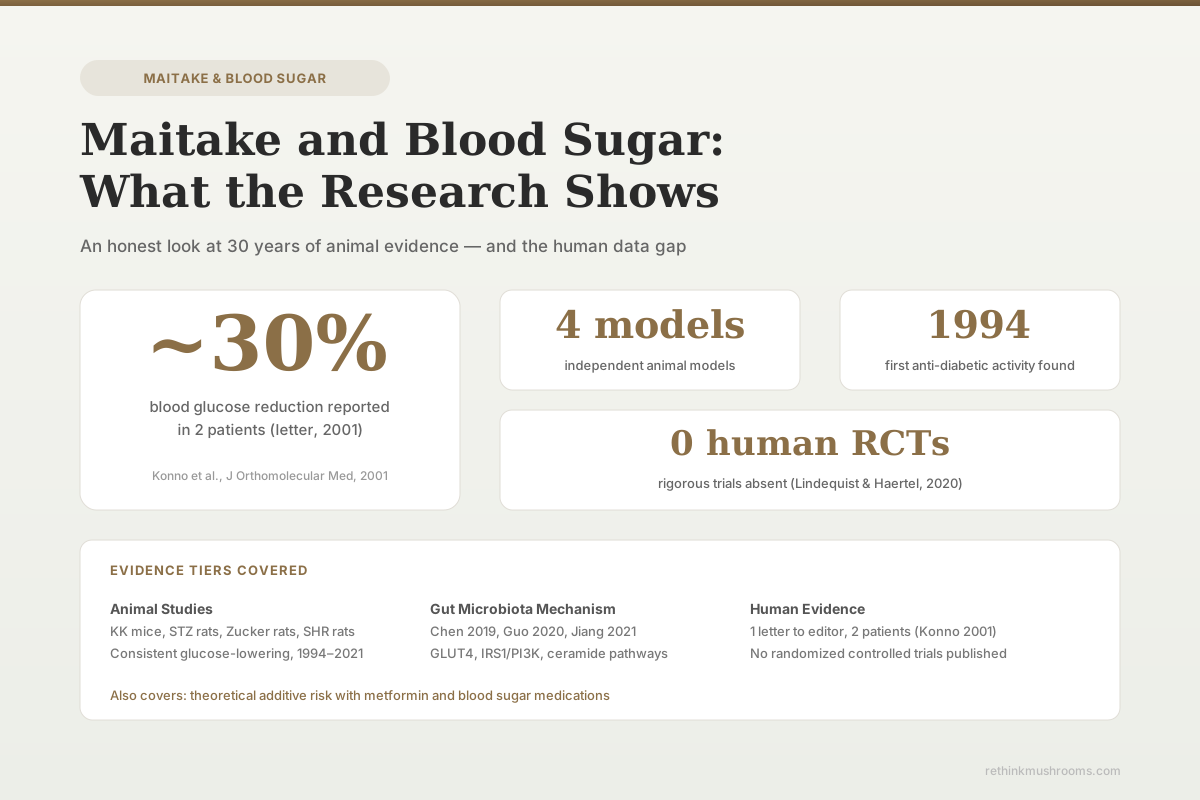
~30% blood glucose reduction
The only published human data for whole maitake and blood sugar is a 2001 letter reporting this reduction in 2 type 2 diabetic patients. Animal studies show consistent effects across four independent models. Human trials have yet to follow.
Konno et al., J Orthomolecular Med, 2001
1994
year first anti-diabetic activity characterized in maitake fruit body
4 models
independent animal models showing consistent glucose-lowering effects
2019–2020
gut microbiota pathway independently confirmed in two studies
Konno et al., J Orthomolecular Med, 2001
 View as image ↗
If you have seen the claim that maitake mushroom lowers blood sugar by 30%, you have likely seen the same two-patient case report cited dozens of times without anyone mentioning it was a letter to the editor, not a clinical trial. That is the most important thing to understand going into any honest review of maitake mushroom blood sugar research: the human evidence is almost entirely absent, the animal evidence is consistently positive, and very few sources are willing to say both things in the same sentence.
This article does.
Maitake (Grifola frondosa), covered in more depth in the complete maitake guide, has been studied for its effects on blood glucose since at least 1994. What the research reveals is a mushroom with genuine and consistent glucose-lowering effects in animal models, a recently discovered mechanism involving gut bacteria, and a near-complete absence of rigorous human trials. Understanding which category each piece of evidence falls into matters enormously for reading the research honestly.
Key Takeaways
- Animal studies from 1994 through 2021 consistently show maitake polysaccharides lower fasting blood glucose across multiple independent diabetic models, including KK mice, streptozotocin-diabetic rats, and Zucker fatty rats
- Manohar et al. (2002) showed maitake extract lowered both blood glucose and blood insulin in insulin-resistant mice, proving the mechanism is improved insulin sensitivity rather than increased insulin secretion
- In 2019, Chen et al. identified an additional mechanism: maitake polysaccharides rebalanced gut bacteria composition, with improvements in blood glucose correlating with increases in beneficial bacterial strains
- Guo et al. (2020) independently confirmed the gut-glucose connection and also documented simultaneous triglyceride reductions, suggesting maitake affects multiple metabolic markers at once
- The only published human data for whole maitake and blood glucose is a 2001 letter to the editor reporting approximately 30% reduction in 2 type 2 diabetic patients, not a clinical trial
- A 2020 clinical trial review (Lindequist and Haertel) found that rigorous human randomized controlled trials are largely absent for maitake and all medicinal mushrooms studied alongside diabetes
The Evidence at a Glance: What Maitake Blood Sugar Research Actually Shows
Animal studies consistently show maitake polysaccharides lower fasting blood glucose and improve insulin resistance. The only published human data is a 2001 letter reporting approximately 30% glucose reduction in 2 patients. Larger human trials do not yet exist.
That is a shorter summary than most maitake articles will give you, but it is the accurate one. Lindequist and Haertel's 2020 survey of clinical trial evidence for medicinal mushrooms and type 2 diabetes concluded that rigorous human randomized controlled trials are "largely absent" across nearly all medicinal mushrooms studied for blood sugar effects, not just maitake.[1]
The 2009 Natural Standard systematic review by Ulbricht et al. reached the same verdict more than a decade earlier: promising evidence for maitake across several applications, including blood sugar, but insufficient evidence for definitive clinical recommendations due to the lack of rigorous human trials.[6] That the same conclusion holds fifteen years later says more about the absence of investment in human trials than about any lack of biological plausibility.
Here is how the full evidence breaks down:
| Evidence Type | What It Shows |
|---|---|
| Animal studies (multiple, independent) | Consistent glucose and insulin-resistance improvements across KK mice, STZ rats, Zucker fatty rats |
| Gut microbiota studies (2019–2020) | Blood glucose reduction correlated with bacterial community rebalancing |
| Human data (2 patients, 1 letter, 2001) | Approximately 30% blood glucose reduction reported; not a controlled trial |
| Clinical trial reviews (2009, 2020) | Promising preclinical signals; no rigorous human RCTs identified |
The absence of human trial data does not mean the animal research is unimportant. It means the animal evidence should be read as what it actually is: preclinical evidence that something biologically interesting is happening, which provides the rationale for designing human trials rather than the basis for clinical conclusions.
Thirty Years of Animal Research: Consistent Effects Across Four Diabetic Models
The animal evidence for maitake and blood sugar is not a single study cited repeatedly. It is a collection of studies using different animal models, different research groups, and different maitake preparations, all arriving at similar conclusions.
Kubo et al. identified anti-diabetic activity in the maitake fruit body as early as 1994, tracing the glucose-lowering effect to a specific polysaccharide fraction rather than the whole mushroom broadly.[2] That foundational work established both that the effect was real in animal models and that it was fraction-specific rather than diffuse.
Horio and Ohtsuru, writing in the Journal of Nutritional Science and Vitaminology in 2001, tested maitake extract in rats with streptozotocin-induced diabetes, a standard model for type 1-like diabetes where the pancreatic insulin-producing cells are chemically destroyed. The researchers ran oral glucose tolerance tests, which measure how quickly blood sugar returns to baseline after a sugar challenge. Maitake-treated animals showed improved glucose tolerance compared to untreated controls.[3]
A critical mechanistic question was answered by Manohar et al. in 2002. The question: does maitake lower blood sugar by pushing the pancreas to release more insulin, or by making the body's cells more responsive to the insulin already there? The team gave a water-soluble maitake extract to KK mice, a strain that develops severe insulin resistance and is widely used as an obesity-linked diabetes model, and measured both blood glucose and blood insulin levels.[4]
Both fell.
If maitake had been triggering more insulin secretion, blood glucose would have dropped while insulin levels stayed the same or rose. The fact that both went down together points clearly to improved insulin sensitivity: the body's cells became more responsive to the insulin already circulating, so less of it was needed to manage blood sugar. This insulin-sensitizing mechanism is generally considered more favorable from a long-term metabolic perspective than glucose lowering through forced secretion.
A second study from 2002 by Talpur et al. confirmed these findings across two more animal models: Zucker fatty rats, which develop obesity-driven insulin resistance, and spontaneously hypertensive rats. In both strains, whole maitake powder and its fractions produced blood glucose-lowering effects without a compensatory rise in insulin, the same insulin-sensitizing fingerprint Manohar had identified in KK mice.[5]
The Talpur 2002 study also documented simultaneous blood pressure reductions in the hypertensive rat model. This is not a coincidence: insulin resistance and hypertension share overlapping physiology. The connection between maitake's glucose effects and its blood pressure effects is explored in detail in Maitake and Blood Pressure: Antihypertensive Research.
The consistency across KK mice, streptozotocin-diabetic rats, Zucker fatty rats, and spontaneously hypertensive rats, four different experimental models of insulin resistance and diabetes, is one of the more compelling features of the preclinical evidence. Independent models showing the same effect are much stronger evidence than a single model repeated multiple times.
For readers interested in the specific maitake fractions (SX-fraction versus D-fraction) and how their mechanisms differ, that is covered in Maitake SX-Fraction and Insulin Sensitivity.
What 2019 and 2020 Research Added: Gut Bacteria as a Blood Sugar Mechanism
Most maitake-and-blood-sugar articles mention beta-glucan vaguely as the active ingredient and stop there. Research from the last six years tells a more complex and more interesting story.
Chen et al. published a 2019 study testing a novel maitake polysaccharide (GFP) in type 2 diabetic mice, measuring not just blood glucose but the full picture of changes happening inside the animals: signaling proteins, blood markers, and gut bacterial composition.[7]
Two findings were notable. First, the polysaccharide activated the IRS1/PI3K/GLUT4/JNK signaling chain, the molecular pathway that moves glucose transporters to the surface of cells so that glucose can enter from the bloodstream. GLUT4 is the glucose transporter protein; when more of them move to the cell surface, the cell absorbs glucose more efficiently, and blood levels fall. Second, blood glucose improvement correlated with measurable changes in gut bacterial composition: specifically, increases in Bifidobacterium and Lactobacillus, two bacterial genera associated with metabolic health, and decreases in Clostridium, a genus associated with systemic inflammation.
Guo et al., in a 2020 study in the International Journal of Biological Macromolecules, found the same gut-glucose relationship using different maitake polysaccharides in a different diabetic mouse model.[8] The 2020 study also documented simultaneous reductions in both fasting blood glucose and triglycerides, indicating that maitake polysaccharides were affecting lipid metabolism at the same time as glucose metabolism.
Why does the gut bacterial connection matter? The leading hypothesis involves inflammation. Certain bacterial species produce compounds that interfere with insulin signaling by triggering low-grade systemic inflammation. When polysaccharides from maitake feed beneficial bacteria and suppress inflammatory ones, the result is a less inflamed metabolic environment where insulin signaling functions more efficiently. This is a plausible mechanism in rodents; it has not been tested in humans.
The ceramide pathway adds a third angle. Jiang et al. (2021) tested maitake polysaccharides in mice fed a high-fat diet, a model that produces obesity and metabolic syndrome, which often precedes type 2 diabetes. Via changes in ceramide metabolism (a lipid-signaling pathway involved in fat accumulation and insulin resistance), maitake polysaccharides reduced fat accumulation and improved both triglyceride and cholesterol levels in the high-fat-diet mice.[9]
The relevance extends beyond the glucose endpoint: obesity, elevated triglycerides, and disrupted lipid metabolism are part of the same metabolic cluster that includes type 2 diabetes. If maitake polysaccharides are affecting multiple components of that cluster simultaneously, the mechanism is broader than a focused glucose-lowering effect. The multi-target metabolic picture is explored further in Maitake and Metabolic Syndrome: Multi-Target Effects. The hepatic lipid connection is covered in Maitake and Liver Health: Hepatoprotective Effects.
This gut microbiota and ceramide research is completely missing from every competitor article on maitake and blood sugar. It is also still in early-stage rodent research, which is exactly what makes it interesting rather than clinically actionable: the mechanism is being built out in detail at the preclinical level, which is precisely when human trials should be designed.
The Only Human Evidence: One Letter, Two Patients, Not a Clinical Trial
Here is the complete published human evidence base for whole maitake and blood glucose:
In 2001, Konno et al. published a letter to the editor in the Journal of Orthomolecular Medicine reporting that two type 2 diabetic patients who took maitake experienced approximately 30% reductions in blood glucose.[10]
That is the entire human evidence record for whole maitake on blood glucose.
Not a randomized controlled trial. Not a cohort study. Not a case series with a comparison group. A letter to the editor reporting two cases, with no control subjects, no blinding, no standardized dosing protocol described, and no specified follow-up period.
This is worth being explicit about because the 30% figure circulates on supplement review sites and product pages as though it came from a clinical trial. It did not. The Konno 2001 letter is a real peer-reviewed publication reporting a genuine clinical observation. But two patients is not clinical evidence; it is the starting point for a hypothesis that properly designed trials could test. The distinction matters enormously for anyone trying to decide what the evidence actually supports.
Lindequist and Haertel's 2020 review, which surveyed clinical trial data for medicinal mushrooms and type 2 diabetes through the entire published literature, found that maitake's situation was not unusual. For nearly all medicinal mushrooms studied in the context of blood sugar, the pattern was the same: consistent animal evidence, limited or absent human trial data, and a need for properly controlled human studies before any clinical conclusions could be drawn.[1] The 2009 Natural Standard review reached the same conclusion.[6]
For a detailed look at the Georgetown University animal research, which is widely mischaracterized online as "clinical trials" despite being rodent studies conducted at Georgetown's physiology department, see Maitake and Glucose Tolerance: The Georgetown University Clinical Research.
For a full synthesis of the type 2 diabetes-specific evidence, including what the SX-fraction pilot data in seven patients (Konno 2013) shows and why it differs from the Konno 2001 letter, see Maitake for Type 2 Diabetes: Clinical Evidence and Mechanisms.
Maitake and Blood Sugar Medications: The Additive Mechanism
The animal studies establish that maitake's glucose-lowering effect works primarily through insulin sensitization, making cells more responsive to insulin, which reduces how much blood glucose circulates. Metformin, the most widely prescribed type 2 diabetes medication, reduces blood glucose through a related pathway: it suppresses glucose production in the liver and improves insulin sensitivity in peripheral tissues.
If both maitake and metformin reduce blood glucose through overlapping mechanisms, combining them could produce additive glucose-lowering effects, potentially pushing blood sugar below the therapeutic target in someone already on medication.
This is not a documented interaction in humans. No clinical study has measured what happens when people on metformin, insulin, or other diabetes medications also take maitake extract. It is a mechanistically plausible inference from the established animal evidence, and it represents the kind of question that human pharmacokinetic studies should address.
The same logic applies, in principle, to any blood glucose-lowering drug combined with a supplement that has glucose-lowering effects in animal models. It is also one more reason why the calls in both the Lindequist 2020 and Ulbricht 2009 reviews for properly designed human trials matter: without them, the real-world interaction profile cannot be characterized.[1]
For mechanistic depth on how maitake polysaccharides interact with glucose pathways at the molecular level, see How Maitake Affects Glucose Metabolism.
The Bottom Line
The maitake blood sugar research is genuinely interesting and genuinely incomplete. Animal studies from 1994 through 2021 consistently show maitake polysaccharide fractions lower fasting blood glucose across multiple independent diabetic models, through mechanisms including insulin sensitization, GLUT4 upregulation, and gut bacterial rebalancing. The only published human data is a 2001 letter to the editor reporting approximately 30% glucose reduction in 2 patients with type 2 diabetes. No randomized controlled trial has tested maitake for blood sugar effects in humans. The preclinical evidence is the foundation, not the final word.
Frequently Asked Questions
Sources & References
- 1RTHM-00632·Lindequist, Ulrike et al. (2020). “Medicinal Mushrooms for Treatment of Type 2 Diabetes: An Update on Clinical Trials..” International journal of medicinal mushrooms.Study breakdown →PubMed →↩
- 2RTHM-00015·Kubo, K et al. (1994). “Anti-diabetic activity present in the fruit body of Grifola frondosa (Maitake). I..” Biological & pharmaceutical bulletin.Study breakdown →PubMed →↩
- 3RTHM-00035·Horio, H et al. (2001). “Maitake (Grifola frondosa) improve glucose tolerance of experimental diabetic rats..” Journal of nutritional science and vitaminology.Study breakdown →PubMed →↩
- 4RTHM-00097·Manohar, V et al. (2002). “Effects of a water-soluble extract of maitake mushroom on circulating glucose/insulin concentrations in KK mice..” Diabetes.Study breakdown →PubMed →↩
- 5RTHM-00053·Talpur, Nadeem A et al. (2002). “Antihypertensive and metabolic effects of whole Maitake mushroom powder and its fractions in two rat strains..” Molecular and cellular biochemistry.Study breakdown →PubMed →↩
- 6RTHM-00319·Ulbricht, Catherine et al. (2009). “Maitake mushroom (Grifola frondosa): systematic review by the natural standard research collaboration..” Journal of the Society for Integrative Oncology.Study breakdown →PubMed →↩
- 7RTHM-01042·Chen, Yuqing et al. (2019). “Hypoglycemic activity and gut microbiota regulation of a novel polysaccharide from Grifola frondosa in type 2 diabetic mice..” Food and chemical toxicology : an international journal published for the British Industrial Biological Research Association.Study breakdown →PubMed →↩
- 8RTHM-01193·Guo, Wei-Ling et al. (2020). “Hypoglycemic and hypolipidemic activities of Grifola frondosa polysaccharides and their relationships with the modulation of intestinal microflora in diabetic mice induced by high-fat diet and streptozotocin..” International journal of biological macromolecules.Study breakdown →PubMed →↩
- 9RTHM-01369·Jiang, Xue et al. (2021). “Anti-obesity effects of Grifola frondosa through the modulation of lipid metabolism via ceramide in mice fed a high-fat diet..” Food & function.Study breakdown →PubMed →↩
- 10. Source details for this reference are not yet available.