Maitake & Blood Sugar
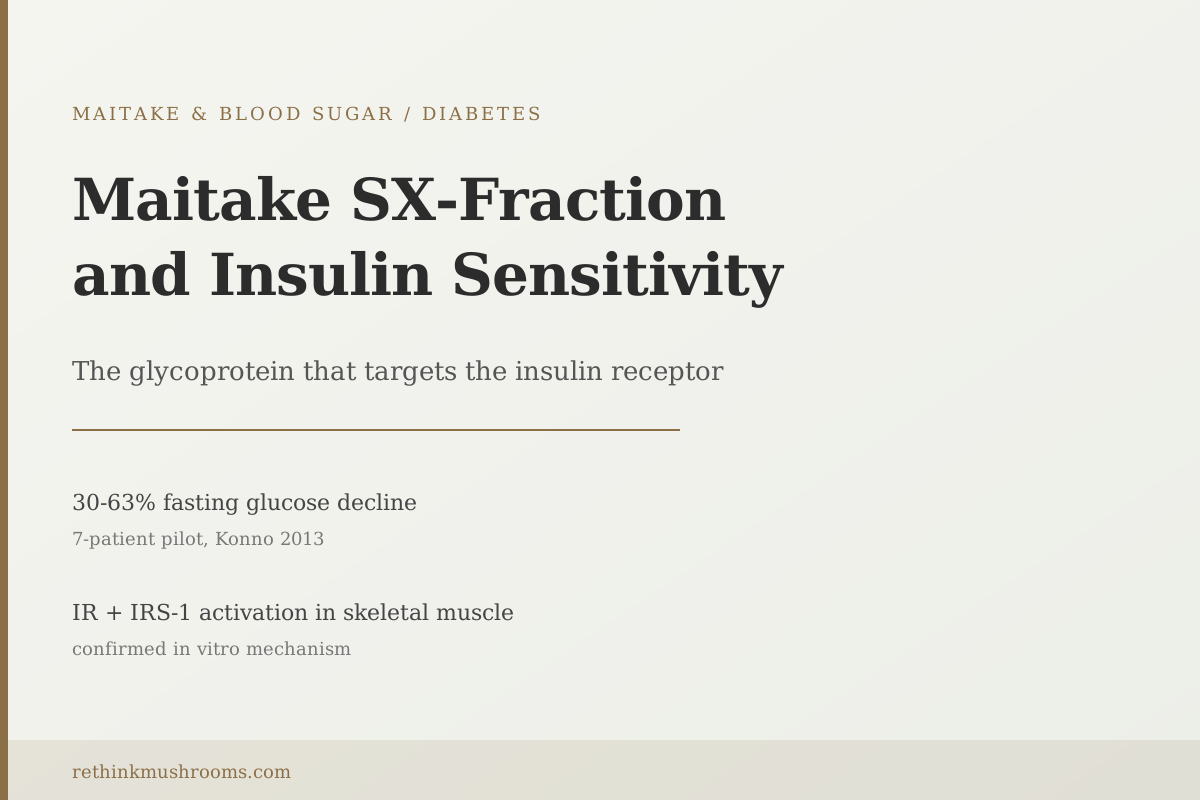
30-63% fasting glucose decline
Seven type 2 diabetics adding SX-fraction to their oral medications showed fasting blood glucose drop 30 to 63% over two to four weeks in the only published human pilot for this specific maitake extract.
Konno, Int J Gen Med, 2013
7 patients
in the only human pilot of SX-fraction for T2DM
Glycoprotein
not beta-glucan; a different molecule with a different mechanism
IR + IRS-1
the two insulin signaling proteins SX-fraction activates in muscle cells
Konno, Int J Gen Med, 2013
 View as image ↗
In 2013, a researcher named Sensuke Konno published a small pilot study with seven people who had type 2 diabetes and were already taking oral medications for it. He added SX-fraction, a specific extract from maitake mushroom, to their existing treatment, and over two to four weeks their fasting blood glucose dropped anywhere from 30% to 63%.[1] That range is wide, but every patient moved in the same direction. It remains the most direct published human evidence for a specific maitake extract targeting insulin resistance.
SX-fraction is not the maitake extract most people have heard of. That's D-fraction, which activates immune cells and has been studied for immune support and cancer adjunct therapy. SX-fraction is a different molecule with a different mechanism: it targets the insulin signaling pathway at the receptor level, not the immune system. The distinction matters enormously, and most supplement sites either ignore it or confuse the two.
This article covers the SX-fraction evidence from the beginning: the Georgetown University animal studies of the early 2000s, the mechanism work in skeletal muscle cells, the seven-patient pilot, and what a 2010 PCOS trial adds to the insulin-sensitizing story. For the broader maitake overview, see what maitake is and how it works.
Key Takeaways
- SX-fraction is a glycoprotein extracted from maitake; D-fraction is a beta-glucan. They are different molecules targeting different systems: immune cells for D-fraction, insulin receptor signaling for SX-fraction
- In insulin-resistant KK mice, SX-fraction lowered both blood glucose AND circulating insulin at the same time, proving the mechanism is peripheral sensitization rather than stimulating the pancreas to produce more insulin (Manohar et al., 2002)
- Preuss et al. (2012) found SX-fraction outperformed metformin and ACE inhibitor benchmarks on measured insulin sensitivity in diabetic rats, the finding that made it a compelling drug-candidate lead
- Konno (2013) confirmed the molecular pathway: SX-fraction activates the insulin receptor (IR) and IRS-1 in skeletal muscle cells, triggering glucose uptake through the same Akt/GLUT4 cascade that insulin itself uses
- The 7-patient Konno 2013 clinical component showed 30-63% fasting glucose reduction over 2-4 weeks; a directional signal, not a controlled trial, and not sufficient to establish efficacy
- A 2010 PCOS trial (Chen et al.) tested SX-fraction in 80 women because PCOS is fundamentally driven by insulin resistance; the 80% ovulation rate achieved provides indirect human evidence that the insulin-sensitizing mechanism works in people
SX-Fraction vs D-Fraction: Why the Distinction Matters
If you've read about maitake mushroom before, the extract you most likely encountered was D-fraction. D-fraction is a beta-glucan: a long chain of glucose units linked in a specific pattern that immune cells recognize. It binds to receptors on natural killer cells and macrophages, and it's been studied for immune activation and cancer support applications.
SX-fraction is a glycoprotein. That means it's a protein molecule with carbohydrate chains attached, with a molecular weight of approximately 20,000 daltons. It is not a polysaccharide. It does not activate immune cells.
What SX-fraction does instead is interact with the insulin receptor on the surface of cells, particularly skeletal muscle cells. When the insulin receptor is activated, it triggers a signaling cascade inside the cell that ultimately moves glucose transporters to the cell membrane, letting blood glucose flow in. SX-fraction appears to enhance this process.
This matters practically because someone taking D-fraction for immune support is doing something completely different from someone taking SX-fraction for insulin sensitivity. The two fractions target different systems. The research behind one does not automatically transfer to the other. When researchers at Georgetown University began investigating maitake fractions for metabolic effects in the early 2000s, they were already working from a hypothesis that different chemical fractions would have different activities in the body. The SX-fraction work emerged from that systematic approach.
The Georgetown Animal Studies: The Critical Clue Was Insulin Going Down Too
Between 2002 and 2012, a research group at Georgetown University's Department of Physiology (led by Harry Preuss) published a series of studies testing maitake fractions in animal models of insulin resistance and hypertension. Supplement sites frequently call this the "Georgetown clinical research," implying human trials. It was not. These were studies in rats and mice. They are detailed in a dedicated article on the Georgetown maitake glucose tolerance research.
What the animal studies found was consistent and mechanistically telling.
Manohar and colleagues gave KK mice, a strain that develops insulin resistance naturally, a water-soluble maitake extract. The mice showed lower circulating blood glucose. But they also showed lower circulating insulin.[2]
That second finding is the mechanistically important one. If maitake were stimulating the pancreas to secrete more insulin, you'd see blood glucose fall while insulin rose (the pancreas working harder to clear glucose from circulation). Instead, both dropped together. The only explanation that accounts for both changes: cells became more sensitive to whatever insulin was already circulating. The pancreas relaxed because less insulin was needed to achieve the same blood glucose clearance.
Talpur and colleagues extended this line of research into Zucker fatty rats, a standard model for obesity-driven insulin resistance and hypertension. Blood glucose dropped. Blood pressure dropped too.[3] A second Talpur study tested both Zucker fatty rats and spontaneously hypertensive rats, and replicated the pattern across both strains: blood glucose lowering without a compensatory rise in insulin, and blood pressure effects alongside the metabolic ones.[4]
The blood pressure connection is not a coincidence. Insulin resistance makes blood vessels less responsive to the vasodilating effects of insulin, contributing to hypertension. An extract that genuinely improves insulin sensitivity at the tissue level would be expected to produce downstream effects on vascular tone as well. The Talpur studies showed both effects together, which is consistent with the insulin-sensitizing hypothesis rather than a nonspecific effect. For the blood pressure side of this research, see maitake and blood pressure: antihypertensive research.
When SX-Fraction Beat Drug Benchmarks on the Insulin Sensitivity Metric
In 2007, Preuss and colleagues published a study that moved from testing whole maitake extracts to identifying the specific fraction responsible for the metabolic effects. When they gave the isolated glycoprotein fraction to spontaneously hypertensive rats, they observed enhanced insulin-hypoglycemic activity and blood pressure reduction; the same dual effect now attributed to a specific molecule rather than the full extract.[5]
Then in 2012, Preuss and colleagues published a study that compared SX-fraction directly to established pharmacological benchmarks.[6] In streptozotocin-induced diabetic rats, they tested SX-fraction against metformin (the standard first-line oral diabetes medication) and an ACE inhibitor (commonly used in diabetics with kidney complications).
On blood glucose reduction, metformin performed as expected. On measured insulin sensitivity, only SX-fraction consistently enhanced it. The other compounds reduced blood glucose through different mechanisms. Metformin primarily reduces liver glucose output rather than sensitizing peripheral tissues to insulin. SX-fraction appeared to work specifically through peripheral insulin sensitivity, which is a mechanistically distinct pathway.
This finding doesn't mean SX-fraction outperforms metformin in clinical use. The study was in rats, the sample sizes were small, and measured insulin sensitivity in diabetic rodents is not the same endpoint as reduced HbA1c in a controlled human trial. What it does mean: the preclinical evidence was pointing toward a specific and real mechanism, not a generic glucose-lowering effect. That specificity is what makes SX-fraction scientifically interesting.
For the broader landscape of maitake and blood sugar research, including animal studies across multiple fractions, see maitake and blood sugar: research on glycemic control.
Inside the Muscle Cell: How SX-Fraction Activates the Insulin Receptor
The 2013 Konno study did two things: it ran an in vitro experiment to work out the molecular mechanism, and it included the seven-patient clinical component. The mechanistic work came first, and it answered the key question about what SX-fraction is actually doing at the molecular level.[1]
The experimental model was L6 cells, a line of skeletal muscle cells used to study insulin signaling. The question: which proteins in the insulin signaling pathway does SX-fraction activate?
The answer was the insulin receptor (IR) and insulin receptor substrate 1, known as IRS-1.
Here is how that pathway works in plain terms. The insulin receptor is a protein that sits on the outside surface of a muscle cell, waiting. When insulin arrives from the bloodstream and binds to it, the receptor changes shape and activates IRS-1 on the inside of the cell membrane. IRS-1 then activates a protein called Akt (also called protein kinase B). Akt sends the signal to GLUT4 transporters, glucose-channel proteins that are normally parked inside the cell, waiting to be called up. When Akt fires, GLUT4 moves to the cell membrane, opens glucose channels, and blood glucose flows into the muscle cell.
SX-fraction activates IR and IRS-1 without insulin present. The downstream cascade (Akt activation, GLUT4 membrane translocation, and glucose uptake) follows the same steps. This is what "insulin sensitization" means at the molecular level: the signaling pathway works more efficiently, or responds at lower insulin concentrations, because the receptor-level activation is enhanced.
This also explains why the Georgetown animal studies showed both glucose and insulin declining simultaneously. More efficient IR activation means more glucose gets cleared from the blood per unit of insulin circulating. The pancreas senses lower blood glucose and reduces output. The whole system settles at lower concentrations of both.
For the broader picture of how maitake polysaccharides and other fractions affect glucose metabolism through GLUT4 and other pathways, see how maitake affects glucose metabolism.
Seven Patients, 30-63% Glucose Reduction, and the Limits of That Data
The clinical component of the Konno 2013 study enrolled seven people with type 2 diabetes who were already taking oral medications for glycemic control.[1] SX-fraction was added to their existing treatment. Over two to four weeks, their fasting blood glucose declined 30 to 63%.
The spread in that range deserves attention. One patient dropped 30%. Another dropped 63%. The variation probably reflects differences in baseline insulin resistance severity, duration of diabetes, and background medications. All seven moved in the same direction.
What this data can support and what it cannot:
It supports the direction. An extract that activates IR and IRS-1 in a dish also appears to lower blood glucose when people take it. That consistency across systems (in vitro, animal, and human) is a meaningful signal.
It does not establish efficacy. There was no control group, so some of the reduction may reflect regression to the mean (patients enrolled when their glucose happened to be elevated, and it came down regardless). The existing medications complicate attribution. SX-fraction added on top of metformin or a sulfonylurea may behave differently than SX-fraction alone. Seven patients is far too small to estimate a real effect size, determine who responds and who doesn't, or detect adverse effects at low frequency.
The study also does not report on drug interactions, an important gap since adding an insulin-sensitizing agent on top of existing diabetes medication could theoretically cause hypoglycemia. No adverse effects were reported in this small cohort, but the sample is too small to draw safety conclusions.
For the full clinical evidence landscape for maitake and type 2 diabetes, including an honest accounting of how many total human patients have been studied and what study types those represent, see maitake for type 2 diabetes: clinical evidence and mechanisms.
The PCOS Trial: 80 Women Tested the Insulin-Sensitizing Hypothesis
Polycystic ovary syndrome is fundamentally a condition of insulin resistance. When insulin resistance is elevated, the ovaries respond by overproducing androgens (male hormones) which disrupts the menstrual cycle and suppresses ovulation. This is why insulin-sensitizing treatments, including metformin, are standard first-line options for PCOS-related infertility. The biochemical mechanism connecting insulin resistance to the ovarian androgen excess is direct and well-established.
In 2010, Chen and colleagues chose SX-fraction as the intervention in a study of 80 women with PCOS (PMID: 21034160). The rationale was the insulin-sensitizing mechanism. If SX-fraction genuinely reduces peripheral insulin resistance, it should reduce the insulin-driven androgen overproduction in the ovaries and restore ovulation.
The outcome was an 80% ovulation rate in the treated group. Clomiphene citrate, the standard first-line ovulation-induction drug for PCOS, typically produces ovulation rates in the 60-85% range depending on the population.
This is not a glucose study, and it does not directly measure blood glucose or insulin sensitivity. What it does provide is something the 7-patient pilot study cannot: eighty people, a clear mechanistic hypothesis, and a positive result in the expected direction. A research group bet 80 patients on the hypothesis that SX-fraction would improve insulin resistance in real humans with a condition driven by insulin resistance, and they observed a result consistent with that hypothesis.
This is indirect evidence. Ovulation rate is not a measure of insulin sensitivity. But the logic chain is short and the direction is consistent: if PCOS androgen excess is driven by insulin resistance, and SX-fraction reduces it enough to restore ovulation in 80% of cases, something is happening at the insulin signaling level in these patients. The PCOS connection is explored in depth in maitake and polycystic ovary syndrome: clinical trial results, and the mechanistic link between insulin resistance and PCOS hormonal disruption is covered in maitake and insulin-driven hormonal imbalance in PCOS.
The SX-fraction story also has an intersection with hypertension. Because insulin resistance contributes to elevated blood pressure through multiple pathways, and because the Georgetown rat studies showed SX-fraction improving both glucose and blood pressure endpoints simultaneously, the maitake for hypertension: clinical and preclinical evidence article covers that angle directly.
The 2020 Evidence Summary: What the Full Research Stack Shows
In 2020, Konno published a comprehensive narrative review of all SX-fraction research in the journal World J Diabetes, titled "SX-Fraction: Promise for Novel Treatment of Type 2 Diabetes."[7] It is the most complete summary of the SX-fraction evidence base available.
The review covers all the major evidence: the Georgetown animal studies showing consistent glucose and blood pressure effects, the in vitro L6 cell work establishing IR/IRS-1/Akt as the molecular pathway, and the 7-patient clinical pilot. On safety, it reports no adverse effects across any of the studies reviewed.
The conclusions are honest about what is missing. The animal evidence is consistent across multiple models. The molecular mechanism is well-characterized. The human data is limited to two very small cohorts: seven patients in the Konno 2013 pilot, and the PCOS trial as indirect evidence. A properly powered, randomized, placebo-controlled trial in humans with type 2 diabetes has not been conducted.
The review concludes that SX-fraction is promising as a treatment lead, that the safety profile appears favorable in the available data, and that larger randomized trials are the logical next step. What exists is a compelling preclinical story with a plausible molecular mechanism and a directional human signal, not an established treatment.
The Bottom Line
SX-fraction is a glycoprotein from maitake mushroom that activates the insulin receptor and IRS-1 in skeletal muscle cells, triggering the same glucose uptake pathway that insulin itself uses. Animal studies from Georgetown University showed consistent glucose and blood pressure lowering via the insulin-sensitizing mechanism, and a 2012 study found SX-fraction outperformed drug benchmarks on the measured insulin sensitivity metric. The human evidence is limited to seven patients in one pilot study (30-63% fasting glucose reduction over 2-4 weeks) and indirect support from a PCOS trial in 80 women. The preclinical evidence is solid; large randomized human trials have not been done.
Frequently Asked Questions
Sources & References
- 1RTHM-00533·Konno, Sensuke et al. (2013). “Possible hypoglycemic action of SX-fraction targeting insulin signal transduction pathway..” International journal of general medicine.Study breakdown →PubMed →↩
- 2RTHM-00097·Manohar, V et al. (2002). “Effects of a water-soluble extract of maitake mushroom on circulating glucose/insulin concentrations in KK mice..” Diabetes.Study breakdown →PubMed →↩
- 3RTHM-00052·Talpur, Nadeem et al. (2002). “Effects of Maitake mushroom fractions on blood pressure of Zucker fatty rats..” Research communications in molecular pathology and pharmacology.Study breakdown →PubMed →↩
- 4RTHM-00053·Talpur, Nadeem A et al. (2002). “Antihypertensive and metabolic effects of whole Maitake mushroom powder and its fractions in two rat strains..” Molecular and cellular biochemistry.Study breakdown →PubMed →↩
- 5RTHM-00229·Preuss, Harry G et al. (2007). “Enhanced insulin-hypoglycemic activity in rats consuming a specific glycoprotein extracted from maitake mushroom..” Molecular and cellular biochemistry.Study breakdown →PubMed →↩
- 6RTHM-00262·Preuss, Harry G et al. (2012). “Fraction SX of maitake mushroom favorably influences blood glucose levels and blood pressure in streptozotocin-induced diabetic rats..” Journal of medicinal food.Study breakdown →PubMed →↩
- 7RTHM-01222·Konno, Sensuke (2020). “SX-fraction: Promise for novel treatment of type 2 diabetes..” World journal of diabetes.Study breakdown →PubMed →↩