Maitake & PCOS
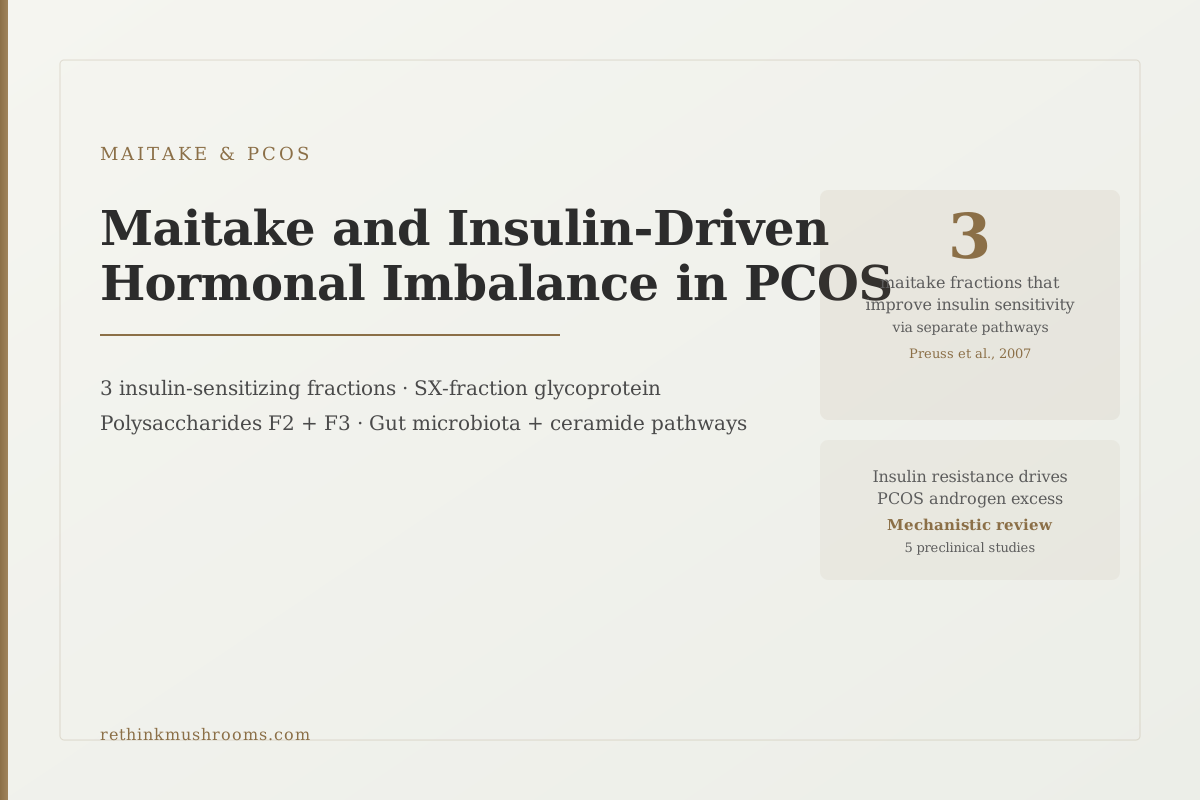
3 maitake fractions
Three distinct maitake compounds, including a glycoprotein and two polysaccharides, each improve insulin sensitivity through separate biochemical pathways in preclinical models. Insulin resistance is the upstream driver of PCOS androgen excess and follicular disruption.
Preuss et al., Molecular and Cellular Biochemistry, 2007
SX-fraction
glycoprotein that improves insulin sensitivity
F2 + F3
maitake polysaccharides with independent insulin-sensitizing effects
Gut + Weight
two additional pathways where maitake may address PCOS drivers
Preuss et al., Molecular and Cellular Biochemistry, 2007
 View as image ↗
Most treatments for polycystic ovary syndrome (PCOS) target the symptoms directly: the irregular cycles, the elevated testosterone, the absent ovulation. Fewer reach deeper, toward the metabolic condition that makes those symptoms possible. That condition is insulin resistance, and the insulin-driven hormonal imbalance of PCOS follows from it in a specific, traceable sequence. Research on maitake mushroom (Grifola frondosa) and its bioactive fractions has produced preclinical evidence on insulin sensitivity that aligns with this mechanism at several points.
This article traces that causal chain: what insulin resistance does to PCOS hormones, where maitake's compounds may intervene, and what the preclinical data actually shows. For a broader introduction to maitake's ecology, forms, and bioactive compounds, see What Is Maitake Mushroom? The 'Dancing Mushroom' Explained.
Key Takeaways
- Insulin resistance is the upstream driver of PCOS androgen excess: elevated insulin signals the ovaries to overproduce testosterone while suppressing the protein that keeps androgens inactive in circulation
- Maitake SX-fraction, a specific water-soluble glycoprotein, improved insulin sensitivity in preclinical models. This is the same compound used in the one published PCOS clinical trial
- Two distinct maitake polysaccharides (F2 and F3) independently improved insulin resistance in diabetic rats through mechanisms separate from SX-fraction, suggesting multiple active routes
- A 2002 study in Diabetes, Obesity and Metabolism found water-soluble maitake extract reduced both circulating glucose AND circulating insulin in a spontaneous type-2 diabetes mouse model
- Maitake reshaped gut microbiota composition in insulin-resistant animal models; gut dysbiosis is increasingly recognized as part of PCOS pathophysiology
- Maitake's anti-obesity effects add another dimension: fat tissue in PCOS actively amplifies androgen production, and reducing adiposity directly improves the hormonal environment
PCOS Doesn't Start With Hormones. It Starts With Insulin.
The name "polycystic ovary syndrome" suggests an ovarian problem. The hormonal measurements (elevated testosterone, disrupted LH/FSH ratio, low SHBG) suggest a hormonal problem. For most patients, the story starts further upstream.
Insulin resistance is the condition where cells stop responding normally to insulin, the hormone that moves glucose from the blood into cells. The body compensates by making more insulin. That excess insulin, called hyperinsulinemia, has effects well beyond glucose metabolism.
In the ovary, insulin interacts with receptors on the theca cells (the androgen-producing cells of the ovarian follicle) that regulate testosterone output. Luteinizing hormone (LH) normally stimulates some androgen production from theca cells to support follicular maturation. Under the influence of chronically elevated insulin, that androgen production accelerates beyond what follicular development requires.
At the same time, high insulin suppresses sex hormone-binding globulin (SHBG), a protein made in the liver that binds testosterone in circulation and keeps it biologically inactive. When SHBG falls, more testosterone becomes active. The combined result is more testosterone produced and less of it bound, creating the androgen excess that defines PCOS.
This is why treating insulin resistance, not just the androgen excess it produces, is a recognized strategy in PCOS management. Metformin, a drug primarily used for type 2 diabetes, is used in PCOS specifically because it improves insulin sensitivity, which in turn reduces androgen levels and can restore ovulation in some patients.
How High Insulin Shuts Down Follicular Development
For a follicle to release an egg, it needs to progress through a maturation sequence driven first by follicle-stimulating hormone (FSH) and then by a sharp LH surge. That progression depends on a hormonal environment where estrogen rises steadily and androgens stay within a narrow range.
When androgens accumulate beyond that range, follicular development stalls. Small follicles begin forming but do not complete the maturation cascade. They remain partially developed. This is what creates the characteristic "polycystic" appearance on ultrasound, though these are not cysts in the pathological sense.
The LH surge that triggers ovulation also fails to occur in an androgen-saturated environment. The brain regions that time the LH surge depend on clean estrogen feedback signals, and those signals get disrupted when testosterone is chronically elevated.
The cascade runs: insulin resistance drives hyperinsulinemia, which amplifies ovarian androgen production and suppresses SHBG, which raises free testosterone, which disrupts follicular maturation and prevents the LH surge, which causes anovulation.
Maitake's potential relevance to PCOS enters at the first step: insulin resistance. If maitake compounds improve insulin sensitivity, the downstream consequences may follow the same logic in reverse.
The Compound That Targets Insulin: Maitake's SX-Fraction
Not all maitake compounds are the same. The mushroom contains multiple structurally distinct bioactive fractions with different physiological targets. The fraction most relevant to insulin sensitivity is the SX-fraction: a specific water-soluble glycoprotein (a protein with sugar chains attached to it) that is structurally distinct from the beta-glucan compounds that most maitake supplements standardize for.
Preuss and colleagues published in Molecular and Cellular Biochemistry in 2007 showing that SX-fraction demonstrated enhanced insulin-hypoglycemic activity in animal models.[1] The SX-fraction does not mimic insulin. It works as an insulin sensitizer, improving the body's response to its own insulin rather than substituting for it. That distinction matters for PCOS: the problem is not insufficient insulin signaling, it is that cells require excessive insulin to achieve normal glucose uptake. An insulin sensitizer addresses that upstream dysfunction.
The SX-fraction is also structurally different from maitake D-fraction, which is the compound responsible for maitake's immune-stimulating and NK cell effects. They have different molecular compositions, different mechanisms, and different primary targets. Most commercial maitake supplements do not specify SX-fraction content, and many are standardized only for D-fraction or total polysaccharide content.
For a detailed breakdown of SX-fraction versus D-fraction, the specific formulation used in PCOS research, and how to evaluate supplements by fraction content, see Maitake and Ovarian Function: SX-Fraction Research in PCOS Models.
A Second Route: Maitake Polysaccharides Also Improve Insulin Resistance
The SX-fraction is a glycoprotein. Maitake also contains distinct polysaccharide compounds (chains of sugar molecules), and at least two of them show independent insulin-sensitizing effects.
Xiao and colleagues published in Food and Function in 2015 showing that maitake polysaccharides F2 and F3 reduced blood glucose in diabetic rats by improving insulin resistance directly.[2] The mechanism the researchers identified operates through pathways separate from the SX-fraction glycoprotein. Maitake appears to contain at least three distinct compounds with insulin-sensitizing activity: SX-fraction, F2, and F3. Each addresses that activity through different molecular routes.
This matters for PCOS. Insulin resistance in PCOS is not a single-pathway problem. It involves multiple tissue types: muscle, liver, adipose tissue, and the ovary itself. Multiple signaling disruptions contribute. A plant source that reaches more than one of those targets through different mechanisms is better positioned, in theory, to produce meaningful improvements in a complex insulin-resistant state than a compound acting through a single route.
Manohar and colleagues added an earlier layer of evidence in 2002, published in Diabetes, Obesity and Metabolism: a water-soluble maitake extract significantly reduced both circulating glucose levels and circulating insulin levels in KK mice, a spontaneous type-2 diabetes model.[3] The venue matters here. Diabetes, Obesity and Metabolism is a peer-reviewed metabolic disease journal, and the study measured circulating insulin as an outcome, not just blood glucose. The reduction in insulin levels, not just glucose, is the specific effect most relevant to PCOS, since it is the excess insulin that drives the androgen cascade.
Manohar et al. (2002) · Diabetes, Obesity and Metabolism
- Population
- Insulin-resistant KK mice (a spontaneous type-2 diabetes model)
- Intervention
- Water-soluble maitake extract (Fraction X), by gavage
- Comparator
- The sulfonylurea drug glipizide, and saline control
- Finding
- The maitake extract lowered both circulating glucose AND circulating insulin. The drop in insulin, not just glucose, is the outcome most directly relevant to PCOS, because it is excess insulin that drives the ovarian androgen cascade.
preliminary Animal model only; measures the metabolic lever upstream of PCOS hormones, not PCOS outcomes themselves.
Manohar et al., Diabetes, Obesity and Metabolism, 2002
The Gut Connection: A Newer Angle on PCOS and Maitake
PCOS is increasingly understood as a condition that involves the gut. Women with PCOS show characteristic patterns of gut dysbiosis (altered bacterial composition) that correlate with the degree of insulin resistance and the severity of androgen excess. Disrupted gut bacteria affect short-chain fatty acid production, intestinal permeability, and systemic inflammation in ways that worsen insulin signaling across multiple tissue types.
Maitake's potential effects on gut microbiota add an angle that the SX-fraction and polysaccharide research does not capture directly. Chen and colleagues published in Food and Chemical Toxicology in 2019 that a novel maitake polysaccharide improved both glucose metabolism and gut microbiota composition simultaneously in type-2 diabetic mice.[4]
This dual effect, improving metabolic markers while reshaping which bacteria dominate the gut, is a characteristic signature of prebiotic-type compounds. Plant compounds that act as substrates for beneficial bacteria can, in some contexts, shift the gut environment toward bacterial populations associated with better insulin signaling. If maitake polysaccharides work this way in humans, they could address insulin resistance through a route that the purely cellular mechanisms of Preuss 2007 and Xiao 2015 do not describe.
This is preclinical and in diabetic mice. Whether maitake's gut microbiota effects translate to humans with PCOS, and whether those effects are large enough to matter clinically, is not yet tested. But the mechanistic plausibility extends the picture beyond what strictly glucose-focused maitake research captured.
The Weight Amplifier: How Fat Tissue Makes PCOS Worse
Weight is not peripheral to PCOS. Fat tissue (adipose tissue) in a PCOS-insulin-resistant context does not simply store excess calories. Fat cells contain an enzyme called aromatase that converts certain hormones into additional testosterone, adding circulating androgens on top of what the ovaries are already overproducing. Fat tissue also generates pro-inflammatory signals that deepen insulin resistance in muscle and liver.
The relationship is bidirectional: insulin resistance promotes fat accumulation, and fat accumulation makes insulin resistance worse. This creates a feedback loop that can make PCOS progressively harder to manage without addressing the adipose component. Weight loss in PCOS, even modest reductions, consistently improves insulin sensitivity, lowers androgen levels, and restores ovulation in a proportion of patients. The challenge is that PCOS itself creates conditions that favor weight gain, generating resistance to the lifestyle interventions that would theoretically help most.
Jiang and colleagues, publishing in Food and Function in 2021, found that maitake reduced fat accumulation in mice fed a high-fat diet through modulation of lipid metabolism via the ceramide pathway.[5] Ceramide is a fat-based signaling molecule that, when elevated in muscle and fat tissue, directly impairs how cells respond to insulin. Reducing ceramide accumulation may therefore address both fat tissue volume and insulin sensitivity through the same mechanism simultaneously.
The anti-obesity data is from a high-fat diet mouse model, and translating it to the human PCOS context involves assumptions that have not been tested directly. But it adds a third dimension to maitake's potential PCOS-relevant activity, beyond the direct insulin-sensitizing effects of SX-fraction and the polysaccharide fractions.
From Insulin Sensitivity to Hormonal Balance: The Full Cascade
Pulling the evidence together produces a mechanistically coherent story, even if human data at each step is limited.
Maitake contains at least three distinct fractions with insulin-sensitizing activity: SX-fraction glycoprotein, polysaccharide F2, and polysaccharide F3. Each reaches that activity through different pathways in animal models. A water-soluble extract reduces circulating insulin levels in diabetic mice. A separate polysaccharide reshapes gut microbiota in insulin-resistant models. Anti-obesity effects operate through ceramide pathway modulation in a high-fat diet model.
If even a portion of these effects translate to the human PCOS context, the downstream implications follow from established PCOS biology. Lower hyperinsulinemia means weaker LH amplification of ovarian androgen production. Less androgen production means higher SHBG levels, which means less free testosterone circulating. Less free testosterone means a follicular environment where maturation can proceed. And a more normal follicular environment allows the LH surge and ovulation to occur.
Mechanistic Convergence
Three Fractions, Three Pathways, One Upstream Lever
Maitake’s unusual feature is not a single potent compound but three structurally distinct fractions that each improve insulin sensitivity through separate preclinical routes. They converge on the same upstream lever in PCOS — excess insulin — whose reduction runs the androgen cascade in reverse. Every tier below is animal or cell data; the human PCOS evidence for these specific effects has not been established.
SX-fraction
Glycoprotein
A water-soluble glycoprotein that acts as an insulin sensitizer — improving the body’s response to its own insulin rather than mimicking it — in spontaneously hypertensive rats
Preuss 2007 [1]
F2 + F3
Polysaccharides
Two distinct sugar-chain fractions that lowered blood glucose in diabetic rats by improving insulin resistance directly, through routes separate from the SX-fraction glycoprotein
Xiao 2015 [2]
Fraction X (FXM)
Water-soluble extract
A water-soluble extract that reduced both circulating glucose AND circulating insulin in KK mice, a spontaneous type-2 diabetes model — the insulin drop is the effect most relevant to PCOS
Manohar 2002 [3]
Improved insulin sensitivity → lower circulating insulin
Lower hyperinsulinemia
the shared downstream effect of all three fractions
Less ovarian androgen
weaker insulin amplification of theca-cell testosterone output
Higher SHBG
the liver clears more testosterone from circulation
Less free testosterone
a follicular environment where maturation can proceed
Ovulation possible
the LH surge is no longer suppressed by androgen excess
How to read it: the three cards are independent inputs, not a single dose-response. Their shared output — less circulating insulin — is the one node that connects maitake’s metabolic research to PCOS hormone biology. The cascade below it is well-established PCOS physiology; what remains untested is whether maitake moves the first node far enough, in humans, to matter clinically.
Sources: Preuss 2007 [1]; Xiao 2015 [2]; Manohar 2002 [3]. All effects shown are from animal or cell models; the downstream cascade is established PCOS physiology, not a maitake-specific human finding.
This is the mechanistic bridge between maitake's metabolic research and the clinical ovulation data from the one published human trial on maitake and PCOS. For full detail on that trial, including how ovulation rates compared to standard treatment, see Maitake and Polycystic Ovary Syndrome: Clinical Trial Results. For an overview of whether maitake can help restore ovulation in PCOS, see Maitake for PCOS: Can It Help Restore Ovulation?.
Where Maitake Fits Alongside Standard PCOS Treatment
Metformin improves insulin sensitivity by reducing glucose production in the liver and by improving how efficiently muscle cells take up glucose. The molecular pathway it targets, AMPK signaling (a cellular energy sensor that regulates both glucose and fat metabolism), is well-characterized and supported by decades of randomized controlled trial data in both type-2 diabetes and PCOS.
Maitake appears to work through structurally different routes: glycoprotein activity on insulin receptor pathways, polysaccharide effects on glucose and lipid metabolism, possible ceramide pathway modulation. These mechanisms are not the same as metformin's, which means, in principle, that maitake would not simply duplicate what metformin does. Whether that translates into additive benefit in PCOS requires clinical testing that has not been done.
The gap between preclinical evidence and clinical validation is where maitake currently sits. The mechanistic story is coherent. The multiple routes of action are genuinely unusual for a single plant food. The human clinical evidence base, however, is thin. Metformin's case rests on randomized controlled trials across thousands of PCOS patients. Maitake's case for insulin sensitization in PCOS rests on animal models, a mechanistic framework, and one open-label ovulation trial that was not designed to measure insulin or androgen levels directly.
- Cell & mechanisticcompleted
SX-fraction acts as an insulin sensitizer on insulin-signaling pathways; polysaccharides engage glucose and lipid metabolism in tissue models.
- Animal modelscompleted
Multiple fractions lowered glucose, insulin, or insulin resistance in diabetic rats and mice; one extract reshaped gut microbiota; another cut fat accumulation via the ceramide pathway.
- Small human trialcurrent
A single open-label maitake trial reported ovulation outcomes in PCOS, but was not designed to measure insulin or androgen levels directly.
- Large randomized trialmissing
No placebo-controlled RCT has tested maitake on insulin, androgens, or ovulation in PCOS — the evidence tier a clinician would act on does not yet exist.
- Meta-analysismissing
Not possible without multiple controlled trials to pool.
The mechanistic and animal tiers are well populated and internally coherent; the human evidence stops at a single open-label ovulation trial. For comparison, metformin's PCOS case rests on randomized trials across thousands of patients.
Preuss 2007; Xiao 2015; Manohar 2002; Chen 2019; Jiang 2021; plus one open-label maitake PCOS ovulation trial
For a direct comparison of maitake with ovulation-induction treatments, including the evidence on side effect profiles, see Maitake vs. Clomid for PCOS: A Comparison Study.
Before You Act On This
ModerateMaitake is investigational for PCOS, not an established treatment
Concern
The insulin-sensitizing evidence for maitake in PCOS is preclinical plus one small open-label trial. It has not been shown in controlled human trials to lower insulin, reduce androgens, or restore ovulation in people with PCOS, and it is not a proven substitute for metformin or ovulation-induction therapy.
What the research says
Treat maitake as a candidate under investigation, not a replacement for evidence-based PCOS care. Decisions about metformin, ovulation induction, or fertility treatment should stay with a clinician who knows your history.
Particularly relevant for: Anyone with PCOS, trying to conceive, pregnant, or taking glucose-lowering or hormonal medication
What to do
Discuss any maitake supplement with your clinician before starting, especially if you take insulin-sensitizing or diabetes medication, since combined glucose-lowering effects have not been studied.
This article is educational and is not medical advice.
The Bottom Line
Maitake contains multiple structurally distinct compounds, including the SX-fraction glycoprotein and at least two polysaccharide fractions, that each improve insulin sensitivity through different pathways in preclinical animal models. Since insulin resistance is the upstream driver of PCOS androgen excess and follicular disruption, this mechanistic research connects to PCOS biology in a coherent and specific way. Additional preclinical data on gut microbiota and anti-obesity effects extend the picture further. The human clinical evidence in PCOS specifically remains limited, and translating animal findings to the complex physiology of PCOS involves assumptions that have not been tested in controlled trials.
Frequently Asked Questions
Sources & References
- 1RTHM-00229·Preuss, Harry G et al. (2007). “Enhanced insulin-hypoglycemic activity in rats consuming a specific glycoprotein extracted from maitake mushroom..” Molecular and cellular biochemistry.Study breakdown →PubMed →↩
- 2RTHM-00410·Xiao, Chun et al. (2015). “Hypoglycemic effects of Grifola frondosa (Maitake) polysaccharides F2 and F3 through improvement of insulin resistance in diabetic rats..” Food & function.Study breakdown →PubMed →↩
- 3RTHM-00097·Manohar, V et al. (2002). “Effects of a water-soluble extract of maitake mushroom on circulating glucose/insulin concentrations in KK mice..” Diabetes.Study breakdown →PubMed →↩
- 4RTHM-01042·Chen, Yuqing et al. (2019). “Hypoglycemic activity and gut microbiota regulation of a novel polysaccharide from Grifola frondosa in type 2 diabetic mice..” Food and chemical toxicology : an international journal published for the British Industrial Biological Research Association.Study breakdown →PubMed →↩
- 5RTHM-01369·Jiang, Xue et al. (2021). “Anti-obesity effects of Grifola frondosa through the modulation of lipid metabolism via ceramide in mice fed a high-fat diet..” Food & function.Study breakdown →PubMed →↩