Maitake & PCOS
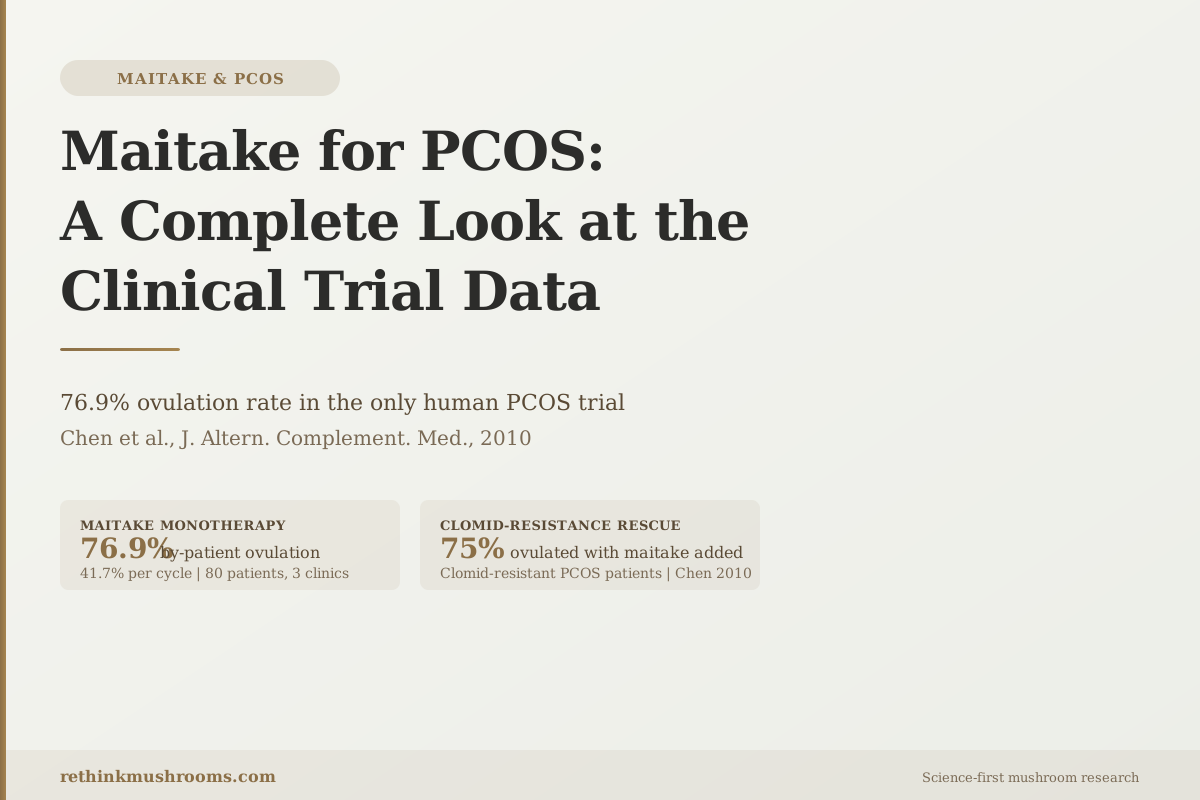
76.9% ovulation rate
A 2010 clinical trial in 80 PCOS patients found maitake SX-fraction achieved a 76.9% ovulation rate as a standalone treatment, and helped 75% of women who had already failed Clomid.
Chen et al., Journal of Alternative and Complementary Medicine, 2010
80 patients
enrolled across 3 Japanese fertility clinics
75% rescue
of Clomid-resistant patients ovulated when maitake was added
2025 review
first systematic review to formally include maitake for PCOS
Chen et al., Journal of Alternative and Complementary Medicine, 2010
 View as image ↗
In 2010, a team of Japanese researchers enrolled 80 women with polycystic ovary syndrome (PCOS) across three fertility clinics and gave part of the group a mushroom extract instead of the standard fertility drug. Three months later, 76.9 percent of the women in the mushroom group had ovulated. The maitake polycystic ovary syndrome clinical trial, published by Chen, Tominaga, Sato, and colleagues in the Journal of Alternative and Complementary Medicine, remains the only controlled human study of its kind. This article breaks down what happened: the trial design, the specific formulation tested, the ovulation numbers, what the researchers found when both treatments failed, and what the evidence genuinely proves.
For an overview of maitake's ecology, bioactive fractions, and general research profile, see What Is Maitake Mushroom? The 'Dancing Mushroom' Explained.
Key Takeaways
- The only clinical trial of maitake for PCOS enrolled 80 patients across three Japanese fertility clinics and ran for up to 12 weeks
- Maitake SX-fraction achieved a 76.9% ovulation rate (20 of 26 patients); clomiphene citrate (Clomid) achieved 93.5% (29 of 31 patients)
- By-cycle ovulation rates were lower than by-patient rates: 41.7% for maitake versus 69.9% for Clomid; both measures show Clomid outperforming maitake as a standalone treatment
- The rescue data was the most striking finding: 75% of Clomid-resistant patients ovulated when maitake was added to their treatment regimen
- The trial was open-label, meaning patients and physicians both knew which treatment was being used; this is the primary methodological limitation
- A 2025 systematic review (Wani and Shaikh, JBRA Assisted Reproduction) was the first to formally include maitake in a structured review of natural PCOS treatments, providing review-level validation
The 80-Patient Trial Most Fertility Specialists Have Never Heard Of
Polycystic ovary syndrome affects an estimated 5 to 10 percent of women of reproductive age. It is the leading single cause of anovulatory infertility, which is infertility caused by the ovaries failing to release eggs. The condition disrupts follicular development through a cascade that begins with insulin resistance, produces excess androgen, and ends with follicles that start developing but stall before releasing an egg.
The standard pharmaceutical approach since the 1960s has been clomiphene citrate (sold as Clomid). It works at the brain's hormone control center (the hypothalamus), blocking estrogen receptors there to produce a surge in follicle-stimulating hormone (FSH). That surge pushes the ovary to mature and release a follicle. It is effective, but not for everyone. Somewhere between 15 and 40 percent of PCOS patients do not respond to Clomid, leaving a meaningful share of women with anovulatory infertility and no effective first-line option.
Chen and colleagues published their maitake study in 2010 after observing that maitake SX-fraction had demonstrated insulin-sensitizing effects in metabolic research.[1] The hypothesis was that improving insulin sensitivity could address the hormonal cascade upstream of anovulation, rather than trying to override it with a hormonal trigger. For a broader look at whether the ovulation findings hold up across the cluster's evidence base, see Maitake for PCOS: Can It Help Restore Ovulation?.
How the Trial Was Set Up: Three Clinics, One Specific Formulation, and Why Both Details Matter
The trial enrolled 80 women with a confirmed PCOS diagnosis across three fertility clinics in Japan. Patients were assigned to one of two monotherapy treatment arms: maitake SX-fraction extract (referred to in the study as MSX) or clomiphene citrate (CC). Each group received their assigned treatment for up to 12 weeks, with ovulation monitored at each cycle using hormonal assays and ultrasound.
The specific formulation tested in the MSX arm matters for anyone trying to interpret or apply the results. Each tablet in the MSX arm contained 18mg of SX-fraction and 250mg of dried maitake powder. SX-fraction is a specific water-soluble glycoprotein isolated from maitake. It is distinct from the better-known D-fraction (which targets immune function and has been studied in oncology) and from standard dried maitake powder. Most maitake supplements on the market are whole extract or D-fraction products. The SX-fraction concentration used in this trial is not a standard label feature of retail maitake supplements. The distinction between D-fraction and SX-fraction is explained in detail in Maitake and Ovarian Function: SX-Fraction Research in PCOS Models.
The trial's most significant methodological limitation is baked into its design: it was open-label. Both patients and physicians knew which treatment each patient was receiving. In controlled trials, blinding prevents expectation effects from influencing outcomes. When a patient knows they are taking an active treatment, their behavior and self-reporting may shift in ways that bias results.
One mitigating factor is specific to ovulation research. Ovulation is an objective biological endpoint. It either happens or it does not, confirmed by a surge in luteinizing hormone (LH) and by ultrasound imaging of follicle rupture. Unlike pain ratings or mood questionnaires, ovulation cannot be willed or self-reported into existence. An open-label design is a genuine limitation here, but it matters less than it would in a trial measuring a subjective outcome. The study authors acknowledged the limitation directly in their publication.
Two Ways to Count Ovulation: Why 76.9% and 41.7% Are Both Real
The study reported ovulation rates in two ways, and both matter for understanding what actually happened.
By patient, 20 of the 26 patients who received maitake SX-fraction ovulated at least once during the trial period, giving a by-patient rate of 76.9 percent.[1] In the clomiphene citrate group, 29 of 31 patients ovulated at least once, giving a by-patient rate of 93.5 percent.
By cycle, looking at what fraction of individual treatment cycles resulted in ovulation, the maitake group achieved ovulation in 41.7 percent of cycles. The clomiphene group achieved ovulation in 69.9 percent of cycles.
The gap between the two sets of numbers reflects something worth understanding. A patient who ovulates in one of three months during the trial is counted as a "responder" in the by-patient calculation. That same patient reduces the overall per-cycle percentage because she did not ovulate in the other two months. The by-cycle rate reflects a harder question: if you take maitake for one month, what are the odds that specific month produces ovulation? The by-patient rate reflects a softer question: over three months, will you ovulate at least once?
Both measures tell the same directional story. Clomid outperformed maitake in both the by-patient and by-cycle calculations, in this one trial. What the maitake by-patient number tells us is that the extract is not an ineffective treatment. A 76.9 percent chance of ovulating at least once in three months is a meaningful clinical signal. What the data does not support is any claim that maitake is equivalent to or interchangeable with Clomid as a standalone ovulation induction agent.
When Monotherapy Failed: The 75% Rescue Rate That Makes This Trial Clinically Relevant
After the monotherapy phase, patients who had not ovulated on their initial assigned treatment were moved to combination therapy: the drug they originally received plus the agent they had not tried. The researchers then tracked whether adding the second treatment could trigger ovulation in patients who had not responded to the first.
Among patients who had not ovulated on maitake monotherapy, all of them ovulated when clomiphene citrate was added.[1] A 100 percent rescue rate for this group. The sample for this subgroup was small, and a ceiling effect is plausible. Patients who came close to ovulating on maitake alone may have needed only a modest additional stimulus. The finding is still notable, but the small n limits what can be concluded from it.
The second rescue finding is the one with clear clinical implications. Among patients who had not ovulated on clomiphene citrate monotherapy (the Clomid-resistant group), 75 percent ovulated when maitake SX-fraction was added to their regimen. Three out of four Clomid-resistant women were able to ovulate, but only with a second agent working through a different mechanism.
This is the most important number in the Chen study, and it is almost never discussed in the consumer content that references the trial. Clomid resistance is not a rare complication. It affects 15 to 40 percent of PCOS patients. These are women for whom the standard first-line treatment has already failed and who, under typical clinical conditions, face either dose escalation, switching to another ovulation-induction agent (now letrozole, per updated guidelines), or assisted reproductive technology.
The mechanistic reason why maitake might help this population is connected to how the two treatments work differently. Clomid and letrozole both act at the hypothalamic-pituitary level, triggering the hormonal cascade that drives follicle maturation. Maitake SX-fraction, based on preclinical research, acts upstream of that cascade by improving insulin sensitivity, which reduces the androgen excess that disrupts follicular development in the first place. When a patient is Clomid-resistant, that resistance reflects something Clomid cannot address. Adding an agent that targets the root of the hormonal dysfunction, rather than trying to override it, produces a mechanistically distinct intervention. That is why combination therapy in a subset like this is logical rather than arbitrary. For the full mechanistic picture, see Maitake and Insulin-Driven Hormonal Imbalance in PCOS.
The Open-Label Problem: What the Trial Design Can and Cannot Rule Out
The Chen study has produced a result that stands out in the natural medicine literature: a clinical trial in PCOS patients, with a clearly defined treatment, a clearly defined endpoint, and reported results that match the mechanistic hypothesis. It has also never been replicated with a blinded, controlled design.
Both of these things are true, and both matter.
The open-label limitation means that expectation effects, whether in how patients self-managed during the trial or how clinical staff interpreted ambiguous monitoring data, cannot be ruled out. Ovulation is objective, but the behavior that surrounds a fertility trial (dietary changes, stress management, compliance with monitoring appointments) is not immune to the belief that one's treatment is working.
The replication gap is a separate concern. The Chen study was published in 2010. No independent research group has run a blinded, controlled replication in the 15 years since. That absence is itself informative, even if the reasons for it are structural rather than scientific. Non-patentable natural compounds attract less pharmaceutical investment than drugs with clear commercial return on trial costs. Academic and foundation funding for PCOS research has historically been insufficient relative to the condition's prevalence. These are real explanations. They do not change the fact that a single open-label trial represents preliminary evidence, not established efficacy.
What the design does rule out is some of the more dramatic alternative explanations. Ovulation cannot be fabricated through willingness to comply. The rates reported are biological outcomes confirmed by independent measurement, not patient satisfaction scores. The trial's findings are a genuine signal. The question is how strong a signal, and whether it replicates in a rigorous design.
For a direct side-by-side comparison of what maitake and Clomid each produce, including the side effect profiles and when each might be the more relevant option, see Maitake vs. Clomid for PCOS: A Comparison Study.
From One Trial to Systematic Review: What Wani 2025 Added to the Evidence
In 2025, Wani and Shaikh published a systematic review in JBRA Assisted Reproduction that surveyed the natural treatment landscape for PCOS.[2] It was the first systematic review to formally include maitake in a structured evidence analysis for PCOS. That distinction matters because systematic reviews apply predefined inclusion criteria to assess whether individual studies meet the bar for inclusion in the broader evidence base. Inclusion is a form of validation: the reviewers looked at the Chen 2010 data and concluded it was credible enough to include.
The Wani 2025 review confirmed the ovulation findings from Chen 2010, and added context from maitake's metabolic research profile. Maitake has demonstrated effects on blood pressure reduction, blood glucose regulation, and serum lipid modification across preclinical and some human research. For PCOS patients, these metabolic effects are directly relevant: PCOS is not purely a reproductive condition. It carries elevated cardiovascular risk, lipid dysregulation, and blood sugar instability that track with the insulin resistance at its core.
What the systematic review did not provide is new human trial data. It synthesized existing evidence. The Chen 2010 study remains the only human trial of maitake for PCOS ovulation. A systematic review of one primary trial is a thin primary evidence base, even when the review itself is rigorous. The significance of Wani 2025 is that it moved maitake from "anecdotally mentioned" in naturopathic circles to "formally reviewed" in the peer-reviewed literature. That is a meaningful step. It is not the same as a second independent clinical trial.
Context: Where Clomid Fits Now and What That Means for Chen 2010's Conclusions
The comparison in the Chen study was against clomiphene citrate. In 2023, international PCOS guidelines were updated to move letrozole, an aromatase inhibitor, ahead of Clomid as the preferred first-line ovulation induction agent. Letrozole produces better ovulation and live birth rates in PCOS patients and has a more favorable side effect profile, particularly regarding endometrial effects. Clomid remains in clinical use but is now second-line.
This update partially dates the Chen study's comparison arm. Maitake SX-fraction was tested against Clomid, not letrozole. Whether maitake would produce similar rescue rates alongside letrozole, or in letrozole-resistant patients, is an open question. The mechanistic argument for why maitake could complement letrozole is the same as for Clomid: letrozole, like Clomid, works at the hypothalamic-pituitary axis and does not address the insulin resistance driving androgen excess. Maitake's proposed mechanism operates upstream of both. But that mechanistic argument requires clinical validation that has not been run.
What the updated guideline context does not change is the core finding: in a population of PCOS patients, a maitake SX-fraction formulation produced ovulation in a majority of tested patients, and rescued three out of four patients who had not responded to a standard pharmaceutical ovulation-induction drug. Those numbers, from one open-label trial, remain the most detailed clinical evidence on maitake for PCOS anovulation. The evidence base should be held at arm's length, with clear awareness of its limitations. And it should be presented accurately, because the alternative is either overstating a preliminary finding or ignoring it entirely. Neither serves patients or the science.
The Bottom Line
The Chen 2010 clinical trial is the only published human study of maitake SX-fraction for PCOS, enrolling 80 patients across three Japanese clinics and finding a 76.9 percent ovulation rate with maitake monotherapy and a 75 percent rescue rate for Clomid-resistant patients on combination therapy. The trial used an open-label design, has not been independently replicated, and compared maitake to Clomid, which is now second-line behind letrozole per 2023 guidelines. The 2025 systematic review by Wani and Shaikh was the first to formally include maitake in a structured PCOS evidence review, confirming that the Chen findings represent credible preliminary evidence worth tracking.
Frequently Asked Questions
Sources & References
- 1RTHM-00330·Chen, Jui-Tung et al. (2010). “Maitake mushroom (Grifola frondosa) extract induces ovulation in patients with polycystic ovary syndrome: a possible monotherapy and a combination therapy after failure with first-line clomiphene citrate..” Journal of alternative and complementary medicine (New York.Study breakdown →PubMed →↩
- 2RTHM-02208·Wani, Rashmi et al. (2025). “Healing with Herbs: A Systematic Review of Natural Treatments for Polycystic Ovary Syndrome..” JBRA assisted reproduction.Study breakdown →PubMed →↩