Maitake & PCOS
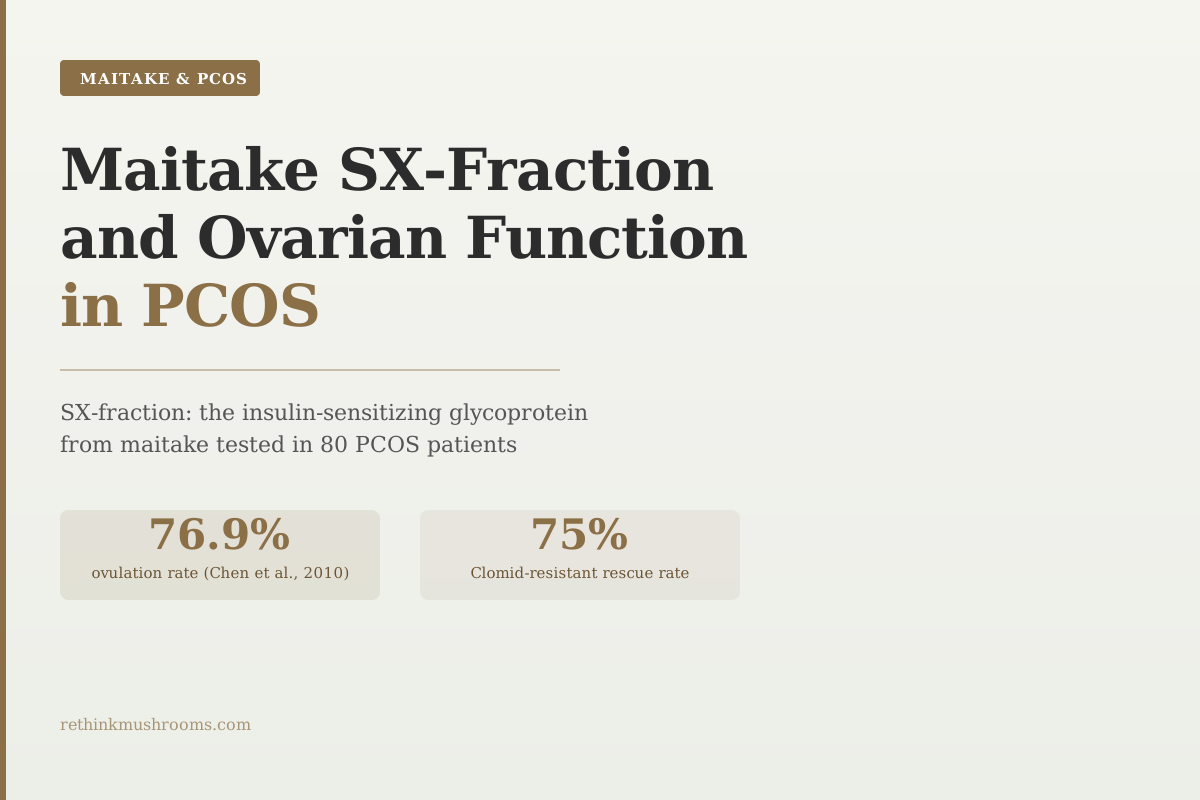
76.9% ovulation rate
Maitake SX-fraction achieved a 76.9% ovulation rate as standalone therapy in a clinical trial of 80 PCOS patients, and rescued 75% of those who had already failed on Clomid.
Chen et al., J Altern Complement Med, 2010
18mg SX-fraction
per tablet in the Chen 2010 clinical protocol
~20,000 Da
average molecular weight of the SX-fraction glycoprotein
75%
of Clomid-resistant PCOS patients ovulated when SX-fraction was added
Chen et al., J Altern Complement Med, 2010
 View as image ↗
When a clinical trial shows a 76.9% ovulation rate in PCOS patients, you'd expect it to be widely cited in women's health content. It isn't. The Chen 2010 trial, which tested maitake SX-fraction against clomiphene citrate in 80 PCOS patients across three Japanese clinics, has been largely invisible to consumer audiences for fifteen years.[1] It circulates in naturopathic practitioner circles. Mainstream fertility coverage hasn't touched it.
Part of the reason is a widespread conflation. Most people who know anything about maitake supplements know about D-fraction, the immune-targeting compound. Maitake SX-fraction is a structurally different compound with a different mechanism: the insulin-sensitizing glycoprotein that was actually tested in PCOS research. It is rarely distinguished from D-fraction in product descriptions, articles, or supplement labels.
This article explains what SX-fraction is, how it differs from D-fraction, what the research shows about its effects on ovarian function in PCOS, and what the trial design can and cannot tell us. For a broader introduction to maitake and its full range of bioactive compounds, the maitake overview covers the landscape. For the broader question of whether maitake can help restore ovulation in PCOS, this overview of the clinical evidence starts there.
Key Takeaways
- SX-fraction is a water-soluble glycoprotein (~20,000 Da) from maitake, structurally unrelated to D-fraction (a beta-glucan polysaccharide that targets the immune system)
- In 80 PCOS patients, maitake SX-fraction achieved a 76.9% by-patient ovulation rate as monotherapy; clomiphene citrate achieved 93.5% in the same trial (Chen et al., 2010)
- When added to failed Clomid treatment, SX-fraction rescued ovulation in 75% of clomiphene-resistant patients
- SX-fraction acts as an insulin sensitizer: it improves cellular insulin response, reducing the hyperinsulinemia that drives androgen excess and follicular arrest in PCOS
- The clinical protocol used 18mg of SX-fraction plus 250mg dried maitake per tablet; most maitake supplements are standardized to D-fraction or generic beta-glucans, not SX-fraction
- Chen 2010 is the only human trial in PCOS; it was open-label and has not been independently replicated
Not All Maitake Is the Same: SX-Fraction vs D-Fraction
SX-fraction (also called MSX) is a specific water-soluble glycoprotein extracted from maitake mushroom (Grifola frondosa) with an average molecular weight of approximately 20,000 Daltons. A glycoprotein is a protein molecule with sugar chains attached to it, which gives it different biological behavior from a pure polysaccharide or a pure protein. SX-fraction's primary research application is improving insulin sensitivity. Its mechanism runs through metabolism, not the immune system.
D-fraction is a different compound entirely. It is a branched polysaccharide: a long-chain sugar molecule with a particular branching structure. Its mechanism is immunological. D-fraction binds to receptors on immune cells and activates natural killer cells, macrophages, and T-cells. Most of the maitake research in immune function, cancer support, and infection contexts uses D-fraction or related polysaccharide fractions. These two compounds share a source organism but have nothing else in common.
In 2007, Preuss and colleagues published a direct characterization of SX-fraction in Molecular and Cellular Biochemistry, finding that it produced enhanced insulin-hypoglycemic activity in an animal model.[2] This means SX-fraction amplifies how well cells respond to insulin, rather than acting as insulin itself. The distinction matters: an insulin sensitizer improves cellular insulin response using the insulin the body already produces. It doesn't lower blood sugar directly. This is the same functional category as metformin, the most widely used drug for insulin resistance in PCOS, though SX-fraction and metformin work through different molecular pathways.
The practical consequence: a maitake supplement standardized to D-fraction would not replicate the compound tested in PCOS research. If the clinical effects on ovarian function run through insulin sensitization, the relevant compound is SX-fraction. Products without it are testing a different thing.
The PCOS Mechanism: Why Insulin Resistance Disrupts Ovarian Function
PCOS is classified as a reproductive disorder. Most of its downstream effects on fertility and menstrual regularity trace back to a metabolic problem: insulin resistance.
When cells throughout the body stop responding efficiently to insulin, the pancreas compensates by releasing more. This elevated circulating insulin is called hyperinsulinemia. It doesn't affect all tissues equally. Ovarian cells are among the most insulin-sensitive in the body, and their specific response to high insulin is to amplify androgen production.
Here is the chain of events. High insulin levels enhance the ovaries' response to LH (luteinizing hormone), causing a specific population of ovarian cells called theca cells to overproduce testosterone and other androgens. At the same time, high insulin suppresses the liver's production of sex hormone binding globulin (SHBG). This protein carries testosterone through the bloodstream and keeps it biologically inactive. When SHBG production drops, free testosterone levels rise, compounding the androgen excess.
The androgenic environment that results disrupts the follicular cycle. Growing follicles fail to mature past an early stage. The LH surge needed to trigger ovulation cannot happen reliably because the hormonal signaling environment is distorted by excess androgens. Month after month, follicles stall at an immature stage. Over time, those stalled follicles create the cysts visible on ovarian ultrasound.
The logic of an insulin sensitizer as a PCOS treatment follows directly from this mechanism. Improve insulin sensitivity, and the cascade reverses: lower circulating insulin reduces the LH amplification of androgen production, SHBG levels recover, free testosterone decreases, and the follicular cycle can proceed toward ovulation.
For a detailed exploration of this pathway and how maitake compounds map onto each step, the article on maitake and insulin-driven hormonal imbalance in PCOS goes deeper. Here, the mechanism is the context for understanding why SX-fraction was the compound of interest in the 2010 clinical trial.
What the 2010 Clinical Trial Found in 80 PCOS Patients
Chen, Tominaga, Sato, and colleagues recruited 80 PCOS patients across three clinics in Japan.[1] Patients were assigned to either maitake SX-fraction monotherapy or clomiphene citrate monotherapy for up to 12 weeks. If initial monotherapy failed, patients crossed over to the combination of both treatments.
The maitake formulation was precisely specified: 18mg of SX-fraction plus 250mg of dried maitake mushroom powder per tablet. This is an important detail for anyone evaluating how to interpret the results: the trial used a specific standardized formulation, not generic maitake extract.
Primary results, measured as the percentage of patients who ovulated:
- Maitake SX-fraction monotherapy: 76.9% (20 of 26 patients ovulated)
- Clomiphene citrate monotherapy: 93.5% (29 of 31 patients ovulated)
By-cycle ovulation rates were lower for both groups. This is expected: not every treatment cycle produces ovulation even in patients who eventually do ovulate.
- Maitake SX-fraction: 41.7% per cycle
- Clomiphene: 69.9% per cycle
Clomiphene outperformed maitake on both measures. That is the straightforward reading of the primary data.
The rescue combination results tell a different story. For patients in the maitake group who had not ovulated after monotherapy, adding clomiphene produced ovulation in 100% of that subgroup. For patients in the clomiphene group who had failed on the drug, adding maitake SX-fraction achieved ovulation in 75% of those resistant patients.
That 75% rescue figure is the result practitioners find most clinically significant. Clomiphene resistance (the inability to ovulate on standard doses) affects approximately 15-40% of PCOS patients who try the drug. For that subgroup, the options have historically been limited. A 75% rescue rate with a botanical adjunct is a meaningful data point, even from a single trial.
The investigators reported no serious adverse events in the maitake group.
For a detailed breakdown of the trial methodology, by-patient vs by-cycle rate interpretation, and statistical context, the clinical trial results article covers the full study protocol. For a direct comparison of how maitake performed against clomiphene across multiple outcome measures, the comparison article addresses that specifically.
The Preclinical Evidence: Multiple Maitake Fractions, Same Insulin Target
The Chen 2010 clinical result doesn't stand alone mechanistically. Several preclinical studies have examined how different maitake compounds affect insulin metabolism, each arriving at the same upstream conclusion: maitake compounds improve insulin sensitivity, through multiple independent pathways.
Preuss et al. (2007) characterized SX-fraction directly in an animal model, establishing that it produced enhanced insulin-hypoglycemic activity.[2] This study identified SX-fraction as the specific compound responsible for the insulin-sensitizing property. The mechanism is sensitizing rather than replacing: SX-fraction helps existing insulin work better at the cellular level, rather than substituting for it.
Xiao et al. (2015) examined maitake polysaccharide fractions F2 and F3, which are structurally different from SX-fraction, in diabetic rats.[3] Both fractions reduced blood glucose through insulin resistance improvement, but through molecular pathways distinct from SX-fraction's mechanism. The implication is convergence: multiple different maitake compounds, operating independently, arrive at the same endpoint of improved insulin sensitivity. This pattern suggests the metabolic property is a consistent, robust feature of maitake, not an artifact of any single extracted compound.
Manohar et al. (2002) tested a water-soluble maitake extract in KK mice, which develop spontaneous type 2 diabetes.[4] This study found meaningful reductions in both circulating glucose and circulating insulin levels. The water-soluble extract format is closer to what most oral supplements actually deliver, compared to highly purified isolated fractions. The metabolic effects held in that less-refined form.
Together, these three studies describe a consistent pattern: multiple maitake compounds, in multiple experimental models, reliably improve insulin signaling. This provides the biological scaffolding for why SX-fraction would improve ovarian function in insulin-resistant PCOS: by reducing the hyperinsulinemia that drives androgen excess, maitake compounds create conditions in which the follicular cycle can proceed.
The Formulation Problem: 18mg SX-Fraction Is Not a Standard Supplement
Understanding what Chen 2010 used is essential for interpreting what the research tested, and for understanding the gap between that and most available products.
The clinical protocol was specific: 18mg of SX-fraction plus 250mg of dried maitake mushroom powder per tablet. The SX-fraction content was precisely defined and standardized to a quantified amount. This is not a generic maitake product.
Most maitake supplements available today fall into one of three categories:
Dried mushroom powder: No standardization to any specific fraction. Total polysaccharide or beta-glucan content may be listed, but the relative amounts of SX-fraction, D-fraction, and other bioactives are not specified and vary by batch, growing conditions, and processing method.
Beta-glucan standardized extract: Standardized to total beta-glucan content. This primarily reflects D-fraction activity: the immune-targeting polysaccharide. A product labeled "30% beta-glucans" may contain little to no quantified SX-fraction, because SX-fraction is a glycoprotein, not a beta-glucan.
D-fraction extract: Standardized specifically to the immune-targeting polysaccharide compound. Mechanistically oriented toward immune support, not insulin sensitization. This is a different compound from what was tested in Chen 2010.
SX-fraction does exist as a commercialized ingredient available in specific supplement formulations. But it is far less common than D-fraction products. Finding a product that matches the clinical protocol requires looking for explicit SX-fraction content listed in milligrams, rather than total maitake extract weight, polysaccharide percentage, or beta-glucan content.
A consumer taking a standard maitake supplement while trying to replicate the Chen 2010 protocol is almost certainly taking something structurally different from what that study tested. Whether typical maitake products have any effect on PCOS through other mechanisms is an open question, but it isn't the question the clinical trial answered.
Why the Chen 2010 Results Are Meaningful but Not Definitive
The Chen 2010 study is the primary piece of human evidence for maitake's effects on ovarian function in PCOS. Understanding its design limitations is part of reading the data accurately.
Open-label design: Patients and clinicians both knew which treatment each person was receiving. In an open-label trial, expectations can influence outcomes. Patients who know they're receiving a botanical treatment may approach sleep, stress, or diet differently from those receiving a pharmaceutical. Ovulation is measured by ultrasound or hormonal assay rather than self-report, which limits but does not eliminate expectation effects.
No placebo control: The trial compared maitake directly to clomiphene. No group received an inactive control. The spontaneous ovulation rate in PCOS without any treatment is unknown from this study design.
Single country, one ethnic population: The trial was conducted in Japan across three Japanese clinics. Population differences in baseline insulin resistance severity, PCOS phenotype, diet, and lifestyle may affect generalizability to other populations.
No independent replication: No second research group has conducted a clinical trial testing maitake SX-fraction for ovulation induction in PCOS. The Chen 2010 result stands alone in the human clinical literature.
The clomiphene comparison has dated somewhat: When Chen 2010 was published, clomiphene citrate was the standard first-line treatment for ovulation induction in PCOS. International PCOS guidelines updated in 2023 now position letrozole as the preferred first-line agent. The principle of maitake as an adjunct for ovulation-induction drug resistance remains relevant, but the specific head-to-head comparison with clomiphene is now a less central clinical question than it was in 2010.
None of these limitations erase the findings. The 76.9% ovulation rate and the 75% rescue result are real numbers from a real trial. The mechanistic case for SX-fraction's effects is biologically coherent and supported by preclinical evidence at multiple levels. But a single open-label trial from one country, with no independent replication, is a starting point for a research program. It isn't a definitive answer.
The Bottom Line
Maitake SX-fraction is a water-soluble glycoprotein that acts as an insulin sensitizer, distinct from the immune-targeting D-fraction found in most maitake supplements. One clinical trial in 80 PCOS patients showed a 76.9% by-patient ovulation rate with SX-fraction monotherapy and a 75% rescue rate when added to failed clomiphene treatment. Preclinical work from Preuss 2007, Xiao 2015, and Manohar 2002 supports the insulin-sensitizing mechanism across multiple maitake fractions and experimental models. The trial was open-label and has not been independently replicated. The specific clinical formulation (18mg SX-fraction plus 250mg dried maitake per tablet) is not standard in most consumer maitake products.
Frequently Asked Questions
Sources & References
- 1RTHM-00330·Chen, Jui-Tung et al. (2010). “Maitake mushroom (Grifola frondosa) extract induces ovulation in patients with polycystic ovary syndrome: a possible monotherapy and a combination therapy after failure with first-line clomiphene citrate..” Journal of alternative and complementary medicine (New York.Study breakdown →PubMed →↩
- 2RTHM-00229·Preuss, Harry G et al. (2007). “Enhanced insulin-hypoglycemic activity in rats consuming a specific glycoprotein extracted from maitake mushroom..” Molecular and cellular biochemistry.Study breakdown →PubMed →↩
- 3RTHM-00410·Xiao, Chun et al. (2015). “Hypoglycemic effects of Grifola frondosa (Maitake) polysaccharides F2 and F3 through improvement of insulin resistance in diabetic rats..” Food & function.Study breakdown →PubMed →↩
- 4RTHM-00097·Manohar, V et al. (2002). “Effects of a water-soluble extract of maitake mushroom on circulating glucose/insulin concentrations in KK mice..” Diabetes.Study breakdown →PubMed →↩