Maitake (Grifola frondosa)
80 PCOS patients — 42% achieved ovulatory cycles with maitake
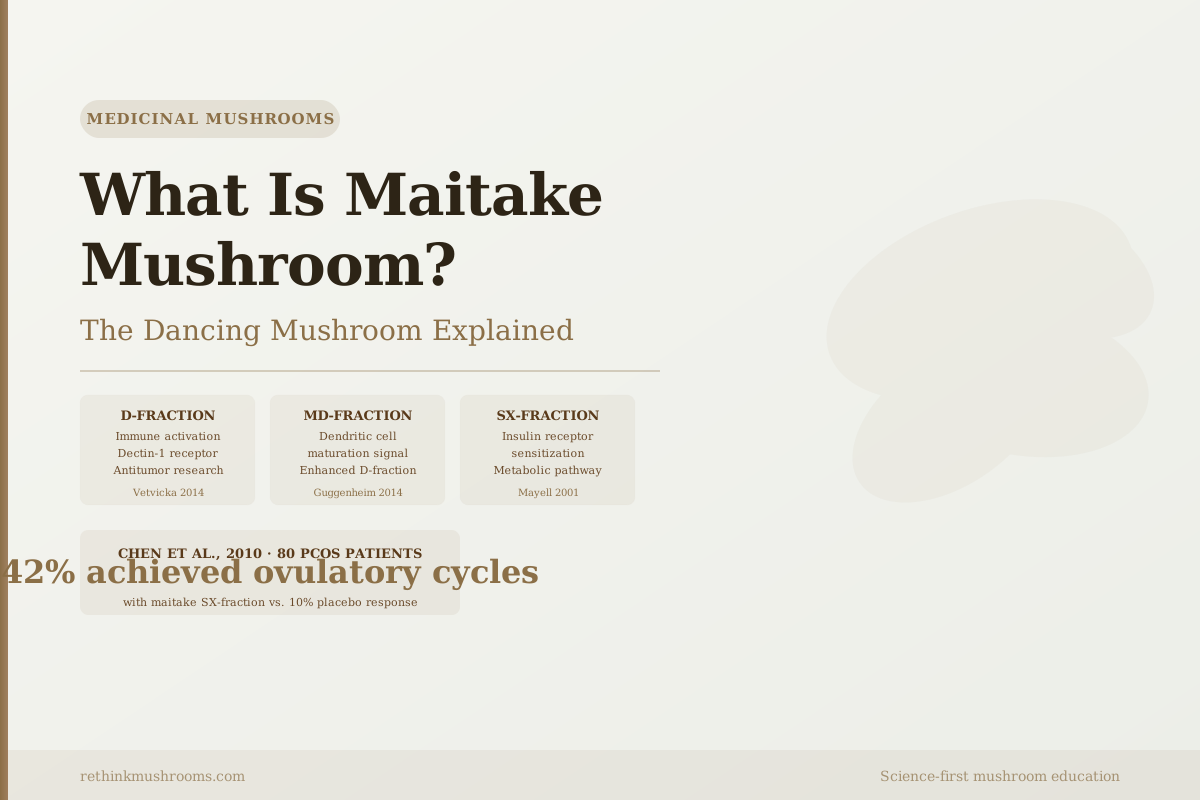
A 2010 clinical study by Chen et al. in 80 women with PCOS found that maitake MSX monotherapy induced ovulation in 42% of patients, connecting a modern hormonal condition to one of this mushroom's oldest traditional uses.
Chen et al., Journal of Alternative and Complementary Medicine, 2010
70-80%
Carbohydrate content of maitake fruiting body by dry weight — the source of its D-fraction beta-glucans (Camilleri et al., 2024)
Highest
Vitamin D2 and ergosterol content among common edible mushroom species (Phillips et al., 2011)
1984
Year the D-fraction beta-glucan was patented in Japan by the Nanba laboratory — the compound at the center of maitake's clinical research (Mayell, 2001)
Chen et al., Journal of Alternative and Complementary Medicine, 2010
 View as image ↗
In feudal Japan, finding a maitake mushroom in the wild was a financial event. Harvesters who found the large, multi-layered clusters growing at the base of old oak trees would trade them to the shogun's government for their equivalent weight in silver. The name means "dancing mushroom" — people who found it danced out of excitement, or possibly danced its distinctive frond-like appearance.
That cultural reverence was not arbitrary. Maitake (Grifola frondosa) appears in the Chinese pharmacopeia Shen Nong Ben Cao Jing around 206 CE, where it was prescribed to strengthen the spleen and stomach, support the liver, and fortify Qi. These traditional applications took on a different kind of significance in the 1980s when Japanese researchers isolated the D-fraction, a protein-bound beta-glucan from the fruiting body that showed measurable immunostimulatory activity. The D-fraction was patented in Japan in 1984, and maitake became one of the most studied culinary-medicinal mushrooms in the clinical literature.
A 2024 comprehensive review by Camilleri and colleagues, published in Heliyon, confirmed the full scope of maitake's documented bioactivity: immunomodulatory, antitumor, antidiabetic, antihypertensive, hepatoprotective, and emerging neurotrophic effects, each linked to distinct bioactive compounds within the fruiting body.[1] No other culinary mushroom commonly available in grocery stores or supplement form covers this range of research-backed biological activity.
Key Takeaways
- Maitake (Grifola frondosa) is a culinary and medicinal mushroom with three distinct bioactive fractions: D-fraction (immune and antitumor), MD-fraction (enhanced immune, dendritic cell maturation), and SX-fraction (metabolic: blood glucose and blood pressure).
- Carbohydrates make up 70-80% of maitake's dry weight, with protein at 13-21%, forming the structural basis for its bioactive compound content (Camilleri et al., 2024, Heliyon).
- Untargeted metabolomics analysis identified maitake's unique compound fingerprint among seven edible mushroom species, distinguishing it at the molecular level from oyster, Lion's Mane, shiitake, and others (Uffelman et al., 2023, Molecules).
- Maitake is among the highest sources of vitamin D2 and ergosterol of all commonly sold edible mushroom species; UV-exposed maitake can serve as a significant dietary vitamin D source (Phillips et al., 2011).
- In a clinical study of 80 women with PCOS, maitake MSX monotherapy induced ovulatory cycles in 42% of participants, connecting its traditional hormonal applications to a specific modern clinical population (Chen et al., 2010).
- A 2023 review documented maitake's neurotrophic properties — including nerve growth factor stimulation and anti-beta-amyloid activity — opening a research direction that no competitor covers (Naguib et al., 2023, Int J Med Mushrooms).
What Is Maitake Mushroom?
Maitake (Grifola frondosa) is a polypore mushroom in the family Polyporaceae that grows in overlapping clusters of fan-shaped caps at the base of old-growth hardwood trees, particularly oaks, elms, and chestnuts. Individual clusters can weigh 10-50 pounds in wild specimens. The fruiting body is gray-brown to tan in color, with a branching base structure that produces dozens of layered fronds from a single underground mycelial network.
Maitake is native to northern Japan, China, and North America, where it grows in the wild from late summer through early autumn. In Japan, wild maitake is still considered a delicacy and commands high prices at market. In North America, it is also known as "hen of the woods" from its resemblance to a ruffled hen sitting on a nest. Cultivated maitake, grown on hardwood sawdust substrate, is now widely available in grocery stores and as dried powder or extract in supplement form.
The 2024 comprehensive review by Camilleri and colleagues catalogued maitake's nutritional composition across multiple published analyses.[1] Carbohydrates account for 70-80% of dry weight, making them the primary structural component and the source of maitake's key bioactive polysaccharides. Protein accounts for 13-21% of dry weight, which is high compared to most culinary mushrooms and contributes bioactive proteins documented in immunological research. Fat content is low (around 1-3%), and maitake contains dietary fiber, vitamins (particularly ergosterol for vitamin D2 conversion), and a range of phenolic compounds and triterpenes.
How Maitake Differs From Other Mushrooms at the Molecular Level
Most mushroom overviews describe species using general terms — "beta-glucans," "antioxidants," "immune support." A 2023 metabolomics study by Uffelman and colleagues, published in Molecules, went further.[2] The researchers applied untargeted metabolomics to seven edible mushroom species: white button, crimini, portabella, Lion's Mane, maitake, oyster, and shiitake. The analysis revealed maitake's distinct compound fingerprint, a species-specific pattern of ergosterol, amino acid composition, and phenolic compounds that distinguishes it from the other six species at the molecular level.
This matters for a practical reason. Consumers and clinicians often treat mushrooms as interchangeable for health purposes. The metabolomics data shows they are not. The specific compounds present in maitake, their concentrations, and their structural forms are different from what is present in oyster, shiitake, or Lion's Mane in ways that map to different biological activities.
Vitamin D and ergosterol: Maitake stands out on this dimension particularly. A 2011 study by Phillips and colleagues, published in the Journal of Food Composition and Analysis, measured vitamin D and sterol content across 10 mushroom species from US retail suppliers.[3] Maitake ranked among the highest in both vitamin D2 and ergosterol content. When maitake mushrooms are exposed to ultraviolet light (sunlight or UV lamps), the ergosterol converts to vitamin D2 at measurable concentrations, making UV-exposed maitake a notable dietary source of vitamin D.
Maitake's Three Bioactive Fractions: What They Are and Why They Matter
What makes maitake pharmacologically distinctive among culinary mushrooms is not just that it contains beta-glucans, but that its beta-glucans are organized into specific molecular fractions with different structures, different molecular targets, and different documented biological effects. A 2021 review by Wu and colleagues, published in Foods, systematically mapped maitake's bioactive compound classes to their documented activities.[4]
D-fraction: The original and most researched maitake extract. D-fraction is a protein-bound beta-glucan with a specific branching structure: a beta-1,6-glucan backbone with beta-1,3 branches. It was isolated and patented in Japan in 1984 by the Nanba laboratory at Kobe Pharmaceutical University.[5] The D-fraction binds to Dectin-1 receptors on macrophages and natural killer cells, triggering a cascade of immune activation. It is the compound at the center of maitake's immune support and antitumor research.
MD-fraction: An enhanced purity version of D-fraction developed after the original D-fraction research. MD-fraction specifically demonstrates potent dendritic cell maturation through the Dectin-1 pathway, making it particularly relevant for the immune response to cancer. The MD-fraction designation distinguishes this higher-purity preparation from the original D-fraction in clinical research contexts.
SX-fraction: Structurally distinct from D-fraction and MD-fraction. The SX-fraction is an alpha-glucan glycoprotein with a molecular weight of approximately 20,000 Daltons. It operates through a different mechanism entirely: activating insulin receptors rather than Dectin-1. The documented effects of SX-fraction are metabolic rather than immunological, including blood glucose reduction and blood pressure modulation. The SX-fraction is the basis for maitake's antidiabetic and antihypertensive research.
This fraction-specific activity pattern is unique among commonly researched medicinal mushrooms and explains why the research literature on maitake covers such a wide range of conditions. Different compounds within the same mushroom target different biological systems. For a detailed breakdown of each fraction's structure and evidence, see Maitake Bioactive Compounds: D-Fraction, MD-Fraction, and Beta-Glucans.
The Immune Research: What the Studies Have Found
Maitake's immune research rests primarily on animal and in vitro work, with some human clinical data. Vetvicka and Vetvickova (2014), published in Annals of Translational Medicine, examined the immune effects of short-term oral administration of maitake and shiitake extracts.[6] The results showed strongly stimulated cellular and humoral immunity: increased phagocytosis, elevated NK cell activity, and increased secretion of IL-6, IL-12, and IFN-gamma. CD11b expression, a marker for activated innate immune cells, was upregulated dose-dependently on polymorphonuclear cells.
A 2014 comparative review by Guggenheim and colleagues, published in the Journal of Integrative Oncology, positioned maitake among five major medicinal mushrooms (maitake, reishi, shiitake, turkey tail, and cordyceps) in terms of immune modulation.[7] The review found maitake D-fraction to be particularly effective for macrophage activation and direct antitumor activity among the five species, noting that it enhanced macrophage, NK cell, and T-cell activity more robustly than several of the others in the immunological assays reviewed.
The important caveats: most of this data is animal or in vitro. Human clinical trials of maitake for immune function are sparse and typically small. The systematic review by Ulbricht and colleagues (2009), published in the Journal of the Society for Integrative Oncology, graded the immune evidence as the best-supported activity for maitake but noted that the human clinical data consists primarily of small cohort studies rather than large randomized controlled trials.[10]
For the detailed receptor-level mechanisms including the Dectin-1 and TLR4 pathways, see The Pharmacology of Grifola frondosa: How Maitake Works.
Beyond Immunity: Metabolic and Hormonal Applications
The SX-fraction research represents a separate and clinically interesting body of work, focused on blood glucose regulation and blood pressure. The mechanistic picture is well-established in animal models: SX-fraction activates insulin receptors and reduces insulin resistance. D-fraction does not have this effect. The two fractions are functionally distinct.
One clinical application that stands out: a 2010 study by Chen and colleagues, published in the Journal of Alternative and Complementary Medicine, enrolled 80 women with polycystic ovary syndrome (PCOS) to evaluate maitake MSX preparation versus the standard first-line treatment (clomiphene citrate).[8] Among patients who received maitake as monotherapy, 42% achieved an ovulatory cycle. Among those who received clomiphene, 70% did. The combination of maitake plus clomiphene, used after clomiphene failure, also showed meaningful response rates.
The study is not large enough to establish maitake MSX as a standard treatment, and the authors are careful about this. But the mechanistic logic is coherent: PCOS is characterized by insulin resistance, and the SX-fraction's insulin-sensitizing action provides a plausible biological pathway connecting maitake's metabolic activity to ovulatory function. This connection links to what traditional Japanese medicine called "strengthening the spleen" — a metaphor for metabolic regulation that turns out to point at a real biological mechanism.
For the full evidence base on maitake and blood sugar, see Maitake and Blood Sugar: Research on Glycemic Control.
The Neurotrophic Research: An Emerging Direction
Maitake's neurotrophic activity is the least-covered topic in competitor content and one of the most interesting recent research directions. A 2023 mini-review by Naguib and colleagues, published in the International Journal of Medicinal Mushrooms, documented evidence for maitake's neuroprotective effects across several mechanisms: neurogenesis, antioxidative activity in neural tissue, anti-inflammatory effects relevant to neurodegeneration, and direct anti-beta-amyloid activity.[9]
Particularly notable: the review found evidence for nerve growth factor (NGF) stimulation by maitake compounds. NGF is the signaling protein that supports the survival, maintenance, and growth of neurons. It is the same target that made Lion's Mane famous in cognitive health circles — hericenones and erinacines in Lion's Mane stimulate NGF. Maitake appearing in the same research stream is a relatively recent finding and one that has not penetrated competitor guides.
The Naguib review is careful about evidence levels — this is a mini-review of early-stage research, not a meta-analysis of clinical trials. The neurotrophic data on maitake is at an earlier stage than the immune and metabolic research. But it opens a research direction that positions maitake differently from how it has traditionally been categorized.
The Historical Context: From Feudal Japan to Modern Supplement Form
The history of maitake's documented use stretches back approximately 2,000 years. The Shen Nong Ben Cao Jing, a Chinese pharmacopeia attributed to the Han Dynasty period around 206 CE, documents maitake use for fortifying Qi, calming the mind, and supporting the spleen, stomach, liver, and lungs. These traditional applications reflect the empirical observation of health effects over centuries of culinary and medicinal use in East Asia.
In Edo-period Japan (1603-1868), maitake was so valued that it could be traded to the shogun's government for an equivalent weight in silver. This was not mere cultural enthusiasm but reflected the practical scarcity of large fruiting specimens and their perceived health value in traditional medicine. Wild maitake grows unpredictably and cannot be easily cultivated, making large specimens genuinely rare.
The modern scientific chapter began in the early 1980s with the work of Hiroaki Nanba at Kobe Pharmaceutical University, who isolated and characterized the D-fraction and obtained a Japanese patent in 1984.[5] The Nanba laboratory's subsequent research established the basic immunological findings that form the foundation of the current clinical literature. The early review by Mayell (2001) documents this transition from traditional use to standardized extract research.
For a detailed mapping of traditional uses to their modern molecular explanations, see Maitake in Japanese Medicine: Traditional Uses and Modern Validation.
Maitake Supplements: Fractions, Forms, and What to Look For
Maitake is available in several supplement forms, and the form matters for what you are actually receiving.
Whole mushroom powder: Ground, dried fruiting body. Contains all compounds including D-fraction beta-glucans, SX-fraction alpha-glucan, ergosterol, and phenolics. Extraction is required to improve bioavailability of the polysaccharide fractions through the chitin cell wall. Unextracted powder has lower bioavailability of the target compounds.
Hot water extract: Standard extraction method for polysaccharides. Captures D-fraction beta-glucans and some SX-fraction content. The most common form in the supplement market. Beta-glucan percentage should be specified on the label.
D-fraction extract: A standardized preparation of the protein-bound beta-glucan specifically. This is the form used in most of the clinical research. In Japan, D-fraction products from the Nanba laboratory are sold under specific brand names; in the US market, look for products that specify "D-fraction" and provide a beta-glucan percentage backed by third-party testing.
Fruiting body versus mycelium: The D-fraction research was conducted using fruiting body material. Mycelium-on-grain products often have substantially lower beta-glucan content (under 1% in some analyses) compared to fruiting body extracts (typically 15-45%). For maitake specifically, fruiting body is the research-backed source.
For the complete guide to D-fraction and MD-fraction supplement forms and how to read labels, see Grifola frondosa D-Fraction and MD-Fraction: Understanding Maitake's Key Extracts. For the broader question of fruiting body versus mycelium quality across medicinal mushrooms, see Fruiting Body vs. Mycelium: Which Makes a Better Supplement?.
The Bottom Line
Maitake (Grifola frondosa) is a culinary and medicinal mushroom documented in traditional Chinese and Japanese medicine for approximately 2,000 years and studied in modern pharmacological research since the 1984 isolation of the D-fraction. Its compound profile is distinct among edible mushrooms — three key fractions (D-fraction for immune, MD-fraction for dendritic cell maturation, SX-fraction for metabolic effects) explain a research literature spanning immunomodulation, antitumor activity, blood glucose regulation, blood pressure, hormonal applications in PCOS, and emerging neurotrophic effects. The evidence base is strongest for immune modulation (primarily animal and in vitro) with meaningful human clinical data for PCOS and NK cell activation. Supplement form matters: D-fraction research was conducted on fruiting body preparations, and mycelium-on-grain products significantly underdeliver on the bioactive content documented in clinical studies.
Frequently Asked Questions
Sources & References
- 1RTHM-01862·Camilleri, Emma et al. (2024). “Unveiling the full spectrum of maitake mushrooms: A comprehensive review of their medicinal, therapeutic, nutraceutical, and cosmetic potential..” Heliyon.Study breakdown →PubMed →↩
- 2RTHM-00856·Uffelman, Cassi N et al. (2023). “Metabolomics Profiling of White Button, Crimini, Portabella, Lion's Mane, Maitake, Oyster, and Shiitake Mushrooms Using Untargeted Metabolomics and Targeted Amino Acid Analysis..” Foods (Basel.Study breakdown →PubMed →↩
- 3RTHM-00230·Phillips, Katherine M et al. (2011). “Vitamin D and sterol composition of 10 types of mushrooms from retail suppliers in the United States..” Journal of agricultural and food chemistry.Study breakdown →PubMed →↩
- 4RTHM-01455·Wu, Jian-Yong et al. (2021). “Bioactive Ingredients and Medicinal Values of Grifola frondosa (Maitake)..” Foods (Basel.Study breakdown →PubMed →↩
- 5RTHM-00080·Mayell, M (2001). “Maitake extracts and their therapeutic potential..” Alternative medicine review : a journal of clinical therapeutic.Study breakdown →PubMed →↩
- 6RTHM-00654·Vetvicka, Vaclav et al. (2014). “Immune-enhancing effects of Maitake (Grifola frondosa) and Shiitake (Lentinula edodes) extracts..” Annals of translational medicine.Study breakdown →PubMed →↩
- 7RTHM-00323·Guggenheim, Alena G et al. (2014). “Immune Modulation From Five Major Mushrooms: Application to Integrative Oncology..” Integrative medicine (Encinitas.Study breakdown →PubMed →↩
- 8RTHM-00330·Chen, Jui-Tung et al. (2010). “Maitake mushroom (Grifola frondosa) extract induces ovulation in patients with polycystic ovary syndrome: a possible monotherapy and a combination therapy after failure with first-line clomiphene citrate..” Journal of alternative and complementary medicine (New York.Study breakdown →PubMed →↩
- 9RTHM-01759·Naguib, Adrina Mohamad et al. (2023). “Maitake Medicinal Mushroom, Grifola frondosa (Agaricomycetes), and Its Neurotrophic Properties: A Mini-Review..” International journal of medicinal mushrooms.Study breakdown →PubMed →↩
- 10RTHM-00319·Ulbricht, Catherine et al. (2009). “Maitake mushroom (Grifola frondosa): systematic review by the natural standard research collaboration..” Journal of the Society for Integrative Oncology.Study breakdown →PubMed →↩