Maitake (Grifola frondosa)
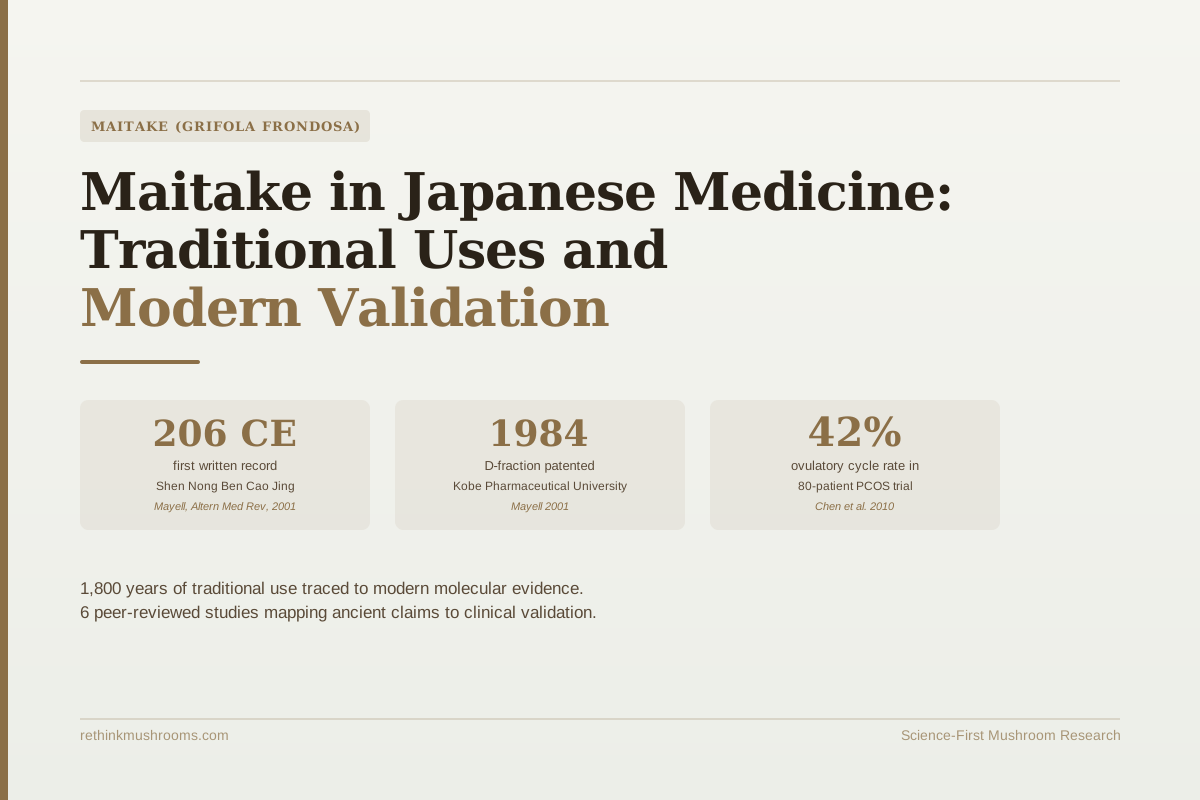
206 CE, the first written record of maitake use
Maitake appears in East Asian medical texts from around 206 CE, prescribed for Qi support and spleen health. Modern researchers have since identified the specific molecular compounds that explain those same effects.
Mayell, Altern Med Rev, 2001
Weight in silver
maitake's feudal Japan value; exchanged at literal silver weight with the shogun
1984
year D-fraction patented at Kobe Pharmaceutical University (Mayell 2001)
42%
ovulatory cycle rate in 80-patient PCOS clinical trial (Chen et al. 2010)
Mayell, Altern Med Rev, 2001
 View as image ↗
In feudal Japan during the Edo period (1603-1868), stumbling upon a maitake mushroom in the forest was worth actual money. People who found maitake could bring it to the domain lord and exchange it for its weight in silver. This was not a folk custom or regional curiosity. It reflected a genuine appreciation for maitake's medicinal and culinary value accumulated over centuries of use, predating the Edo period by over a thousand years.
The story of maitake in traditional medicine is one of the clearest examples of how traditional use and modern pharmacology can map onto each other. The traditional Japanese and Chinese physicians who prescribed maitake for boosting Qi, strengthening the spleen, and supporting liver health were describing observable effects without knowing the chemistry behind them. Modern researchers identified D-fraction, the alpha-glucan SX-fraction, and a distinct maitake protein, each corresponding to one of the traditional therapeutic claims.
This article traces that history and the correspondence between traditional uses and modern evidence. For a comprehensive overview of maitake's pharmacology, see What Is Maitake Mushroom? The "Dancing Mushroom" Explained. For the detailed compound science, see Maitake Bioactive Compounds: D-Fraction, MD-Fraction, and Beta-Glucans.
Key Takeaways
- Maitake has been documented in East Asian medical texts since approximately 206 CE, when the Shen Nong Ben Cao Jing described it for Qi support, spleen and stomach strengthening, and liver health (Mayell 2001)
- During Japan's Edo period (1603-1868), maitake was exchanged with domain lords at its literal weight in silver, making it one of the most economically valued medicinal foods in Japanese recorded history
- D-fraction, maitake's primary immune-active beta-glucan extract, was first isolated and patented at the Nanba laboratory at Kobe Pharmaceutical University in 1984 (Mayell 2001)
- Maitake's alpha-glucan from the fruiting body demonstrated anti-diabetic effects in a KK-Ay diabetic mouse model, validating the traditional use for spleen and stomach strengthening that maps to blood glucose regulation (Hong et al. 2007)
- A clinical study of 80 patients with PCOS found maitake extract produced a 42% ovulatory cycle rate, providing clinical evidence for the traditional hormonal and metabolic applications (Chen et al. 2010)
- A systematic review of maitake's evidence base found immune effects to be the best-supported clinically, with anti-diabetic and antihypertensive effects promising but limited by small clinical trial sizes (Ulbricht et al. 2009)
The Oldest Written Record: Maitake in Ancient East Asian Medicine
The earliest known written reference to maitake as a medicinal substance appears in the Shen Nong Ben Cao Jing, the Chinese pharmacopoeia attributed to the legendary emperor Shennong. The text was compiled during the Han Dynasty around 206 CE and documents the properties of hundreds of plants and fungi for therapeutic use.
Maitake's entry in the text lists uses consistent with what modern researchers would later call immunomodulatory, hepatoprotective, and metabolic effects. The traditional descriptions mention supporting Qi (the body's vital energy), calming the mind, strengthening the spleen and stomach, and supporting liver function.[1]
These are not mystical abstractions. In the framework of classical Chinese medicine, "strengthening the spleen" referred to improving digestive function and regulating how the body processed food, which maps directly to what modern science calls blood glucose regulation and insulin sensitivity. "Liver support" in the same framework corresponded to what we now recognize as hepatoprotective activity. "Boosting Qi" described the observable experience of increased vitality and resistance to illness, consistent with immune activation.
The correspondence between the ancient descriptions and modern molecular findings is not coincidence. Traditional practitioners observed effects over centuries of use and recorded them in functional terms. Researchers in the twentieth century found the molecules responsible for those same functions.
Feudal Japan and the Mushroom Worth Its Weight in Silver
Maitake's name translates directly from Japanese as "dancing mushroom." The story most commonly cited is that foragers would dance with joy upon finding maitake in the wild. The practical reason for that joy was economic as well as culinary. Maitake grows in specific locations in northern Japan (Mitsumata in Niigata Prefecture being one of the most historically noted areas) and was difficult to cultivate until modern techniques were developed in the 1970s.
During the Edo period, maitake was so prized that domain lords (daimyo) would accept it from local foragers in exchange for its weight in silver, bringing it to the shogun as tribute. This was a recognized economic exchange, not an informal barter. The mushroom commanded premium value because of its culinary quality and its documented health properties that had been passed down through both Chinese pharmacopoeial texts and Japanese medical traditions.
The difficulty of wild-harvesting maitake in sufficient quantities also contributed to its value. Unlike shiitake, which could be grown on logs with basic technique, maitake resisted easy cultivation. The foragers who knew where to find it in northern Japan's beech forests held economically valuable knowledge.
A Timeline of Maitake: From Ancient Texts to Clinical Trials
~206 CE: Shen Nong Ben Cao Jing (Han Dynasty) documents maitake for Qi, spleen, liver, and stomach uses
1603-1868: Edo period Japan; maitake traded for its weight in silver by domain lords
1970s: Commercial cultivation of maitake achieved in Japan, making it widely available
1984: Hiroaki Nanba at Kobe Pharmaceutical University patents D-fraction, identifying the key immunomodulatory beta-glucan compound[1]
2001: Comprehensive review (Mayell 2001) establishes the commercial supplement landscape and translates the Nanba research for English-speaking audiences[1]
2002: Clinical study of 36 cancer patients using MD-fraction shows 58-69% tumor regression or symptom improvement across cancer types
2003: First human clinical data published showing D-fraction significantly increased NK cell activity in cancer patients
2007: Alpha-glucan from maitake fruiting body demonstrates anti-diabetic effect in diabetic mice, validating the spleen/stomach traditional use[4]
2009: Systematic review by the Natural Standard Research Collaboration grades maitake evidence for multiple applications, finding immune effects best-supported[3]
2010: Clinical study of 80 PCOS patients confirms maitake's metabolic effects on ovulation, validating traditional hormonal and metabolic uses[5]
2021-2024: Series of comprehensive reviews confirms maitake's multi-system bioactivity across immune, metabolic, neurological, and hepatoprotective applications[2]
When a Japanese Pharmacologist Found the Active Compound
The modern scientific story of maitake begins in earnest in 1984, when Hiroaki Nanba at Kobe Pharmaceutical University isolated the compound responsible for maitake's immunomodulatory activity and filed a patent for it. The compound was called D-fraction: a protein-bound polysaccharide with beta-1,6/beta-1,3 glucan structure extracted from the fruiting body.[1]
The D-fraction patent was the first time maitake's active chemistry had been isolated, characterized, and protected as an intellectual property. It represented the transition from empirical traditional use to mechanistic scientific understanding.
Nanba's laboratory subsequently developed MD-fraction, an enhanced-purity version of D-fraction, and identified the SX-fraction as a separate alpha-glucan compound with distinct metabolic properties. Each fraction turned out to have different biological targets: D-fraction and MD-fraction work primarily through the immune system, activating macrophages and NK cells; SX-fraction works primarily on insulin receptors to improve glucose metabolism and blood pressure.[6]
This separation of fractions was scientifically significant because it explained how a single mushroom could have such diverse documented effects. The traditional uses for spleen/stomach (metabolic) and immune support were produced by different compounds within the same organism, targeting different physiological systems.
Which Traditional Claims Map to Modern Evidence?
Wu and colleagues systematically reviewed maitake's bioactive compounds and mapped each compound class to its biological activities.[2] The mapping provides a framework for evaluating each traditional claim against the current evidence.
"Strengthen the spleen and stomach": In classical Chinese medicine, this described improved digestion and food metabolism. The modern correspondence is blood glucose regulation. Hong and colleagues demonstrated that the alpha-glucan fraction from maitake fruiting body produced significant anti-diabetic effects in KK-Ay mice, a model of type 2 diabetes, reducing fasting blood glucose levels.[4] The SX-fraction specifically, an alpha-glucan glycoprotein, activates insulin receptors and reduces insulin resistance. This maps directly to the traditional claim.
"Boost Qi and resist illness": The Qi concept included what traditional practitioners observed as energy, vitality, and disease resistance. Modern immunology offers a mechanistic explanation: D-fraction activates macrophages, natural killer cells, and T-cell mediated immune responses. A systematic review of maitake found immune effects to be the best-supported activity in the evidence base, with documented activity across multiple immune cell types.[3]
"Support liver health": The hepatoprotective use is supported by a body of preclinical evidence showing maitake extracts reduce liver damage markers in animal models, as documented in the Wu 2021 review.[2] No large human trials have specifically tested maitake for liver protection, so this remains the weakest correspondence between traditional use and clinical evidence.
"Calm the mind": The least directly validated traditional claim. Modern research on maitake's neurotrophic properties is still in early stages, with a 2023 review identifying NGF-stimulating activity and anti-amyloid effects in preclinical models. Whether these translate to clinically meaningful cognitive or mood effects in humans is not yet established.
Blood pressure support: Not a primary traditional claim, but documented empirically. Talpur and colleagues showed that the SX-fraction specifically lowered systolic blood pressure in hypertensive rats, while D-fraction had no effect on blood pressure, confirming that different fractions produce different cardiovascular effects through different mechanisms.[6]
The Clinical Trial That Validated a 1,000-Year-Old Claim
The single most direct validation of maitake's traditional uses in a human clinical trial is a study that most maitake summaries ignore.
Chen and colleagues enrolled 80 women diagnosed with polycystic ovary syndrome (PCOS) in a clinical comparison of maitake extract versus clomiphene citrate, the standard first-line ovulation-inducing medication.[5] PCOS is characterized by insulin resistance and elevated androgens that interfere with ovulation, a metabolic and hormonal condition.
Maitake extract (specifically the MSX fraction) produced a 42% ovulatory cycle rate compared to 70% with clomiphene. The researchers proposed combining both for women who failed to respond to clomiphene alone.
Why does this validate traditional medicine? Because PCOS is fundamentally a metabolic and hormonal condition. The traditional use of maitake to support "spleen" function (metabolic regulation) and "balance hormonal energy" points toward exactly the insulin-sensitizing mechanism that the SX-fraction provides. Traditional practitioners did not know about insulin resistance, but they observed that maitake had effects on conditions we now recognize as metabolic and hormonal in nature. The Chen 2010 study provides clinical proof that the observation was correct.
For the detailed evidence on maitake's PCOS application, see Maitake for PCOS: Can It Help Restore Ovulation?.
Where Traditional Use Runs Ahead of the Evidence
Not every traditional claim has found modern support at the clinical level. A systematic review by Ulbricht and colleagues graded maitake's evidence base across its traditional applications and found a clear hierarchy: immune effects best supported; anti-diabetic and antihypertensive effects promising but limited by small trial sizes; and other traditional applications with only preclinical evidence.[3]
The limitations on the evidence side are real. Most maitake human clinical trials are small, often under 50 participants. Few have been replicated in independent labs. The cancer clinical data (Kodama 2002 and 2003) comes from a single research group in Japan and has not been independently replicated at Phase 3 scale.
Traditional use predating the scientific method cannot itself constitute clinical evidence. The fact that maitake was valued for centuries tells us that practitioners observed effects. It does not confirm which effects, in which populations, at which doses, or through which mechanisms. The modern research is doing that confirmatory work one study at a time.
What traditional use does is point researchers toward the right questions. The Shen Nong Ben Cao Jing told researchers to look at immune activity, blood glucose regulation, and liver function, and modern research confirmed activity in each of those areas. Where the traditional record pointed, the science eventually followed.
For the complete pharmacological picture of how each mechanism works, see The Pharmacology of Grifola frondosa: How Maitake Works. For more on how maitake's blood pressure and metabolic effects compare to other species, see Maitake and Blood Pressure: Antihypertensive Research.
The Bottom Line
Maitake has been used in East Asian medicine since at least 206 CE, with traditional applications corresponding closely to what modern research identifies as immunomodulatory, blood glucose-regulating, and hepatoprotective mechanisms. The 1984 isolation of D-fraction and subsequent identification of the SX-fraction provided the molecular basis for each traditional claim. Clinical validation ranges from strong (immune effects) to moderate (glycemic, hormonal) to preclinical only (liver, cognitive). The Chen 2010 PCOS trial is the clearest example of a single study confirming a traditional use in human patients.
Frequently Asked Questions
Sources & References
- 1RTHM-00080·Mayell, M (2001). “Maitake extracts and their therapeutic potential..” Alternative medicine review : a journal of clinical therapeutic.Study breakdown →PubMed →↩
- 2RTHM-01455·Wu, Jian-Yong et al. (2021). “Bioactive Ingredients and Medicinal Values of Grifola frondosa (Maitake)..” Foods (Basel.Study breakdown →PubMed →↩
- 3RTHM-00319·Ulbricht, Catherine et al. (2009). “Maitake mushroom (Grifola frondosa): systematic review by the natural standard research collaboration..” Journal of the Society for Integrative Oncology.Study breakdown →PubMed →↩
- 4RTHM-00113·Hong, Lei et al. (2007). “Anti-diabetic effect of an alpha-glucan from fruit body of maitake (Grifola frondosa) on KK-Ay mice..” The Journal of pharmacy and pharmacology.Study breakdown →PubMed →↩
- 5RTHM-00330·Chen, Jui-Tung et al. (2010). “Maitake mushroom (Grifola frondosa) extract induces ovulation in patients with polycystic ovary syndrome: a possible monotherapy and a combination therapy after failure with first-line clomiphene citrate..” Journal of alternative and complementary medicine (New York.Study breakdown →PubMed →↩
- 6RTHM-00052·Talpur, Nadeem et al. (2002). “Effects of Maitake mushroom fractions on blood pressure of Zucker fatty rats..” Research communications in molecular pathology and pharmacology.Study breakdown →PubMed →↩