Maitake (Grifola frondosa)
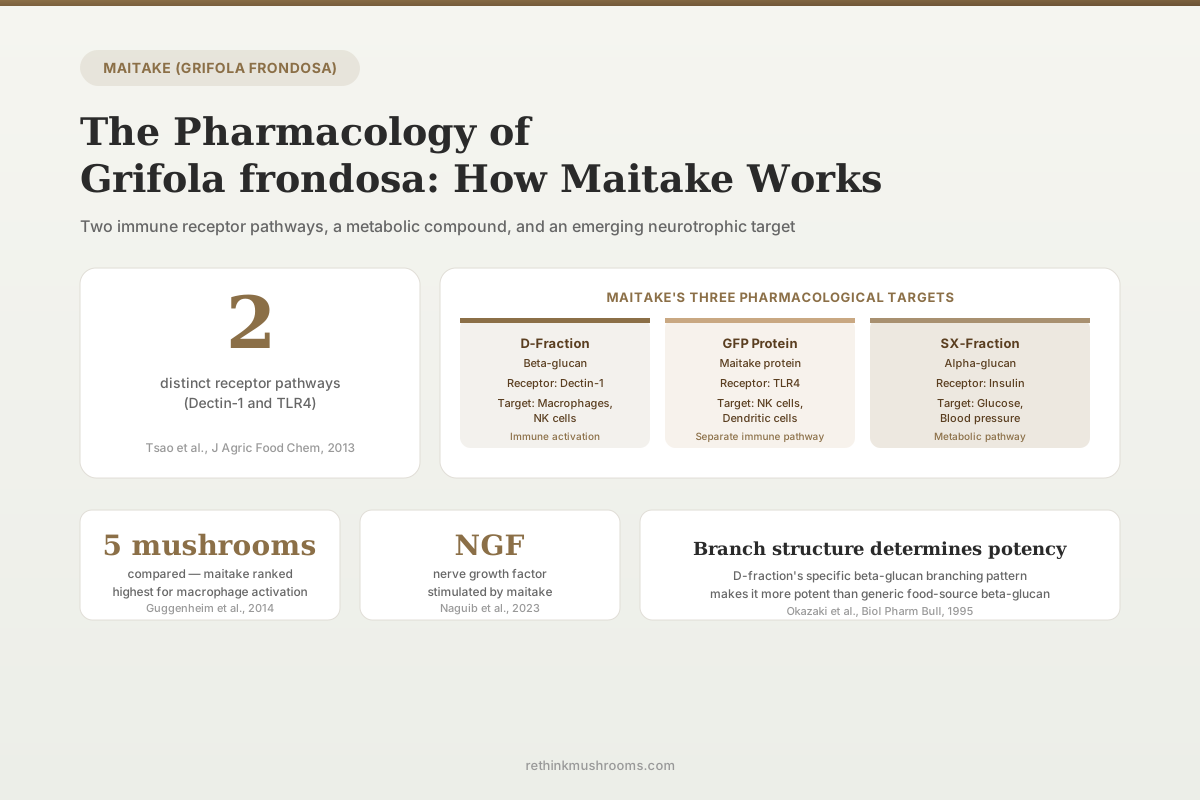
2 distinct receptor pathways
Maitake activates immunity through two separate molecular routes: its D-fraction beta-glucan signals through one receptor on immune cells, while a separate maitake protein triggers immunity through a completely different one.
Tsao et al., J Agric Food Chem, 2013
5 mushrooms
compared, maitake ranked strongest for macrophage activation (Guggenheim 2014)
NGF
nerve growth factor stimulated by maitake in a 2023 neurotrophic review
3 systems
immune, metabolic, and neurotrophic pharmacological targets documented
Tsao et al., J Agric Food Chem, 2013
 View as image ↗
Most articles about maitake describe what it does without explaining how. The immune benefits are listed. The blood sugar effects are mentioned. The standard narrative describes maitake as a single thing that acts on a single system. The actual pharmacology is more interesting than that. Maitake contains at least three classes of compounds that work through three mechanically distinct routes in the body. Its primary immune compound (called D-fraction) binds to one receptor on immune cells. A separate maitake protein activates immunity through a completely different receptor. And a third compound class, the SX-fraction alpha-glucan, operates on metabolism without touching the immune pathway at all. How does maitake mushroom work at the pharmacological level is a question with a multi-part answer. For a broader introduction to maitake, see What Is Maitake Mushroom? The "Dancing Mushroom" Explained.
Key Takeaways
- Maitake's D-fraction beta-glucan activates immune cells by binding to Dectin-1, a receptor that recognizes specific beta-glucan structures and triggers macrophage and NK cell responses.
- A separate maitake protein (called GFP) activates immune cells through a completely different receptor called TLR4, independent of the D-fraction pathway (Tsao et al., 2013).
- Vetvicka and Vetvickova (2014) showed maitake extract strongly stimulated both cellular and humoral immunity, increasing NK cell activity, phagocytosis, and secretion of immune signaling molecules including IL-6, IL-12, and interferon-gamma.
- The specific branching structure of D-fraction's beta-glucan (a long chain backbone with side branches) determines how strongly it activates macrophages; simpler beta-glucan structures from food sources are less potent (Okazaki et al., 1995).
- A 2023 mini-review documented maitake's neurotrophic properties: stimulation of nerve growth factor, anti-inflammatory activity in the nervous system, and potential inhibition of beta-amyloid accumulation (Naguib et al., 2023).
- A 2009 systematic review by Ulbricht and colleagues confirmed that the immune evidence is the best-supported of maitake's activities; antidiabetic and antihypertensive evidence is promising but rests largely on animal and small clinical data.
Maitake Activates Immunity Through Two Separate Molecular Routes
Most discussions of maitake immunopharmacology focus on one compound: D-fraction, the protein-bound beta-glucan polysaccharide that has been studied since the 1980s. D-fraction is real and well-documented. But it is not the only way maitake activates immune cells.
In 2013, Tsao and colleagues characterized a novel protein extracted from maitake (called GFP, for Grifola frondosa protein).[2] This protein is distinct from D-fraction: it is not a polysaccharide, not a beta-glucan, and not detected by the beta-glucan measuring assays used to standardize D-fraction supplements. In mouse experiments, GFP directly activated natural killer cells (the immune system's fast-response "killer cells" that target abnormal cells without prior instruction) and induced the maturation of dendritic cells, which are the immune scouts that detect threats and direct other immune cells to respond.
The receptor that GFP uses to trigger these responses is called TLR4, short for toll-like receptor 4. Cover "TLR4" and the sentence still works: GFP triggers these responses through a specific sensor on the surface of immune cells. D-fraction uses a different sensor, called Dectin-1, which recognizes the structural features of beta-glucan chains. These are two independent alarm systems, activated by two different maitake molecules.
The practical significance: a supplement standardized for D-fraction content (or for beta-glucan percentage) does not capture the GFP protein pathway. Both compounds require their own measurement to confirm presence. Most supplement labels do not account for this.
What Happens to Immune Cells When D-Fraction Activates the Dectin-1 Receptor
Dectin-1 is a receptor found primarily on macrophages (the immune system's large cells that engulf and destroy pathogens and cellular debris), dendritic cells, and neutrophils. When D-fraction's beta-glucan binds to Dectin-1, it sets off a cascade inside the cell.
Vetvicka and Vetvickova tested what this cascade looks like in practice, giving short-term oral maitake extract to mice and measuring the downstream immune effects.[3] The results showed stimulation across both arms of the immune system. Cellular immunity increased: NK cell activity went up, and the rate at which immune cells engulf pathogens (phagocytosis) increased. Humoral immunity also increased, measured by changes in antibody-related responses. Chemical messengers called cytokines, specifically IL-6, IL-12, and interferon-gamma, were secreted at higher levels. CD11b, a surface protein that marks activated immune cells ready for combat, was upregulated on neutrophils in a dose-dependent pattern.
The key phrase there is dose-dependent: more extract produced more activation, up to a point. This is consistent with a receptor-mediated mechanism rather than a nonspecific irritant effect.
In cancer patients, not just in mice, Kodama and colleagues found that oral D-fraction significantly increased NK cell activity compared to baseline measurements.[1] This is one of the relatively few pieces of human clinical data in the maitake immune literature. The study was not blinded or placebo-controlled, so it cannot rule out expectancy effects, but it does confirm that the immunostimulation documented in animal studies also shows up in measurements taken from actual patients.
Why Maitake's Beta-Glucan Structure Is More Potent Than Generic Beta-Glucan
Beta-glucan is not one thing. Oats contain beta-glucan. Yeast cell walls contain beta-glucan. Maitake contains beta-glucan. They are chemically related but structurally different, and the structural differences determine how strongly they activate immune cells.
Okazaki and colleagues established the structure-activity relationship through in vitro experiments, systematically varying the branching patterns of different beta-glucans and measuring how effectively each one triggered cytokine production in macrophages.[4] The finding: the specific branching geometry determines immunostimulatory potency. D-fraction's beta-glucan has a long backbone with side branches at regular intervals, a pattern that fits the Dectin-1 receptor's recognition geometry particularly well. Simpler beta-glucan structures, like those found in oat bran, have different branching patterns that produce weaker macrophage responses.
This is why the supplement industry's generic use of "beta-glucan" on labels is pharmacologically imprecise. A supplement listing "beta-glucan content" without specifying the source and structural type is not telling you whether it contains the specific molecular structure that drives D-fraction's immune effects. For a detailed breakdown of D-fraction versus other maitake fractions, see Maitake Bioactive Compounds: D-Fraction, MD-Fraction, and Beta-Glucans.
How Maitake Compares to Other Medicinal Mushrooms for Immune Activation
Guggenheim and colleagues published a review comparing the immune-modulating activities of five major medicinal mushrooms: Maitake, Reishi, Shiitake, Turkey Tail, and Cordyceps.[5] Each mushroom has documented immune effects, but they are not equivalent. The review positioned maitake as particularly strong for macrophage activation and direct antitumor immune activity, compared to Reishi (which has more anti-inflammatory and adaptogenic evidence) and Turkey Tail (which has stronger evidence for dendritic cell and T-cell activation in oncology settings).
The comparative framing matters for understanding what maitake is and isn't. Maitake's pharmacological profile is not interchangeable with other mushrooms even when they are all described as "immune boosters" on supplement labels. The receptor pathways are different, the compound structures are different, and the downstream immune cell responses differ accordingly.
For maitake specifically, the macrophage activation story is the most mechanistically detailed. The D-fraction beta-glucan binds Dectin-1, the GFP protein binds TLR4, macrophages and NK cells respond. The cascade is relatively well-characterized compared to many botanical supplement mechanisms.
For maitake's immune health applications in detail, see Maitake and Immune Health: How It Activates Immune Cells.
The SX-Fraction: A Completely Separate Metabolic Mechanism
D-fraction and the GFP protein are both immune-oriented compounds. The SX-fraction is neither. It is an alpha-glucan glycoprotein, structurally distinct from D-fraction's beta-glucan, and its primary documented effects are metabolic rather than immunological.
Camilleri and colleagues, in a 2024 comprehensive review of maitake's therapeutic potential, identified the SX-fraction as the compound responsible for maitake's antidiabetic and antihypertensive effects, distinct from the D-fraction immunomodulatory pathway.[8] The SX-fraction activates insulin receptors and reduces insulin resistance, a mechanism consistent with blood glucose lowering. It does not activate Dectin-1 or TLR4.
Ulbricht and colleagues, in a systematic review, noted that the antidiabetic and antihypertensive evidence for maitake is "promising but limited"; there are animal studies with positive results and small clinical observations, but no large controlled trials establishing clinical efficacy for metabolic conditions.[6]
The fraction-specific distinction is practically significant: a product standardized for D-fraction for immune support may have minimal SX-fraction content and thus minimal metabolic activity. The compound driving immune effects is not the same compound driving glucose effects. For more on the glycemic research, see Maitake and Blood Sugar: Research on Glycemic Control.
The Neurotrophic Discovery: Maitake and the Brain
Competitors discussing maitake pharmacology cover the immune and metabolic pathways. None cover the emerging third area: neurotrophic activity.
Naguib and colleagues published a 2023 mini-review documenting that maitake exhibits neuroprotective effects through several mechanisms.[7] The review documented:
- Stimulation of nerve growth factor (NGF): NGF is a protein that nerve cells need to grow, survive, and maintain their connections. Maitake appears to stimulate its production, a mechanism also investigated in lion's mane mushroom (via the hericenones erinacines), but through a different chemical route.
- Anti-inflammatory effects in the nervous system: Neuroinflammation is increasingly recognized as a contributor to cognitive decline. Maitake's anti-inflammatory compounds appear to act in neural tissue.
- Anti-beta-amyloid activity: Beta-amyloid is the sticky protein that clumps together in the brains of people with Alzheimer's disease. Maitake extracts showed inhibitory activity against beta-amyloid accumulation in preclinical models.
- Promotion of new nerve cell growth (neurogenesis): Maitake appears to support the formation of new neurons, particularly in the hippocampus, the brain region most important for memory.
The 2023 review is a mini-review, not a clinical trial. Its evidence is preclinical, and the neurotrophic research on maitake is several decades behind the immune research. What it documents is the biological plausibility of cognitive applications, not clinical efficacy. But it identifies maitake as a candidate for cognitive research in a way no competitor has yet reported.
The 2024 comprehensive review by Camilleri and colleagues confirmed this trajectory, listing neurotrophic and even cosmetic applications among maitake's emerging research directions.[8]
What the Evidence Actually Looks Like: Strong in the Lab, Thin in Humans
Understanding maitake's pharmacology requires holding two things at once: the mechanisms are relatively well-characterized, and the human clinical evidence is sparse.
Ulbricht and colleagues graded the evidence in their systematic review by study quality.[6] The immune effects are the best-supported, with mechanistic studies in multiple model systems and at least some human clinical data (including Kodama 2003's NK cell study in cancer patients). The antidiabetic and antihypertensive evidence is "promising" in animal models but lacks adequately powered randomized controlled trials in humans. The neurotrophic evidence (Naguib 2023) is entirely preclinical.
This does not mean the mechanisms are uncertain. It means the clinical translation has not been rigorously tested. Receptor binding, cytokine release, and NK cell activation have been measured across multiple studies by independent research groups. The question is not whether these mechanisms exist in model systems. The question is whether oral supplementation in humans produces the same effects at the doses and in the populations studied.
Most of the mechanistic work reviewed here uses purified fractions (D-fraction, GFP protein extract) rather than whole mushroom powder. Whole maitake supplements vary considerably in D-fraction content, depending on extraction method and whether fruiting body or mycelium is used. For a guide to what matters in a maitake supplement label, see Grifola frondosa D-Fraction and MD-Fraction: Understanding Maitake's Key Extracts. For the question of fruiting body versus mycelium quality, see Fruiting Body vs. Mycelium: Which Makes a Better Supplement?.
The Bottom Line
Maitake's pharmacology is more mechanistically differentiated than most coverage suggests. Its D-fraction beta-glucan activates immune cells via the Dectin-1 receptor, while a separate maitake protein (GFP) triggers a parallel immune response via TLR4. The specific branching structure of D-fraction's beta-glucan explains why it is more potent than generic food-source beta-glucans. A third compound class, the SX-fraction alpha-glucan, operates on metabolic pathways without touching the immune system. An emerging fourth area, neurotrophic activity, includes NGF stimulation and anti-beta-amyloid properties documented in preclinical models. The immune mechanisms are the best-characterized and have some human clinical support; the metabolic and neurotrophic areas remain at earlier evidence stages.
Frequently Asked Questions
Sources & References
- 1RTHM-00112·Kodama, Noriko et al. (2003). “Effect of Maitake (Grifola frondosa) D-Fraction on the activation of NK cells in cancer patients..” Journal of medicinal food.Study breakdown →PubMed →↩
- 2RTHM-00558·Tsao, Yao-Wei et al. (2013). “Characterization of a novel maitake (Grifola frondosa) protein that activates natural killer and dendritic cells and enhances antitumor immunity in mice..” Journal of agricultural and food chemistry.Study breakdown →PubMed →↩
- 3RTHM-00654·Vetvicka, Vaclav et al. (2014). “Immune-enhancing effects of Maitake (Grifola frondosa) and Shiitake (Lentinula edodes) extracts..” Annals of translational medicine.Study breakdown →PubMed →↩
- 4RTHM-00017·Okazaki, M et al. (1995). “Structure-activity relationship of (1-->3)-beta-D-glucans in the induction of cytokine production from macrophages, in vitro..” Biological & pharmaceutical bulletin.Study breakdown →PubMed →↩
- 5RTHM-00323·Guggenheim, Alena G et al. (2014). “Immune Modulation From Five Major Mushrooms: Application to Integrative Oncology..” Integrative medicine (Encinitas.Study breakdown →PubMed →↩
- 6RTHM-00319·Ulbricht, Catherine et al. (2009). “Maitake mushroom (Grifola frondosa): systematic review by the natural standard research collaboration..” Journal of the Society for Integrative Oncology.Study breakdown →PubMed →↩
- 7RTHM-01759·Naguib, Adrina Mohamad et al. (2023). “Maitake Medicinal Mushroom, Grifola frondosa (Agaricomycetes), and Its Neurotrophic Properties: A Mini-Review..” International journal of medicinal mushrooms.Study breakdown →PubMed →↩
- 8RTHM-01862·Camilleri, Emma et al. (2024). “Unveiling the full spectrum of maitake mushrooms: A comprehensive review of their medicinal, therapeutic, nutraceutical, and cosmetic potential..” Heliyon.Study breakdown →PubMed →↩