Maitake and Blood Pressure
21 mmHg
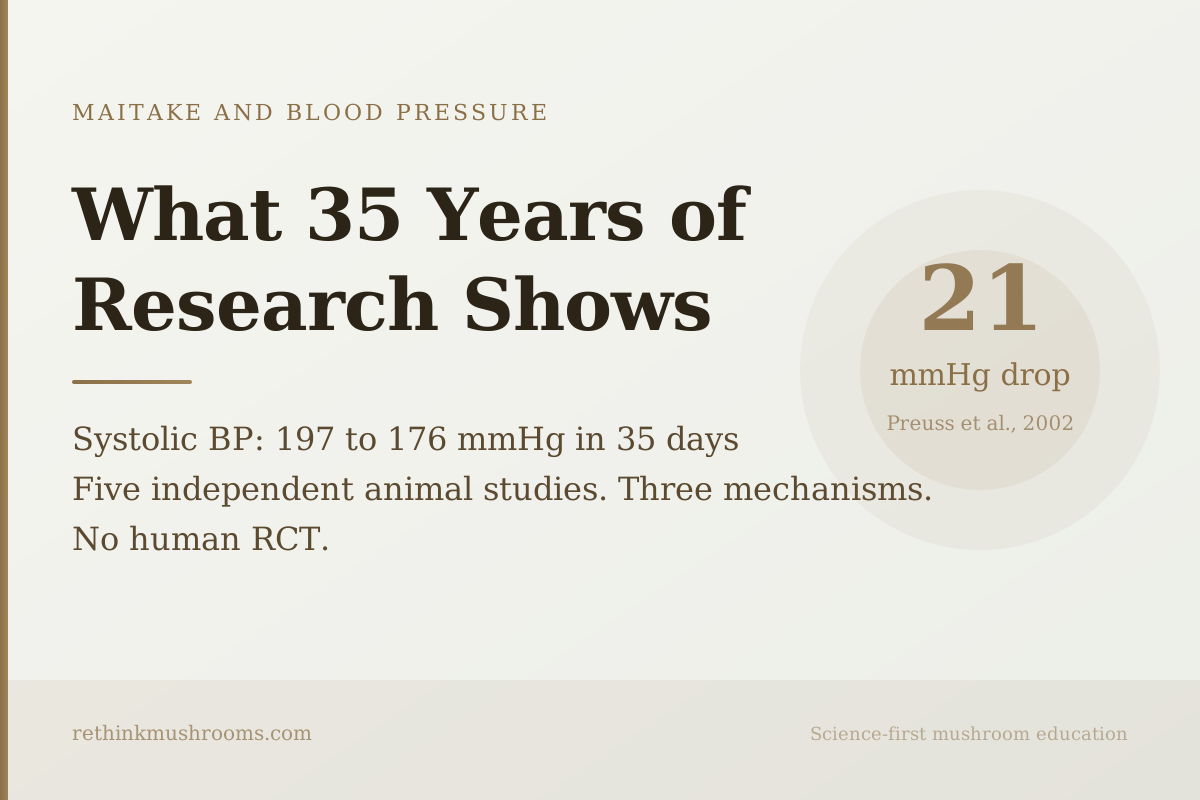
Whole maitake powder cut systolic blood pressure by 21 points in hypertensive rats within 35 days. This result has been replicated across five independent animal studies spanning 35 years.
Preuss et al., Molecular and Cellular Biochemistry, 2002
1988
year the BP-active fruit body fraction was first isolated
5+
independent animal studies confirm blood pressure reduction
0 RCTs
no human clinical trial has been conducted
Preuss et al., Molecular and Cellular Biochemistry, 2002
 View as image ↗
In 2002, a research team at Georgetown University fed whole maitake mushroom powder to rats with severe, stable high blood pressure and measured their systolic pressure after 35 days. It dropped from 197 to 176 mmHg, a 21-point reduction that was statistically robust (p<0.001).[1] Maitake blood pressure research didn't start there, but this is the number most often cited, and for good reason: it was the most precise quantification of an effect that three independent research groups had already documented across 15 years of prior work.
The question this article addresses is simple: what does the evidence actually show, and where does it stop? The short answer is that animal studies are consistent, the mechanisms are well-characterized, and no human randomized controlled trial exists. That gap is important and is not minimized here.
This article covers the full research record: how the evidence accumulated from 1987 to 2024, the three distinct biological routes through which maitake appears to reduce blood pressure, and the 2010 experiment that confirmed the mechanism through a direct pharmacological test.
For a broader introduction to maitake and its bioactive compound classes, see What Is Maitake Mushroom? The Dancing Mushroom Explained.
Key Takeaways
- Preuss et al. (2002) found whole maitake powder cut systolic blood pressure from 197 to 176 mmHg in 35 days in genetically hypertensive rats (p<0.001)
- The first evidence of maitake's antihypertensive effects was published in 1987; the specific blood-pressure-active fraction in the fruit body was isolated in 1988
- A 2010 Preuss study used a losartan challenge to directly confirm that maitake works through the renin-angiotensin hormone system, the same pathway targeted by ACE inhibitor and ARB drug classes
- Three overlapping mechanisms have been documented: direct ACE enzyme inhibition, broader renin-angiotensin system suppression, and nitric oxide pathway enhancement
- The 2023 Rauf systematic review in Phytotherapy Research identified maitake among the most studied edible mushrooms for hypertension management and confirmed multiple converging antihypertensive mechanisms
- No randomized controlled trial exists in humans; the Krittanawong 2021 cardiovascular systematic review describes mushroom blood pressure evidence as "potential benefit," not an established effect
21 mmHg in 35 Days: The Number That Defines This Research Area
The spontaneously hypertensive rat, or SHR, is the standard model for antihypertensive research. SHR rats are not given high blood pressure by researchers. They are a genetically inbred strain that develops high blood pressure reliably from birth, with systolic pressures rising progressively until they stabilize in adulthood at levels roughly analogous to severe human hypertension. Researchers use SHR because the hypertension is stable and predictable, and because the underlying mechanism, elevated activity in the hormone system that regulates blood vessel tone, is similar to essential hypertension in humans.
Preuss and colleagues (2002) divided SHR rats into treatment groups and fed them three different maitake preparations separately: whole maitake mushroom powder, the ether-soluble (ES) fraction extracted from it, and the SX-fraction. The ether-soluble fraction is essentially a concentration of the fat-soluble compounds in the mushroom, including the ACE-inhibitory components that a 1988 study had already identified as the primary antihypertensive fraction. The SX-fraction is a polysaccharide-protein complex with a different chemical profile. After 35 days, the whole powder group showed systolic pressures averaging 176 mmHg, down from a starting average of 197 mmHg. The ether-soluble fraction produced the largest individual reduction across the three preparations.[1]
The 2021 Deng comprehensive review of Grifola frondosa bioactives confirms that whole maitake preparations contain multiple compound classes with overlapping cardiovascular activity: long-chain sugars called polysaccharides (including the D-fraction and MD-fraction studied extensively for immune effects), ether-soluble lipophilic compounds, and protein-derived peptides.[7] This is relevant to interpreting Preuss 2002: whole mushroom powder is not a single compound. Its blood pressure effect likely reflects contributions from several of these classes acting through different routes.
For a closer look at what these fractions are and how they compare, see The Pharmacology of Grifola frondosa: How Maitake Works.
How the Evidence Was Built: The Research Trail from 1987 to 2002
The Preuss 2002 result was not the beginning of maitake blood pressure research. It was the culmination of 15 years of accumulating evidence from three independent research groups.
The earliest published evidence comes from Kabir and colleagues at the Tokyo University of Agriculture and Technology. Their 1987 paper tested dietary maitake and shiitake in spontaneously hypertensive rats and found that both mushrooms significantly reduced systolic blood pressure. The maitake-fed animals also showed reductions in total plasma cholesterol and triglycerides, an early indication that maitake's cardiovascular effects extended beyond blood pressure alone into lipid metabolism.[2]
The following year, Adachi and colleagues published what became the foundational paper for understanding how maitake reduces blood pressure. Where Kabir's team had measured a dietary effect using whole mushroom, Adachi's team asked a more specific question: which part of the maitake fruit body is actually responsible? They systematically extracted and fractionated different portions of the mushroom and tested each separately for antihypertensive activity. The ether-soluble fraction was the primary active component.[3]
This 1988 paper is almost never cited in supplement content, but it established something important: the blood pressure-lowering activity was in the fruit body, the part of the mushroom you eat, and it resided in a specific chemical fraction rather than being a general dietary effect of eating more plant material. That distinction matters for understanding which preparations carry the most antihypertensive evidence.
Kabir's group followed up in 1989 with a replication study. Independent animals, same SHR model, same dietary maitake intervention. Systolic and diastolic blood pressure both decreased in maitake-fed animals.[4] This was not a follow-up with the same animals from 1987. It was a new experiment with a fresh cohort of rats, run to confirm that the 1987 finding was reproducible.
By the time Preuss and colleagues ran their 2002 experiment, three independent groups working over 15 years had already observed maitake's blood pressure effect in the same rat model across four separate experiments. What the 2002 Preuss paper added was precise quantification (the 197 to 176 mmHg result), testing of multiple preparations side by side, and a pointer toward the renin-angiotensin system as the primary mechanism, which the 2010 follow-up study would confirm directly.
Three Mechanisms Researchers Have Identified
Animal studies and mechanistic reviews have identified at least three distinct biological routes through which maitake compounds appear to reduce blood pressure. The 2023 Rauf systematic review, published in Phytotherapy Research, synthesized the mushroom-hypertension literature and identified converging antihypertensive pathways across edible mushroom species, with maitake among the most studied examples.[6] The 2021 Deng review of maitake bioactives provides the Grifola-specific mechanistic detail.[7]
ACE inhibition. ACE stands for angiotensin-converting enzyme, the enzyme that turns angiotensin I (an inactive hormone) into angiotensin II (a potent vasoconstrictor that narrows blood vessels and raises pressure). Blocking this enzyme is how a major class of prescription blood pressure drugs works, including lisinopril and enalapril. Maitake's ether-soluble fraction has documented ACE inhibitory activity. The Deng 2021 review identifies ACE inhibitory peptides among the compounds isolated from Grifola frondosa, meaning the mushroom contains protein fragments that physically block this enzyme the same way pharmaceutical ACE inhibitors do.[7] The 2002 Preuss result, with the ES fraction showing the strongest blood pressure reduction, is consistent with ACE inhibition as a primary mechanism in that fraction.[1]
Broader renin-angiotensin system suppression. The renin-angiotensin system (RAS) is a multi-step hormone cascade that controls blood vessel tone and blood pressure. ACE inhibition is one intervention point in that system, but maitake's effect appears to extend beyond just blocking the ACE conversion step. The Preuss 2010 study showed that animals treated with maitake had measurably reduced serum ACE activity as a biomarker. And the losartan challenge, discussed in the next section, provided direct pharmacological evidence that the overall RAS tone was reduced in maitake-treated animals, not just the activity of one enzyme within the system.[5]
Nitric oxide pathway. The 2023 Rauf review describes nitric oxide-related mechanisms as contributing to edible mushroom antihypertensive effects, and the Deng 2021 review corroborates this across maitake fractions.[6][7] Nitric oxide is the molecule blood vessel walls release to relax and widen, reducing pressure through the vessel itself rather than through the RAS hormone system. This pathway is distinct from ACE inhibition and may explain why different maitake fractions show antihypertensive activity even when they have different ACE inhibitory potency.
For a deeper look at the ACE inhibition pathway specifically, see Grifola frondosa and ACE Inhibition: Natural Blood Pressure Support. For the full renin-angiotensin system story, see Maitake and Renin-Angiotensin System Modulation: Blood Pressure Mechanisms.
The 2010 Smoking Gun: Aging Rats and the Losartan Challenge
The most mechanistically rigorous study in this body of research is not the often-cited Preuss 2002 paper. It is the 2010 follow-up by the same group, published in the International Journal of Medical Sciences, and it contains the strongest direct evidence that maitake's antihypertensive mechanism runs through the renin-angiotensin system.[5]
The 2010 study used aging female rats, not the classic SHR model. As female rats age, their blood pressure rises progressively. This is a different model than the severe, genetically fixed hypertension in SHR rats, and it is arguably more relevant to the pattern of age-related blood pressure elevation common in older adults. The experiment ran for four months, tracking whether maitake extracts could slow or stop that progression.
Maitake-treated animals showed significantly attenuated progression of systolic hypertension over the four months. But the key contribution of the study is what happened next: a losartan challenge.
At the end of the treatment period, researchers gave all animals a single dose of losartan, a prescription angiotensin receptor blocker (ARB). Losartan reduces blood pressure by blocking the receptor on blood vessel walls that angiotensin II activates. It cuts off the final step in the RAS cascade. The challenge works as a mechanism test through the following logic: if maitake had been reducing blood pressure by suppressing RAS activity, the maitake-treated animals should already have a quieter RAS. A dose of losartan should then produce a smaller additional blood pressure drop in those animals, because there is less RAS activity left to block. This is exactly what happened.
Maitake-treated rats showed a smaller blood pressure response to losartan than untreated control rats. Their renin-angiotensin system was already partially suppressed. This is not circumstantial evidence. It is a direct pharmacological test of mechanism, the same approach drug researchers use to confirm that a compound is working through a specific biological pathway.[5]
Preuss 2010 also reported decreases in serum ACE activity in maitake-treated animals, alongside improvements in triglyceride levels and insulin sensitivity. The blood pressure effects appeared alongside broad metabolic changes, consistent with the 1987 Kabir finding that also showed cholesterol and triglyceride reductions alongside the blood pressure effect.[2]
This is the study that competitor content almost never cites, despite being the most direct mechanistic evidence in the maitake blood pressure literature. For the full picture of how maitake interacts with cardiovascular risk factors beyond blood pressure, see Maitake and Cardiovascular Risk Reduction and Maitake for Hypertension: Clinical and Preclinical Evidence.
What the Modern Reviews Say and Where the Evidence Stops
Three systematic and comprehensive reviews published between 2021 and 2024 provide the current synthesis of where maitake blood pressure research stands.
The Krittanawong 2021 systematic review, published in The American Journal of Medicine, analyzed seven prospective cohort studies on mushroom consumption and cardiovascular outcomes. Its conclusion was deliberately measured: mushroom consumption shows "potential health benefit" for blood pressure and lipid profiles, but the evidence did not reach a threshold for an established effect.[9] This framing is appropriate: systematic reviews of observational studies cannot establish that eating mushrooms causes blood pressure reduction, and most of the studies in that review covered mushroom consumption broadly rather than maitake specifically.
The Rauf 2023 systematic review in Phytotherapy Research focused specifically on edible mushrooms as functional foods for hypertension management and identified maitake as among the most studied species in this context.[6] The review's mechanistic synthesis, covering ACE inhibition, RAS modulation, potassium-mediated vasodilation, and antioxidant activity, provides the current best framework for understanding why animal studies consistently find the antihypertensive effect. The 2024 comprehensive review of maitake pharmacology synthesizes the full evidence base from 1987 to 2024 and affirms antihypertensive activity as one of the better-characterized preclinical effects of Grifola frondosa.[8]
None of these reviews report a human randomized controlled trial on maitake and blood pressure, because none has been conducted. The evidence base for this specific effect is entirely preclinical: five animal model studies conducted between 1987 and 2012, the mechanistic confirmation from the 2010 losartan challenge, and systematic reviews synthesizing those findings.
The absence of a human trial after 35 years of consistent animal evidence requires explanation. Several overlapping problems make this translation difficult. Dosing is not standardized across maitake preparations, and whole mushroom powder, D-fraction, SX-fraction, and ether-soluble fraction are not interchangeable. Funding for non-patentable food ingredients is limited compared to pharmaceutical development. And the regulatory pathway for making a specific blood pressure health claim about a food ingredient requires clinical evidence that no sponsor has yet funded. The animal evidence is real; the clinical gap is also real.
Maitake also contains ergothioneine, an antioxidant concentrated uniquely in mushrooms, which has its own documented cardiovascular protective effects. For that dimension of mushroom heart health, see Ergothioneine and Cardiovascular Disease: The Mushroom-Exclusive Antioxidant.
The honest state of the evidence is this: if you are a researcher, the preclinical case for maitake as an antihypertensive is among the stronger ones in the functional food literature, with a replicated effect across five animal studies and a mechanism confirmed by pharmacological challenge. If you are a person with high blood pressure, no human clinical trial tells you whether this translates. That gap is worth knowing, because no competitor content in this space acknowledges it clearly.
The Bottom Line
Five independent animal studies conducted between 1987 and 2012 consistently document maitake mushroom's ability to reduce systolic blood pressure in hypertensive rat models, with a 21 mmHg reduction in 35 days being the most cited result. The 2010 Preuss losartan challenge study provided direct pharmacological confirmation that the mechanism runs through the renin-angiotensin system. Three overlapping pathways have been identified: ACE inhibition, broader RAS suppression, and nitric oxide enhancement. The 2023 Rauf systematic review and 2024 comprehensive review affirm these findings as the current best summary of the literature. No randomized controlled trial in humans has been conducted.
Frequently Asked Questions
Sources & References
- 1. Source details for this reference are not yet available.
- 2. Source details for this reference are not yet available.
- 3. Source details for this reference are not yet available.
- 4. Source details for this reference are not yet available.
- 5. Source details for this reference are not yet available.
- 6. Source details for this reference are not yet available.
- 7. Source details for this reference are not yet available.
- 8. Source details for this reference are not yet available.
- 9. Source details for this reference are not yet available.