Maitake and Blood Pressure
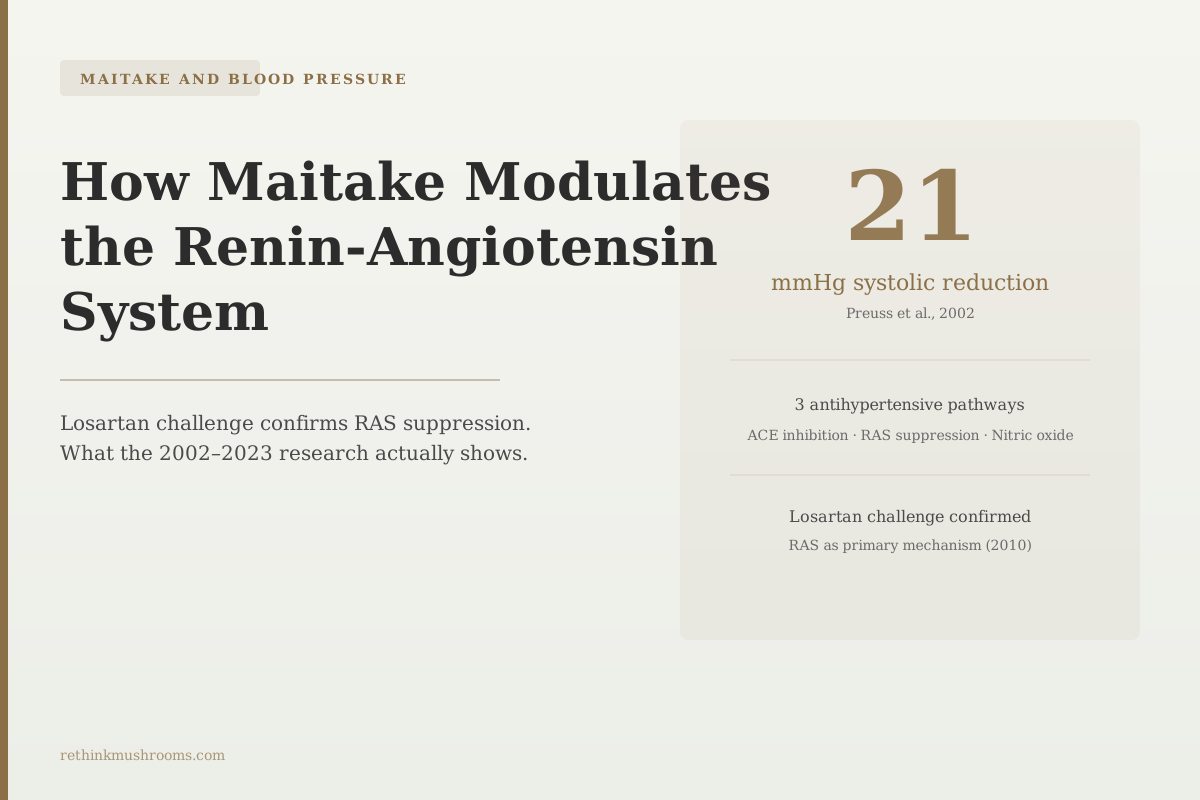
21 mmHg
Whole maitake powder dropped systolic blood pressure from 197 to 176 mm Hg within 35 days in a 2002 study, with reduced serum ACE activity confirmed as the mechanism.
Preuss et al., Molecular and Cellular Biochemistry, 2002
3 pathways
ACE inhibition, RAS suppression, and nitric oxide enhancement
Losartan test
2010 challenge confirmed RAS as the primary mechanism
No human RCTs
All mechanism data comes from animal models to date
Preuss et al., Molecular and Cellular Biochemistry, 2002
 View as image ↗
Most accounts of maitake and blood pressure stop at "it works like a natural ACE inhibitor." That's accurate but incomplete. The mechanism runs deeper, and a 2010 experiment confirmed exactly how deep.
Researchers gave aging hypertensive rats maitake extract for four months. Then they administered losartan, a drug that directly blocks the renin-angiotensin system (RAS), the hormonal cascade that controls blood pressure by regulating vessel constriction and kidney fluid retention. In untreated rats, losartan produced a substantial blood pressure drop. In the maitake-treated rats, the drop was smaller. The maitake had already suppressed the RAS; the drug had less work to do.
That experiment is the clearest mechanistic evidence yet for how the maitake renin angiotensin system interaction actually works. This article traces the full picture, from the first active fraction isolated in 1988 to the 2023 systematic review that mapped the molecular details. For the broader overview of what maitake is and how it works, see What Is Maitake Mushroom. For the summary of blood pressure evidence across study types, see Maitake and Blood Pressure: Antihypertensive Research.
Key Takeaways
- The 2010 Preuss et al. study confirmed RAS involvement through a losartan challenge: maitake-treated rats showed less blood pressure reduction from the RAS-blocking drug, meaning their renin-angiotensin system was already suppressed before the drug arrived
- Maitake's ether-soluble fraction reduced serum ACE activity and dropped systolic blood pressure from 197 to 176 mm Hg within 35 days in a 2002 Preuss animal study (p<0.001)
- The SX-fraction operates through a different route: nitric oxide system enhancement causes blood vessels to dilate rather than targeting ACE directly
- ACE inhibitory peptides from maitake's protein content block the ACE enzyme directly at its active site, a distinct mechanism from the broader serum ACE activity reduction documented in whole-fraction studies
- The 2023 Rauf systematic review in Phytotherapy Research identifies five overlapping antihypertensive mechanisms in maitake: ACE inhibition, RAS modulation, potassium-mediated vasodilation, antioxidant activity, and anti-inflammatory pathways
- No human randomized controlled trial has tested which specific maitake fraction or preparation most effectively targets the RAAS — all mechanistic data to date comes from animal models
What the Renin-Angiotensin System Does and Why It Matters for Blood Pressure
Blood pressure is not a fixed number set by the heart. A hormonal feedback loop called the renin-angiotensin-aldosterone system, or RAAS, constantly adjusts it based on blood volume, sodium levels, and signals from the kidneys.
The loop works in sequence. When blood pressure drops or sodium levels fall, the kidneys release an enzyme called renin. Renin converts a circulating blood protein into a molecule called angiotensin I. A second enzyme, ACE (angiotensin-converting enzyme), converts angiotensin I into angiotensin II, the active signaling molecule. Angiotensin II does three things simultaneously: it tells blood vessels to constrict, it triggers the adrenal glands to release aldosterone (a hormone that makes the kidneys retain sodium and water), and it signals the nervous system to increase cardiovascular output. Blood pressure rises.
In hypertension, this loop runs chronically overactive. Vessels stay constricted, the kidneys hold excess fluid, or both. The result is persistently elevated blood pressure that the body treats as its new normal.
Two classes of blood pressure drugs work by interrupting this loop at different points. ACE inhibitors block the enzyme that produces angiotensin II. Angiotensin receptor blockers (ARBs) block the receptor where angiotensin II binds to trigger its effects. Losartan is an ARB. Its role in the 2010 Preuss study was to probe exactly which point in this loop maitake was acting on.[6]
Maitake extracts reduce serum ACE activity and dampen overall RAAS activation. The 2010 losartan challenge confirmed this directly: maitake-treated rats showed smaller blood pressure reduction after the ARB drug was given, indicating their renin-angiotensin system was already suppressed before the drug arrived.
The Losartan Challenge: The Experiment That Confirmed Maitake Works Through the RAS
Reducing blood pressure and specifically suppressing the renin-angiotensin system are not the same thing. Blood pressure can fall through many routes: reduced heart rate, vasodilation from nitric oxide, diuretic effects, or reduced nervous system activity. Confirming that the RAS pathway specifically is being suppressed requires a test that isolates it.
Preuss et al. designed exactly that test, published in the International Journal of Medical Sciences in 2010.[3] They gave aging female rats maitake extract for four months and observed that the treated group showed attenuated progression of age-related systolic hypertension. Then they administered losartan to both the maitake group and an untreated control group.
The results separated clearly. Control rats, with their RAAS running at full strength, showed a substantial blood pressure drop from the losartan. Maitake-treated rats showed less reduction from the same dose of the same drug.
What that asymmetry means is specific. Losartan works by blocking angiotensin II receptors. If a substance has already suppressed RAAS activity, adding losartan produces a smaller additional drop in blood pressure, because fewer angiotensin II signals were reaching those receptors in the first place. The maitake-treated rats had reduced RAAS tone before the drug entered the picture. The drug confirmed it.
This type of experiment is called a pharmacological challenge. It is used in preclinical pharmacology to distinguish between substances that lower blood pressure through a specific pathway versus those that produce effects through unrelated routes. The study also directly measured serum ACE activity in the maitake-treated animals and confirmed it was reduced. The losartan challenge provided the functional corroboration.
The same study found that maitake reduced triglycerides and improved insulin sensitivity in the aging female rats alongside the blood pressure effects. The RAAS mechanism was not operating in isolation from metabolic effects, which matters for understanding which populations the data may be most relevant to.
The 1988 Origin: Isolating the Active Fraction From Maitake Fruit Body
The 2010 losartan confirmation followed more than twenty years of investigation that had been tracking the same direction.
Adachi et al. published the first isolation of blood pressure-lowering activity from Grifola frondosa in Chemical and Pharmaceutical Bulletin in 1988.[1] They separated maitake into its chemical components using different solvents and tested each fraction in hypertensive rats. The ether-soluble fraction, the portion that separates out when maitake extract is mixed with an organic solvent, produced the strongest antihypertensive effect. This was foundational work: it established that the blood pressure activity was located in a specific chemical portion of the mushroom, not distributed uniformly throughout it.
Preuss et al. returned to this in 2002, published in Molecular and Cellular Biochemistry.[2] They tested whole maitake powder, the ether-soluble (ES) fraction, and other fractions in spontaneously hypertensive rats (SHR), a strain bred to develop high blood pressure. The ether-soluble fraction produced the most pronounced result: systolic blood pressure fell from 197 to 176 mm Hg within 35 days, a reduction of 21 mm Hg (p<0.001). The study identified alterations in the renin-angiotensin system as the primary mechanism for that fraction.
Whole maitake powder had a more moderate effect. The blood pressure activity was concentrated in the ether-soluble portion. This fraction-specificity matters because it means the mechanism is chemically localized, not a general anti-inflammatory or adaptogenic effect spread across the whole mushroom. For a detailed look at the compound classes found in each maitake fraction, see The Pharmacology of Grifola frondosa: How Maitake Works.
The SX-Fraction's Separate Route: Nitric Oxide and Vasodilation
If the ether-soluble fraction works through ACE and the RAAS, the SX-fraction appears to lower blood pressure through a different mechanism entirely.
Talpur et al. tested both the D-fraction and SX-fraction of maitake in Zucker fatty rats in 2002, published in Molecular and Cellular Biochemistry.[4] Zucker fatty rats develop obesity-linked hypertension alongside metabolic syndrome, making them a model for one of the most common patterns of high blood pressure in humans. Both fractions lowered blood pressure. The SX-fraction additionally improved insulin sensitivity and triglyceride levels. The mechanism was identified as enhancement of the nitric oxide (NO) system.
Nitric oxide is a molecule produced by the inner lining of blood vessels that signals the vessel's muscle layer to relax. When the vessel relaxes, it widens. When it widens, resistance to blood flow drops and blood pressure falls. This is vasodilation, and it is the same fundamental pathway that nitrate-based cardiovascular drugs use. It is entirely separate from ACE inhibition or RAS suppression.
Preuss et al. revisited the SX-fraction in 2012, published in the Journal of the American College of Nutrition, using a diabetic rat model with both elevated blood glucose and high blood pressure.[5] The SX-fraction lowered both blood glucose and blood pressure. Nitric oxide enhancement was again identified as the mechanism for the blood pressure effect. The dual glucose-and-blood-pressure lowering in diabetic models is significant because hypertension and insulin resistance co-occur frequently in metabolic syndrome, and the SX-fraction data suggests a different clinical context from the ether-soluble fraction's RAS activity.
What the Talpur and Preuss 2012 data suggest together is that maitake's antihypertensive effects arise from at least two independent, chemically distinct pathways operating in parallel. The ether-soluble fraction targets the RAS through ACE suppression. The SX-fraction targets vasodilation through NO. These mechanisms don't compete with each other.
The nitric oxide pathway also connects to how the blood vessel lining maintains cardiovascular health more broadly. For the vascular research on mushroom compounds and endothelial nitric oxide production, see Ergothioneine and Endothelial Function: Vascular Research.
ACE Inhibitory Peptides vs. Reduced Serum ACE Activity: Two Separate Things
One distinction that gets missed in nearly all competitor coverage is the difference between two types of ACE-related effects in maitake, which are chemically distinct and operate through different logic.
The first is reduced serum ACE activity. This is what Preuss et al. documented in 2002 and confirmed mechanistically in 2010: the ether-soluble fraction lowered the measurable activity of ACE circulating in the blood.[2][3] This is a systemic effect. Less ACE activity throughout the body means less conversion of angiotensin I to angiotensin II everywhere. The suppression appears to be upstream, with maitake reducing RAAS cascade activation before it reaches the ACE step.
The second is direct ACE inhibitory peptides. These are short protein fragments found in maitake that physically block the ACE enzyme at its active site. The 2023 Rauf systematic review in Phytotherapy Research catalogued both types of evidence and noted that maitake-derived peptides can inhibit ACE with potency values comparable to some pharmaceutical ACE inhibitors.[6] The 2021 Deng et al. review in Foods described how polysaccharide fractions and protein-derived components of Grifola frondosa each contribute separately to the antihypertensive profile.[7]
The conceptual distinction matters. Direct ACE inhibitory peptides block the enzyme the way a molecule fits into an active site, physically preventing it from processing its substrate. Reduced serum ACE activity reflects a broader suppression of the RAAS cascade, with less enzyme produced or activated to begin with. Both routes end at the same place, less angiotensin II reaching its receptors, but they operate at different points in the pathway and through different chemistry.
This also explains why the losartan challenge result is particularly informative. Losartan is not an ACE inhibitor. It blocks the receptor downstream of ACE. The fact that it had a reduced effect in maitake-treated rats means maitake was suppressing the system upstream of where losartan acts, pointing to RAAS-level suppression rather than simple ACE enzyme competition.
What the 2023 Systematic Review Adds to the Mechanism Picture
The 2023 Rauf et al. systematic review in Phytotherapy Research represents the most current synthesis of the edible mushroom and hypertension evidence base, and it maps five distinct antihypertensive pathways with the most precision available in the literature.[6]
Rauf identified the following mechanisms across edible mushrooms including maitake: ACE inhibition by peptides, direct RAS modulation (the systemic RAAS suppression pathway documented by Preuss), potassium-mediated vasodilation, antioxidant activity, and anti-inflammatory pathways. Each is chemically distinct. Each operates at a different point in the blood pressure regulation system.
The potassium mechanism deserves a mention because it is entirely dietary and independent of the biochemical pathways. Maitake is naturally high in potassium, which counteracts sodium's blood-pressure-raising effect in the kidney. Whole food maitake and isolated fractions are likely working through different proportions of all five mechanisms.
The antioxidant and anti-inflammatory pathways operate on longer time scales than ACE suppression. ACE inhibition and nitric oxide enhancement produce relatively acute changes in vessel tension and blood pressure. Anti-inflammatory and lipid-lowering effects accumulate over time and primarily reduce cardiovascular risk at the structural level rather than immediate blood pressure readings. The 2024 comprehensive review in the Journal of Functional Foods noted this temporal distinction explicitly, framing maitake's cardiovascular action as multi-phase.[8]
The 2021 Deng et al. review frames the full scope: Grifola frondosa has documented activity at every level of the cardiovascular risk cascade, covering blood pressure regulation, lipid metabolism, glucose management, and vascular inflammation.[7] The cardiovascular benefit is not a single mechanism but an overlapping set of them. For the cholesterol and atherosclerosis components of that evidence, see Maitake and Cardiovascular Risk Reduction.
Which Maitake Preparation Targets the RAS? What the Evidence Can and Cannot Tell You
The animal evidence clearly distinguishes between fractions. The ether-soluble fraction carries the strongest documented RAS mechanism. The SX-fraction targets nitric oxide and metabolic pathways. Whole maitake powder produces a more moderate, distributed effect across both. But all of these studies used precisely defined laboratory fractions, not the commercial preparations available in the supplement market.
Commercial maitake comes in several forms: whole dried mushroom powder, hot water extracts (which concentrate polysaccharides like beta-glucan), alcohol extracts, and dual water-and-alcohol extracts. The ether-soluble fraction that Adachi isolated in 1988 and that Preuss tested in 2002 is not labeled on any supplement. The SX-fraction is similarly not a standard commercial product. The compounds most directly responsible for the documented RAS effects are not identifiable on a supplement label.
The 2023 Rauf review explicitly names dosage standardization as the central challenge in mushroom antihypertensive research. Different preparations contain different concentrations of active compounds, different polysaccharide profiles, and different peptide fractions, which makes it impossible to translate animal study doses into human-applicable guidance with the evidence currently available.[6]
What the evidence does support is that the preclinical mechanistic case for maitake and the RAS is unusually well-developed by the standards of medicinal mushroom research. The 1988 Adachi fraction identification, the 2002 Preuss ether-soluble fraction data with specific blood pressure numbers, the 2010 losartan challenge confirmation, and the 2023 systematic review synthesis all point consistently in the same direction across three decades of animal research. The gap is human trial data and, specifically, trials using standardized preparations with RAAS-specific endpoints.
For the current state of human versus animal evidence side by side, see Maitake for Hypertension: Clinical and Preclinical Evidence. For the specific ACE inhibitory peptide research, see Grifola frondosa and ACE Inhibition: Natural Blood Pressure Support.
The Bottom Line
Maitake works on the renin-angiotensin system through at least two chemically distinct mechanisms: the ether-soluble fraction suppresses serum ACE activity and reduces RAAS tone (confirmed by the 2010 Preuss losartan challenge), while the SX-fraction enhances nitric oxide production through a separate vasodilation pathway. ACE inhibitory peptides derived from maitake's protein content add a third direct-blocking mechanism documented in the 2023 Rauf systematic review. All mechanistic evidence comes from animal models. No human randomized controlled trial has tested which maitake preparation most effectively targets the RAAS specifically.
Frequently Asked Questions
Sources & References
- 1. Source details for this reference are not yet available.
- 2. Source details for this reference are not yet available.
- 3. Source details for this reference are not yet available.
- 4. Source details for this reference are not yet available.
- 5. Source details for this reference are not yet available.
- 6. Source details for this reference are not yet available.
- 7. Source details for this reference are not yet available.
- 8. Source details for this reference are not yet available.