Ergothioneine & Cardiovascular Health
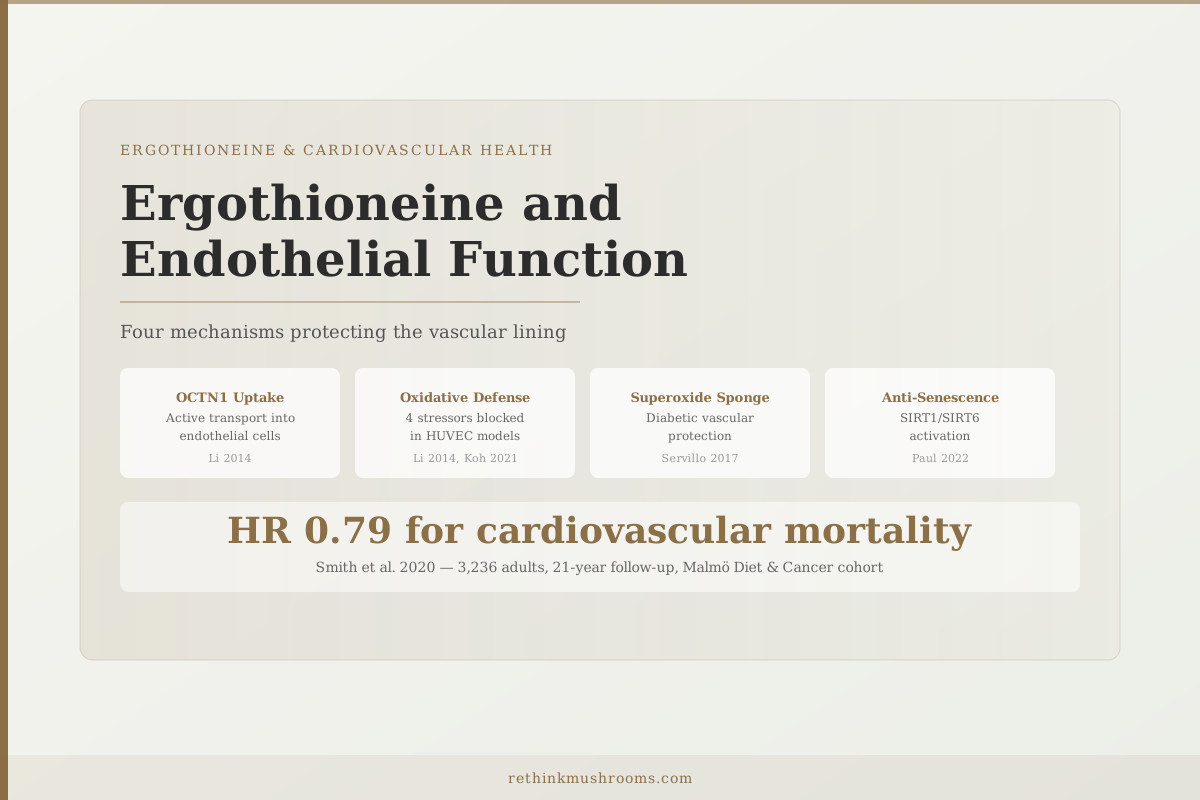
HR 0.79 for CVD mortality
In a 21-year Swedish cohort of 3,236 adults, higher plasma ergothioneine was the strongest metabolomic predictor of lower cardiovascular mortality.
Smith E et al., Heart (British Cardiac Society), 2020
4 stressors
endothelial cells survived via OCTN1 uptake
SIRT1/SIRT6
anti-senescence pathway activated by ergothioneine
4 mechanisms
protecting the vascular lining simultaneously
Smith E et al., Heart (British Cardiac Society), 2020
 View as image ↗
The endothelium is not a passive pipe lining. It is an active tissue, one cell thick, that regulates blood flow, manages inflammation, controls which molecules cross into the vessel wall, and prevents clotting. When the endothelium fails, those controls fail with it. A blood vessel with dysfunctional endothelium is a vessel on its way to atherosclerosis, hypertension, or thrombosis.
Most cardiovascular research focuses on cholesterol, blood pressure, and lifestyle. The endothelium itself, and the specific molecular protection it requires, gets less attention. Ergothioneine changes that conversation. A sulfur amino acid found almost exclusively in mushrooms, ergothioneine is actively transported into endothelial cells, where it appears to protect against four distinct threats simultaneously. For background on what ergothioneine is and why the body went to the trouble of building a dedicated transporter for it, see What Is Ergothioneine? The Longevity Amino Acid. This article focuses on the vascular endothelial biology: the mechanisms, the in vitro data, the animal studies, and the population numbers.
Key Takeaways
- Li 2014 showed endothelial cells pre-loaded with ergothioneine via OCTN1 survived four types of oxidative damage — hydrogen peroxide, paraquat, high glucose, and oxidized LDL — with significantly less cell death than unprotected cells
- Koh 2021 found that 7-ketocholesterol, a cholesterol oxidation product elevated in cardiovascular disease, caused dose-dependent endothelial cell death that ergothioneine significantly attenuated
- Servillo 2017 showed ergothioneine acts as a superoxide sponge in hyperglycemic endothelial cells, with even the resulting oxidation products retaining cytoprotective activity
- Paul 2022 identified SIRT1/SIRT6 activation as a key ergothioneine mechanism — these proteins delay the premature aging of endothelial cells that drives vascular dysfunction
- Gokce 2018 demonstrated in rat aorta that ergothioneine preserved acetylcholine-mediated vascular relaxation against heavy-metal-induced endothelial dysfunction
- Smith 2020 validated these mechanisms against 21 years of human outcomes: higher plasma ergothioneine was associated with HR 0.79 for cardiovascular mortality and HR 0.80 for coronary artery disease
Why Endothelial Dysfunction Is the First Step Toward a Heart Attack
Endothelial dysfunction is the upstream condition that makes most cardiovascular disease possible. Before plaques form, before arteries harden, before clots develop, the endothelium breaks down.
In a healthy state, endothelial cells produce nitric oxide, a signaling molecule that relaxes blood vessel walls and keeps them from becoming sticky. They prevent monocytes — circulating immune cells — from docking to the vessel wall. They maintain a tight barrier between the blood and the surrounding tissue. And they resist the kind of cell death that triggers inflammation.
When oxidative stress damages endothelial cells, those functions erode. Nitric oxide production drops. Surface adhesion molecules go up, giving monocytes somewhere to land. The barrier between blood and tissue weakens. Inflammatory signals amplify. This is endothelial dysfunction — not a disease itself, but the precondition for most cardiovascular disease.
That's why ergothioneine's ability to protect endothelial cells is mechanistically meaningful. It's not acting on a downstream symptom. It's acting on the condition that makes the rest of the disease process possible. The connection between this molecular protection and plaque formation is detailed in Ergothioneine and Atherosclerosis Prevention.
OCTN1: How Ergothioneine Gets Inside Vascular Endothelial Cells
Ergothioneine can't protect endothelial cells from the outside. It needs to get in. The mechanism that makes this happen is a transporter protein called OCTN1 (organic cation/carnitine transporter 1), and its existence is one of the most compelling pieces of evidence that ergothioneine plays a real physiological role in vascular protection.
OCTN1 is a highly specific active transporter — it concentrates ergothioneine inside cells from the bloodstream even when external concentrations are low. For a detailed explanation of what this transporter does and why its existence is so scientifically significant, see OCTN1: The Dedicated Transporter That Proves Ergothioneine Matters.
Li et al. 2014 demonstrated that human vascular endothelial cells (HUVECs) take up ergothioneine specifically through OCTN1 — blocking the transporter prevented uptake, and uptake could be measured directly by tracking the compound inside the cells.[1] The endothelium actively draws ergothioneine from the circulation and concentrates it. The body built a dedicated import mechanism for this compound in vascular tissue.
The Halliwell 2020 review, a comprehensive examination of ergothioneine's biology, confirmed that OCTN1 expression is highest in tissues with the greatest oxidative demands: heart, liver, kidney, and brain.[2] The cardiovascular system sits at the top of that list. It handles the highest volume of blood flow and faces chronic oxidative exposure.
The Servillo 2017 cardiovascular pharmacology review added the anatomical detail that makes this directly relevant to heart disease: OCTN1 is expressed in coronary artery tissue, not just in generic vascular endothelium.[3] The arteries that supply the heart muscle itself are actively importing this compound.
Four Stressors, Four Wins: What the HUVEC Protection Data Shows
Li et al. 2014 didn't just demonstrate uptake. They tested what ergothioneine-loaded cells could survive.[1]
Human umbilical vein endothelial cells were pre-loaded with ergothioneine via OCTN1 and then exposed to four separate damaging agents:
Hydrogen peroxide — a reactive oxygen species used to model acute oxidative stress. Ergothioneine-loaded cells survived substantially better.
Paraquat — a more potent oxidant that generates superoxide radicals inside cells. Ergothioneine-loaded cells again showed lower oxidative stress and better viability.
High glucose — the condition that characterizes diabetic blood vessels. Ergothioneine-loaded cells were protected against the metabolic and oxidative damage that high glucose causes.
Oxidized LDL — the modified cholesterol particle that drives foam cell formation and is directly toxic to endothelium. Ergothioneine-loaded cells showed significantly less apoptosis (programmed cell death) than unprotected cells.
In each case, the mechanism was ergothioneine acting as a direct antioxidant and reactive-oxygen-species neutralizer within the cell. The compound didn't just sit there — it was consumed in the protection process, which is exactly what you'd expect from an active antioxidant rather than a passive structural component.
These four stressors are not theoretical. They represent the actual insults that endothelial cells face in cardiovascular disease (oxidative stress, ischemia, diabetes, high LDL). The Li 2014 results show ergothioneine is mechanistically relevant to each.
When Cholesterol Oxidizes and Becomes Directly Toxic
Not all the threat to endothelial cells comes from reactive oxygen species. Some of it comes from oxidized cholesterol itself.
7-Ketocholesterol is a compound formed when cholesterol is oxidized by reactive oxygen species. It accumulates in atherosclerotic plaques and is elevated in people with cardiovascular disease and diabetes. Unlike native cholesterol, 7-ketocholesterol is directly toxic to cells — it triggers apoptosis, causes mitochondrial damage, and drives inflammation.
Koh et al. 2021 tested what ergothioneine does in endothelial cells challenged with 7-ketocholesterol.[4] Human brain endothelial cells were exposed to increasing doses of 7-ketocholesterol, which produced dose-dependent apoptosis and necrosis — cell death by two different pathways. When ergothioneine was added, cell death was significantly attenuated and mitochondrial function was preserved.
This finding is mechanistically distinct from the Li 2014 results. Li 2014 showed protection against reactive oxygen species. Koh 2021 showed protection against a specific cytotoxic cholesterol oxidation product. These are two different insults, and ergothioneine addresses both.
7-Ketocholesterol is directly relevant to atherosclerotic plaque biology. Plaques are enriched in oxidized cholesterol species, and 7-ketocholesterol-induced endothelial death in the artery wall accelerates the inflammatory cascade. Ergothioneine's ability to protect against it adds a layer to the atherosclerosis-prevention picture described in Ergothioneine and Atherosclerosis Prevention.
Diabetic Arteries and the Superoxide Sponge Mechanism
People with diabetes develop atherosclerosis faster and more severely than non-diabetic individuals. The primary driver is hyperglycemia-induced oxidative stress: high blood sugar causes endothelial cells to produce excess superoxide, a reactive oxygen species that damages the endothelium and accelerates every downstream step of cardiovascular disease.
Servillo et al. 2017 examined ergothioneine specifically in this high-glucose scenario.[5] They found that ergothioneine scavenges superoxide directly in hyperglycemic endothelial cells. When ergothioneine captures superoxide, it is chemically modified — oxidized into ergothioneine-derived compounds. Critically, those products retain cytoprotective activity. The compound continues to protect cells even after the initial scavenging reaction consumes the original molecule.
This behavior — continuous protection even as the compound is being consumed and converted — is what the researchers characterized as a "superoxide sponge" effect. For diabetic patients whose arterial walls are in a state of chronic superoxide excess, this mechanism is particularly relevant.
The implication is that plasma ergothioneine level may be especially important for people with metabolic syndrome or diabetes, the populations at highest vascular risk. If endothelial cells in a hyperglycemic environment are consuming ergothioneine faster to neutralize superoxide, dietary intake that maintains plasma levels becomes more consequential.
How Blood Vessels Age: The SIRT1/SIRT6 Anti-Senescence Pathway
Aging is one of the strongest risk factors for cardiovascular disease, and one major reason is endothelial senescence — the process by which endothelial cells stop dividing, lose function, and begin secreting inflammatory signals. Senescent endothelial cells can't be replaced normally, and they poison the local environment for neighboring cells.
SIRT1 and SIRT6 are proteins in the sirtuin family, often called longevity proteins, that regulate cellular stress responses and delay senescence. SIRT1 activation is associated with better endothelial function and reduced vascular aging. SIRT6 plays a parallel role in DNA repair and oxidative stress resistance.
Paul 2022, reviewing ergothioneine's roles as a "stress vitamin," identified SIRT1/SIRT6 activation as one of the compound's key vascular mechanisms.[6] Ergothioneine promotes SIRT1 and SIRT6 activity in endothelial cells, which delays the senescence process and maintains the regenerative capacity of the vascular lining.
The Servillo 2017 cardiovascular review corroborated this, explicitly connecting SIRT1/SIRT6-mediated endothelial anti-senescence to the cardiovascular protection picture — a mechanism the review's authors described as one of the most clinically significant aspects of ergothioneine's vascular biology.[3]
This is the mechanism most competitors miss. VCAM-1 suppression and antioxidant activity are covered in some reviews. The SIRT1/SIRT6 anti-senescence pathway and its implications for vascular aging are almost entirely absent from the popular coverage of ergothioneine. It also connects ergothioneine to the broader longevity biology: the same sirtuins that help endothelial cells resist aging are implicated in lifespan extension more broadly. For the cardiovascular-longevity connection, see Ergothioneine and Heart Health: Cardiovascular Protection Research.
Beyond Cell Culture: What Happened in Live Vessel Tissue
Cell culture data is valuable but limited. A compound can look promising in a dish and fail to protect real tissue. The Gokce 2018 study moved the evidence one step further.
Gokce et al. 2018 tested ergothioneine in rat aortic tissue exposed to mercury chloride — a heavy metal that damages the endothelium and impairs its ability to relax blood vessels on command.[7] Specifically, mercury chloride impairs acetylcholine-mediated vasorelaxation — the normal process by which the endothelium releases nitric oxide in response to a chemical signal and allows the vessel to widen.
Ergothioneine preserved this vasorelaxation response. Aortic tissue treated with ergothioneine alongside mercury chloride maintained its ability to relax in response to acetylcholine, while untreated tissue showed impaired dilation. The mechanism appeared to involve both antioxidant activity and metal chelation — ergothioneine can bind certain metal ions, reducing their ability to damage tissue.
The vascular relaxation result matters because impaired vasodilation is one of the earliest measurable signs of endothelial dysfunction in humans. It precedes visible atherosclerosis by years and is used clinically as a risk marker. A compound that preserves relaxation function in damaged tissue is protecting something measurable and clinically relevant.
Martin 2010 added a complementary angle in human arterial endothelial cells: ergothioneine reduced VCAM-1, ICAM-1, and E-selectin expression — the adhesion molecules that allow immune cells to dock and trigger inflammation.[8] Fewer docking ports means fewer monocytes entering the arterial wall, which means less downstream inflammation.
The Lam-Sidun 2021 cardiometabolic preclinical review synthesized the full picture: ergothioneine protects endothelial cells from multiple forms of injury, reduces foam cell formation in macrophage models, and is associated with smaller plaques in animal atherosclerosis models.[9]
Population Validation: Do These Mechanisms Translate to Real Cardiovascular Outcomes?
The most important test of any proposed mechanism is whether it predicts outcomes in real human populations.
Smith et al. 2020 provided that test on a substantial scale.[10] The Malmö Diet and Cancer cohort followed 3,236 Swedish adults for a median of 21.4 years, measuring plasma levels of 112 metabolites and tracking cardiovascular events. Plasma ergothioneine was the metabolite most strongly associated with protection: HR 0.79 for cardiovascular mortality, HR 0.80 for coronary artery disease, HR 0.86 for all-cause mortality.
These associations held after adjustment for traditional cardiovascular risk factors. People with higher plasma ergothioneine — achieved primarily through mushroom consumption — had meaningfully better cardiovascular outcomes over two decades.
The mechanistic evidence explains why. If ergothioneine prevents endothelial senescence via SIRT1/SIRT6, protects against 7-ketocholesterol-induced cell death, scavenges superoxide in hyperglycemic conditions, and preserves vascular relaxation response, you'd expect people with more of it to have healthier arteries. Smith 2020 shows they do.
The population-level data is covered in more depth, including age-related depletion patterns, in Low Plasma Ergothioneine and Heart Disease Risk: Population Study Data.
The Four Mechanisms Together, and What's Still Missing
The endothelial protection case for ergothioneine rests on four mechanistic pillars:
OCTN1-mediated active uptake — the body concentrates ergothioneine in endothelial cells, confirming it as physiologically relevant to vascular function (Li 2014, Halliwell 2020).
Broad oxidative stress defense — protection against hydrogen peroxide, paraquat, high glucose, and oxidized LDL — the actual stressors endothelial cells face in cardiovascular disease (Li 2014).
Specific cytotoxin defense — protection against 7-ketocholesterol, the cholesterol oxidation product enriched in atherosclerotic plaques (Koh 2021).
Anti-senescence via SIRT1/SIRT6 — delay of the aging process in endothelial cells, preserving their regenerative capacity and reducing inflammatory signaling (Paul 2022, Servillo 2017).
Each mechanism has independent experimental support. Together, they describe a compound that operates upstream of most cardiovascular disease processes.
What's missing: a randomized controlled trial testing whether ergothioneine supplementation improves measurable endothelial function in humans — flow-mediated dilation, plasma nitric oxide, or endothelial senescence biomarkers. The mechanistic and population data are substantial. A clinical trial would close the causal gap.
The Bottom Line
Ergothioneine protects vascular endothelial cells through four distinct mechanisms: OCTN1-mediated active uptake concentrating the compound in vascular tissue; broad antioxidant defense against hydrogen peroxide, paraquat, high glucose, and oxidized LDL (Li 2014); protection against 7-ketocholesterol-induced endothelial apoptosis (Koh 2021); and anti-senescence activity via SIRT1/SIRT6 that delays vascular aging (Paul 2022). In a 3,236-person, 21-year cohort, higher plasma ergothioneine was associated with HR 0.79 for cardiovascular mortality (Smith 2020). No RCT has yet tested ergothioneine supplementation against endothelial function endpoints in humans.
Frequently Asked Questions
Sources & References
- 1RTHM-00616·Li, Rachel W S et al. (2014). “Uptake and protective effects of ergothioneine in human endothelial cells..” The Journal of pharmacology and experimental therapeutics.Study breakdown →PubMed →↩
- 2. Source details for this reference are not yet available.
- 3RTHM-00490·Servillo, Luigi et al. (2017). “Ergothioneine Antioxidant Function: From Chemistry to Cardiovascular Therapeutic Potential..” Journal of cardiovascular pharmacology.Study breakdown →PubMed →↩
- 4RTHM-01373·Koh, Sally Shuxian et al. (2021). “Effect of Ergothioneine on 7-Ketocholesterol-Induced Endothelial Injury..” Neuromolecular medicine.Study breakdown →PubMed →↩
- 5RTHM-00910·Servillo, Luigi et al. (2017). “Ergothioneine products derived by superoxide oxidation in endothelial cells exposed to high-glucose..” Free radical biology & medicine.Study breakdown →PubMed →↩
- 6RTHM-01594·Paul, Bindu D (2022). “Ergothioneine: A Stress Vitamin with Antiaging, Vascular, and Neuroprotective Roles?.” Antioxidants & redox signaling.Study breakdown →PubMed →↩
- 7RTHM-00960·Gökçe, Göksel et al. (2018). “Ergothioneine prevents endothelial dysfunction induced by mercury chloride..” Experimental and therapeutic medicine.Study breakdown →PubMed →↩
- 8RTHM-00353·Martin, Keith R (2010). “The bioactive agent ergothioneine, a key component of dietary mushrooms, inhibits monocyte binding to endothelial cells characteristic of early cardiovascular disease..” Journal of medicinal food.Study breakdown →PubMed →↩
- 9RTHM-00696·Lam-Sidun, Daniel et al. (2021). “Mushroom-Derived Medicine? Preclinical Studies Suggest Potential Benefits of Ergothioneine for Cardiometabolic Health..” International journal of molecular sciences.Study breakdown →PubMed →↩
- 10RTHM-00655·Smith, Einar et al. (2020). “Ergothioneine is associated with reduced mortality and decreased risk of cardiovascular disease..” Heart (British Cardiac Society).Study breakdown →PubMed →↩