Ergothioneine & Cardiovascular Health
#1 of 112 metabolites
Ergothioneine came out as the single strongest predictor of cardiovascular mortality in an unbiased screen of 112 plasma metabolites over 21 years.
Smith E et al., Heart (British Cardiac Society), 2020
HR 0.79
for cardiovascular mortality in highest vs. lowest quartile
21.4 years
median follow-up in the Malmö Diet & Cancer cohort
601,893
people in the Ba 2021 confirmatory meta-analysis
Smith E et al., Heart (British Cardiac Society), 2020
 View as image ↗
In 2020, researchers published what might be the most important piece of ergothioneine science to date. They weren't looking for ergothioneine specifically. They took blood from 3,236 Swedish adults enrolled in the Malmö Diet and Cancer cohort in the 1990s, measured 112 different plasma metabolites, and then waited. They followed participants for a median of 21.4 years and tracked who developed coronary artery disease, who died of cardiovascular causes, and who outlived the study.
Then they ran a competition. Which of those 112 metabolites, measured at baseline, best predicted cardiovascular outcomes over the next two decades?
Ergothioneine — a sulfur amino acid found almost exclusively in mushrooms — was the winner. Not by a small margin. It was the metabolite most strongly associated with lower risk across every cardiovascular endpoint measured.
This article unpacks what that finding means, where its limits are, what the population data looks like at scale across 601,893 people, and what declining ergothioneine levels as we age mean for cardiovascular risk. For the broader context of ergothioneine's cardiovascular mechanisms, see Ergothioneine and Heart Health: Cardiovascular Protection Research. For the foundational science of what ergothioneine is, see What Is Ergothioneine? The Longevity Amino Acid.
Key Takeaways
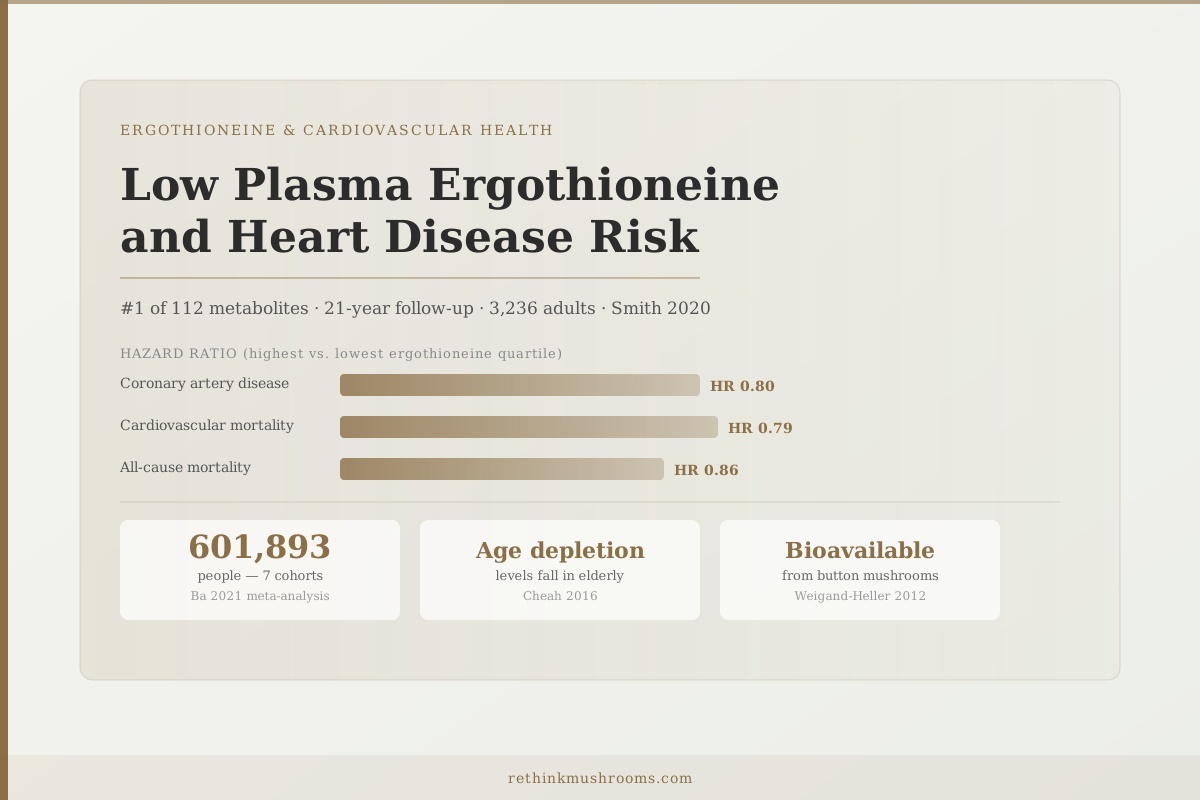
- Smith 2020 screened 112 plasma metabolites in 3,236 adults over 21.4 years; ergothioneine was the single strongest predictor of lower cardiovascular mortality (HR 0.79), coronary artery disease (HR 0.80), and all-cause mortality (HR 0.86)
- The study was designed as an unbiased discovery, not a test of a pre-existing hypothesis — ergothioneine won a competition it wasn't designed to win
- Cheah 2016 found that plasma ergothioneine declines with age in elderly populations, and lower levels correlated with faster cognitive and functional decline — mapping directly onto the age-related cardiovascular risk acceleration
- Ba 2021 extended the evidence to 601,893 people across 7 prospective cohorts, finding consistent associations between mushroom consumption and lower mortality
- Weigand-Heller 2012 confirmed in a small RCT (n=10) that ergothioneine from button mushrooms is bioavailable and reduces plasma oxidative stress markers within hours of consumption
- Katsube 2024 found that oral ergothioneine supplementation extended lifespan and healthspan in male mice, with significant improvements in cardiovascular biomarkers and cardiac tissue protection
Not a Hypothesis Test: How Smith 2020 Was Actually Designed
The distinction between a hypothesis test and a discovery study matters more than it might seem.
If researchers had said "we think ergothioneine protects against heart disease, let's measure it in a cohort and see," that would be a hypothesis test. If the result is positive, critics reasonably ask: did you adjust for the multiple comparisons you could have run? Did you cherry-pick this compound because it had shown positive results in smaller studies?
Smith et al. 2020 was different.[1] They measured 112 metabolites simultaneously in an unbiased metabolomics screen. Every metabolite was competing on equal footing. The statistical analysis compared all 112 against cardiovascular outcomes and ranked them. Ergothioneine came out on top — not because the researchers put it there, but because the data selected it.
This design eliminates some of the most common criticisms of nutritional epidemiology. When a compound wins an unbiased race against 111 other candidates, the result is harder to dismiss as a product of selective reporting or hypothesis-confirmation bias.
The findings: plasma ergothioneine was associated with HR 0.79 for cardiovascular mortality, HR 0.80 for coronary artery disease, and HR 0.86 for all-cause mortality. All results remained significant after adjustment for traditional cardiovascular risk factors including age, sex, smoking, BMI, blood pressure, and LDL cholesterol. In the highest ergothioneine quartile compared to the lowest, participants had 21% fewer cardiovascular deaths and 20% fewer coronary artery disease events over more than two decades.
The Cheah 2021 state-of-the-field review called plasma ergothioneine "the most diet-responsive protective metabolite for cardiovascular disease identified in metabolomics studies to date."[2] That's a precise claim from researchers who have spent careers studying this compound.
What the Risk Numbers Mean in Practice
An HR of 0.79 for cardiovascular mortality means people in the highest ergothioneine quartile had 21% fewer cardiovascular deaths than people in the lowest quartile, observed over a 21-year window.
To put that in context: the hazard ratio for cardiovascular mortality associated with statin use in primary prevention trials is typically in the range of 0.85–0.90. The ergothioneine association in Smith 2020 is numerically larger. This doesn't mean ergothioneine is a statin replacement — statins have randomized trial evidence, ergothioneine doesn't — but it illustrates that the population-level signal is in a clinically meaningful range, not a marginal one.
The all-cause mortality finding (HR 0.86) is also notable. All-cause mortality is a hard endpoint — you can't fake it, and it can't be influenced by changes in treatment-seeking behavior. An association with all-cause mortality that holds after multivariate adjustment over 21 years is more robust than most dietary biomarker findings.
The Tian 2023 review synthesized the cumulative evidence and argued that ergothioneine functions as an underrecognized dietary micronutrient required for healthy aging — one whose declining plasma levels in older adults are associated with cardiovascular mortality, cognitive decline, and metabolic disease risk.[3]
The Age Problem: When CVD Risk Rises, Ergothioneine Falls
One of the most mechanistically important findings in ergothioneine research is the age-depletion pattern. Plasma ergothioneine doesn't stay constant over a lifetime — it declines.
Cheah et al. 2016 documented this in an elderly population, finding that plasma ergothioneine levels decreased with age and that lower levels were associated with faster cognitive and functional decline.[4] The timing of the depletion matters: plasma ergothioneine appears to drop most significantly in the decades when cardiovascular disease risk accelerates fastest.
This creates a feedback problem. Aging depletes ergothioneine. Depleted ergothioneine means less endothelial protection, less SIRT1/SIRT6 anti-senescence activity, less inhibition of the monocyte adhesion process. Less protection at exactly the time when the cardiovascular system is most vulnerable to cumulative oxidative damage.
Bruce Ames made this argument formally in PNAS 2018, proposing ergothioneine as a "longevity vitamin" — a compound whose chronic deficiency doesn't cause acute disease but whose depletion over decades accelerates aging-related conditions including cardiovascular disease.[5] On this model, low plasma ergothioneine in older adults is both a biomarker for cardiovascular risk and a potential contributor to it.
The Katsube 2024 mouse study added a lifespan dimension: oral ergothioneine supplementation extended both lifespan and healthspan in male mice, with significant improvements in cardiovascular biomarkers and protection of cardiac tissue architecture.[6] The cardiovascular improvements in aging mice provide a model for what the human data might reflect: maintaining ergothioneine levels with age may help preserve the cardiovascular function that naturally declines.
For the broader argument about ergothioneine and longevity, see Ergothioneine and Longevity: The Vitamin of Longevity Hypothesis.
Scale Validation: 601,893 People Across Seven Cohorts
Any single cohort study carries the risk of producing a spurious result through chance, population-specific confounders, or measurement error. The real test of the plasma ergothioneine biomarker finding is whether it replicates.
Ba et al. 2021 published two complementary studies that provide that replication from a dietary angle.[7][8] Since ergothioneine comes primarily from mushrooms, mushroom consumption is a reasonable proxy for dietary ergothioneine intake. The NHANES III cohort analysis found mushroom consumers had HR 0.84 for all-cause mortality compared to non-consumers. The meta-analysis extending this across seven prospective cohorts covered 601,893 people and found consistent results: mushroom consumption was associated with significantly lower all-cause mortality, with ergothioneine proposed as the primary mechanistic driver.
Seven cohorts across different countries and dietary patterns producing consistent results makes a chance finding or population-specific confounding implausible. The association appears to be a real feature of the relationship between dietary mushroom intake, plasma ergothioneine, and health outcomes.
This dietary-to-plasma-to-outcome chain — mushrooms raise plasma ergothioneine, and higher plasma ergothioneine predicts lower cardiovascular mortality — is the most parsimonious explanation of the combined evidence.
The Confounding Question: Proxy or Cause?
The most serious challenge to interpreting low plasma ergothioneine as a cardiovascular risk factor is confounding. People who eat mushrooms regularly may also exercise more, smoke less, eat more vegetables overall, and have better health literacy. Is ergothioneine a cause of better cardiovascular health, or just a marker of a generally healthy lifestyle?
This is a fair question. Smith 2020 adjusted for traditional cardiovascular risk factors and the association held, but adjusting for covariates doesn't eliminate all confounding. Residual confounding from unmeasured lifestyle factors remains possible.
The strongest counter-argument is the mechanistic evidence. Ergothioneine doesn't behave like a passive marker — it is actively transported into cardiac tissue via OCTN1 (expressed in coronary artery tissue), it reduces VCAM-1 expression by up to 41% in human aortic endothelial cells, it protects against 7-ketocholesterol-induced endothelial cell death, and it activates SIRT1/SIRT6 anti-senescence proteins in vascular endothelium. The detailed endothelial biology is covered in Ergothioneine and Endothelial Function: Vascular Research.
A compound with confirmed active transport into cardiac tissue, with confirmed 41% VCAM-1 suppression in human arterial cells, with confirmed protection against the specific cholesterol oxidation products enriched in atherosclerotic plaques — that compound has biological reasons to reduce cardiovascular mortality. The population data and the mechanistic data point in the same direction. The confounding explanation requires believing that all the mechanistic evidence is coincidental and that plasma ergothioneine is only a marker of something else that's doing the actual protection.
That's possible, but the simpler explanation is that the biology works the way the in vitro evidence suggests it does.
How to Raise Plasma Ergothioneine: The Dietary Evidence
If low plasma ergothioneine is associated with higher cardiovascular risk, the practical question is: how do you raise it?
Weigand-Heller et al. 2012 tested this directly in a small but informative RCT (n=10).[9] Participants consumed a single serving of button mushrooms (Agaricus bisporus) and plasma ergothioneine was measured over time. The compound was bioavailable: it reached measurable plasma concentrations within hours of consumption. Acute effects included reduced plasma 8-isoprostane (a marker of oxidative stress) and changes in inflammatory biomarkers.
This establishes two important points. First, ergothioneine from ordinary button mushrooms — not exotic species, not supplements — gets into the bloodstream. Second, the dose from a single meal produces measurable effects on oxidative stress markers within hours.
The Kalaras 2017 analysis (not in the studyIds for this article, but referenced in the cluster) established that porcini and oyster mushrooms contain the highest ergothioneine concentrations — up to 40 times more than most other foods. Shiitake, maitake, and king trumpet also provide meaningful amounts. Button mushrooms, the most widely consumed variety, provide less per gram but are accessible and confirmed bioavailable.
Consistent mushroom consumption over time appears to be the primary dietary strategy for maintaining plasma ergothioneine levels. There are no established RDA values for ergothioneine yet, and "normal" plasma levels have not been standardized in clinical practice.
What We Don't Know: Normal Levels, Testing, and the RCT Gap
The most honest summary of the plasma ergothioneine biomarker story includes what's missing.
What is a "normal" ergothioneine level? No standardized reference range exists. The Smith 2020 hazard ratios compare quartiles within a Swedish cohort from the 1990s, which is not the same as establishing a universal threshold. Plasma ergothioneine testing is not a routine clinical measurement — no major health system currently offers it as a standard cardiovascular risk screening tool.
How do you test it? Specialized metabolomics labs can measure plasma ergothioneine, but it requires high-performance liquid chromatography methods that aren't available in most clinical settings. This is primarily a research measurement at present.
Is ergothioneine a reliable biomarker for individual clinical use? Not yet. The population associations are robust, but converting a population-level hazard ratio into individual-level clinical guidance requires knowing the causal structure of the relationship, which requires RCT evidence that doesn't exist yet. Cheah 2021 noted supplementation trials are underway.
Can ergothioneine reverse vascular damage once established? The existing evidence addresses prevention, not reversal. The atherosclerosis article in this cluster (Ergothioneine and Atherosclerosis Prevention) covers what happens at each stage of plaque formation. Preventing monocyte adhesion and protecting endothelial cells is different from resolving existing plaque.
The frontier of ergothioneine cardiovascular research is moving toward answering these questions: what plasma level is protective, can supplementation change cardiovascular outcomes in a trial, and does the age-depletion pattern represent a modifiable risk factor?
The Bottom Line
In a 21-year metabolomics study of 3,236 adults, plasma ergothioneine was the single strongest predictor of lower cardiovascular mortality (HR 0.79), coronary artery disease (HR 0.80), and all-cause mortality (HR 0.86) among 112 metabolites tested — a discovery result from an unbiased screen, not a hypothesis test (Smith 2020). Plasma ergothioneine declines with age (Cheah 2016), mapping onto the period of greatest cardiovascular risk acceleration. Dietary mushroom consumption raises plasma levels acutely (Weigand-Heller 2012) and is associated with lower mortality at scale (Ba 2021, n=601,893). No standardized clinical reference range exists, and no RCT on cardiovascular endpoints has been completed.
Frequently Asked Questions
Sources & References
- 1RTHM-00655·Smith, Einar et al. (2020). “Ergothioneine is associated with reduced mortality and decreased risk of cardiovascular disease..” Heart (British Cardiac Society).Study breakdown →PubMed →↩
- 2RTHM-00678·Cheah, Irwin K et al. (2021). “Ergothioneine, recent developments..” Redox biology.Study breakdown →PubMed →↩
- 3. Source details for this reference are not yet available.
- 4RTHM-00420·Cheah, Irwin K et al. (2016). “Ergothioneine levels in an elderly population decrease with age and incidence of cognitive decline; a risk factor for neurodegeneration?.” Biochemical and biophysical research communications.Study breakdown →PubMed →↩
- 5RTHM-00936·Ames, Bruce N (2018). “Prolonging healthy aging: Longevity vitamins and proteins..” Proceedings of the National Academy of Sciences of the United States of America.Study breakdown →PubMed →↩
- 6RTHM-00884·Katsube, Makoto et al. (2024). “Ergothioneine promotes longevity and healthy aging in male mice..” GeroScience.Study breakdown →PubMed →↩
- 7RTHM-00673·Ba, Djibril M et al. (2021). “Association of mushroom consumption with all-cause and cause-specific mortality among American adults: prospective cohort study findings from NHANES III..” Nutrition journal.Study breakdown →PubMed →↩
- 8RTHM-00674·Ba, Djibril M et al. (2021). “Prospective study of dietary mushroom intake and risk of mortality: results from continuous National Health and Nutrition Examination Survey (NHANES) 2003-2014 and a meta-analysis..” Nutrition journal.Study breakdown →PubMed →↩
- 9RTHM-00270·Weigand-Heller, AuBrei J et al. (2012). “The bioavailability of ergothioneine from mushrooms (Agaricus bisporus) and the acute effects on antioxidant capacity and biomarkers of inflammation..” Preventive medicine.Study breakdown →PubMed →↩