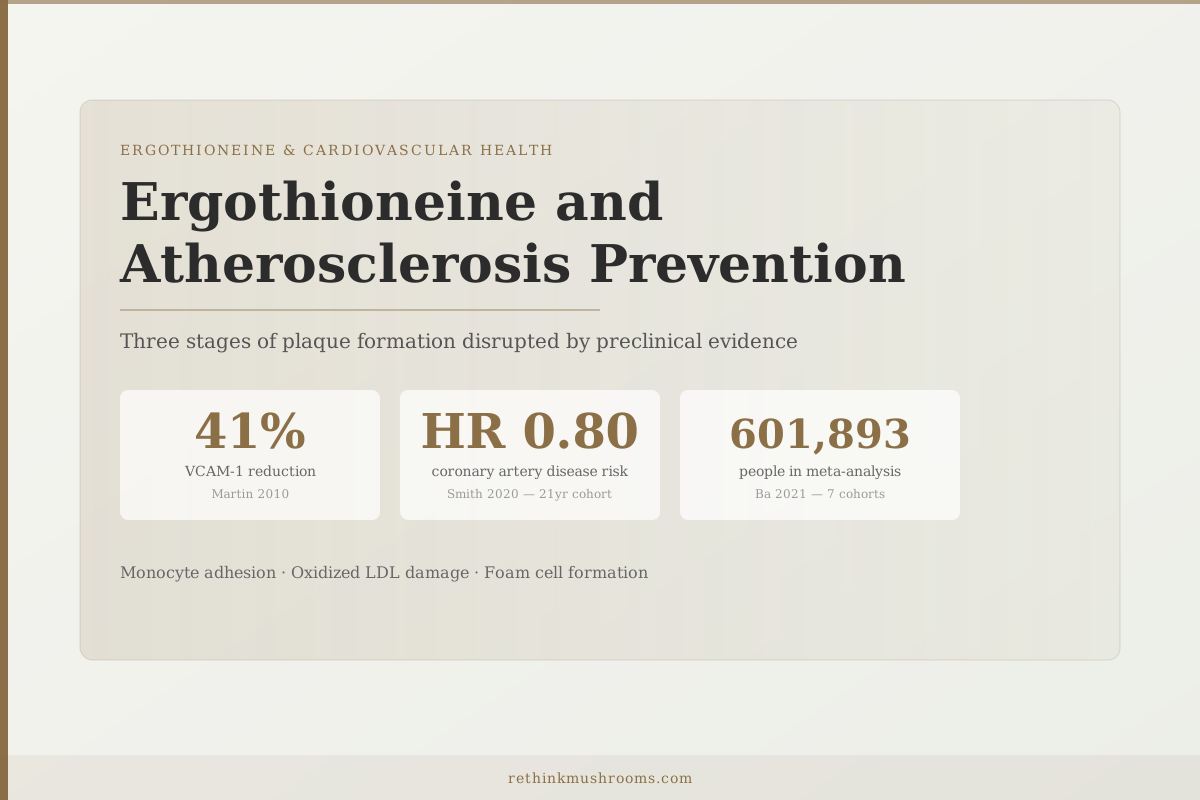
Ergothioneine & Cardiovascular Health
41% VCAM-1 reduction
Ergothioneine at physiologically achievable concentrations reduced a key monocyte-docking molecule by up to 41% in human arterial cells.
Martin KR, J Med Food, 2010
3 stages
of atherosclerosis disrupted by preclinical data
HR 0.80
for coronary artery disease in 21-year cohort
601,893
people across 7 cohorts in Ba 2021 meta-analysis
Martin KR, J Med Food, 2010
 View as image ↗
Atherosclerosis doesn't start with a sudden blockage. It starts with an irritated vessel wall. The inner lining of an artery gets inflamed, and it begins displaying proteins that act as a landing strip for circulating immune cells. Those immune cells dock, migrate into the wall, gorge on oxidized fat, and become what researchers call foam cells. Foam cells accumulate into plaque. That's the sequence behind most heart attacks and strokes.
A sulfur amino acid found almost exclusively in mushrooms appears to interrupt that sequence at multiple stages. This is not a single mechanism story — the evidence shows ergothioneine acting at the adhesion step, the oxidized-LDL damage step, and the foam cell formation step. For a broader introduction to ergothioneine itself, see What Is Ergothioneine? The Longevity Amino Acid. This article is specifically about atherosclerosis: what the cell culture and animal studies found, what the population data shows, and where the research still has gaps.
Key Takeaways
- Martin 2010 found ergothioneine reduced VCAM-1 expression by up to 41% in human aortic endothelial cells at concentrations achievable through regular mushroom consumption
- Li 2014 showed endothelial cells pre-loaded with ergothioneine survived oxidized LDL exposure with significantly less apoptosis than unprotected cells
- Lam-Sidun 2021 reviewed animal model data showing reduced foam cell formation and smaller atherosclerotic plaque areas in ergothioneine-treated subjects
- Smith 2020 followed 3,236 adults for a median of 21.4 years; higher plasma ergothioneine was associated with HR 0.80 for coronary artery disease
- The Ba 2021 meta-analysis across 601,893 people found consistent associations between mushroom consumption and lower mortality, with ergothioneine proposed as the key mediating factor
- No randomized controlled trial has yet tested ergothioneine directly against atherosclerotic endpoints; the mechanistic and population data are substantial, but a causal claim awaits clinical trial evidence
Atherosclerosis Starts Here: How Plaque Actually Forms
To understand how ergothioneine might prevent atherosclerosis, you need to understand how plaque builds. The process is a cascade, and ergothioneine appears to interfere with at least three links in the chain.
It begins with endothelial activation. The endothelium is the single-cell-thick layer lining every blood vessel. When something irritates it — elevated LDL cholesterol, high blood sugar, chronic inflammation, oxidative stress — it responds by displaying surface proteins called adhesion molecules. The three most studied are VCAM-1 (vascular cell adhesion molecule-1), ICAM-1 (intercellular adhesion molecule-1), and E-selectin. These molecules function as docking ports for monocytes, which are white blood cells that circulate in the bloodstream.
Once a monocyte docks via VCAM-1 and ICAM-1, it migrates through the vessel wall into the intima, the innermost arterial layer. There, it encounters oxidized LDL particles — cholesterol that has been chemically altered by reactive oxygen species. The monocyte, now transformed into a macrophage, begins engulfing the oxidized LDL. When a macrophage has absorbed so much oxidized fat that it can barely function, it becomes a foam cell.
Foam cells don't clear the area. They die inside the arterial wall and release their contents, triggering more inflammation, recruiting more monocytes, and building the mass that becomes plaque: a fibrous, lipid-rich accumulation that narrows the artery and, if it ruptures, triggers a clot.
Ergothioneine shows up in this story at three of those steps: the adhesion molecule upregulation step, the oxidized-LDL endothelial damage step, and the foam cell formation step. Each has its own research thread.
The 41% Number: What Martin 2010 Found in Human Arterial Cells
In 2010, Kenneth Martin at Tufts University published results from a direct test of ergothioneine on human aortic endothelial cells — the same cell type lining the coronary arteries.[1]
The experiment simulated endothelial activation by exposing cells to TNF-alpha, a major inflammatory cytokine that reliably drives VCAM-1 and ICAM-1 upregulation. This is the standard in vitro model for the early inflammatory steps of atherosclerosis. Then ergothioneine was added at concentrations of 0.1 to 0.3 millimolar.
Those concentrations matter. They fall within the range achievable through dietary intake, meaning someone eating mushrooms consistently can reach plasma ergothioneine levels in this zone without pharmaceutical-grade supplementation.
Martin found that ergothioneine reduced VCAM-1 expression by up to 41%. ICAM-1 and E-selectin were also significantly reduced. And when monocytes were then introduced to the treated endothelial cells, far fewer docked. The very first step in plaque formation — monocyte recruitment to the arterial wall — was substantially blunted.
A 41% reduction in the primary docking molecule is mechanistically meaningful. Atherosclerosis can't proceed normally if monocytes can't reach the arterial wall. Reducing the number of monocytes that successfully dock reduces the pool of potential foam cells downstream.
The Servillo 2017 cardiovascular pharmacology review placed this result in a broader framework: OCTN1, the dedicated ergothioneine transporter, is expressed in coronary artery tissue, which means the heart actively concentrates ergothioneine from the circulation.[2] The body has built dedicated machinery to pull this compound into cardiac tissue. To understand why that machinery exists and what it tells us about ergothioneine's importance, see OCTN1: The Dedicated Transporter That Proves Ergothioneine Matters.
What Happens When Oxidized LDL Meets the Arterial Wall
Even if monocyte docking is reduced, the arterial wall faces a second threat: oxidized LDL itself. Oxidized LDL is directly toxic to endothelial cells. It triggers apoptosis (programmed cell death) and drives further inflammation, which accelerates the entire atherosclerosis process even before foam cells form.
Li et al. 2014 tested ergothioneine's protective effect in human umbilical vein endothelial cells, the standard laboratory model for vascular endothelial research.[3] The researchers pre-loaded cells with ergothioneine via OCTN1 and then exposed them to four different damaging agents: hydrogen peroxide, paraquat (a potent oxidant), high-glucose conditions, and oxidized LDL.
In each case, cells that had taken up ergothioneine showed substantially less oxidative damage and better survival than unprotected cells. The oxidized-LDL protection is directly relevant to atherosclerosis: endothelial cells that survive oxidized-LDL exposure don't trigger the inflammatory cascade that recruits additional monocytes and accelerates plaque growth.
The Lam-Sidun 2021 review synthesized the preclinical cardiometabolic evidence and added the foam cell picture.[4] In macrophage models, ergothioneine reduced foam cell formation — the critical step where immune cells gorge on oxidized fat and become trapped in the arterial wall. In animal models, ergothioneine treatment was associated with smaller atherosclerotic plaque areas. If you interrupt the oxidized-LDL damage step, you reduce the foam cell step. If you reduce the foam cell step, you slow plaque accumulation.
Paul 2022, a comprehensive review positioning ergothioneine as a "stress vitamin," connected these preclinical findings to a biological logic: ergothioneine is concentrated by the body in tissues facing the highest oxidative load, including heart and vascular tissue.[5] That tissue distribution matches the locations where atherosclerosis does its damage.
The Diabetic Artery: Why High Blood Sugar Accelerates Plaque (and Where Ergothioneine Fits)
Atherosclerosis in people with diabetes progresses faster than in non-diabetic individuals. One major driver is hyperglycemia-induced oxidative stress: high blood sugar causes cells to generate excess superoxide, a reactive oxygen species that damages the endothelium and accelerates every step of the atherosclerosis process.
Servillo et al. 2017 (a separate paper from the cardiovascular review) investigated what happens to ergothioneine specifically in hyperglycemic endothelial cells.[6] They found that ergothioneine actively scavenges superoxide under high-glucose conditions. When ergothioneine captures superoxide, it is oxidized itself — forming ergothioneine-derived oxidation products. Critically, those oxidation products retain cytoprotective activity. Ergothioneine doesn't neutralize the threat once and disappear; the resulting compounds continue to protect cells.
The researchers described ergothioneine as acting like a "superoxide sponge" — a term that captures both the ongoing scavenging activity and the sustained protective output even after the initial compound is consumed.
For the diabetic arterial wall, where superoxide production is chronically elevated, this is a mechanistically important finding. The compound appears most protective in the high-oxidative-stress environments where atherosclerosis accelerates fastest.
The Tung 2020 review confirmed ergothioneine as a key bioactive behind mushroom-mediated protection against metabolic syndrome, including dyslipidemia and cardiovascular complications that are the hallmarks of diabetic heart disease.[7]
Population Data: Whether the Mechanisms Show Up in Real Outcomes
Laboratory mechanisms only matter if they translate to real cardiovascular outcomes in humans. For that, you need population data.
Smith et al. 2020 provided the strongest evidence.[8] The Malmö Diet and Cancer cohort enrolled 3,236 Swedish adults and followed them for a median of 21.4 years, measuring plasma metabolites and tracking cardiovascular events. Out of 112 metabolites measured in an unbiased metabolomics screen — a competition among 112 candidates to find the most protective — plasma ergothioneine came out on top: HR 0.80 for coronary artery disease, HR 0.79 for cardiovascular mortality, HR 0.86 for all-cause mortality (all p less than 0.01).
An HR of 0.80 means people in the highest ergothioneine quartile had 20% fewer coronary artery disease events than those in the lowest quartile over more than two decades of follow-up. That signal held after adjustment for traditional cardiovascular risk factors.
The Ba 2021 NHANES III cohort study added a parallel line of evidence from a different direction: mushroom consumers had an HR of 0.84 for all-cause mortality compared to non-consumers, with ergothioneine proposed as the primary mediating factor.[9] Since mushrooms are the primary dietary source of ergothioneine, this connects dietary behavior to the plasma biomarker evidence from Sweden.
The Ba 2021 meta-analysis extended that finding to 601,893 people across seven prospective cohorts, finding consistent associations between mushroom consumption and lower mortality.[10] The scale of the meta-analysis makes a chance finding implausible.
The Weigand-Heller 2012 bioavailability RCT (n=10) confirmed that ergothioneine from button mushrooms reaches the bloodstream and produces measurable acute effects: reduced plasma 8-isoprostane (an oxidative stress marker) and changes in inflammatory biomarkers within hours of consumption.[11] The compound doesn't just get absorbed — it does something detectable quickly.
For a detailed breakdown of what the plasma biomarker data specifically shows across populations, see Low Plasma Ergothioneine and Heart Disease Risk: Population Study Data.
The Confounding Question Worth Taking Seriously
If plasma ergothioneine tracks with lower cardiovascular risk, one reasonable question is whether it's just a proxy for a healthy lifestyle rather than a causal factor. People who eat mushrooms regularly may also eat more vegetables, exercise more, and smoke less. Would the association disappear if you controlled for everything?
The Smith 2020 analysis adjusted for traditional cardiovascular risk factors and the associations held. That doesn't rule out all confounding — no observational study can — but it makes a purely proxy-variable explanation harder to sustain.
More importantly, the mechanistic evidence provides biological plausibility. A compound that measurably reduces VCAM-1 expression in human arterial cells at dietary concentrations (Martin 2010), that protects endothelial cells from oxidized LDL (Li 2014), that reduces foam cell formation in animal models (Lam-Sidun 2021), and that is actively concentrated by cardiac tissue via a dedicated transporter (Servillo 2017) — that compound has reasons to be causally associated with lower coronary disease risk. The population data and the mechanistic data point in the same direction.
Other mushroom-derived compounds show cardiovascular benefits through distinct mechanisms. Shiitake and Heart Disease Prevention covers how eritadenine affects lipid metabolism, a pathway that doesn't overlap with ergothioneine's antioxidant and adhesion-molecule effects.
What the Evidence Does and Doesn't Say
The mechanistic case for ergothioneine as an anti-atherosclerotic compound rests on human cell culture data (Martin 2010, Li 2014), animal model plaque studies (Lam-Sidun 2021), and population data showing lower coronary artery disease rates in people with higher plasma levels (Smith 2020).
What doesn't exist yet: a randomized controlled trial testing whether ergothioneine supplementation reduces atherosclerotic plaque progression in humans. That study hasn't been completed. Cheah and Halliwell's 2021 state-of-the-field review noted that human supplementation trials are underway, but cardiovascular endpoint data is not yet available.
This matters for how you interpret the evidence. The mechanistic data shows ergothioneine can inhibit processes that drive atherosclerosis in controlled experimental conditions. The population data shows higher levels track with lower coronary disease rates across decades of follow-up. Neither tells you definitively that giving someone ergothioneine will reduce their plaque burden. That's the research frontier.
For the broader cardiovascular picture, including the post-MI remodeling data and the doxorubicin cardioprotection angle, see Ergothioneine and Heart Health: Cardiovascular Protection Research. For the endothelial biology in greater detail, see Ergothioneine and Endothelial Function: Vascular Research.
The Bottom Line
Ergothioneine disrupts atherosclerosis at three mechanistically distinct points: it reduces VCAM-1-mediated monocyte adhesion to the arterial wall by up to 41% (Martin 2010), protects endothelial cells from oxidized-LDL-induced apoptosis via OCTN1-mediated uptake (Li 2014), and reduces foam cell formation in animal models (Lam-Sidun 2021). Population data from 3,236 adults followed 21 years shows HR 0.80 for coronary artery disease in higher-ergothioneine quartiles (Smith 2020), consistent across a 601,893-person meta-analysis (Ba 2021). No human RCT has tested ergothioneine against atherosclerotic endpoints directly; the biological plausibility is strong, but a causal claim awaits clinical trial evidence.
Frequently Asked Questions
Sources & References
- 1RTHM-00353·Martin, Keith R (2010). “The bioactive agent ergothioneine, a key component of dietary mushrooms, inhibits monocyte binding to endothelial cells characteristic of early cardiovascular disease..” Journal of medicinal food.Study breakdown →PubMed →↩
- 2RTHM-00490·Servillo, Luigi et al. (2017). “Ergothioneine Antioxidant Function: From Chemistry to Cardiovascular Therapeutic Potential..” Journal of cardiovascular pharmacology.Study breakdown →PubMed →↩
- 3RTHM-00616·Li, Rachel W S et al. (2014). “Uptake and protective effects of ergothioneine in human endothelial cells..” The Journal of pharmacology and experimental therapeutics.Study breakdown →PubMed →↩
- 4RTHM-00696·Lam-Sidun, Daniel et al. (2021). “Mushroom-Derived Medicine? Preclinical Studies Suggest Potential Benefits of Ergothioneine for Cardiometabolic Health..” International journal of molecular sciences.Study breakdown →PubMed →↩
- 5RTHM-01594·Paul, Bindu D (2022). “Ergothioneine: A Stress Vitamin with Antiaging, Vascular, and Neuroprotective Roles?.” Antioxidants & redox signaling.Study breakdown →PubMed →↩
- 6RTHM-00910·Servillo, Luigi et al. (2017). “Ergothioneine products derived by superoxide oxidation in endothelial cells exposed to high-glucose..” Free radical biology & medicine.Study breakdown →PubMed →↩
- 7RTHM-00660·Tung, Yu-Tang et al. (2020). “Edible Mushrooms: Novel Medicinal Agents to Combat Metabolic Syndrome and Associated Diseases..” Current pharmaceutical design.Study breakdown →PubMed →↩
- 8RTHM-00655·Smith, Einar et al. (2020). “Ergothioneine is associated with reduced mortality and decreased risk of cardiovascular disease..” Heart (British Cardiac Society).Study breakdown →PubMed →↩
- 9RTHM-00673·Ba, Djibril M et al. (2021). “Association of mushroom consumption with all-cause and cause-specific mortality among American adults: prospective cohort study findings from NHANES III..” Nutrition journal.Study breakdown →PubMed →↩
- 10RTHM-00674·Ba, Djibril M et al. (2021). “Prospective study of dietary mushroom intake and risk of mortality: results from continuous National Health and Nutrition Examination Survey (NHANES) 2003-2014 and a meta-analysis..” Nutrition journal.Study breakdown →PubMed →↩
- 11RTHM-00270·Weigand-Heller, AuBrei J et al. (2012). “The bioavailability of ergothioneine from mushrooms (Agaricus bisporus) and the acute effects on antioxidant capacity and biomarkers of inflammation..” Preventive medicine.Study breakdown →PubMed →↩