Ergothioneine — The Longevity Amino Acid
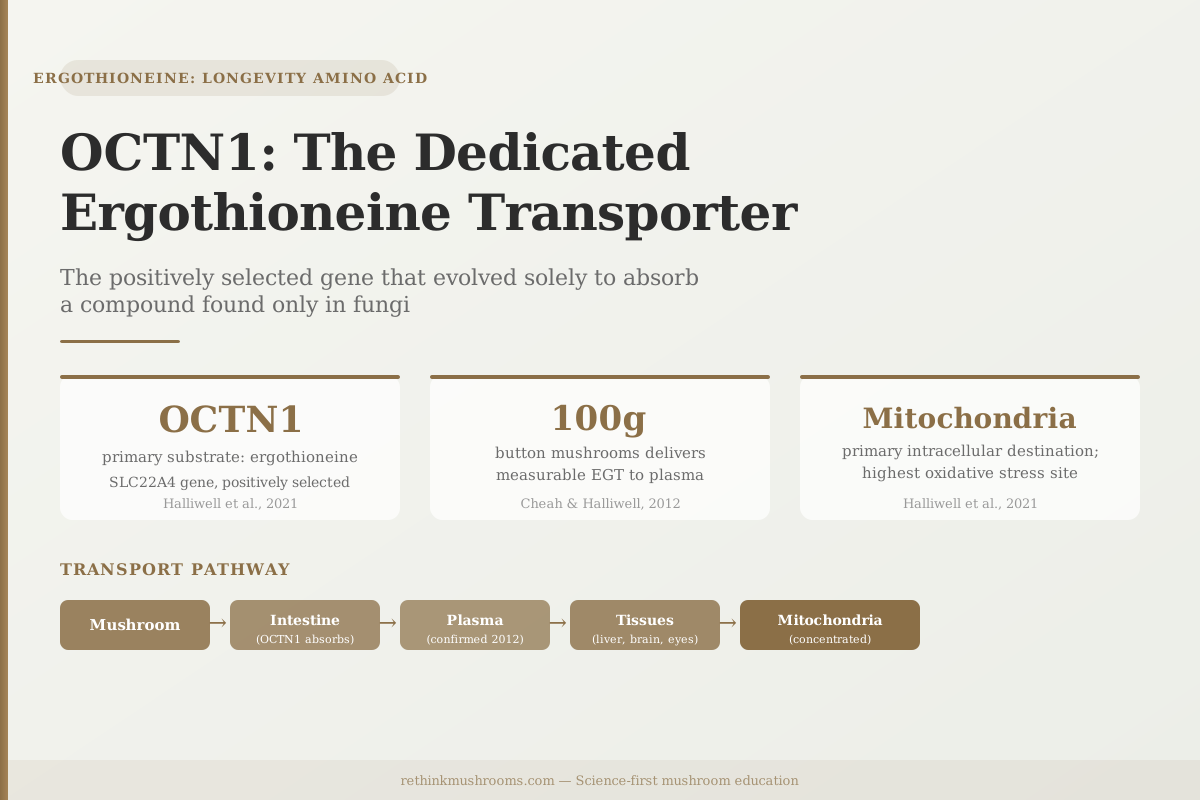
100g mushrooms
A single 100-gram serving of button mushrooms delivers measurable ergothioneine to plasma via the OCTN1 transporter, the dedicated molecular gateway that evolution built specifically to absorb this compound.
Cheah and Halliwell, Biochem Biophys Res Commun, 2012.
OCTN1
the only membrane transporter dedicated primarily to ergothioneine
SLC22A4
the gene encoding OCTN1, among the most positively selected in humans
Mitochondria
primary intracellular destination where OCTN1 concentrates ergothioneine
Cheah and Halliwell, Biochem Biophys Res Commun, 2012.
 View as image ↗
The human genome contains roughly 20,000 protein-coding genes. A small fraction of those are described as positively selected, meaning natural selection actively worked to preserve and strengthen them across evolutionary time. Organisms that lost these genes left fewer descendants. Organisms that kept them thrived.
OCTN1, encoded by the SLC22A4 gene, is among those positively selected genes. Its primary function is narrow: it is a membrane transporter that moves ergothioneine from food into your intestinal cells and concentrates it in specific tissues. No other compound has its own dedicated transporter of this kind.
That combination, positive selection pressure paired with a dedicated molecular gateway, is the strongest biological argument that ergothioneine matters. The body does not evolve expensive dedicated infrastructure for nutrients it doesn't need.
For the broader overview of what ergothioneine is and why mushrooms are the only dietary source, see What Is Ergothioneine? The Amino Acid Your Body Hoards. This article goes deep on the transporter itself.
Key Takeaways
- OCTN1 (SLC22A4) is among the most positively selected genes in the human genome, meaning evolution punished organisms that lost its function; its primary substrate is ergothioneine (Halliwell et al., 2021)
- Jones and colleagues confirmed in 2014 that ergothioneine biosynthesis is absent from all animal and plant genomes, meaning OCTN1 co-evolved alongside fungi as humans' only reliable dietary source
- Cheah and Halliwell (2012) confirmed that 100g of button mushrooms delivers measurable ergothioneine to plasma via OCTN1, validating the transporter's function for dietary intake
- OCTN1 concentrates ergothioneine specifically in high-oxidative-stress tissues: mitochondria, liver, kidneys, eyes, and brain (Halliwell et al., 2021)
- Ergothioneine does not become pro-oxidant after neutralizing reactive species, making it uniquely valuable to concentrate rather than use-and-excrete (Servillo et al., 2017)
- Elderly populations have significantly lower plasma ergothioneine levels, suggesting OCTN1 efficiency or dietary intake declines with age (Cheah et al., 2016)
What "Positively Selected" Means: Why This Makes OCTN1 Remarkable
Genes can have three basic evolutionary fates. Most are neutral: they do their job, mutations don't matter much, and their sequence drifts over time. Some are negatively selected: mutations that break them are harmful, so natural selection removes those mutations. A small number are positively selected: natural selection actively favored new mutations that made them work better.
Positive selection is evolutionary evidence that a gene matters for survival and reproduction. It's the genome's way of saying this function was important enough to optimize, not just maintain.
The SLC22A4 gene, which encodes the OCTN1 transporter protein, has been under positive selection in the human lineage. This has been recognized in genetic studies because the gene shows signatures of selective sweeps, where advantageous versions of the gene spread rapidly through populations.[3]
What makes this remarkable is that OCTN1's primary function is to absorb ergothioneine from food. Not a macronutrient. Not a classical vitamin. A compound produced only by fungi and a handful of soil bacteria, which humans cannot synthesize.
Evolution built and optimized specialized molecular machinery specifically to capture a compound from food that only grows in fungi. That is a level of biological investment that demands explanation.
OCTN1 Decoded: The Membrane Protein Whose Primary Job Is Absorbing Ergothioneine
OCTN1 is an organic cation transporter, part of the SLC22 family of solute carriers. The family includes transporters for carnitine, organic anions, and various drugs. OCTN1 was originally classified as a "novel organic cation transporter" when it was cloned in 1997, before its primary substrate was identified.
The naming suggests carnitine transport, but OCTN1 and OCTN2 are functionally different. OCTN2 is the primary carnitine transporter. OCTN1's primary physiological substrate is ergothioneine. This distinction matters because it means OCTN1 is not an opportunistic transporter that happens to pick up ergothioneine; it is a transporter that ergothioneine appears to have shaped.
OCTN1 is expressed in multiple tissues but is especially concentrated in the small intestine (where dietary ergothioneine is absorbed), the kidneys (where ergothioneine is reabsorbed from urine rather than excreted), and high-metabolic-rate tissues including the liver, eyes, brain, and erythrocytes.[3]
The kidney expression is particularly telling. The body doesn't just absorb ergothioneine; it reabsorbs it from the filtrate before it can be lost in urine. This active retention at multiple organ levels is additional evidence that the body treats ergothioneine as a compound worth conserving.
Why Fungi Made It and Animals Built a Gateway for It: The Co-Evolution Story
Ergothioneine biosynthesis exists in all major fungal phyla. It is absent from all plant and animal genomes. Jones and colleagues' 2014 genomic analysis confirmed this distribution by tracing the Egt-1 and Egt-2 biosynthesis genes across the tree of life: present throughout fungi, acquired by a few bacteria through horizontal gene transfer, absent everywhere else.[2]
This means that for the entire span of animal evolution, the only reliable source of ergothioneine in a terrestrial diet was fungi. Mushrooms, molds, and other fungi saturate the soil environments where early animals foraged. Animals that evolved efficient machinery to absorb ergothioneine from these sources had an advantage. OCTN1 is that machinery.
The co-evolution story runs in parallel: fungi evolved the ability to synthesize ergothioneine (likely as a protective molecule in high-oxidative environments), and animals evolved OCTN1 to capture it. Neither event required coordination. The compound was available; the transporter evolved to exploit it.
For more on why the biosynthesis pathway is absent from all plant and animal genomes and what this means for dietary intake, see Why Only Fungi Make Ergothioneine (And Why That Matters).
Where OCTN1 Delivers Ergothioneine: The Tissues With the Highest Oxidative Load
After absorption in the intestine, ergothioneine is not distributed evenly. OCTN1 expression in specific tissues creates concentration gradients that deliver ergothioneine precisely where oxidative stress is highest.
Halliwell and colleagues' 2021 comprehensive review documents the tissue distribution: ergothioneine accumulates at measurably high levels in the liver, kidneys, eyes, erythrocytes (red blood cells), bone marrow, and brain. These are not random tissues. They are the organs with the highest metabolic rates, the highest mitochondrial density, and consequently the highest ongoing production of reactive oxygen species.[3]
Mitochondria deserve particular attention. Mitochondria are the site of most cellular reactive oxygen species production, because the electron transport chain that generates cellular energy is inherently leaky. A small percentage of electrons escape and react with oxygen to form superoxide and other reactive species. Mitochondria are therefore under constant oxidative attack from within.
Ergothioneine concentrates in mitochondria specifically. This localization makes it a first-responder antioxidant at the site of reactive oxygen species generation, rather than a general-circulation compound that might arrive at the mitochondria after damage has spread.
The eye distribution is also notable. Lens cells and retinal cells have no mitochondrial turnover mechanism; they accumulate oxidative damage over a lifetime. High ergothioneine concentrations in ocular tissue suggest a long-term protective role against the slow oxidative damage that underlies cataracts and macular degeneration.
The Recyclable Antioxidant: Why Concentrating This Compound Makes Biological Sense
Most antioxidants work by donating an electron or hydrogen atom to neutralize a reactive species. After this donation, the antioxidant molecule itself becomes oxidized and potentially reactive. Vitamin C becomes dehydroascorbic acid after oxidizing, which can act as a pro-oxidant at high concentrations. Glutathione becomes oxidized glutathione (GSSG) and must be enzymatically recycled.
Ergothioneine behaves differently. Servillo and colleagues' 2017 review documents that ergothioneine exists in two tautomeric forms: a thiol form and a thione form. The thione form (dominant under physiological conditions) is far more stable than a typical thiol-based antioxidant. After scavenging a reactive species, ergothioneine does not become a damaging oxidized species; it returns to its stable configuration without generating reactive byproducts.[5]
This chemical stability is precisely why concentrating ergothioneine makes biological sense. The body cannot enzymatically regenerate it (it cannot synthesize ergothioneine at all), but it doesn't need to dispose of oxidized ergothioneine byproducts either. Once ergothioneine is transported into a cell and concentrated, it remains active without requiring the regeneration cycles that vitamin C or glutathione demand.
The combination of non-self-made status, dedicated transporter, tissue-specific concentration, and self-resetting antioxidant chemistry gives ergothioneine a functional profile unlike any other antioxidant compound in human biology.
Bioavailability Confirmed: 100 Grams of Mushrooms Delivers Measurable EGT to Plasma
The evolutionary and mechanistic arguments for OCTN1 are compelling, but they require a practical confirmation: does eating mushrooms actually deliver ergothioneine through OCTN1 into circulation?
Cheah and Halliwell's 2012 study provided that confirmation. They fed participants 100 grams of button mushrooms (Agaricus bisporus, the most common commercial mushroom) and measured plasma ergothioneine at intervals afterward. Ergothioneine rose measurably in plasma, confirming that OCTN1 in the intestinal epithelium is functional for dietary ergothioneine absorption from whole food.[1]
The study also confirmed no significant rise in uric acid, which addressed a safety question (some sulfur compounds can elevate uric acid and trigger inflammatory responses). Ergothioneine absorption via OCTN1 does not produce this side effect at dietary doses.
What this means practically: button mushrooms, the least exotic commercially available mushroom, deliver ergothioneine effectively. The transporter functions as expected. Species with higher ergothioneine content (porcini, king oyster) would presumably produce larger plasma increases at equivalent serving sizes, though direct comparisons at matched weights have not been published for all species.
When OCTN1 Goes Wrong: Disease Risk, Aging, and Declining Levels
The SLC22A4 gene is not just a research curiosity. Variants in the gene have been associated with Crohn's disease risk and rheumatoid arthritis susceptibility. This disease association is what placed SLC22A4 under intense research scrutiny before ergothioneine's importance was fully understood. It is now thought that reduced OCTN1 function in the intestine may alter gut barrier integrity and inflammatory tone, partly by reducing ergothioneine availability in intestinal tissues.
Aging appears to reduce plasma ergothioneine levels through a combination of mechanisms. Cheah and colleagues' 2016 study followed elderly populations and found that plasma ergothioneine was significantly lower in older adults compared to younger controls, and that lower ergothioneine levels correlated with greater cognitive decline and frailty markers.[4]
The age-related decline could reflect reduced OCTN1 expression in the aging intestine, reduced dietary mushroom intake in older populations, or both. The correlation with cognitive decline does not establish causation; it is consistent with either low ergothioneine causing accelerated neurological aging, or neurological decline leading to reduced food intake and therefore lower ergothioneine, or both processes operating together.
What the Cheah 2016 data establishes clearly is that ergothioneine levels are not static across the lifespan. The body's stores of this compound, maintained by dietary intake and OCTN1 activity, decline with age. Given the tissue distribution data (high in brain and mitochondria-rich tissues), declining levels precisely in the tissues most vulnerable to aging-related oxidative damage is a meaningful signal.
For a broader look at the epidemiological evidence linking ergothioneine levels to health outcomes, including the mortality association studies, see The History of Ergothioneine: From Discovery to 'Longevity Vitamin' Debate.
What OCTN1 Delivers Inside Cells: The Longevity Pathway Connection
Once OCTN1 has transported ergothioneine into a cell, what happens next?
A 2024 review examining longevity pathways documented the intracellular mechanisms through which ergothioneine acts beyond simple antioxidant scavenging. Ergothioneine appears to activate Nrf2, the master regulator of the body's internal antioxidant defense systems. Nrf2 activation switches on a cascade of protective enzymes including superoxide dismutase, catalase, and glutathione peroxidase.[6]
The same review documents evidence for AMPK activation by ergothioneine. AMPK is the cell's energy sensor; when activated, it promotes cellular cleanup processes (autophagy), improves mitochondrial biogenesis, and suppresses inflammatory signaling. AMPK activation is one of the mechanisms shared by caloric restriction, metformin, and exercise — compounds and behaviors strongly associated with longevity in multiple organisms.[6]
FOXO transcription factor activation and mTOR suppression are also documented in the 2024 review. Both FOXO activation and mTOR suppression are consistently found in long-lived organisms and in interventions that extend lifespan in model systems.
The chain from OCTN1 to longevity pathway activation runs: OCTN1 absorbs dietary EGT from mushrooms; EGT is concentrated in mitochondria-rich tissues; inside cells, EGT scavenges reactive species directly (via its stable thione chemistry) and activates Nrf2, AMPK, and FOXO.
None of these mechanistic findings have been confirmed in long-term human clinical trials. The pathway-activation evidence comes from cell culture and animal models. But the mechanistic plausibility is substantial, and the epidemiological associations (lower EGT with greater cognitive decline; higher EGT with lower mortality risk) align with the direction these pathways predict.
For more on the mitochondrial protection angle, see Ergothioneine and Mitochondrial Protection. For the brain health implications from the cognitive decline data, see Ergothioneine and Brain Health: Neuroprotective Research.
The Bottom Line
OCTN1 (SLC22A4) is a positively selected human membrane transporter whose primary function is absorbing ergothioneine from dietary sources and concentrating it in high-oxidative-stress tissues including mitochondria, liver, brain, and eyes. The gene's positive selection status is the strongest biological argument that ergothioneine is important; evolution does not invest in dedicated molecular infrastructure for compounds that don't matter. Dietary delivery from mushrooms is confirmed: 100g of button mushrooms produces measurable plasma ergothioneine via OCTN1. Ergothioneine levels decline with age, and lower levels correlate with cognitive decline. The intracellular mechanisms (Nrf2, AMPK, FOXO activation) have mechanistic support from preclinical data; human clinical trial confirmation is still needed.
Frequently Asked Questions
Sources & References
- 1. Source details for this reference are not yet available.
- 2. Source details for this reference are not yet available.
- 3. Source details for this reference are not yet available.
- 4. Source details for this reference are not yet available.
- 5. Source details for this reference are not yet available.
- 6. Source details for this reference are not yet available.