Ergothioneine Foundation & Science
HR 0.86 for overall mortality per 1 SD higher plasma ergothioneine
Across 3,236 Swedish adults followed a median 21.4 years, each standard-deviation increment in plasma ergothioneine was associated with lower overall mortality (HR 0.86) and lower cardiovascular mortality (HR 0.79). It was an observational cohort, and ergothioneine was identified as a marker of a health-conscious food pattern.
Smith et al., 2020
Only fungi
and some bacteria synthesize ergothioneine; no plant or animal genome contains the pathway
1 of 10
putative 'longevity vitamins' reviewed by Ames in PNAS 2018
Declines after 60
whole blood levels fall with age; adults with mild cognitive impairment had lower plasma levels
Smith et al., 2020
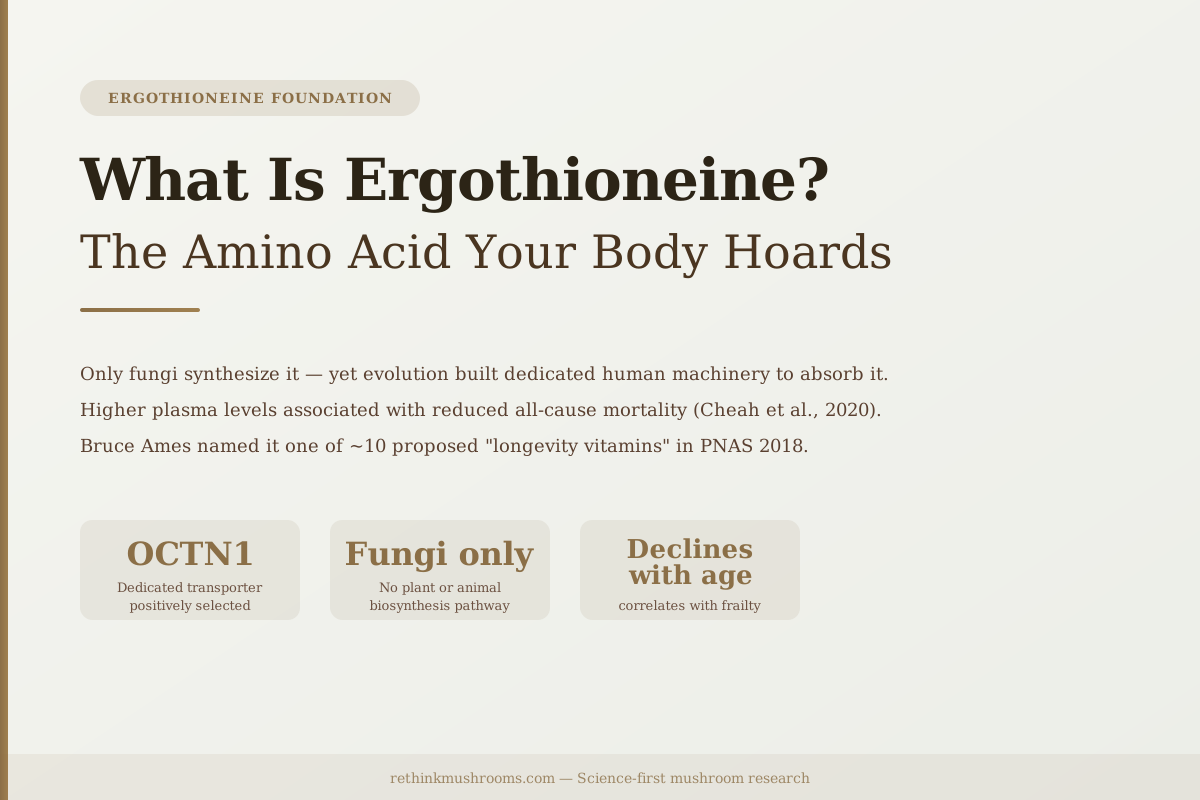 View as image ↗
The human body absorbs one particular compound from food using a transporter that reviewers describe as largely or completely specific to it. The transporter is called OCTN1. It does not handle a broad portfolio of nutrients the way the proteins that absorb most vitamins and amino acids do. And once the compound is taken up, the body holds onto it — not for hours, but for weeks or months. [11]
The compound in question is not something the human body can manufacture. No plant makes it either. The only organisms with the biological machinery to synthesize it are fungi and certain bacteria. [9] Yet the human body maintains the infrastructure to absorb it, shuttle it into the blood, and accumulate it in specific tissues — preferentially, one influential proposal argues, in the places under the most oxidative stress and inflammation. [4]
That asymmetry — a compound we cannot make, paired with a dedicated system for taking it up and hanging onto it — is the starting point for understanding ergothioneine. It is also, honestly, the strongest single argument that the compound matters, and it is a structural argument rather than a clinical one. What the rest of this article does is separate that structural case from the much shakier claims that get layered on top of it.
Key Takeaways
- Ergothioneine is a sulfur-containing amino acid that only fungi and certain bacteria can synthesize; the human body cannot make it and obtains it from diet.
- The human genome encodes a transporter, OCTN1 (SLC22A4), for which ergothioneine is the principal known substrate, and the compound accumulates in high-stress tissues including liver, eyes, kidneys, and brain.
- Mushrooms are by far the leading dietary source, but they are not the only one: a food survey also detected ergothioneine in kidney, liver, black and red beans, and oat bran (Ey et al., 2007).
- Species ranking is not settled. Three quantification studies each crowned a different species, and levels vary with growing substrate, tissue, and harvest flush (Kalaras 2017; Lo 2012; Tsiantas 2021).
- Human bioavailability from mushrooms was shown in a small crossover pilot in 10 healthy men using 8 g and 16 g of mushroom powder, measuring uptake into red blood cells (Weigand-Heller et al., 2012).
- Whole blood ergothioneine declines significantly after age 60, and a subset of participants with mild cognitive impairment had lower plasma levels than age-matched controls (Cheah et al., 2016).
- In 3,236 Swedish adults followed a median 21.4 years, each 1 SD higher plasma ergothioneine was associated with lower overall mortality (HR 0.86) and cardiovascular mortality (HR 0.79) — an observational association, in a study that identified ergothioneine as a biomarker of a health-conscious diet (Smith et al., 2020).
- Biochemist Bruce Ames reviewed ergothioneine as one of 10 putative "longevity vitamins" in a 2018 PNAS paper: nutrients that may not prevent acute illness but that his triage theory predicts are needed for long-term maintenance.
- The antioxidant explanation is the most contested part of the case, not the most secure: leading researchers in the field state that evidence for antioxidant activity being ergothioneine's principal role in vivo is weak (Halliwell et al., 2023).
The Transporter That Absorbs One Compound — And the Body That Won't Let It Go
Most nutrients enter the body through general transport systems. The proteins that absorb vitamins, minerals, and standard amino acids handle dozens of different molecules; their job is to recognize and capture a wide class of useful compounds as they pass through the intestinal wall.
OCTN1 does not work that way. It is an organic cation transporter, and ergothioneine is its principal known substrate — Ey and colleagues describe ergothioneine as being specifically accumulated in cells via OCTN1, and a 2023 review by Halliwell, Tang, and Cheah characterizes the transporter as "largely or completely specific" for it. [9][11]
The retention is as striking as the specificity. Once ergothioneine is taken up, it stays. The 2023 review notes it is retained within the body for weeks or months. [11] A direct human pharmacokinetic study makes the same point from the other end: when Cheah and colleagues gave pure ergothioneine to healthy volunteers, it was avidly absorbed and retained, with less than 4% of the administered dose appearing in urine. [10]
Where it ends up is also not random. Cheah and colleagues describe ergothioneine as accumulating preferentially in tissues predisposed to higher levels of oxidative stress and inflammation. [4] That distribution pattern is what turns a chemistry curiosity into a plausible physiological story: a compound routed toward the tissues doing the most metabolic work.
Two cautions are worth flagging before that story runs away with itself. First, "accumulates where oxidative stress is highest" is a description of a distribution, not a demonstration that the compound is doing protective work once it arrives. Second, the evolutionary framing that often accompanies this argument — that the transporter gene shows positive selection, and therefore the compound must be important — is a plausibility argument rather than evidence of benefit. It tells you the machinery was worth maintaining. It does not tell you what happens if a given person eats more mushrooms.
The bioavailability of dietary ergothioneine has been tested directly in humans, though on a smaller scale than popular accounts suggest. Weigand-Heller, Kris-Etherton, and Beelman ran a pilot study in 10 healthy men using a randomized, crossover, dose-response, postprandial design at Penn State. Participants received a mushroom test meal containing 8 grams or 16 grams of mushroom powder, and the researchers measured ergothioneine uptake into red blood cells. Ergothioneine was bioavailable after mushroom consumption. The study also reported a blunted postprandial triglyceride response at both doses — and, awkwardly for the antioxidant narrative, total ORAC antioxidant capacity decreased after the mushroom meals. [3]
Weigand-Heller, Kris-Etherton & Beelman (2012) · Preventive Medicine
- Population
- 10 healthy men, General Clinical Research Center, Pennsylvania State University (2009)
- Intervention
- Mushroom test meal containing 8 g or 16 g Agaricus bisporus mushroom powder
- Comparator
- 0 g mushroom powder, randomized crossover, postprandial time-course
- Finding
- Ergothioneine was bioavailable, assessed by postprandial red blood cell uptake. A blunted postprandial triglyceride response appeared at both 8 g and 16 g versus 0 g. Total ORAC antioxidant capacity decreased after both mushroom meals.
preliminary A ten-person pilot in men only, with no long-term outcomes. It establishes that dietary ergothioneine gets into the body — nothing about disease risk. Note this is the study frequently miscited as a trial of 100 g of whole button mushrooms measuring plasma levels; it used mushroom powder and measured red blood cells.
Weigand-Heller AJ, Kris-Etherton PM, Beelman RB (2012). Preventive Medicine 54 Suppl:S75-8. PMID 22230474.
It is often noted that variants in SLC22A4 have been linked to inflammatory conditions including Crohn's disease and rheumatoid arthritis, and Ey and colleagues note that OCTN1 and ergothioneine have been implicated in the etiopathogenesis of autoimmune disorders. [9] This is suggestive of the transporter's functional importance, but it is genuinely ambiguous evidence: a transporter can matter for reasons that have nothing to do with its best-known substrate, and disease-association genetics rarely resolves which direction the causal arrow points.
The molecular mechanics of the OCTN1 system, including its expression across tissues, the gene's evolutionary history, and what the transporter's distribution pattern tells us about ergothioneine's biological role, are covered in depth at OCTN1: The Dedicated Transporter That Proves Ergothioneine Matters.
What Ergothioneine Is (And Why Its Chemistry Is Unusual)
Ergothioneine is a sulfur-containing amino acid derived from histidine, one of the 20 standard amino acids that proteins are built from. But ergothioneine is not incorporated into proteins. It exists free in cells, where it serves as a stress-response compound rather than a structural building block.
The sulfur group is key. Formally, ergothioneine is the betaine of 2-mercapto-L-histidine, and its sulfur sits in what chemists call a thione configuration. [8] That differs from the thiol configuration found in cysteine and glutathione, and the difference is not cosmetic. Servillo and colleagues single out the redox behavior of ergothioneine versus alkylthiols such as cysteine and glutathione as the finding that opened new perspectives on its role during oxidative damage. [8]
This stability is a coherent reason why accumulating ergothioneine in metabolically stressed tissues would be safe rather than counterproductive. It is worth being precise about what that argument does and does not establish: it explains why hoarding this particular molecule is chemically viable. It does not, by itself, demonstrate that the hoarding delivers a health benefit. That gap is the subject of a later section, and it is wider than most coverage of ergothioneine admits.
Ergothioneine was first isolated in 1909 from the ergot fungus (Claviceps purpurea), which is where its name comes from. [8] For most of the 20th century it attracted only specialized attention: interesting chemistry, no identified deficiency disease, no obvious clinical angle. As Servillo and colleagues put it, more than a century after its discovery, understanding of its in vivo mechanism remains limited and the compound still intrigues researchers.
Ergothioneine is not currently classified as an essential nutrient. Essential vitamins and amino acids are defined by the acute deficiency diseases that occur without them: scurvy from vitamin C deficiency, pellagra from niacin deficiency. No equivalent acute deficiency syndrome has been identified for ergothioneine. The research question is whether chronic sub-optimal intake accelerates long-term biological deterioration in ways that only become visible over decades.
The Biosynthesis Gap: Why No Animal (Including You) Can Make This
Ergothioneine is produced in nature only by certain fungi and a few other microbes. [12] Servillo and colleagues narrow it further: synthesis is confined to Actinomycetales and non-yeast-like fungi, and mammals acquire the compound solely from dietary sources. [8]
This means every unit of ergothioneine in the human body arrived from outside. The body cannot manufacture it from amino acids it already has, or from vitamins or minerals. The only route in is the diet.
Here is where the popular version of this story goes wrong, and it is worth correcting carefully because the corrected version is still remarkable.
The claim you will encounter repeatedly is that no plant or animal food contains meaningful ergothioneine, so mushrooms are the sole source. The primary food survey does not support that. Ey, Schömig, and Taubert measured ergothioneine across common foods by liquid chromatography tandem mass spectrometry. They found that only some foods contained it at all, with the highest concentrations in specialty mushrooms — but also detectable levels in kidney, liver, black and red beans, and oat bran. [9]
Beelman and colleagues supply the mechanism that reconciles this with the biosynthesis gap. Ergothioneine is found in small amounts throughout the food chain, most likely because soil-borne fungi pass it on to plants through root associations. The plants are not making it; they are picking it up from fungi in the soil. Beelman's group draws a pointed implication from this: agricultural practices that disrupt beneficial fungus-plant root relationships could reduce ergothioneine levels in crops grown under those conditions, which makes the compound's availability in the food supply partly a farming question. [12]
Dietary Sources
Mushrooms Lead by a Wide Margin — But They Are Not the Only Source
A common claim is that no plant or animal food contains ergothioneine. The primary food survey does not support that. Ey and colleagues measured ergothioneine across common foods and found the highest levels in specialty mushrooms — alongside detectable amounts in kidney, liver, black and red beans, and oat bran. Bar length is ordinal, reflecting where each group ranked, not measured concentrations.
Specialty mushrooms
HighestThe clear top of the survey. Species vary widely among themselves, which is a separate question from whether mushrooms lead the field — they do.
Kidney and liver
DetectableOrgan meats, not muscle meat. Animals accumulate ergothioneine from fungal exposure in their own diet and concentrate it in the same high-stress organs humans do.
Black and red beans, oat bran
DetectablePlant foods with measurable ergothioneine. Beelman 2020 attributes this to soil fungi transferring the compound into plant roots — the plants do not synthesize it themselves.
Most other foods surveyed
Little to noneEy found that only some foods contained ergothioneine at all. The gap between a mushroom-inclusive diet and a mushroom-free one is real — it is just not the absolute zero that popular coverage implies.
Why the correction matters: the accurate version of this claim is still striking. Mushrooms are far and away the leading dietary source, and a diet without them supplies very little. But “no other food contains any” is an overstatement that makes the compound sound more exotic than the evidence does, and it obscures a genuinely interesting mechanism — ergothioneine reaches beans and oat bran through soil fungi, which means farming practice can move it up or down in the food supply.
Sources: Ey 2007 [9], Dietary sources and antioxidant effects of ergothioneine, J Agric Food Chem 55(16):6466–74; Beelman 2020 [12], Is ergothioneine a ‘longevity vitamin’ limited in the American diet?, J Nutr Sci 9:e52. Bar lengths are ordinal rankings, not measured concentrations.
Source Claims
Are Mushrooms the Only Food Containing Ergothioneine?
The claim
“No plant, grain, or animal food contains ergothioneine — mushrooms are the exclusive dietary source.”
A compression of two true facts: only fungi and some bacteria synthesize ergothioneine, and mushrooms lead every food survey by a wide margin. The leap from 'only fungi make it' to 'only mushrooms contain it' is the error.
What research shows
OverstatedEy and colleagues detected ergothioneine in kidney, liver, black and red beans, and oat bran alongside the specialty mushrooms that topped their survey. Beelman and colleagues describe it as present in small amounts throughout the food chain, transferred to plants by soil fungi.
The corrected claim still favors mushrooms heavily. They are, by a distance, the leading dietary source, and a diet without them supplies comparatively little. But 'nothing else contains any' is false, and the transfer route through soil fungi is a genuinely interesting mechanism the oversimplified version erases.
Ey J, Schömig E, Taubert D (2007). J Agric Food Chem 55(16):6466-74. PMID 17616140. Beelman RB et al. (2020). J Nutr Sci 9:e52. PMID 33244403.
Among mushrooms themselves, the differences between species are large — but the ranking is less settled than it is usually presented. Kalaras and colleagues at Penn State (a group including Beelman) measured ergothioneine and glutathione across mushroom species and reported ergothioneine spanning 0.15 to 7.27 mg per gram of dry weight, a roughly fifty-fold spread, correlated with glutathione levels at r = 0.62. They also found both antioxidants more concentrated in cap tissue than stem tissue, and higher levels in button mushrooms harvested during the third cropping flush than the first — possibly a response to increased oxidative stress. [2]
That last detail matters more than it first appears. If harvest timing moves ergothioneine content within a single species, then any published figure for "how much ergothioneine is in mushroom X" is a snapshot of particular specimens, not a constant.
The heat stability of ergothioneine is often cited as practically important, and the general picture in the literature is that ordinary cooking does not destroy it, though prolonged water-based cooking with the liquid discarded can reduce what ends up on the plate. Treat this as a working rule of thumb rather than a precisely quantified result — cooking-loss figures vary considerably between studies and preparations.
The dietary adequacy question follows directly from the biosynthesis gap. Beelman and colleagues frame it explicitly: there is mounting evidence for ergothioneine's potential to prevent or mitigate chronic diseases of aging, which is what prompted the suggestion that it be considered a longevity vitamin, and further research is needed on how agricultural practice affects its availability in the human diet. [12] Ames made the broader version of the argument in his 2018 PNAS paper, noting that nutrient deficiencies are highly prevalent in the United States and elsewhere, and that improved diet or appropriate supplementation could reduce consequent risk of chronic disease and premature aging. [1] Whether low ergothioneine intake specifically matters over a lifetime remains the central open question.
The full picture of fungal biosynthesis, including why the Egt1/Egt2 pathway is in fungi and nowhere else and what the dietary implications are for different populations, is in Why Only Fungi Make Ergothioneine (And Why That Matters).
Two Population Studies, One Direction: Lower Levels, Worse Outcomes
The hypothesis that ergothioneine matters for human health would remain speculative if the only evidence were evolutionary and mechanistic. Population studies provide a different type of evidence: direct measurements of ergothioneine in real people, compared against health outcomes.
Two studies, from two different research groups, provide the strongest human data. They are frequently conflated in popular coverage, and often attributed to the same authors, so it is worth keeping them straight.
The first is Cheah and colleagues in 2016, working in Singapore. They found that whole blood ergothioneine levels in elderly individuals decline significantly beyond 60 years of age. Within that group, a subset of participants with mild cognitive impairment had significantly lower plasma ergothioneine than age-matched subjects. The authors concluded that ergothioneine deficiency may be a risk factor predisposing individuals to neurodegenerative disease. [4]
Two precision notes, because this study is routinely overstated. It reports a decline beyond age 60, not a smooth gradient across all age groups. And it links low levels to mild cognitive impairment specifically — physical frailty is a hypothesis raised in later review work, not a finding of this paper.
The direction of causation is genuinely uncertain here. People who are cognitively declining often eat less overall, eat a narrower diet, and absorb nutrients less efficiently. Lower ergothioneine in people who are already impaired may reflect the consequences of that impairment rather than a cause of it. This is a cross-sectional comparison inside an observational study, which is among the weakest designs for separating cause from consequence.
The second study is the more striking one, and it is not by the same group. Smith and colleagues analyzed the population-based Malmö Diet and Cancer study in Sweden. They measured 112 plasma metabolites in 3,236 participants who were free of cardiovascular disease and diabetes at baseline, then followed them for a median of 21.4 years, during which 603 developed cardiovascular disease, 362 developed diabetes, and 843 died. [5]
Ergothioneine was the metabolite most strongly connected to what the authors termed a health-conscious food pattern. Per one standard-deviation increment, higher ergothioneine was associated with lower risk of coronary disease (HR 0.85, p = 0.01), lower cardiovascular mortality (HR 0.79, p = 0.002), and lower overall mortality (HR 0.86, p = 4 × 10⁻⁵).
Smith, Ottosson, Hellstrand, Ericson, Orho-Melander, Fernandez & Melander (2020) · Heart
- Population
- 3,236 adults free of cardiovascular disease and diabetes at baseline, Malmö Diet and Cancer study, Sweden
- Intervention
- None — observational. 112 plasma metabolites measured by LC-MS, related to outcomes over a median 21.4 years
- Comparator
- Within-cohort comparison across metabolite levels, multivariable-adjusted Cox models
- Finding
- Ergothioneine was the metabolite most strongly associated with a health-conscious food pattern. Per 1 SD increment: coronary disease HR 0.85 (p=0.01), cardiovascular mortality HR 0.79 (p=0.002), overall mortality HR 0.86 (p=4e-5). Over follow-up, 603 developed CVD, 362 developed diabetes, 843 died.
positive A large, long, well-adjusted cohort — and still observational. The study's own framing is important: ergothioneine was identified as a dietary biomarker of a healthy eating pattern. That makes confounding by overall diet quality the central alternative explanation, not a footnote to it. This study is frequently and incorrectly attributed to Cheah and colleagues.
Smith E, Ottosson F, Hellstrand S, Ericson U, Orho-Melander M, Fernandez C, Melander O (2020). Heart 106(9):691-697. PMID 31672783.
That last point deserves emphasis rather than a hedge. The Smith study was designed to find plasma metabolites that mark a healthy food pattern and then test whether those markers predict disease. Ergothioneine came out as the strongest such marker. Being an excellent biomarker of eating well is entirely compatible with having no independent causal effect at all — a possibility the authors themselves gesture at when they describe the association as potentially "induced by a specific healthy dietary intake."
Taken together, the two studies point in a consistent direction: lower ergothioneine tracks with worse aging outcomes across different populations, designs, and endpoints. That consistency is meaningful. It is also exactly what you would expect if ergothioneine were a high-quality marker of a good diet, which is why the mechanistic work matters — it is the only thing distinguishing these findings from a very well-measured proxy for eating your vegetables.
The cardiovascular protection evidence, including what Servillo's 2017 chemical review identifies as the most likely mechanisms, is covered at Ergothioneine and Heart Health: Cardiovascular Protection Research.
The 2018 PNAS Paper That Changed How Researchers Think About Ergothioneine
Before 2018, ergothioneine research was largely confined to biochemistry and nutrition journals read by specialists. A paper in the Proceedings of the National Academy of Sciences by biochemist Bruce Ames, one of the most cited scientists alive and known for developing the Ames mutagenicity test, placed ergothioneine into a framework that changed the terms of the conversation.
Ames' paper introduced the concept of "longevity vitamins," a proposed category for nutrients required by what he called longevity proteins — those that protect against future damage — as distinct from survival proteins needed for immediate survival and reproduction. [1] The basis for this category is Ames' triage theory.
The triage theory holds that the body allocates nutrients according to priority when they are in short supply. Immediate survival functions, including maintaining heart function, mounting an immune response, and keeping blood sugar stable, have first claim on available nutrients. Long-term maintenance functions like DNA repair, mitochondrial integrity, and clearing oxidative damage from tissues get what is left over.
The clinical problem with this rationing is that the long-term functions are sacrificed silently. Vitamin C deficiency causes scurvy within weeks; the symptom is visible and urgent. But if DNA repair is chronically under-resourced because some longevity-protective nutrient is perpetually just adequate rather than optimal, the damage accumulates invisibly over decades. It shows up as cancer, cardiovascular disease, or neurodegeneration in the sixth or seventh decade of life. By then, the original nutritional cause is long gone and invisible.
Ames proposed that ergothioneine fits this pattern. It does not cause acute symptoms when absent. But chronic sub-optimal intake, the triage theory predicts, would quietly direct biological resources away from longevity-protecting functions, accelerating the damage that aggregates into age-related disease.
Ames reviewed the evidence for taurine as a conditional vitamin and for 10 compounds as putative longevity vitamins: ergothioneine — which he describes as "the fungal antioxidant" and lists first — the bacterial metabolites pyrroloquinoline quinone and queuine, and the carotenoids lutein, zeaxanthin, lycopene, alpha- and beta-carotene, beta-cryptoxanthin, and astaxanthin. [1]
- Cell and mechanistic studiescompleted
Extensive. Distinct thione redox chemistry characterized; OCTN1 uptake demonstrated in transporter-expressing cells. Notably, Ey's cell work found protection only against copper-induced toxicity and far weaker than glutathione.
- Animal studiescompleted
A substantial preclinical literature across neuroprotection, cardioprotection, hepatoprotection, and inflammation models, surveyed in review work by Cheah and Halliwell.
- Human observational cohortscompleted
Cheah 2016 (decline after age 60, lower levels in mild cognitive impairment) and Smith 2020 (n=3,236, median 21.4 years, mortality hazard ratios). Both observational; Smith identifies ergothioneine as a healthy-diet biomarker.
- Small human trialscurrent
Cheah 2017 administered pure ergothioneine to healthy volunteers and characterized uptake and retention. Oxidative-damage and inflammation biomarkers trended down, but most changes were non-significant. Weigand-Heller 2012 established bioavailability in 10 men.
- Large randomized trials with clinical endpointsmissing
None. No randomized trial has supplemented ergothioneine and measured disease incidence, cognitive trajectory, or mortality as a primary outcome.
- Meta-analysis of clinical trialsmissing
Not possible — there is no body of endpoint trials to pool.
The mechanistic and observational rungs are genuinely well populated, and the small-trial rung establishes that pure ergothioneine is absorbed and retained by humans without evident harm. The two rungs that would convert the longevity vitamin hypothesis into an established finding are empty. Nothing here supports treating ergothioneine as a proven intervention.
Ames 2018 (PMID 30322941); Ey 2007 (PMID 17616140); Cheah 2016 (PMID 27444382); Cheah 2017 (PMID 27488221); Smith 2020 (PMID 31672783); Cheah & Halliwell 2021 (PMID 33558182); Halliwell 2023 (PMID 36623925); Weigand-Heller 2012 (PMID 22230474).
The longevity vitamin classification is a hypothesis, and Ames presents it as one — the paper's own language is proposal and review, not demonstration. It is a hypothesis with real mechanistic grounding, suggestive epidemiological support, and a plausible evolutionary rationale. What would confirm or refute it are trials that raise ergothioneine intake and track health outcomes over long periods, controlling for the dietary confounders that make cohort studies hard to interpret. Those trials have not been done.
The full intellectual history of the longevity vitamin debate is at The History of Ergothioneine: From Discovery to 'Longevity Vitamin' Debate. The evidence for the longevity hypothesis specifically is at Ergothioneine and Longevity: The Vitamin of Longevity Hypothesis.
The Antioxidant Story Is the Weakest Link, Not the Strongest
The antioxidant explanation is the one most commonly cited in popular coverage of ergothioneine. It is also, within the research literature, the most contested claim attached to the compound — and the objections come from inside the field, including from the researchers who have done the most to advance ergothioneine science. This section is the one most likely to differ from what you have read elsewhere.
Start with the case in favor, because it is real. Standard antioxidant chemistry involves electron donation: a reactive oxygen species encounters the antioxidant, which sacrifices an electron to neutralize the threat and becomes oxidized itself. Regenerating those oxidized forms takes other reducing agents, and at high local concentrations some oxidized byproducts can become mildly pro-oxidant. This is the general shape of why the clinical history of antioxidant supplementation has been disappointing — large trials of high-dose vitamin E, beta-carotene, and vitamin A have generally failed to reduce mortality.
Ergothioneine's thione configuration makes it markedly more resistant to spontaneous oxidation than a thiol. Servillo and colleagues reviewed this chemistry, arguing that recent evidence about differences in redox behavior between ergothioneine and alkylthiols such as cysteine and glutathione has opened new perspectives on its role during oxidative damage, with particular relevance to cardiovascular protection. [8]
Now the case against, which popular coverage almost never mentions.
Ey and colleagues tested ergothioneine's protective potency directly, in OCTN1-expressing cells, against a range of oxidative stressors, benchmarked against glutathione. Ergothioneine protected against only one stressor — copper(II)-induced toxicity — and was far less potent than glutathione. Their conclusion was blunt: ergothioneine "is not involved in the intracellular antioxidant thiol defense system." [9]
The more consequential objection comes from a 2023 review by Halliwell, Tang, and Cheah — that is, from Halliwell and Cheah, the two researchers most associated with advancing the ergothioneine literature. Their review states that while ergothioneine's antioxidant properties are well established in vitro, the evidence that antioxidant activity is its principal function in vivo is weak. They add a useful calibration: this is not unique to ergothioneine, since the in vivo antioxidant evidence for vitamin C and for flavonoids is also weak, whereas alpha-tocopherol does have demonstrated in vivo antioxidant effects in humans. [11]
The human data sit uncomfortably between these positions. When Cheah and colleagues gave pure ergothioneine to healthy volunteers, they saw decreasing trends in biomarkers of oxidative damage and inflammation — allantoin, 8-hydroxy-2'-deoxyguanosine, 8-iso-PGF2α, protein carbonylation, and C-reactive protein. Most of those changes were non-significant. The authors' own reading was that the trend is consistent with animal work suggesting ergothioneine may function as a major antioxidant, but perhaps only under conditions of oxidative stress — and they framed the study as laying a foundation for future human research rather than demonstrating an effect. [10]
Contested Mechanism
“It’s a Powerful Antioxidant” Is the Weakest Part of the Case, Not the Strongest
Almost every popular account of ergothioneine leads with antioxidant activity. Within the research literature that is the most contested claim attached to the compound — and the objection comes from inside the field, including from the authors who have done the most to promote ergothioneine research.
What supports the antioxidant account
- Servillo 2017 — Ergothioneine’s redox chemistry genuinely differs from that of cysteine and glutathione, which is what makes a distinct biological role plausible rather than assumed.
- Cheah 2017 — Pure ergothioneine given to healthy humans is avidly absorbed and retained, with under 4% excreted in urine. A body that holds onto a compound that hard is doing something with it.
- Cheah 2017 — Oxidative-damage and inflammation markers trended downward after administration — the right direction for the hypothesis.
What cuts against it
- Cheah 2017 — Those biomarker changes were mostly non-significant. The authors framed the study as laying groundwork for future trials, not as demonstrating an effect.
- Ey 2007 — In OCTN1-expressing cells, ergothioneine protected only against copper-induced toxicity and was far less potent than glutathione. The authors concluded it is not part of the intracellular antioxidant thiol defence system.
- Halliwell 2023 — A review co-authored by the field’s most prominent researchers states plainly that while the in-vitro antioxidant activity is well established, the evidence that this is ergothioneine’s principal function in vivo is weak.
How to hold both: the strong parts of the ergothioneine case are the dedicated transporter, the tissue distribution, the retention in the body, and the long-cohort associations. “Antioxidant” is a description of what the molecule can do in a test tube, not an established account of what it does inside a person. Treating the weakest link as the headline is how a compound gets oversold — and how the next round of disappointing supplement trials gets set up.
Sources: Servillo 2017 [8], J Cardiovasc Pharmacol 69(4):183–191; Ey 2007 [9], J Agric Food Chem 55(16):6466–74; Cheah 2017 [10], Antioxid Redox Signal 26(5):193–206; Halliwell 2023 [11], Annu Rev Food Sci Technol 14:323–345.
The honest summary is that "powerful antioxidant" is a description of what ergothioneine does in a test tube, promoted into an explanation of what it does in a person. The strong parts of the ergothioneine case are structural: the largely specific transporter, the tissue distribution, the unusual retention, and the long-cohort associations. If the compound turns out to matter, there is a live possibility that antioxidant scavenging is not the mechanism by which it does.
The detailed chemistry, including how ergothioneine compares structurally to glutathione and why its stability differs, is in What Is Ergothioneine? The Only Amino Acid With a Dedicated Human Transporter.
Which Mushrooms Have the Most Ergothioneine (And Why Nobody Agrees)
You will find confident league tables of ergothioneine by mushroom species across the internet, usually crowning porcini or king oyster. The measurement literature does not actually agree on a winner, and understanding why is more useful than memorizing a ranking that the next study will overturn.
Three quantification studies illustrate the problem. Kalaras and colleagues reported ergothioneine ranging from 0.15 to 7.27 mg per gram of dry weight across the species they measured, without a single headline champion. [2] Lo and colleagues surveyed 19 species and found Volvariella volvacea, the paddy straw mushroom, highest in fruiting bodies at 537.27 mg/kg — with porcini (Boletus edulis) trailing at 258.03 mg/kg, Pleurotus ferulae at 250.23, and P. salmoneostramineus at 222.08. [13] Tsiantas and colleagues, comparing three species, found Pleurotus citrinopileatus highest at 822.1 ± 20.6 mg/kg dry sample. [14]
Measurement Audit
Three Studies, Three Different Winners
Popular coverage names a fixed top-ranked mushroom for ergothioneine. The measurement literature does not agree on one. Each study below tested a different panel of species, grown on different substrates, using different analytical methods — and each produced a different leader.
Kalaras 2017
Multiple species, Food ChemistryReports a range, not a winner — 0.15 – 7.27 mg/g dry weight
Measured ergothioneine and glutathione side by side. The spread across species is roughly fifty-fold. Also found more in cap than stem tissue, and more in the third cropping flush of button mushrooms than the first — so even one species is not one number.
Lo 2012
19 species, Int J Med MushroomsVolvariella volvacea (paddy straw) — 537.27 mg/kg in fruiting bodies
Porcini (Boletus edulis) came in well behind at 258.03 mg/kg, with Pleurotus ferulae at 250.23 and P. salmoneostramineus at 222.08. A species almost absent from Western popular coverage topped the table.
Tsiantas 2021
3 species, MoleculesPleurotus citrinopileatus (golden oyster) — 822.1 ± 20.6 mg/kg dry sample
Also showed that growing substrate shifts the result: olive-oil and wheat-straw by-products produced the highest ergothioneine. And that UV-Vis spectrometry gives invalid readings here, which casts doubt on older numbers obtained that way.
What survives the disagreement: specialty and exotic species consistently outrank the common white button mushroom, often by an order of magnitude, and the within-species variation driven by substrate, tissue, and harvest flush is large enough that any single published figure is a snapshot rather than a constant. What does not survive is a definitive species-by-species league table. If your goal is more ergothioneine, the reliable move is variety and specialty species rather than chasing one named mushroom.
Sources: Kalaras 2017 [2], Food Chemistry 233:429–433; Lo 2012 [13], International Journal of Medicinal Mushrooms; Tsiantas 2021 [14], Molecules 26(7). Values are as reported in each paper; units differ between studies and are shown as published, not converted.
Three studies, three different leaders. The explanation is not that someone made a mistake. It is that each study tested a different panel of species, grown on different substrates, using different analytical methods — and every one of those variables moves the number.
Tsiantas and colleagues demonstrate two of those variables directly. Growing substrate changed the result: mushrooms produced on olive-oil and wheat-straw by-products contained the highest ergothioneine, while grape-marc substrates favored lovastatin instead. And analytical method mattered enormously — their validated LC-MS methods gave reliable results, while UV-Vis spectrometry was hindered by co-absorbance from other constituents and produced invalid readings. [14] That last finding casts real doubt on older ergothioneine figures obtained by UV-Vis.
Kalaras and colleagues add the within-species variables: cap tissue held more than stem tissue, and button mushrooms from the third cropping flush contained more than those from the first. [2]
The bioavailability question is separate from the content question, and worth restating precisely because it is so often garbled. The Weigand-Heller pilot used 8 and 16 grams of mushroom powder in 10 healthy men and measured red blood cell uptake — not 100 grams of whole button mushrooms measured in plasma, as is frequently reported. [3] What it establishes is that ergothioneine from ordinary culinary mushrooms does reach the bloodstream. What it does not establish is any particular serving size as sufficient, optimal, or protective.
The implication for typical Western diets, in which mushrooms appear rarely or not at all, is a consistent dietary ergothioneine gap relative to populations that eat them regularly. Whether closing that gap produces measurable health benefits over decades is precisely the question the observational studies point toward and cannot answer.
For a full species-by-species breakdown including wild varieties, see Ergothioneine Content by Mushroom Species: A Complete Ranking.
Consistent Effects Across Many Models, But What Preclinical Evidence Can't Tell You
Before the population studies and before the Ames PNAS paper, the evidence base for ergothioneine came largely from laboratory experiments: cell cultures and animal models. Cheah and Halliwell surveyed developments in this literature in a 2021 review in Redox Biology, noting the recent surge of interest in the compound, its accumulation at high levels in the body from diet, its possible physiological roles in human health and development, and the observation that blood levels decline with age and with the onset of various diseases. [6]
A note on how to read that review, and on how it is often miscited: it is a narrative review of recent advances, not a systematic review with a registered protocol and a formal synthesis. That distinction matters for how much weight the breadth of preclinical findings can carry.
The breadth is nonetheless genuine. Protective effects have been reported across models of neuronal oxidative stress relevant to Parkinson's and Alzheimer's pathology, cardiac models including ischemia-reperfusion injury, liver toxicity models, and inflammatory conditions across multiple cell types. Servillo and colleagues summarize the same territory, citing evidence for protection against cardiovascular disease, chronic inflammatory conditions, ultraviolet radiation damage, and neuronal injury. [8]
When one compound shows protective effects across such different experimental systems, that is weak evidence of a shared underlying mechanism — and it is also exactly the pattern produced by publication bias, since studies finding nothing in a given model are less likely to be written up. Both readings are live.
The translation problem is the decisive one. Preclinical work tells us how ergothioneine behaves at the molecular level and in animals. It does not reliably predict whether those mechanisms produce clinical benefit in humans, at what dose, over what period, in whom. The history of antioxidant research is littered with compounds that looked extraordinary preclinically and failed in human trials — which is not a rhetorical flourish here but the specific reason Halliwell and colleagues distinguish so sharply between in vitro antioxidant activity and in vivo function. [11]
Preclinical evidence is the foundation for running human trials. It is not a substitute for having run them.
The 2024 Hypothesis: Could Ergothioneine Deficiency Drive Neurodegeneration?
In 2024, Halliwell and Cheah published a review in Free Radical Biology & Medicine built around a specific and testable proposal: that ergothioneine is an important nutrient in the human body, especially for maintenance of normal brain function, and that low body levels predispose humans to significantly increased risks of neurodegenerative disease — cognitive impairment, dementia, and Parkinson's disease — and possibly other age-related conditions including frailty, cardiovascular disease, and eye disease. [7]
Note the form of that statement. It is a proposal the authors then review the scientific basis for, not a conclusion derived from new data. The paper's own framing is "we propose" and "the present article reviews the substantial scientific basis supporting these proposals." That is a hypothesis paper by an author team with a well-known position in the field, which is a reason to engage with the argument and also a reason not to treat it as independent confirmation. It is also the correct source for the frailty and eye-disease associations that are frequently, and incorrectly, attributed to the 2016 cohort study.
The argument assembles lines of evidence that accumulated independently. Neurons take up ergothioneine via OCTN1. The brain is metabolically intense and correspondingly exposed to oxidative stress. Neurodegenerative diseases feature oxidative damage prominently. And ergothioneine levels fall with age — Cheah's 2016 data showed the decline beyond 60 and the lower levels in mild cognitive impairment — at the same period of life when neurodegenerative risk climbs. [4]
The 2024 paper adds a further proposal worth flagging because it is rarely reported: that ergothioneine and dietary vitamin E may act in parallel, or even synergistically, to protect different parts of the brain, with both potentially qualifying as "neuroprotective vitamins." [7]
The authors also make a practical argument for urgency that is independent of how strong the evidence currently is: by the time dementia is typically diagnosed, damage to the brain is extensive and likely irreversible, so prevention is where any benefit would have to be realized. That is a sound reason to prioritize research. It is not, by itself, evidence that ergothioneine prevents anything.
Where this leaves the reader is a hypothesis that is specific, biologically coherent, and genuinely testable — and untested. Trials examining whether sustained ergothioneine intake alters cognitive trajectory or disease incidence in aging populations are what would settle it, and they have not been run.
Interpreting This Research
ModerateNo Established Dose, No Demonstrated Clinical Benefit, No Treatment Role
Concern
Ergothioneine is widely sold as a supplement on the strength of the longevity and neuroprotection hypotheses described in this article. No randomized trial has shown that supplementation prevents, slows, or treats any disease, and no evidence-based dose exists for any health outcome. The strongest human data are observational associations in which ergothioneine was explicitly identified as a marker of overall dietary quality.
What the research says
Treat ergothioneine as an active research question rather than an intervention. Eating mushrooms as part of a varied diet is well supported on general nutritional grounds and carries the ergothioneine along with it. Supplementation is a bet on a hypothesis that has not been tested with clinical endpoints.
Particularly relevant for: Anyone considering ergothioneine supplements, particularly older adults concerned about cognitive decline, and anyone taking prescribed medication or managing a diagnosed condition
What to do
This article is educational and is not medical advice. It does not recommend any supplement, dose, or treatment. Discuss any supplement with a physician or pharmacist before starting one, especially if you take prescription medication, are pregnant or breastfeeding, or have an existing medical condition — and never substitute a supplement for prescribed treatment.
Cheah IK et al. (2017). Antioxid Redox Signal 26(5):193-206. PMID 27488221. Smith E et al. (2020). Heart 106(9):691-697. PMID 31672783. Halliwell B, Cheah I (2024). Free Radic Biol Med 217:60-67. PMID 38492784.
The complete neurological evidence, including the mechanistic case for ergothioneine in neurons, the cognitive decline associations, and what clinical investigations are underway, is at Ergothioneine and Brain Health: Neuroprotective Research.
What the Evidence Adds Up To
The honest summary of the ergothioneine evidence in 2026 has four parts, and the fourth is usually left out.
The structural case is strong. The body absorbs a compound it cannot make, using a transporter described as largely or completely specific for it, then retains that compound for weeks or months while excreting very little. It accumulates preferentially in tissues under high oxidative stress. That combination of dedicated uptake and long retention is unusual, and it is the most compelling reason to take the compound seriously.
The epidemiological case is suggestive but structurally confounded. Whole blood levels decline after 60, and adults with mild cognitive impairment had lower plasma levels than age-matched peers. Across 3,236 Swedish adults followed a median 21.4 years, higher plasma ergothioneine tracked lower cardiovascular and overall mortality. These findings are consistent with the hypothesis — and equally consistent with ergothioneine being an excellent biomarker of a good diet, which is what the study that produced the mortality figures set out to identify.
The clinical case is essentially absent. There is no randomized trial supplementing ergothioneine and measuring disease incidence, cognitive trajectory, or mortality. What exists at the trial level is a small pharmacokinetic study showing that pure ergothioneine is absorbed and retained by humans, with biomarker trends that mostly did not reach significance.
And the mechanistic case for the most-cited mechanism is contested. The antioxidant framing that dominates popular coverage is the part of the story that ergothioneine's own leading researchers have publicly qualified: the in vitro activity is well established, the evidence that this is its principal in vivo function is weak, and one cell-based study concluded the compound is not part of the intracellular antioxidant thiol defense system at all.
Ergothioneine is not a proven therapeutic and should not be described as one. It is a biologically distinctive dietary compound with an unusually strong structural argument for importance, real but confounded epidemiological support, an actively disputed mechanism, and a set of specific hypotheses that remain testable and untested. That is a genuinely interesting position for a research field to be in. It is not a reason to buy anything, and the gap between those two statements is where most writing on this compound goes wrong.
The Bottom Line
Ergothioneine is a sulfur-containing amino acid synthesized only by fungi and certain bacteria, taken up by a human transporter (OCTN1) that reviewers describe as largely or completely specific for it, then retained in the body for weeks or months. Mushrooms are by far the leading dietary source, though not the only one — kidney, liver, beans, and oat bran also contain measurable amounts, reaching plants via soil fungi (Ey 2007; Beelman 2020). The human evidence is observational: whole blood levels decline after age 60 and were lower in adults with mild cognitive impairment (Cheah 2016), and across 3,236 Swedes followed a median 21.4 years, each 1 SD higher plasma level tracked lower overall mortality (HR 0.86) and cardiovascular mortality (HR 0.79) — in a study that identified ergothioneine as a biomarker of a health-conscious diet (Smith 2020). Bruce Ames reviewed it as one of 10 putative "longevity vitamins" in 2018. Two things are commonly overstated: species rankings are unsettled and method-dependent, and the antioxidant mechanism is contested, with leading researchers stating that evidence for antioxidant activity being its principal role in vivo is weak (Halliwell 2023). No randomized trial has tested supplementation against a clinical endpoint. This is education, not medical advice.
Frequently Asked Questions
Sources & References
- 1RTHM-00936·Ames, Bruce N (2018). “Prolonging healthy aging: Longevity vitamins and proteins..” Proceedings of the National Academy of Sciences of the United States of America.Study breakdown →PubMed →↩
- 2RTHM-00476·Kalaras, Michael D et al. (2017). “Mushrooms: A rich source of the antioxidants ergothioneine and glutathione..” Food chemistry.Study breakdown →PubMed →↩
- 3RTHM-00270·Weigand-Heller, AuBrei J et al. (2012). “The bioavailability of ergothioneine from mushrooms (Agaricus bisporus) and the acute effects on antioxidant capacity and biomarkers of inflammation..” Preventive medicine.Study breakdown →PubMed →↩
- 4RTHM-00420·Cheah, Irwin K et al. (2016). “Ergothioneine levels in an elderly population decrease with age and incidence of cognitive decline; a risk factor for neurodegeneration?.” Biochemical and biophysical research communications.Study breakdown →PubMed →↩
- 5RTHM-00655·Smith, Einar et al. (2020). “Ergothioneine is associated with reduced mortality and decreased risk of cardiovascular disease..” Heart (British Cardiac Society).Study breakdown →PubMed →↩
- 6RTHM-00678·Cheah, Irwin K et al. (2021). “Ergothioneine, recent developments..” Redox biology.Study breakdown →PubMed →↩
- 7RTHM-01898·Halliwell, Barry et al. (2024). “Are age-related neurodegenerative diseases caused by a lack of the diet-derived compound ergothioneine?.” Free radical biology & medicine.Study breakdown →PubMed →↩
- 8RTHM-00490·Servillo, Luigi et al. (2017). “Ergothioneine Antioxidant Function: From Chemistry to Cardiovascular Therapeutic Potential..” Journal of cardiovascular pharmacology.Study breakdown →PubMed →↩
- 9RTHM-00213·Ey, Janine et al. (2007). “Dietary sources and antioxidant effects of ergothioneine..” Journal of agricultural and food chemistry.Study breakdown →PubMed →↩
- 10RTHM-00856·Cheah, Irwin K et al. (2017). “Administration of Pure Ergothioneine to Healthy Human Subjects: Uptake, Metabolism, and Effects on Biomarkers of Oxidative Damage and Inflammation..” Antioxidants & redox signaling.Study breakdown →PubMed →↩
- 11RTHM-01705·Halliwell, Barry et al. (2023). “Diet-Derived Antioxidants: The Special Case of Ergothioneine..” Annual review of food science and technology.Study breakdown →PubMed →↩
- 12RTHM-01170·Beelman, Robert B et al. (2020). “Is ergothioneine a 'longevity vitamin' limited in the American diet?.” Journal of nutritional science.Study breakdown →PubMed →↩
- 13RTHM-00256·Lo, Yu-Chang et al. (2012). “Comparative study of contents of several bioactive components in fruiting bodies and mycelia of culinary-medicinal mushrooms..” International journal of medicinal mushrooms.Study breakdown →PubMed →↩
- 14RTHM-00725·Tsiantas, Konstantinos et al. (2021). “On the Identification and Quantification of Ergothioneine and Lovastatin in Various Mushroom Species: Assets and Challenges of Different Analytical Approaches..” Molecules (Basel.Study breakdown →PubMed →↩