Ergothioneine Dietary Sources & Intake
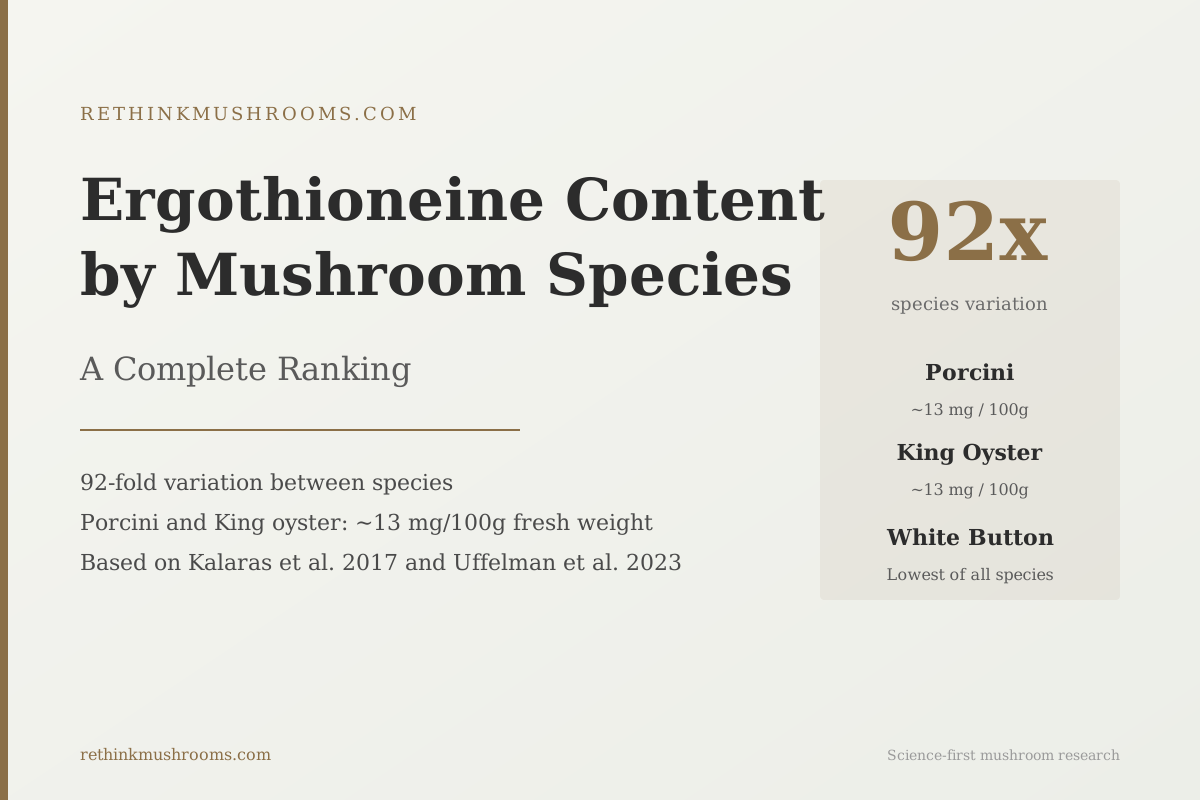
92x variation between species
Ergothioneine levels vary 92-fold across mushroom species, meaning the mushroom you choose matters more than how many mushrooms you eat.
Lee et al., Mycobiology, 2009
~13 mg/100g
Porcini and King oyster fresh weight (Kalaras 2017)
7 species
Commercial mushrooms profiled in 2023 metabolomics study
75 g cooked
Button mushrooms sufficient to measurably raise plasma ergothioneine
Lee et al., Mycobiology, 2009
 View as image ↗
Most people who eat mushrooms for their health reach for white button or cremini. Those happen to be the species with the least ergothioneine content of any commonly consumed mushroom. Lee and colleagues measured ergothioneine across mushroom species in a systematic comparison and found a 92.3-fold difference between the highest and lowest values.[2] The species you choose matters far more than the quantity you eat. This is the reference guide for that data: a complete picture of ergothioneine content by mushroom species, what happens to it during cooking, and what human studies show about absorption.
Ergothioneine is a sulfur-containing amino acid that the human body cannot synthesize and actively accumulates in cells via a dedicated transporter. For a deeper look at the mechanism, the pillar article covers what ergothioneine is and why the body prioritizes it. This article focuses on the dietary numbers: which species deliver the most, which deliver the least, and what the research shows about preparation and bioavailability.
Key Takeaways
- Porcini and King oyster mushrooms contain approximately 13 mg of ergothioneine per 100g fresh weight, the highest measured values among commonly studied species, per Kalaras et al. 2017
- Ergothioneine content varies 92.3-fold across mushroom species, making species selection the most impactful single factor in dietary ergothioneine intake (Lee et al., 2009)
- White button mushrooms contain the least ergothioneine of the common commercial species despite being the most widely consumed (Kalaras et al., 2017; Uffelman et al., 2023)
- Shiitake and oyster mushrooms contain substantially more ergothioneine than white button mushrooms, confirmed by independent 2023 metabolomics profiling using untargeted methods (Uffelman et al., 2023)
- Ergothioneine is thermostable: normal cooking does not dramatically reduce content, and water-based cooking methods retain it in the cooking liquid rather than destroying it (Liu et al., 2020)
- Eating 75 grams of cooked white button mushrooms raised plasma ergothioneine measurably within hours in a human RCT, confirming dietary ergothioneine is efficiently absorbed from cooked mushrooms (Weigand-Heller et al., 2012)
Why Species Selection Matters More Than Serving Size
When a nutrient varies by a factor of 92 between the lowest and highest sources within a single food category, the composition question matters more than the quantity question. Lee and colleagues established this range in 2009, measuring ergothioneine across fruiting bodies of diverse mushroom species and finding that the gap was not just statistically large but practically consequential.[2] The difference between eating white button mushrooms and eating King oyster mushrooms for ergothioneine is roughly equivalent to eating 10 to 20 times as many button mushrooms to reach the same intake.
Kalaras and colleagues published the most comprehensive species comparison study in 2017, measuring ergothioneine alongside glutathione across a range of cultivated and wild mushrooms using consistent analytical methods.[1] This study became the reference dataset for ergothioneine rankings because it covered the commercially relevant species under controlled conditions with transparent methodology. Tsiantas and colleagues independently validated the hierarchy using a different analytical approach in 2021, arriving at the same species at the top and bottom of the ranking.[3] The consistency across methods gives the rankings meaningful credibility — they don't reverse or shift significantly when measured differently.
The practical implication is simple: switching from white button to King oyster or oyster mushrooms in even a few meals per week meaningfully changes total weekly ergothioneine intake without requiring more frequent mushroom consumption.
For the practical side of those servings translated into daily intake targets, the article on how much mushroom you need for optimal ergothioneine intake runs the math on serving sizes across species.
The Complete Species Rankings: Ergothioneine Content From 13 mg Down
The Kalaras 2017 study places Porcini (Boletus edulis) and King oyster (Pleurotus eryngii) at the top of the rankings, each measuring approximately 13 mg per 100g fresh weight.[1] These are the highest values measured among species studied under consistent analytical conditions. The 2023 metabolomics study from Uffelman and colleagues profiled seven common commercial species using untargeted analysis and confirmed that oyster mushrooms (Pleurotus ostreatus) and shiitake (Lentinula edodes) contain substantially more ergothioneine than white button mushrooms.[4]
The table below organizes species from highest to lowest based on Kalaras 2017, Uffelman 2023, and Lee 2009. Where specific fresh-weight values are available from primary sources, they are listed. Where a study established directional rankings without publishing all absolute values, the relative tier is noted.
| Species | Ergothioneine (mg/100g fresh) | Availability | Primary Source |
|---|---|---|---|
| Porcini (Boletus edulis) | ~13 | Wild; seasonal | Kalaras 2017 |
| King oyster (Pleurotus eryngii) | ~13 | Cultivated | Kalaras 2017 |
| Oyster (Pleurotus ostreatus) | High (substantially above button) | Cultivated | Uffelman 2023 |
| Shiitake (Lentinula edodes) | High (substantially above button) | Cultivated | Uffelman 2023 |
| Maitake (Grifola frondosa) | Moderate-high | Cultivated/wild | Uffelman 2023 |
| Lion's Mane (Hericium erinaceus) | Moderate | Cultivated | Uffelman 2023 |
| Crimini/Baby bella (A. bisporus) | Low-moderate | Cultivated | Uffelman 2023 |
| Portabella (A. bisporus mature) | Low-moderate | Cultivated | Uffelman 2023 |
| White button (Agaricus bisporus) | Lowest | Cultivated | Kalaras 2017 |
For the middle-tier species, the Uffelman 2023 metabolomics study provided directional evidence (which species rank above or below others) using untargeted profiling. Tsiantas and colleagues cross-validated the upper-tier rankings for the high-ergothioneine species using independent methods in 2021.[3] The overall pattern across all three datasets is consistent: Pleurotus species (oyster mushrooms) and Boletus species (Porcini) lead; Agaricus bisporus in all its commercial forms trails.
For a focused practical guide on the top species with shopping advice, the companion article on which mushrooms have the most ergothioneine covers the actionable switching case.
Wild vs. Cultivated: Why Porcini Tops Every Chart But Is Hard to Buy
Porcini's position at the peak of the ranking reflects something fundamental about how ergothioneine is made. Only fungi can synthesize ergothioneine from scratch, using a pathway that requires specific fungal enzymes not present in plants or animals. Mushrooms that form mycorrhizal relationships with trees tend to produce the most ergothioneine, and Porcini is a classic mycorrhizal species that cannot be commercially cultivated at scale.[2] It arrives at markets only as a foraged wild mushroom, and availability is seasonal and geographically variable.
The deeper reason for why fungal biosynthesis matters is covered in the article on why only fungi make ergothioneine and what that means for dietary sources. The short version: because only fungi make it, the species with the most biosynthetic activity have the highest content, and that tends to correlate with ecological complexity rather than cultivation success.
King oyster is the practical alternative to Porcini for anyone who cannot reliably source fresh wild boletes. It matches Porcini's ergothioneine content at approximately 13 mg per 100g fresh weight, it is cultivated reliably year-round, and it appears in most Asian grocery stores and increasingly in mainstream supermarkets. That's the most actionable single takeaway from the Kalaras 2017 rankings for someone actively trying to increase ergothioneine intake.
Fruiting Body vs. Mycelium: When Form Changes the Numbers
Most ergothioneine research measures fruiting bodies because that's what people eat. Lo and colleagues found something worth noting for supplement consumers: in several mushroom species, mycelial cultures contain more ergothioneine than the fruiting body.[5] The relationship is not uniform across species, and the substrate used to grow the mycelium plays a role in the final content.
This finding matters for evaluating mushroom supplements, which frequently use mycelial biomass grown on grain rather than whole fruiting bodies. A supplement made from King oyster mycelium is not guaranteed to contain the same ergothioneine as 100g of fresh King oyster fruiting body. The ranking data from Kalaras 2017 and Uffelman 2023 describes fruiting bodies and does not translate directly to product labels.
Lee and colleagues found that adding methionine to mycelial growth medium significantly increased ergothioneine production in most species they tested.[2] Methionine is a precursor in the ergothioneine biosynthesis pathway, so supplementing the growth medium effectively raises fungal output. This finding is relevant to manufacturers and growers rather than to consumers buying whole mushrooms at the grocery store.
For whole-food dietary purposes, the fruiting-body data in this article's table is the correct reference. For supplement evaluation, the Lo 2012 finding is a reminder that a product's form and substrate history determine whether fruiting-body rankings apply.
Does Cooking Destroy Ergothioneine? The Reassuring Answer
Liu and colleagues tested ergothioneine stability under a range of cooking and storage conditions in 2020 and found the compound is thermostable.[6] Normal cooking temperatures do not dramatically reduce ergothioneine content. Even acid and base conditions and prolonged high-heat treatment had only modest effects, not the large losses one might expect from a delicate antioxidant compound.
The practical exception is water-solubility. Ergothioneine dissolves in water, so when mushrooms are boiled or simmered in liquid, some of their ergothioneine leaches into the cooking water.[6] Discarding that water (as when boiling mushrooms and draining them) removes the ergothioneine that transferred to the liquid. Keeping the cooking liquid in the dish retains it. Soups, stews, risottos, and sauces where mushrooms cook in liquid that stays in the meal preserve the ergothioneine that leaches from the mushroom tissue.
Dry-heat methods avoid the solubility issue entirely. Sautéing, roasting, and grilling keep the ergothioneine in the mushroom without the leaching risk, and the thermal stability means the compound survives those temperatures intact.
The cooking stability finding is practically absent from most consumer content about ergothioneine. Liu 2020 is a clear answer to a question that consumers frequently raise: you don't need to eat mushrooms raw, and sautéing does not destroy the ergothioneine you're trying to consume.
From the Plate to Your Blood: What the Human Absorption Data Shows
The clearest dietary absorption evidence comes from Weigand-Heller and colleagues, who ran a controlled trial with 10 participants in 2012.[7] Participants ate 75 grams of cooked white button mushrooms. Researchers measured plasma ergothioneine and whole-blood antioxidant capacity at intervals afterward. Plasma ergothioneine increased significantly within hours of eating, and whole-blood antioxidant capacity rose alongside it.
Two things make this finding useful for interpreting the species ranking data. First, it confirms that dietary ergothioneine is efficiently absorbed from cooked mushrooms specifically. The heat treatment that cooking requires did not prevent absorption. Second, white button mushrooms are the lowest-ranking species in the ergothioneine content table. If 75 grams of the least ergothioneine-rich commercial mushroom raises plasma ergothioneine measurably, then a comparable serving of Shiitake or King oyster (which contain substantially more) would be expected to produce a larger increase.
The sample size of 10 limits how precisely this can be extrapolated. Weigand-Heller 2012 did not compare multiple species or test dose-response relationships. What it provides is the mechanistic confirmation that the content ranking data translates into actual plasma changes after eating. The absorption mechanism involves OCTN1, a dedicated transporter that actively pulls ergothioneine from the intestine into cells during digestion. For a full treatment of that mechanism, the article on what ergothioneine is and its dedicated human transporter covers how OCTN1 determines the rate-limiting step in dietary ergothioneine uptake. The ergothioneine also reaches specialized tissues: the article on ergothioneine and eye health illustrates where the compound concentrates and why that concentration pattern suggests dietary sources matter for specific tissues.
The Bottom Line
Ergothioneine content varies 92-fold across mushroom species, with Porcini and King oyster at the top at approximately 13 mg per 100g fresh weight and white button mushrooms at the bottom. Rankings are consistent across multiple independent studies using different analytical methods. Ergothioneine survives normal cooking with only modest water-solubility losses, and human data confirms that eating cooked mushrooms raises plasma ergothioneine measurably. The practical takeaway: switching from button to King oyster or oyster mushrooms meaningfully increases ergothioneine intake without eating more mushrooms.
Frequently Asked Questions
Sources & References
- 1RTHM-00476·Kalaras, Michael D et al. (2017). “Mushrooms: A rich source of the antioxidants ergothioneine and glutathione..” Food chemistry.Study breakdown →PubMed →↩
- 2RTHM-00301·Lee, Wi Young et al. (2009). “Ergothioneine contents in fruiting bodies and their enhancement in mycelial cultures by the addition of methionine..” Mycobiology.Study breakdown →PubMed →↩
- 3RTHM-00725·Tsiantas, Konstantinos et al. (2021). “On the Identification and Quantification of Ergothioneine and Lovastatin in Various Mushroom Species: Assets and Challenges of Different Analytical Approaches..” Molecules (Basel.Study breakdown →PubMed →↩
- 4RTHM-00856·Uffelman, Cassi N et al. (2023). “Metabolomics Profiling of White Button, Crimini, Portabella, Lion's Mane, Maitake, Oyster, and Shiitake Mushrooms Using Untargeted Metabolomics and Targeted Amino Acid Analysis..” Foods (Basel.Study breakdown →PubMed →↩
- 5RTHM-00256·Lo, Yu-Chang et al. (2012). “Comparative study of contents of several bioactive components in fruiting bodies and mycelia of culinary-medicinal mushrooms..” International journal of medicinal mushrooms.Study breakdown →PubMed →↩
- 6RTHM-00633·Liu, Xinqi et al. (2020). “A Study on the Antioxidant Properties and Stability of Ergothioneine from Culinary-Medicinal Mushrooms..” International journal of medicinal mushrooms.Study breakdown →PubMed →↩
- 7RTHM-00270·Weigand-Heller, AuBrei J et al. (2012). “The bioavailability of ergothioneine from mushrooms (Agaricus bisporus) and the acute effects on antioxidant capacity and biomarkers of inflammation..” Preventive medicine.Study breakdown →PubMed →↩