Ergothioneine Dietary Sources & Intake
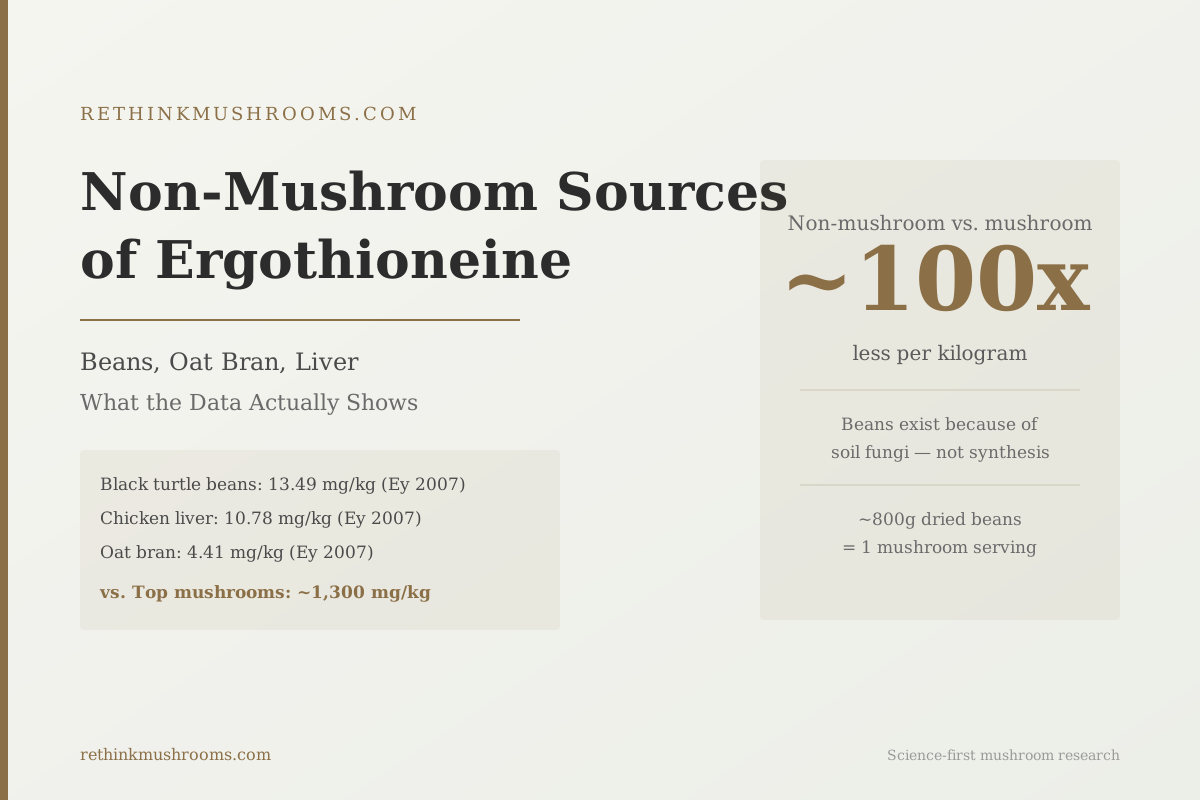
~100x less ergothioneine than mushrooms
Black turtle beans contain 13.49 mg of ergothioneine per kg dry weight. King oyster mushrooms contain approximately 1,300 mg/kg. That gap defines the non-mushroom conversation.
Ey et al., J Agric Food Chem, 2007
13.49 mg/kg
Black turtle beans, highest non-mushroom plant source (Ey 2007)
10.78 mg/kg
Chicken liver, highest animal source measured (Ey 2007)
~1,300 mg/kg
Top mushroom species in dry weight (Ey 2007 comparison)
Ey et al., J Agric Food Chem, 2007
 View as image ↗
Non-mushroom sources of ergothioneine do exist. The surprising fact is that they exist at all, since only fungi can actually make ergothioneine from scratch. Beans, oat bran, liver, and a handful of other foods contain measurable amounts, and for people who don't eat mushrooms, understanding these sources matters. The less surprising fact is the scale: the best non-mushroom plant source measured by Ey and colleagues in 2007 contained about 100 times less ergothioneine per kilogram than the top mushroom species.[1]
This article covers what the research has actually measured, explains why non-fungal foods contain any ergothioneine at all, and gives an honest accounting of what non-mushroom dietary sources can and cannot provide. The pillar article covers what ergothioneine is and why the body accumulates it. The complete mushroom species ranking covers the full mushroom comparison data. This article focuses on everything outside that category.
Key Takeaways
- Non-mushroom plant foods with the highest measured ergothioneine content: black turtle beans at 13.49 mg/kg dry weight, red kidney beans at 4.52 mg/kg dry weight, and oat bran at 4.41 mg/kg dry weight (Ey et al., 2007)
- The highest animal source measured was chicken liver at 10.78 mg/kg dry weight; organ meats accumulate ergothioneine by eating food grown in fungal-rich environments (Ey et al., 2007)
- Top mushroom species reach approximately 1,300 mg/kg dry weight, making them roughly 100 times richer in ergothioneine than the best non-mushroom plant sources (Ey 2007; Kalaras 2017)
- Non-fungal foods contain ergothioneine because they absorbed it from soil fungi or through fungal associations during growth; no plant or animal can synthesize ergothioneine independently
- About 800g of dried black turtle beans would be needed to match the ergothioneine in a single 85g serving of King oyster mushrooms
- Beans and oat bran can meaningfully contribute to ergothioneine intake in mushroom-light diets, but they cannot substitute for regular mushroom consumption as a primary source
Yes, Beans Have Ergothioneine. Here Is How Much, Exactly
Ey and colleagues published the most comprehensive measurement study of ergothioneine across non-mushroom food sources in 2007, using validated analytical methods to quantify ergothioneine in a wide range of plant and animal foods.[1] The results confirmed that non-mushroom sources do contain ergothioneine, but the absolute amounts place them in a completely different tier from even low-ranking mushroom species.
Among plant foods, black turtle beans produced the highest measured value at 13.49 mg per kilogram dry weight. Red kidney beans came in at 4.52 mg/kg, and oat bran at 4.41 mg/kg. The pattern across all non-mushroom plant foods was consistent: values remained below 15 mg/kg dry weight.[1]
| Food | Ergothioneine (mg/kg dry weight) | Source |
|---|---|---|
| Black turtle beans | 13.49 | Ey 2007 |
| Chicken liver | 10.78 | Ey 2007 |
| Red kidney beans | 4.52 | Ey 2007 |
| Oat bran | 4.41 | Ey 2007 |
| Top mushroom species | ~1,300 | Ey 2007 comparison; Kalaras 2017 |
The comparison with mushrooms puts these numbers in context. Ey 2007 also measured mushrooms and reported values reaching approximately 1,300 mg/kg dry weight at the upper end of the species range. Kalaras and colleagues independently confirmed that top species like King oyster and Porcini sit at the top of the ergothioneine spectrum.[3] The ratio between the best non-mushroom plant source (13.49 mg/kg) and the top mushroom species (~1,300 mg/kg) is roughly 96-fold, effectively 100 times the content per kilogram.
Why Non-Fungal Foods Have Any Ergothioneine at All
The presence of ergothioneine in beans, oat bran, and organ meats requires explanation, because only fungi possess the enzymatic pathway to synthesize ergothioneine. No plant or animal has the biosynthetic toolkit. The article on why only fungi make ergothioneine and what that means covers the biosynthesis pathway in detail. Here, the dietary question is: how does ergothioneine get into non-fungal foods?
The leading explanation involves two pathways. First, plants grown in fungal-rich soil absorb ergothioneine that soil fungi have produced. Legumes like beans form intimate relationships with soil microorganisms, and their roots sit in fungal networks that produce ergothioneine as a metabolic byproduct. The beans absorb some of this from their growing environment rather than making it themselves. Second, mycorrhizal fungi associations, which are present in most agricultural soils, represent another route for trace amounts of ergothioneine to enter plant tissues.
The oat bran finding fits the same picture: oats grown in soil with significant fungal activity would be expected to absorb trace amounts of ergothioneine. The relatively high value for black turtle beans compared to other legumes may reflect differences in the soil microbiome associated with legume cultivation or in the intensity of symbiotic fungal relationships.
Syahputra and colleagues, in their 2025 comprehensive review of ergothioneine as a functional nutraceutical, note the broader dietary source picture: non-mushroom foods contain ergothioneine precisely because of their association with fungi in the environment, and the amounts present reflect the indirect pathway of acquisition rather than direct biosynthesis.[5]
Animal Sources: Liver, Kidney, and How Accumulated Ergothioneine Ends Up in Meat
Animal-derived foods contain ergothioneine through the dietary route: animals eat ergothioneine-containing foods, absorb it via OCTN1 (the dedicated transporter), and accumulate it in tissues. Organ meats, particularly liver and kidney, accumulate the highest amounts because these tissues have higher OCTN1 expression and serve as ergothioneine reservoirs in the body.
Ey and colleagues measured chicken liver at 10.78 mg/kg dry weight, making it the highest animal source in their dataset and nearly comparable to the best legume sources.[1] Kidney and other organ meats would be expected to contain similar amounts based on the same accumulation logic, though Ey 2007 did not report all organ types. Regular muscle meat (what most people eat as "meat") contains far less than organ meats because ergothioneine preferentially concentrates in the liver and kidney rather than in skeletal muscle.
Seafood is occasionally mentioned in discussions of ergothioneine sources, but the data from Ey 2007 suggests that fish and shellfish values are low compared to organ meats. Shellfish that feed on marine fungi may accumulate more than fin fish, but published measurements for most seafood types remain sparse.
Syahputra and colleagues' 2025 review confirms that the animal food ergothioneine content reflects the animals' own dietary history with fungi: herbivores in fungal-rich environments, or omnivores that consumed ergothioneine-rich foods, accumulate more in their tissues.[5]
The Sobering Math: How Much Beans to Match One Mushroom Serving
Working through the arithmetic puts the practical reality of non-mushroom sources in sharp relief. King oyster mushrooms contain approximately 13 mg of ergothioneine per 100g fresh weight per Kalaras 2017, meaning an 85g serving delivers roughly 11 mg.[3]
Black turtle beans, at 13.49 mg/kg dry weight from Ey 2007, contain 1.349 mg per 100g of dried beans.[1] To match the 11 mg in one 85g King oyster serving, you would need approximately 815 grams of dried black turtle beans. Cooked, that translates to roughly 2 kg of cooked beans. A standard meal-sized portion of cooked beans (about 150g) delivers approximately 0.2 mg of ergothioneine.
With the Japan average daily intake set at 6.6 mg per day per Tian 2023, achieving that benchmark from black turtle beans alone would require eating approximately 500g of dried beans daily.[2] That is neither practical nor nutritionally advisable as a primary dietary strategy.
Oat bran, at 4.41 mg/kg dry weight, performs similarly poorly by the numbers. A 40g serving of oat bran contains approximately 0.18 mg of ergothioneine. Reaching even the low USA average of 1.1 mg per day from oat bran alone would require several hundred grams of oat bran daily.
How the Body Absorbs Ergothioneine From Non-Mushroom Sources
The absorption mechanism is the same regardless of the food source. Shimizu and colleagues demonstrated in 2015 that OCTN1, a transporter protein in the intestinal epithelium, actively captures ergothioneine from digested food and carries it into circulation.[4] This transporter operates identically whether the ergothioneine arrived from mushrooms, beans, or liver. For a complete treatment of OCTN1 and its unique role as the only dedicated amino acid transporter of its kind in humans, the article on what ergothioneine is and its dedicated human transporter explains the mechanism in full.
The relevant difference between sources is the concentration arriving at the intestinal transporter. A meal including 150g of cooked beans delivers roughly 0.2 mg of ergothioneine to the transporter; a comparable weight of King oyster mushrooms delivers closer to 20 mg. The OCTN1 system can handle both; the downstream plasma levels will differ proportionally. For people who eat no mushrooms, consuming beans, oat bran, and organ meats regularly still contributes some ergothioneine to circulating levels, even if the amounts are small.
Tian and colleagues calculated that Americans average approximately 1.1 mg of ergothioneine per day, a figure that reflects limited mushroom consumption and relies in part on these minor non-mushroom contributors.[2] The non-mushroom food sources are what push that baseline above zero for people who eat no mushrooms at all. For the context of how that 1.1 mg/day compares to achievable targets with mushrooms, the companion article on how much mushroom you need for optimal ergothioneine intake runs the serving-size math.
Syahputra and colleagues' 2025 review of ergothioneine as a functional nutraceutical synthesizes the bioavailability picture across all dietary forms and confirms that OCTN1 efficiency is similar regardless of source: mushroom-derived ergothioneine and bean-derived ergothioneine are absorbed through the same transporter with the same priority system.[5] The gap between sources is purely a content question, not an absorption question.
The Practical Conclusion: Beans and Oat Bran Help, But Cannot Replace Mushrooms
The non-mushroom data tells a consistent story. Non-fungal foods do contain ergothioneine, and for completeness they are worth knowing about. Black turtle beans, red kidney beans, oat bran, and organ meats are the best-documented non-mushroom sources, all measured in Ey 2007. They contribute meaningfully to the baseline ergothioneine intake in mushroom-light diets and are worth including in regular eating for other nutritional reasons too.
But the scale difference is too large for substitution. Reaching Japan's 6.6 mg/day ergothioneine intake from beans alone would require quantities of legumes that are impractical as a daily dietary pattern. The 100-fold gap between the best non-mushroom plant source and the top mushroom species is not a gap that cooking habits or food quantity can close.
What non-mushroom sources can realistically achieve is a meaningful floor. A diet that regularly includes legumes, organ meats, and whole grains will keep some ergothioneine moving through the OCTN1 transport system on a daily basis, even in the complete absence of mushrooms. The Shimizu 2015 finding that OCTN1 in intestinal tissue becomes more active during inflammation suggests that even small amounts of dietary ergothioneine from non-mushroom sources may be physiologically relevant when the body most needs antioxidant support.[4]
The honest framing is this: eating black turtle beans several times a week contributes approximately 0.4 to 0.8 mg of ergothioneine to the diet. Adding oat bran and chicken liver on separate days might push a non-mushroom eater to 1.5 to 2 mg per day — above the USA average, still well below Japan's 6.6 mg average, and without a single mushroom. That is not nothing, and it matters for people who genuinely avoid mushrooms due to allergy, texture preferences, or access limitations.
For people who do eat mushrooms, the non-mushroom data is interesting context rather than practical guidance. Choosing King oyster or oyster mushrooms over white button achieves in one serving what a careful non-mushroom dietary strategy achieves in a week. The Tian 2023 population data makes this difference consequential: the six-fold intake gap between Japan and the USA maps exactly onto the gap between a mushroom-centered and a mushroom-absent dietary approach to ergothioneine.[2]
The Bottom Line
Non-mushroom foods do contain ergothioneine, but at levels approximately 100-fold lower than top mushroom species. Ey 2007 measured the best non-mushroom plant sources: black turtle beans at 13.49 mg/kg and oat bran at 4.41 mg/kg dry weight, compared to mushrooms reaching ~1,300 mg/kg. These foods contain ergothioneine because they absorbed it from soil fungi during growth, not through independent synthesis. They contribute to baseline dietary intake, particularly in mushroom-light diets, but cannot substitute for mushroom consumption as a primary ergothioneine source.
Frequently Asked Questions
Sources & References
- 1RTHM-00213·Ey, Janine et al. (2007). “Dietary sources and antioxidant effects of ergothioneine..” Journal of agricultural and food chemistry.Study breakdown →PubMed →↩
- 2RTHM-01805·Tian, Xiaoying et al. (2023). “Ergothioneine: an underrecognised dietary micronutrient required for healthy ageing?.” The British journal of nutrition.Study breakdown →PubMed →↩
- 3RTHM-00476·Kalaras, Michael D et al. (2017). “Mushrooms: A rich source of the antioxidants ergothioneine and glutathione..” Food chemistry.Study breakdown →PubMed →↩
- 4RTHM-00732·Shimizu, Takuya et al. (2015). “Organic cation transporter Octn1-mediated uptake of food-derived antioxidant ergothioneine into infiltrating macrophages during intestinal inflammation in mice..” Drug metabolism and pharmacokinetics.Study breakdown →PubMed →↩
- 5RTHM-02192·Syahputra, Rony Abdi et al. (2025). “Ergothioneine as a functional nutraceutical: Mechanisms, bioavailability, and therapeutic implications..” The Journal of nutritional biochemistry.Study breakdown →PubMed →↩