Ergothioneine Dietary Sources & Intake
10-20x more ergothioneine than button mushrooms
Switching from white button to King oyster multiplies your ergothioneine intake 10 to 20 times without changing how often you eat mushrooms.
Kalaras et al., Food Chem, 2017; Lee et al., Mycobiology, 2009
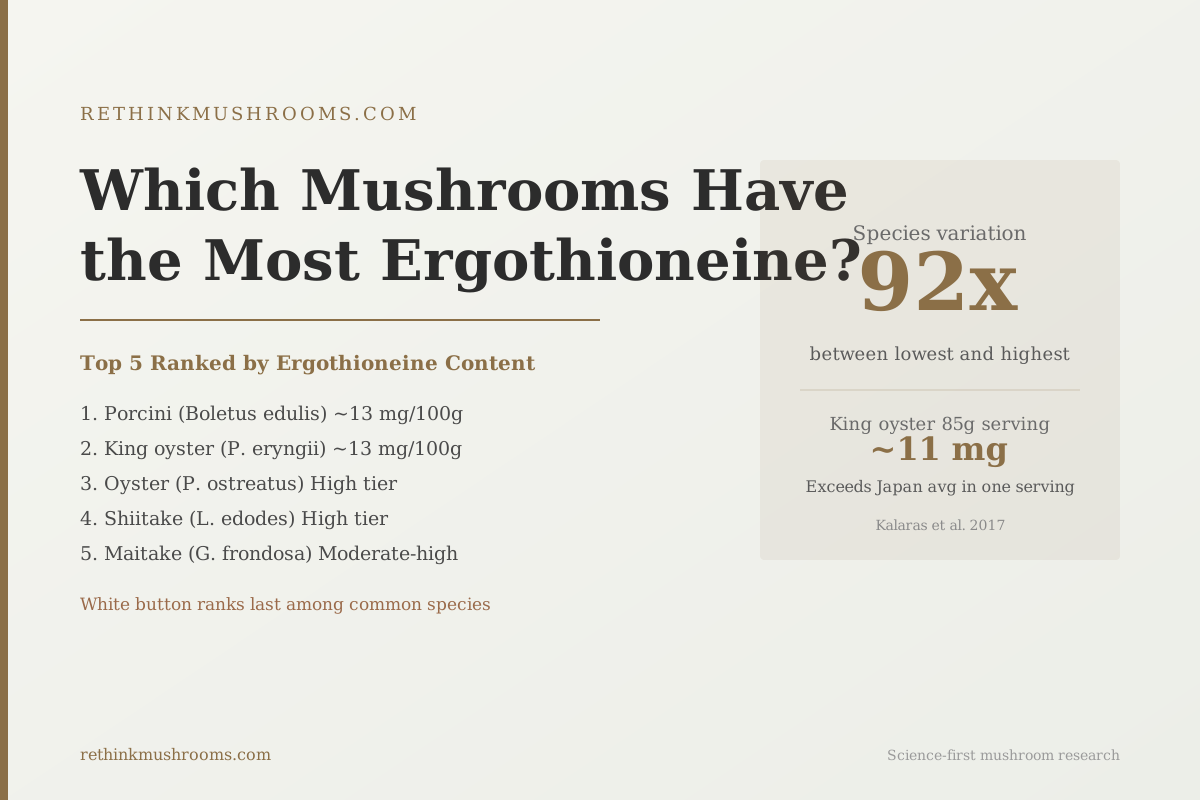
Porcini
Highest ergothioneine at ~13 mg/100g fresh weight (Kalaras 2017)
King oyster
Top cultivated species, matches Porcini at ~13 mg/100g (Kalaras 2017)
92.3-fold
Total species variation measured by Lee et al. 2009
Kalaras et al., Food Chem, 2017; Lee et al., Mycobiology, 2009
 View as image ↗
Most mushroom shoppers default to white button. It is the most widely available, the most familiar, and the cheapest. It is also the species with the least ergothioneine of any mushroom commonly sold in grocery stores. Lee and colleagues found a 92.3-fold difference in ergothioneine content between the highest and lowest mushroom species they measured. White button sits near the bottom of that range.[4] The species you pick matters far more than how frequently you eat mushrooms.
This is the practical guide to which mushrooms have the most ergothioneine, built around the Kalaras 2017 study and the 2023 Uffelman metabolomics data. For the full reference table covering 20-plus species, the complete species ranking article covers the comprehensive data. This article answers the shopping question: which mushrooms are worth prioritizing, and what changes when you switch away from button mushrooms. For background on what ergothioneine is and why the body prioritizes it, the pillar article covers the mechanism.
Key Takeaways
- Porcini (Boletus edulis) and King oyster (Pleurotus eryngii) are the highest-ergothioneine mushrooms measured at approximately 13 mg per 100g fresh weight (Kalaras et al., 2017)
- Shiitake and oyster mushrooms contain substantially more ergothioneine than white button mushrooms, confirmed independently by 2023 metabolomics data (Uffelman et al., 2023)
- Ergothioneine content varies 92.3-fold across mushroom species, making species selection the most impactful dietary lever for increasing ergothioneine intake (Lee et al., 2009)
- White button mushrooms rank at the bottom of common commercial species despite being the most consumed mushroom in the world (Kalaras 2017; Uffelman 2023)
- Switching from white button to King oyster or oyster mushrooms for the same number of meals substantially increases weekly ergothioneine intake without additional frequency of mushroom consumption
- Porcini outperforms all cultivated species but is wild, seasonal, and not reliably available in most grocery stores. King oyster is the practical cultivated equivalent.
The Answer Most Mushroom Shoppers Don't Know
The mushroom most people reach for when they're thinking about health is, ironically, the worst choice for ergothioneine. White button mushrooms (Agaricus bisporus) and their mature forms, crimini and portabella, sit at the bottom of the ergothioneine rankings. Kalaras and colleagues published the most comprehensive single comparison in 2017 and found that Porcini and King oyster each measured at approximately 13 mg per 100g fresh weight, while white button measured "far less" at the other end of the range.[1]
The 92.3-fold species variation Lee et al. found in 2009 makes this gap concrete: the best species doesn't just contain a little more ergothioneine than the worst.[4] It contains roughly 100 times more. For someone buying mushrooms specifically because they've read about ergothioneine and longevity, the species decision dwarfs every other dietary choice in this category.
The good news is that the top-performing cultivated alternative is widely available year-round. King oyster mushrooms are sold at most Asian grocery stores and increasingly at mainstream supermarkets. Switching from button to King oyster for the same meal, the same frequency, multiplies ergothioneine intake by the factor separating the two species. No change in how much you cook or how often.
The Top 5 Mushrooms for Ergothioneine: The Ranked List
The ranking below draws on Kalaras 2017 as the primary reference and Uffelman 2023 for updated commercial species data. For species where Kalaras 2017 published specific values, they are listed. For species where Uffelman 2023 established relative rankings without publishing all absolute values, the tier is noted.
1. Porcini (Boletus edulis): ~13 mg/100g fresh weight The highest-measured species in the Kalaras 2017 study, tied with King oyster. Wild, seasonal, and cannot be commercially cultivated. Fresh porcini appears primarily in autumn in Europe and North America; dried porcini is available year-round and retains ergothioneine because the compound is thermostable.
2. King oyster (Pleurotus eryngii): ~13 mg/100g fresh weight Matches Porcini at the top of the rankings and is commercially cultivated year-round. The best practical answer for most grocery shoppers. One 85g serving delivers approximately 11 mg of ergothioneine, exceeding Japan's average daily intake of 6.6 mg in a single meal.[1]
3. Oyster mushroom (Pleurotus ostreatus): High tier Uffelman and colleagues confirmed in their 2023 metabolomics profiling that oyster mushrooms contain substantially more ergothioneine than white button mushrooms.[2] Cultivated year-round, readily available, and a strong everyday alternative to button mushrooms.
4. Shiitake (Lentinula edodes): High tier Also confirmed substantially higher than white button in Uffelman 2023.[2] Among the most widely consumed mushrooms globally after button, making it both accessible and a meaningful ergothioneine upgrade. Dried shiitake retains ergothioneine and is broadly available.
5. Maitake (Grifola frondosa): Moderate-high tier Also profiled in Uffelman 2023, with measurable ergothioneine above button mushrooms.[2] Maitake has a strong culinary profile and additional bioactive compounds that make it a valuable addition beyond ergothioneine alone.
Tsiantas and colleagues independently cross-validated the top of these rankings in 2021 using a different analytical method and found consistent results: the same species at the top of the hierarchy regardless of measurement approach.[3] The rankings are analytically stable across methods.
What a 92-Fold Variation Means for Your Weekly Mushroom Habit
The 92.3-fold species variation finding from Lee 2009 is not an abstract statistical claim.[4] It has a direct implication for anyone who eats mushrooms primarily as button or crimini: you could be getting somewhere between 10 and 90 times less ergothioneine per meal than you would from a different mushroom, without changing anything else about your cooking habits or portion size.
This matters more than frequency. Someone who eats King oyster mushrooms once a week likely consumes more ergothioneine than someone who eats white button mushrooms three times a week. The species multiplier overwhelms the frequency advantage. The Japan-USA intake gap that Tian and colleagues documented in 2023 (6.6 mg/day versus 1.1 mg/day) is largely explained by species selection: Japanese cuisine traditionally incorporates shiitake, oyster, and enoki, while the American diet leans on button mushrooms when mushrooms appear at all.[5]
Switching species is the highest-leverage single change available within the mushroom category.
The Wild Card: Why Porcini Tops Every Chart But Rarely Shows Up in Weekly Shopping
Porcini mushrooms lead the ergothioneine rankings because of an ecological relationship that also makes them difficult to buy. Porcini are mycorrhizal fungi, meaning they form symbiotic root partnerships with trees rather than growing independently. This ecological dependency means they cannot be commercially cultivated at scale, and all porcini sold fresh are foraged. For the full explanation of why only fungi synthesize ergothioneine and why mycorrhizal species tend to be richer in it, the article on why only fungi make ergothioneine covers the biosynthesis pathway.
The practical implication: fresh Porcini appears in autumn at specialty grocers and farmers markets in regions with the right forest ecosystems. Dried porcini is widely available year-round and provides the same ergothioneine because the compound survives dehydration and normal cooking temperatures. A small quantity of dried porcini rehydrated in warm water, with the soaking liquid included in the dish to retain leached ergothioneine, is a practical way to access Porcini's exceptional ergothioneine content outside of foraging season.
King oyster fills the gap for anyone who cannot source Porcini reliably. Both species measure approximately 13 mg per 100g fresh weight per Kalaras 2017, and King oyster is available year-round at predictable prices.[1]
The 2023 Commercial Species Update: What Metabolomics Confirmed
The Uffelman 2023 metabolomics study adds important nuance to the Kalaras 2017 data for the seven most widely available commercial mushroom species.[2] Uffelman and colleagues used untargeted metabolomics profiling, a broader analytical approach that captures compounds beyond what targeted assays look for, on White Button, Crimini, Portabella, Lion's Mane, Maitake, Oyster, and Shiitake mushrooms.
The findings reinforced what Kalaras 2017 established for the species in common between the two studies. Shiitake and oyster mushrooms showed substantially more ergothioneine than white button mushrooms. Crimini and portabella (both mature Agaricus bisporus) measured similarly to white button, not surprisingly since they're the same species at different growth stages.
The 2023 data also provides the most recent snapshot using modern analytical methods, important for a compound where measurement precision has improved considerably since the earlier literature. Tsiantas 2021 had already cross-validated with a third independent method, so we now have three independent analytical confirmations of the same species hierarchy.[3]
What Button Mushrooms Actually Contain (Not Zero)
White button mushrooms rank last among common commercial species for ergothioneine, but they are not zero. The Kalaras 2017 study measured white button as the lowest-ranking species, and Uffelman 2023 confirmed this across the seven commercial species their metabolomics profiling covered.[1][2] Button mushrooms provide some ergothioneine; they just provide far less than the alternatives at the same serving size.
The reason this matters for the switching argument: moving from button to King oyster doesn't eliminate one source and replace it with another. It multiplies what that source delivers, through the same eating pattern. The population context from Tian 2023 is instructive: the USA's 1.1 mg/day average is not zero, and that average includes some contribution from the white button mushrooms that dominate American supermarkets.[5] Japan's 6.6 mg/day average reflects a pattern where people eat higher-ergothioneine species with similar frequency. The gap is a species gap, not a mushroom-eating frequency gap.
For a full translation of species rankings into daily serving guidance, the article on how much mushroom you need for optimal ergothioneine intake runs the Japan-USA comparison through a practical serving-size table.
For people who are already eating mushrooms regularly, the ergothioneine opportunity is entirely in the species switch. For people thinking about adding more ergothioneine from diet without mushrooms, the article on non-mushroom ergothioneine sources including beans and oat bran shows what non-mushroom foods can realistically contribute, though as that analysis shows, the amounts are substantially smaller.
The Bottom Line
Porcini and King oyster mushrooms lead the ergothioneine rankings at approximately 13 mg per 100g fresh weight per Kalaras 2017, with oyster mushrooms and shiitake close behind in the high tier per Uffelman 2023. White button mushrooms rank last among common commercial species. The 92.3-fold species variation means switching from button to King oyster multiplies ergothioneine intake 10 to 20 times without changing how often you eat mushrooms. Porcini is the wild leader but King oyster is the practical cultivated equivalent for year-round grocery shopping.
Frequently Asked Questions
Sources & References
- 1RTHM-00476·Kalaras, Michael D et al. (2017). “Mushrooms: A rich source of the antioxidants ergothioneine and glutathione..” Food chemistry.Study breakdown →PubMed →↩
- 2RTHM-00856·Uffelman, Cassi N et al. (2023). “Metabolomics Profiling of White Button, Crimini, Portabella, Lion's Mane, Maitake, Oyster, and Shiitake Mushrooms Using Untargeted Metabolomics and Targeted Amino Acid Analysis..” Foods (Basel.Study breakdown →PubMed →↩
- 3RTHM-00725·Tsiantas, Konstantinos et al. (2021). “On the Identification and Quantification of Ergothioneine and Lovastatin in Various Mushroom Species: Assets and Challenges of Different Analytical Approaches..” Molecules (Basel.Study breakdown →PubMed →↩
- 4RTHM-00301·Lee, Wi Young et al. (2009). “Ergothioneine contents in fruiting bodies and their enhancement in mycelial cultures by the addition of methionine..” Mycobiology.Study breakdown →PubMed →↩
- 5RTHM-01805·Tian, Xiaoying et al. (2023). “Ergothioneine: an underrecognised dietary micronutrient required for healthy ageing?.” The British journal of nutrition.Study breakdown →PubMed →↩