Ergothioneine Dietary Sources & Intake
6x more ergothioneine in Japan vs. USA
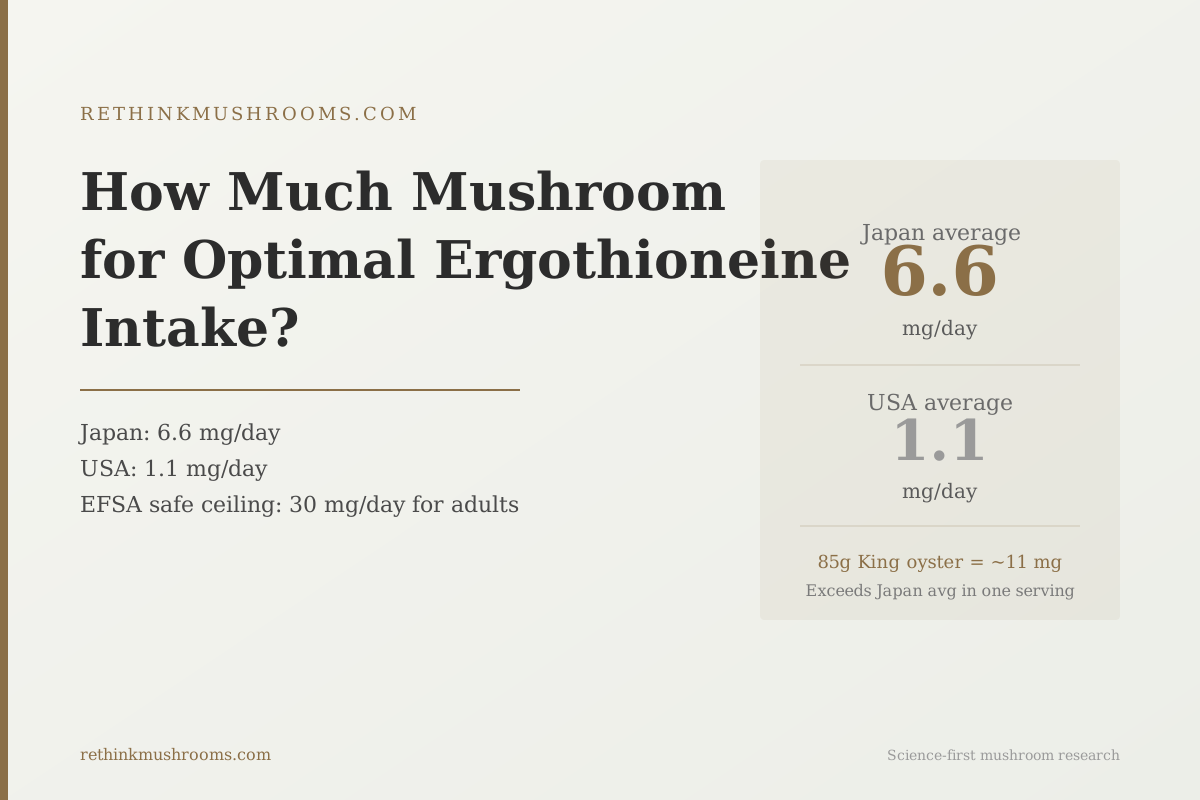
Japan averages 6.6 mg of dietary ergothioneine per day versus 1.1 mg in the USA, a six-fold gap that tracks closely with population longevity differences.
Tian et al., Br J Nutr, 2023
6.6 mg/day
Average ergothioneine intake in Japan (Tian 2023)
30 mg/day
EFSA safety ceiling for adults (EFSA 2017)
~11 mg
Ergothioneine in one 85g serving of King oyster mushrooms
Tian et al., Br J Nutr, 2023
 View as image ↗
There is no official recommended daily allowance for ergothioneine per day from mushrooms, but the population data gives us a useful reference point. Japan averages about 6.6 mg per day per person, largely from a diet rich in shiitake, oyster, and other ergothioneine-dense mushroom species. Americans average about 1.1 mg per day. Tian and colleagues, reviewing this intake gap in 2023, noted that it correlates closely with well-documented differences in longevity between the two populations. This correlation doesn't prove causation, but it gives the intake question practical relevance.[1]
This article answers the dosing question with the best data available: what the population studies suggest, what safety regulators have established as a ceiling, and how much ergothioneine different mushroom species deliver per typical serving. The pillar article on what ergothioneine is and why the body prioritizes it covers the mechanism; this article focuses on the practical numbers.
Key Takeaways
- Japan averages 6.6 mg of dietary ergothioneine per day versus 1.1 mg in the USA, a six-fold gap that tracks with population longevity differences (Tian et al., 2023)
- No official recommended daily intake exists for ergothioneine, but the European Food Safety Authority established 30 mg/day as a safe upper limit for adults and 20 mg/day for children (EFSA, 2017)
- One 85g serving of King oyster mushrooms delivers approximately 11 mg of ergothioneine, exceeding Japan's average daily intake in a single meal (Kalaras 2017)
- White button mushrooms are the lowest-ergothioneine commercial species; even so, a white button mushroom meal measurably raises blood ergothioneine, though it likely delivers only near the USA's low average daily intake (Weigand-Heller et al., 2012)
- OCTN1, a dedicated transporter in intestinal cells, actively absorbs ergothioneine from food and prioritizes delivery to immune cells during inflammation (Shimizu et al., 2015)
- No human RCT has established a causal dose-response relationship between ergothioneine intake and any specific health outcome; the population intake data is associative, not prescriptive
Japan Averages 6x More Ergothioneine Per Day: What the Population Intake Gap Looks Like
Tian and colleagues reviewed ergothioneine intake data across populations in a 2023 paper published in the British Journal of Nutrition.[1] Their analysis found that Japanese adults average approximately 6.6 mg of ergothioneine per day, while American adults average approximately 1.1 mg per day. The difference reflects dietary pattern more than anything else: Japanese cuisine traditionally incorporates high-ergothioneine mushroom species like shiitake several times per week, while the American diet leans heavily on white button mushrooms when mushrooms appear at all.
Tian et al. noted that this intake disparity correlates with the longevity advantage Japan holds over the USA in population health data. They framed ergothioneine as an underrecognized dietary micronutrient required for healthy ageing, comparing it structurally to a vitamin in terms of how the body handles it: accumulated via a dedicated transporter, concentrated in long-lived cells, and not replaceable through any other dietary pathway.[1]
The correlation does not prove that ergothioneine causes longevity differences. Japan's longevity advantages have multiple contributing factors. What the Tian 2023 data does establish is a plausible benchmark: the population with substantially higher ergothioneine intake also shows substantially better age-related health outcomes, and the dietary mechanism is understood well enough to take the comparison seriously. The 6.6 mg/day figure is the most useful practical target available, short of a clinical recommendation that doesn't yet exist.
Ergothioneine Intake Context
One King Oyster Serving Clears Japan’s Daily Average
There is no official recommended intake for ergothioneine, so these are the four numbers worth anchoring to. A single 85 g serving of King oyster mushrooms (~11 mg) exceeds Japan’s average daily intake and sits well below the EFSA safety ceiling. Scale is linear in mg/day; the ceiling (30 mg/day) sets the maximum.
USA average intake
Tian 2023
Japan average intake
Tian 2023 — tracks longevity gap
One 85 g King oyster meal
Kalaras 2017 — exceeds Japan average
EFSA adult safety ceiling
EFSA 2017 — food alone rarely reaches this
Read it this way: the practical target is not the ceiling but the gap between the USA and Japan averages. Switching from white button to King oyster or shiitake a few times a week moves you across that gap in ordinary meals. The Japan figure is a population reference, not a clinical prescription — no human trial has fixed an optimal dose for any specific outcome.
Sources: Tian et al. (2023), Br J Nutr (intake averages); Kalaras et al. (2017), Food Chemistry (species content); EFSA (2017), EFSA Journal (30 mg/day adult safety ceiling for synthetic L-ergothioneine).
How Much Do You Get From a Single Serving? A Species-by-Species Guide
Translating species content data into serving-size numbers requires the Kalaras 2017 ergothioneine measurements plus standard serving weights. Kalaras and colleagues found Porcini and King oyster at approximately 13 mg per 100g fresh weight, the highest values among the species they measured.[2]
The table below estimates ergothioneine per typical serving for the species where absolute content data is available. For the specialty species, Uffelman and colleagues profiled seven common commercial varieties by untargeted metabolomics with targeted amino-acid quantification in 2023, confirming that oyster and shiitake rank well above white button; the relative tier is noted where a precise per-serving figure is not broken out here.[8]
| Species | Ergothioneine (mg/100g) | 85g serving | 100g serving | vs. Japan avg (6.6 mg/day) |
|---|---|---|---|---|
| King oyster (Pleurotus eryngii) | ~13 | ~11 mg | ~13 mg | 1 serving exceeds target |
| Porcini (Boletus edulis) | ~13 | ~11 mg | ~13 mg | 1 serving exceeds target |
| Oyster mushrooms | High tier | Likely exceeds Japan avg | n/a | Strong contributor |
| Shiitake | High tier | Likely near or exceeds Japan avg | n/a | Strong contributor |
| Maitake / Lion's Mane | Moderate tier | Partial contribution | n/a | Multiple servings needed |
| White button | Lowest tier | ~1-2 mg estimated | n/a | Near USA avg only |
For the species in the "high tier," the 85g estimate reflects Uffelman 2023's finding that oyster and shiitake contain substantially more ergothioneine than white button, without a precise per-serving figure broken out here.[8] The complete species ranking article covers species content data in full table form.
The practical takeaway: switching from white button to King oyster or oyster mushrooms means a single typical serving likely reaches or exceeds the Japan average daily intake. On white button, the same serving covers roughly the USA average. Not nothing, but one-sixth the ergothioneine.
The Safety Ceiling: What Regulators Say About Maximum Intake
The European Food Safety Authority reviewed synthetic L-ergothioneine as a novel food ingredient in 2017 and concluded it is safe at up to 30 mg per day for adults and up to 20 mg per day for children.[6] This was an assessment of supplemental ergothioneine, not food-derived ergothioneine, but it establishes the regulatory safety envelope.
For perspective on what this ceiling means in food terms: reaching 30 mg per day from mushrooms alone would require approximately 230g of King oyster mushrooms daily. That is roughly two large portions, every day, of the highest-ergothioneine commercial species available. From ordinary cooking patterns, hitting the safety ceiling from food alone is not realistically achievable.
The 6.6 mg/day Japan figure sits comfortably below the 30 mg/day ceiling and represents an achievable dietary target with regular consumption of high-ergothioneine species. Syahputra and colleagues, in their 2025 comprehensive review of ergothioneine as a functional nutraceutical, surveyed the available therapeutic evidence and the safety profile for both dietary and supplemental forms.[7] The broader safety picture supports dietary intake without concern at achievable food levels, with the caveat that high-dose supplement use should stay within the EFSA ceiling.
For readers who cannot source high-ergothioneine mushrooms regularly, the article on non-mushroom sources of ergothioneine covers what beans, oat bran, and animal organs contribute, though the quantities are considerably smaller than mushroom sources.
How Ergothioneine Gets From Food Into Your Cells
Understanding absorption helps explain why eating the right species matters beyond just the content numbers. Shimizu and colleagues investigated the OCTN1 transporter in intestinal tissue using an animal model and found that this single protein acts as the gating mechanism for dietary ergothioneine uptake.[5] OCTN1 in intestinal epithelial cells actively captures ergothioneine from digested food, concentrating it in the absorptive layer before releasing it into circulation. During intestinal inflammation, OCTN1 appears to preferentially shuttle ergothioneine toward infiltrating immune cells, suggesting the transporter prioritizes delivery to sites of active oxidative stress.
This transport dependency means dietary ergothioneine is not passively absorbed like small water-soluble molecules. The OCTN1 system has a capacity limit, and in theory a very high single dose might be absorbed less efficiently than the same total amount split across meals. The Shimizu 2015 findings were in mice, so direct translation to human absorption kinetics requires caution, but the transporter mechanism itself is conserved across mammals.
For a full treatment of OCTN1 and why it is uniquely dedicated to ergothioneine among the amino acids, the article on what ergothioneine is and its dedicated human transporter covers the mechanism in depth.
Weigand-Heller and colleagues confirmed the dietary absorption story in a human pilot study: 10 healthy men ate a test meal containing 8 g or 16 g of white button mushroom powder and showed a significant postprandial rise in red blood cell ergothioneine.[3] This was a small crossover sample, and notably the study's total antioxidant capacity marker (ORAC) did not rise after the meals, so the honest takeaway is narrow: ergothioneine from a mushroom meal reaches circulation, not that a single meal boosts overall antioxidant status. The study used button mushrooms (lowest ergothioneine species), suggesting that higher-ergothioneine species would produce a larger response per gram.
Cooking and Preparation: What Affects How Much You Actually Absorb
Liu and colleagues found in 2020 that ergothioneine is thermostable: normal cooking temperatures do not dramatically reduce its content in mushrooms.[4] This means the serving-size calculations above apply to cooked mushrooms, not just raw ones. You don't need to eat mushrooms raw to preserve ergothioneine content.
The relevant preparation consideration is water-solubility. Ergothioneine dissolves in water, so boiling mushrooms and discarding the cooking liquid removes the ergothioneine that has leached out.[4] Soups, stews, and braises where the mushroom liquid stays in the dish retain that ergothioneine in the meal. Dry-heat cooking (sautéing, roasting, grilling) avoids the issue because no leaching liquid is produced.
Weigand-Heller 2012 reinforces the absorption side of this: a white button mushroom meal measurably raised red blood cell ergothioneine in human participants, confirming that ergothioneine from a prepared mushroom meal reaches circulation.[3] The practical picture: sautéing King oyster mushrooms, adding shiitake to miso soup and retaining the broth, or roasting oyster mushrooms as a side dish all preserve ergothioneine content and allow efficient absorption.
For the complete guide to which mushrooms have the most ergothioneine, including the practical switching argument for replacing white button in your weekly shop, the companion article covers the full rankings with shopping context.
What We Don't Know Yet: The Honest Limits of the Evidence
No human RCT has established a causal dose-response relationship between ergothioneine intake and any specific health outcome. The Japan-USA comparison is epidemiological and associative. It points in a direction, but it cannot establish that ergothioneine specifically, at 6.6 mg/day versus 1.1 mg/day, explains the longevity gap.
The EFSA safety ceiling of 30 mg/day was set based on safety evaluation of synthetic ergothioneine as a novel food, not on therapeutic dosing evidence for health benefits. It tells us the upper safe limit but not the optimal intake. Syahputra and colleagues' 2025 review of ergothioneine as a functional nutraceutical synthesizes the available mechanistic and therapeutic evidence and notes that while the case for ergothioneine's health relevance is strong on mechanistic grounds, the clinical evidence for specific health outcomes at specific doses remains in early stages.[7]
What is established: ergothioneine is a dietary compound the body actively accumulates in long-lived cells; dietary intake raises blood levels; Japan's higher-intake population shows better longevity outcomes; and the compound is safe at dietary and supplement levels well above typical food intake. What is not established: an optimal daily dose for any particular health benefit. The 6.6 mg/day Japan average is a reasonable population-level reference point, not a prescription.
This article is educational and is not medical advice. It describes food-based ergothioneine intake, not treatment for any condition. If you are pregnant, breastfeeding, managing a health condition, or considering ergothioneine supplements rather than food sources, talk to a qualified healthcare professional about what is appropriate for you.
The Bottom Line
No official RDA for ergothioneine exists, but population data from Tian 2023 offers a practical reference: Japan averages 6.6 mg per day, six times the US average, correlating with significant longevity advantages. One 85g serving of King oyster mushrooms delivers approximately 11 mg, exceeding that benchmark in a single meal. EFSA established 30 mg/day as a safe ceiling for adults. No human RCT has yet established a causal dose-response relationship between ergothioneine intake and specific health outcomes.
Frequently Asked Questions
Sources & References
- 1RTHM-01805·Tian, Xiaoying et al. (2023). “Ergothioneine: an underrecognised dietary micronutrient required for healthy ageing?.” The British journal of nutrition.Study breakdown →PubMed →↩
- 2RTHM-00476·Kalaras, Michael D et al. (2017). “Mushrooms: A rich source of the antioxidants ergothioneine and glutathione..” Food chemistry.Study breakdown →PubMed →↩
- 3RTHM-00270·Weigand-Heller, AuBrei J et al. (2012). “The bioavailability of ergothioneine from mushrooms (Agaricus bisporus) and the acute effects on antioxidant capacity and biomarkers of inflammation..” Preventive medicine.Study breakdown →PubMed →↩
- 4RTHM-00633·Liu, Xinqi et al. (2020). “A Study on the Antioxidant Properties and Stability of Ergothioneine from Culinary-Medicinal Mushrooms..” International journal of medicinal mushrooms.Study breakdown →PubMed →↩
- 5RTHM-00732·Shimizu, Takuya et al. (2015). “Organic cation transporter Octn1-mediated uptake of food-derived antioxidant ergothioneine into infiltrating macrophages during intestinal inflammation in mice..” Drug metabolism and pharmacokinetics.Study breakdown →PubMed →↩
- 6RTHM-00920·Turck, Dominique et al. (2017). “Statement on the safety of synthetic l-ergothioneine as a novel food - supplementary dietary exposure and safety assessment for infants and young children, pregnant and breastfeeding women..” EFSA journal. European Food Safety Authority.Study breakdown →PubMed →↩
- 7RTHM-02192·Syahputra, Rony Abdi et al. (2025). “Ergothioneine as a functional nutraceutical: Mechanisms, bioavailability, and therapeutic implications..” The Journal of nutritional biochemistry.Study breakdown →PubMed →↩
- 8RTHM-00856·Uffelman, Cassi N et al. (2023). “Metabolomics Profiling of White Button, Crimini, Portabella, Lion's Mane, Maitake, Oyster, and Shiitake Mushrooms Using Untargeted Metabolomics and Targeted Amino Acid Analysis..” Foods (Basel.Study breakdown →PubMed →↩