Ergothioneine — The Longevity Amino Acid
4 longevity pathways studied
Preclinical research links ergothioneine to four longevity-associated signaling pathways: Nrf2, FOXO, AMPK, and mTOR, connecting the amino acid's unusual chemistry to established mechanisms of cellular aging.
Apparoo et al., 2022
Thione
the sulfur group that lets ergothioneine reset itself after neutralizing free radicals
OCTN1
the dedicated transport protein the body evolved to absorb ergothioneine from diet
16g
of Agaricus bisporus mushroom powder delivered bioavailable ergothioneine to human blood cells in a controlled trial (Weigand-Heller et al., 2012)
Apparoo et al., 2022
 View as image ↗
Most antioxidants sacrifice themselves. Vitamin C gives up an electron to neutralize a free radical, becomes dehydroascorbic acid, and must be regenerated by another molecule or discarded. Vitamin E does something similar. Glutathione can become pro-oxidant at high concentrations. The biology of antioxidants is full of trade-offs: neutralize one reactive species, produce another.
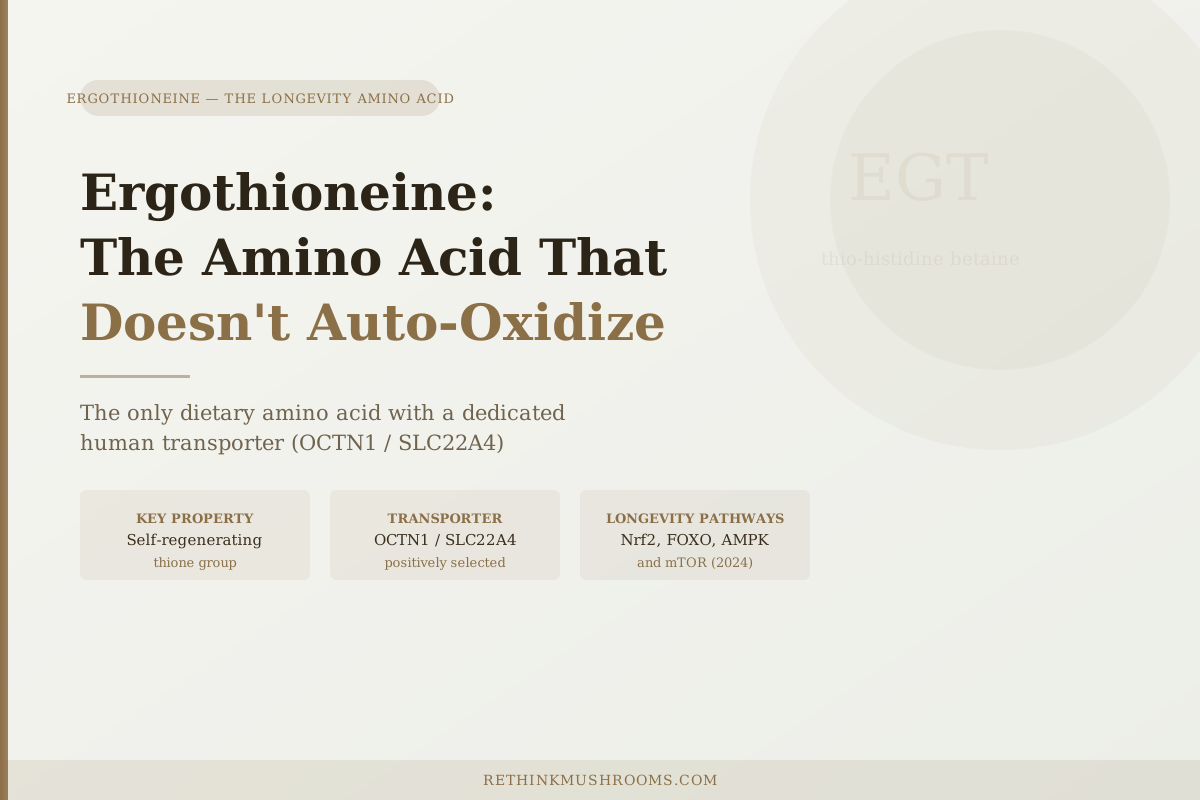
Ergothioneine works differently. It is a sulfur-containing amino acid that neutralizes free radicals without becoming a reactive species itself. It resets. And the human body evolved a dedicated transporter, OCTN1, to absorb it from food and concentrate it in the exact tissues where this property matters most.
That combination of properties (chemical self-regeneration and dedicated biological hoarding) is what distinguishes ergothioneine from other dietary antioxidants and what makes its evolutionary and dietary biology worth understanding in detail. This article covers the chemistry: what ergothioneine is structurally, how its antioxidant mechanism differs from all common alternatives, and what OCTN1 reveals about the compound's biological importance.
Key Takeaways
- Ergothioneine is a thio-histidine betaine: structurally derived from the amino acid histidine but with a sulfur group at the C-2 position that completely changes its biochemical behavior (Servillo et al., 2017)
- After neutralizing a free radical, ergothioneine reforms as the reduced thione without producing reactive byproducts; unlike vitamin C or glutathione, it does not require external regeneration and does not become pro-oxidant
- The body evolved OCTN1 (gene: SLC22A4) as a dedicated transporter for ergothioneine: expressed in the intestinal wall, kidneys, and high-stress tissues, its only established physiological substrate is ergothioneine (Cheah and Halliwell, 2021)
- A 2012 human trial confirmed that ergothioneine from Agaricus bisporus (button) mushrooms is bioavailable, showing measurable postprandial uptake into red blood cells after a mushroom meal (Weigand-Heller et al., 2012); a separate human study found that oral ergothioneine is avidly absorbed into plasma and whole blood (Cheah et al., 2017)
- Bruce Ames proposed ergothioneine as a "longevity vitamin" in 2018: not preventing acute deficiency symptoms but required for the longevity-supporting functions that triage theory predicts the body de-prioritizes under scarcity (Ames, PNAS, 2018)
- Preclinical studies and reviews link ergothioneine to four longevity-associated signaling pathways: Nrf2, FOXO, AMPK, and mTOR (Apparoo et al., 2022)
The Chemistry: What Makes Ergothioneine Structurally Unusual
Ergothioneine is classified as a thio-histidine betaine. Each word in that name is informative.
"Thio" indicates sulfur. The compound is structurally derived from the amino acid histidine, but with a modification: a sulfur-containing thione group replaces a nitrogen-containing imidazole proton at the C-2 position of the imidazole ring. This modification produces a molecule that is more stable, more selective in its reactivity, and more resistant to degradation than histidine.
"Betaine" indicates that the nitrogen in the trimethylated amino group carries a permanent positive charge. This charge makes ergothioneine zwitterionic (carrying both a positive and a negative charge) at physiological pH. The zwitterionic form is the form recognized and transported by OCTN1.
In aqueous solution and inside cells, ergothioneine exists in two tautomeric forms: the thiol form (with a free SH group) and the thione form (with a double-bonded sulfur). At physiological pH, the thione form predominates overwhelmingly. This is the active antioxidant form.
Servillo and colleagues reviewed the antioxidant chemistry of ergothioneine in 2017.[1] Their analysis identified the key property: ergothioneine is resistant to auto-oxidation. After the thione reacts with a reactive oxygen species, it reforms as the thione rather than becoming a stable oxidized product that would need to be regenerated by another reducing agent.
The contrast with common antioxidants is direct. Vitamin C (ascorbic acid) becomes dehydroascorbic acid after donating an electron. Dehydroascorbic acid is mildly reactive and must be regenerated by glutathione or other reducing equivalents. In high enough concentrations, ascorbate can act as a pro-oxidant. Vitamin E (alpha-tocopherol) becomes the tocopheryl radical after antioxidant activity, requiring vitamin C or other reducers to regenerate it. Glutathione, the body's most abundant intracellular antioxidant, forms glutathione disulfide (GSSG) when oxidized and requires NADPH and glutathione reductase to be recycled.
Ergothioneine does not require external regeneration in the same way. The thione-to-thione cycling means the molecule continues functioning without accumulating a problematic oxidized form or drawing on other reducing equivalents. This is the chemical basis for why the body concentrates ergothioneine in tissues: a self-regenerating antioxidant that can be held in reserve without depleting the regeneration machinery.
Antioxidant Mechanism
Why Ergothioneine Resets While Other Antioxidants Are Spent
Ergothioneine
Vitamin C / E, Glutathione
What it becomes after neutralizing a radical
Reforms as the active thione
A distinct oxidized product (dehydroascorbate, tocopheryl radical, GSSG)
Needs external regeneration?
No — self-regenerating
Yes — requires other reducing equivalents (NADPH, vitamin C, glutathione)
Pro-oxidant risk at high levels
Not observed
Vitamin C can turn pro-oxidant; GSSG buildup shifts redox balance
Suited to long-term tissue storage?
Yes — held in reserve without draining the recycling machinery
Limited — must be continuously recycled to stay active
The defining difference is regeneration. Vitamin C, vitamin E, and glutathione each become a stable oxidized form after donating electrons and must be recycled by other systems to work again. Ergothioneine’s thione group cycles back to its active state on its own, which is why the body can concentrate and store it in high-oxidative-stress tissues.
Source: Servillo et al. (2017), Antioxidants & Redox Signaling — Ergothioneine antioxidant function.
OCTN1: The Dedicated Transporter
OCTN1 is a membrane transport protein encoded by the SLC22A4 gene. It is classified as an organic cation transporter, but its primary physiological substrate in humans appears to be ergothioneine, a compound that is not synthesized in the body at all.
This is the evolutionary biology argument for ergothioneine's importance. OCTN1 is expressed in the small intestine, where it actively absorbs ergothioneine from food into the intestinal cells. It is expressed in the kidney proximal tubules, where it prevents ergothioneine from being lost in urine. It is expressed in high-stress tissues, where it concentrates ergothioneine intracellularly.
Cheah and colleagues' 2021 review documented the tissue distribution of OCTN1 expression: the highest concentrations are in metabolically active, oxidatively stressed tissues: mitochondria-rich cells in the liver, kidneys, and eyes, and neural tissue in the brain.[4] The protein's presence in these tissues is not incidental: the gene product is expressed precisely where a stable, self-regenerating antioxidant would provide the most benefit.
The evolutionary genetics of SLC22A4 add force to this argument. The gene shows strong evidence of positive selection across primate evolution, meaning organisms that maintained it had better survival and reproduction outcomes. For context: positive selection is the same process that preserved hemoglobin genes and immune receptor genes. A gene for absorbing a dietary antioxidant being under this level of evolutionary pressure implies the compound it transports was consistently available in the ancestral diet, pointing to consistent fungi consumption, and was biologically critical enough that organisms without efficient OCTN1 were disadvantaged.
For the full evolutionary and mechanistic analysis of OCTN1, the dedicated article on OCTN1 and the ergothioneine transporter covers the SLC22A4 genetics and the Crohn's disease connection in depth.
Where the Body Concentrates Ergothioneine
Knowing where OCTN1 sends ergothioneine explains why it matters. The compound does not distribute uniformly throughout the body. It concentrates in specific tissues.
Cheah and Halliwell (2021) documented the distribution:[4] the highest tissue concentrations are found in erythrocytes (red blood cells, which carry it through circulation but cannot synthesize antioxidants), the liver (the body's primary detoxification organ and a major site of oxidative load), the kidneys (high metabolic activity and filtration-related oxidative stress), the lens and cornea of the eye (intense UV exposure and no blood supply for antioxidant delivery), bone marrow (where rapid cell division creates reactive oxygen species), and neural tissue in the brain.
Each of these locations shares two characteristics: high oxidative stress and, in most cases, limited ability to replace damaged molecules quickly. Neurons in the brain do not divide; once they are damaged, they are often lost permanently. The lens of the eye is similar: the crystallin proteins in the lens last a lifetime and are not replaced. Concentrating a stable, self-regenerating antioxidant in these tissues is a precise biological strategy.
Human studies confirm that dietary ergothioneine reaches the bloodstream via OCTN1. A 2012 trial in healthy volunteers showed that ergothioneine from a meal of Agaricus bisporus (common button mushroom) powder was bioavailable, with measurable postprandial uptake into red blood cells.[2] A separate 2017 study administering pure oral ergothioneine found it was avidly absorbed and retained, producing significant increases in plasma and whole-blood concentrations with very low urinary excretion (under 4% of the dose).[6] Together, these results confirm that OCTN1 is functional for dietary ergothioneine from ordinary food mushrooms.
Is Ergothioneine an Essential Amino Acid?
The short answer: not in the classical sense, but the question misses the point.
Essential amino acids are those humans cannot synthesize and must obtain from diet. Ergothioneine meets this criterion: humans have no biosynthesis pathway for it, and all dietary ergothioneine comes from fungi or bacteria.[3] However, the classical "essential" category implies that deficiency produces acute, recognizable symptoms. Scurvy is caused by vitamin C deficiency. Rickets by vitamin D deficiency. These are acute and obvious. Ergothioneine deficiency, if it exists as a clinical entity, does not appear to cause a distinctive acute syndrome.
Bruce Ames addressed this in his 2018 paper in the Proceedings of the National Academy of Sciences.[3] He proposed a category of "longevity vitamins" that are not essential for short-term survival but are required for the long-lived proteins and cellular processes that support aging healthily. Ergothioneine was one of the compounds he placed in this category.
The triage theory underlying Ames' proposal: when an organism faces nutritional scarcity, the body prioritizes functions critical for immediate survival over functions that support long-term cellular maintenance. A cell that needs to survive the next few days will sacrifice antioxidant reserves in non-critical tissues to protect critical ones. Chronic sub-optimal intake of a longevity vitamin would not produce observable short-term symptoms; it would instead accelerate the gradual cellular damage that accumulates over decades. The clinical consequence would appear as accelerated biological aging, not as a named deficiency disease.
This is the honest framing of ergothioneine's importance: not proven-essential-in-the-classical-sense, but hypothetically essential for aging well, with epidemiological and mechanistic evidence that the hypothesis deserves serious attention. The full history of the ergothioneine and longevity vitamin debate covers how this argument developed from the 1909 discovery to the current discussion.
L-Ergothioneine vs. Other Forms
Ergothioneine in food, including in all edible mushrooms, is L-ergothioneine. The "L" prefix indicates the stereochemical configuration: the L-form is the natural form present in living organisms. OCTN1 transports L-ergothioneine specifically; the D-form (the mirror-image stereoisomer) is not efficiently transported.
In practice, every discussion of ergothioneine in a dietary or clinical context refers to L-ergothioneine. There is no significant dietary source of D-ergothioneine, and it is not present in edible mushrooms. When mushroom products or ergothioneine supplements list ergothioneine content, L-ergothioneine is what they contain.
The thiol/thione tautomerism is a separate chemistry question. At physiological pH, approximately 97% of ergothioneine in aqueous solution exists in the thione form. The thione form is the antioxidant-active state. Some older literature uses "thiol form" to describe ergothioneine because early characterization was done in different conditions, but in the body and in food, the thione predominates.
What Ergothioneine Does at the Cellular Level: Four Longevity Pathways
The antioxidant chemistry described in this article is the foundation. But ergothioneine also interacts with specific cellular regulatory pathways that are relevant to aging and longevity.
Reviews of ergothioneine's potential role as an anti-aging agent highlight several longevity-relevant signaling pathways it interacts with in preclinical models.[5] Four are especially well-studied:
Nrf2 pathway: Nrf2 (nuclear factor erythroid 2-related factor 2) is the master transcription factor for cellular antioxidant response. When oxidative stress is detected, Nrf2 activates a large suite of antioxidant and detoxification genes. Ergothioneine has been found to activate Nrf2, amplifying the endogenous antioxidant response beyond its own direct scavenging activity.
FOXO pathway: FOXO (forkhead box O) transcription factors regulate genes involved in stress resistance, cell cycle arrest, and apoptosis. FOXO activation is associated with longevity across multiple model organisms. Ergothioneine's interaction with FOXO signaling connects it to stress-resistance pathways at the transcriptional level.
AMPK: AMP-activated protein kinase is the cell's primary energy sensor. When cellular energy decreases (AMP/ATP ratio increases), AMPK activates, switching the cell toward energy conservation and cellular repair. AMPK activation is associated with extended lifespan in animal models. Ergothioneine has been found to activate AMPK in cellular systems.
mTOR inhibition: mTOR (mechanistic target of rapamycin) is a central regulator of cell growth and metabolism. Excessive mTOR activity is associated with accelerated aging; mTOR inhibition (as with rapamycin) extends lifespan in animal models. Ergothioneine's effects on mTOR signaling add a fourth mechanism through which the compound may influence cellular aging.
The honest framing: almost all of this pathway evidence is preclinical. The Nrf2, FOXO, AMPK, and mTOR interactions have been demonstrated in cell culture and animal models. Whether dietary ergothioneine from mushrooms activates these pathways in humans at physiologically relevant concentrations has not been established by controlled clinical trials. For the full perspective on ergothioneine and long-term longevity research, the dedicated article on ergothioneine and the longevity vitamin hypothesis covers what is established versus what is still speculative.
The Bottom Line
Ergothioneine is a thio-histidine betaine with a sulfur group that enables it to neutralize free radicals without auto-oxidizing to a reactive species, distinguishing it from vitamin C, vitamin E, and glutathione. The body evolved OCTN1 (SLC22A4), a dedicated transport protein, to absorb it from food and concentrate it in high-oxidative-stress tissues including mitochondria, liver, kidneys, eyes, and brain. Dietary ergothioneine from Agaricus bisporus mushrooms is bioavailable in humans, taken up into blood cells, and oral ergothioneine reaches plasma via OCTN1, confirming food-sourced delivery. Whether ergothioneine qualifies as a longevity vitamin in the Ames 2018 framework depends on preclinical evidence for Nrf2, FOXO, AMPK, and mTOR pathway interactions, evidence that is mechanistically coherent though not yet confirmed by controlled human trials.
Frequently Asked Questions
Sources & References
- 1RTHM-00490·Servillo, Luigi et al. (2017). “Ergothioneine Antioxidant Function: From Chemistry to Cardiovascular Therapeutic Potential..” Journal of cardiovascular pharmacology.Study breakdown →PubMed →↩
- 2RTHM-00270·Weigand-Heller, AuBrei J et al. (2012). “The bioavailability of ergothioneine from mushrooms (Agaricus bisporus) and the acute effects on antioxidant capacity and biomarkers of inflammation..” Preventive medicine.Study breakdown →PubMed →↩
- 3RTHM-00936·Ames, Bruce N (2018). “Prolonging healthy aging: Longevity vitamins and proteins..” Proceedings of the National Academy of Sciences of the United States of America.Study breakdown →PubMed →↩
- 4RTHM-00678·Cheah, Irwin K et al. (2021). “Ergothioneine, recent developments..” Redox biology.Study breakdown →PubMed →↩
- 5RTHM-01480·Apparoo, Yasaaswini et al. (2022). “Ergothioneine and its prospects as an anti-ageing compound..” Experimental gerontology.Study breakdown →PubMed →↩
- 6RTHM-00856·Cheah, Irwin K et al. (2017). “Administration of Pure Ergothioneine to Healthy Human Subjects: Uptake, Metabolism, and Effects on Biomarkers of Oxidative Damage and Inflammation..” Antioxidants & redox signaling.Study breakdown →PubMed →↩