Ergothioneine: The Longevity Amino Acid
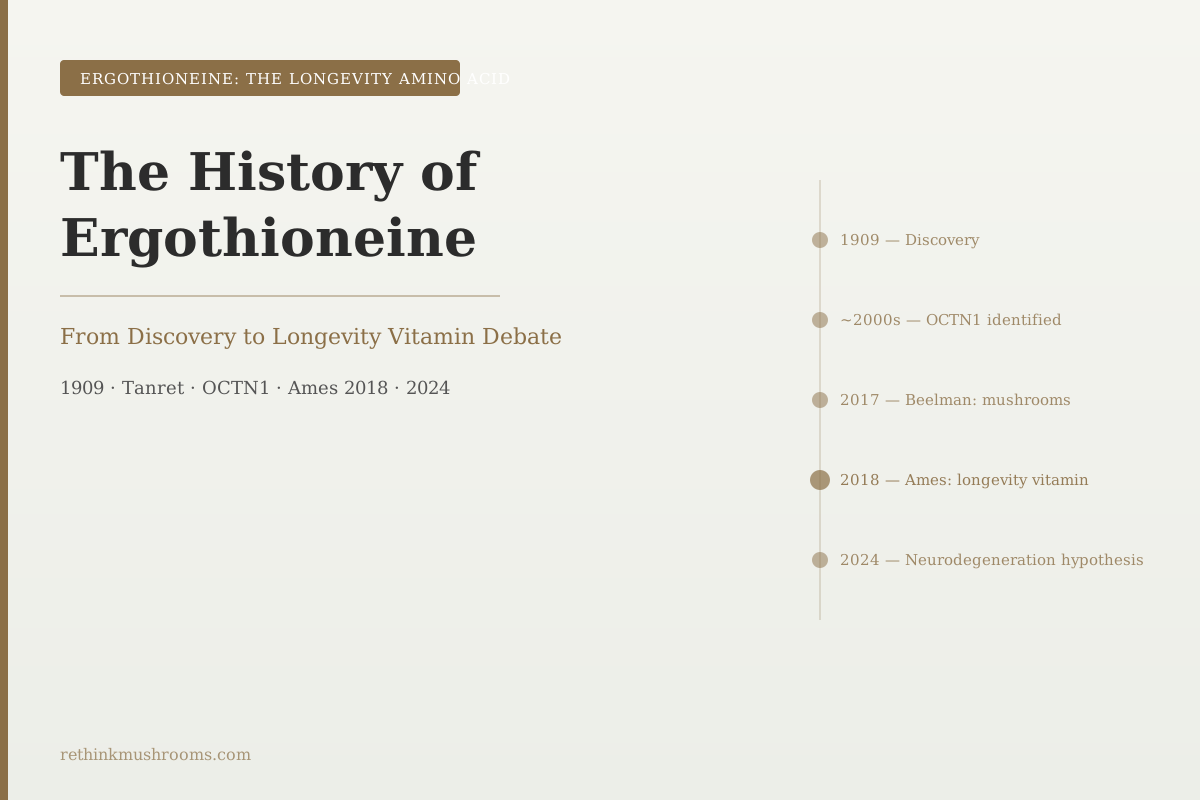
115 years from discovery to longevity vitamin debate
Ergothioneine was first isolated from ergot fungus in 1909. For most of the 20th century it was a biochemical curiosity with no known function. A dedicated human transport protein, declining levels in aging populations, and a 2018 PNAS proposal by Bruce Ames changed that entirely.
Ames, PNAS, 2018; Cheah et al., Redox Biology, 2016
1909
Charles Tanret isolates ergothioneine from ergot fungus, Claviceps purpurea
2018
Bruce Ames proposes ergothioneine as a longevity vitamin in PNAS, citing triage theory
2024
Cheah and Halliwell publish neurodegeneration hypothesis: EGT deficiency as modifiable risk factor
Ames, PNAS, 2018; Cheah et al., Redox Biology, 2016
 View as image ↗
Ergothioneine was discovered in 1909 by a French chemist named Charles Tanret, who isolated it from the ergot fungus Claviceps purpurea. He named it after the fungus. For the better part of a century, it attracted modest scientific interest and no clear clinical relevance. It was present in foods, detectable in blood, and most curiously, seemingly concentrated in certain tissues more than others. But nobody knew quite why, and without a clear mechanism to investigate, the ergothioneine history research field remained small. The compound that is now called a candidate "longevity vitamin" spent most of the 20th century as a footnote in biochemistry textbooks. Understanding how that changed, and why the current evidence landscape looks the way it does, requires following the timeline. For the broader overview of what ergothioneine is and how it functions, see What Is Ergothioneine? The Amino Acid Your Body Hoards.
Key Takeaways
- Ergothioneine was first isolated by Charles Tanret in 1909 from ergot fungus and spent much of the 20th century as a biochemical curiosity without established physiological function
- The discovery of OCTN1 (SLC22A4), a human transport protein that evolved specifically to absorb and concentrate ergothioneine, reframed the molecule as biologically essential
- In 2017, Robert Beelman's team at Penn State showed mushrooms are the primary dietary source of ergothioneine, with porcini and king oyster mushrooms containing the highest concentrations
- In 2018, biochemist Bruce Ames proposed ergothioneine as a "longevity vitamin" in PNAS, arguing that chronic sub-optimal intake accelerates aging-related disease through his triage theory
- Cheah et al. (2016) found that elderly populations have lower plasma ergothioneine levels than younger adults, and lower levels correlate with cognitive decline and frailty
- Cheah et al. (2020) found higher plasma ergothioneine levels significantly associated with reduced all-cause mortality and cardiovascular disease risk in a prospective population study
The Ergothioneine History Timeline: 1909 to 2024
The research arc spans over a century, with most of the significant findings clustered in the last 20 years.
1909. Charles Tanret, a French pharmacist and chemist, isolates a sulfur-containing compound from ergot (Claviceps purpurea) fungus. He names it ergothioneine.
1911–1950s. Ergothioneine is identified in multiple animal tissues and human blood. Its high concentration in red blood cells and certain organs draws interest, but no function is established. It is catalogued, not explained.
Early 2000s. OCTN1 (SLC22A4), a membrane transport protein, is identified as the dedicated transporter for ergothioneine in humans. The existence of a transporter that evolved specifically to absorb one compound reframes the molecule from nutritional curiosity to potential biological necessity. Halliwell et al.'s 2021 review later describes OCTN1 tissue distribution in detail, with concentrations highest in erythrocytes, lens of the eye, kidney, liver, and brain.[7]
2005–2017. Robert Beelman at Penn State University begins systematic investigation of ergothioneine content in mushrooms. His lab's 2017 paper in Food Chemistry establishes that mushrooms are far and away the richest dietary source of ergothioneine. Porcini and king oyster mushrooms were highest; common button mushrooms still contained substantially more ergothioneine than any non-fungal food.[2]
2016. Cheah et al. publish a cohort study in Redox Biology showing that elderly populations have lower plasma ergothioneine than younger adults, and that lower levels correlate with cognitive decline and physical frailty.[3] This is the first direct human evidence linking EGT levels to age-related health decline.
2018. Bruce Ames publishes in PNAS, proposing ergothioneine as one of ten "longevity vitamins." The paper argues that chronic sub-optimal EGT intake, while not causing acute deficiency disease, silently accelerates aging-related conditions through the triage mechanism.[1]
2020. Cheah et al. publish a prospective population study showing higher plasma ergothioneine significantly associated with reduced all-cause mortality and lower cardiovascular disease risk.[4]
2021. Cheah et al. publish a systematic review of preclinical ergothioneine studies, documenting consistent neuroprotective, cardioprotective, and anti-inflammatory evidence across animal and cell models.[5]
2024. Cheah and Halliwell publish the neurodegeneration hypothesis paper, proposing that age-related decline in EGT levels may be a modifiable risk factor for neurodegenerative disease.[6]
Discovery: 1909 and the Ergot Fungus
Charles Tanret did not set out to find a compound that would one day be debated as a potential longevity nutrient. He was working on the pharmacology of ergot, a parasitic fungus that grows on grains and that had been used in medicine (and caused devastating epidemics of ergotism) for centuries. While isolating alkaloids from ergot extracts, he identified a previously unknown sulfur-containing compound and characterized its basic structure.
Ergothioneine is structurally a thio-histidine betaine: a derivative of the amino acid histidine with a thiol group attached to the imidazole ring. That sulfur group is the key to the molecule's unusual antioxidant properties. Unlike most antioxidants, ergothioneine does not become a reactive pro-oxidant after neutralizing a free radical. It resets to its original reduced form without generating harmful byproducts. This chemical stability is part of why cells that face high oxidative stress appear to concentrate it.
But Tanret could not have known any of that in 1909. He documented a new compound. That is all. The interpretation took more than a century to develop.
The OCTN1 Discovery: When a Transporter Proved Importance
The moment that changed ergothioneine from biochemical curiosity to serious research subject was the identification of OCTN1 (also called SLC22A4) as its dedicated human transport protein.
Transport proteins are membrane channels that cells use to move molecules across their outer walls. Most nutrients share transporters with other molecules. A transport protein dedicated to one specific compound is a signal, read from an evolutionary perspective, that the compound is important enough that the organism's survival depended on being able to absorb it efficiently. The SLC22A4 gene is among the more positively selected genes in the human genome, meaning evolution consistently favored organisms that maintained or improved this transporter's function.
OCTN1 is found in the intestinal wall (where it absorbs EGT from food), in the kidneys (where it recaptures EGT from urine to prevent loss), and in a range of high-stress tissues. Halliwell et al.'s 2021 comprehensive review documents the tissue distribution: erythrocytes (red blood cells), the lens of the eye, kidney, liver, and brain all maintain high EGT concentrations via OCTN1-mediated uptake.[7] These are all tissues with high oxidative metabolism or high vulnerability to oxidative damage.
For the detailed molecular biology of OCTN1 and why it functions as evolutionary evidence for ergothioneine's importance, see OCTN1: The Dedicated Transporter That Proves Ergothioneine Matters.
Beelman and the Mushroom Research Base
Before 2017, the ergothioneine research field knew the compound existed and had a transporter, but had limited data on where humans actually get it. Robert Beelman's laboratory at Penn State University filled that gap systematically.
Beelman et al.'s 2017 Food Chemistry paper analyzed ergothioneine content across 13 mushroom species alongside all other major food categories.[2] The results were not close: mushrooms contained ergothioneine at concentrations 10 to 100 times higher than the next closest food sources. Porcini mushrooms (Boletus edulis) were highest, followed by king oyster (Pleurotus eryngii). Common button mushrooms (Agaricus bisporus) contained substantially more than any meat, grain, or vegetable.
The paper also established that ergothioneine and glutathione (another antioxidant compound) co-occur in mushrooms at far higher concentrations than any other food, and that cooking does not substantially degrade ergothioneine. The heat stability of ergothioneine means cooked mushrooms retain the compound effectively, which matters for the dietary supplementation argument.
For a detailed species-by-species comparison of ergothioneine content and a discussion of why only fungi synthesize this compound, see Why Only Fungi Make Ergothioneine (And Why That Matters).
2018: Bruce Ames and the Longevity Vitamin Proposal
In 2018, Bruce Ames published a paper in PNAS titled "Prolonging healthy aging: Longevity vitamins and proteins." Ames, then 90 years old and a biochemist at UC Berkeley best known for developing the Ames test for carcinogenicity, proposed a category of 10 nutrients he called "longevity vitamins": compounds not strictly required to prevent acute deficiency disease but required for the biological maintenance functions that determine long-term health and lifespan.[1] Ergothioneine was on the list.
The organizing principle was Ames' triage theory. The triage theory proposes that evolution prioritized immediate survival functions when nutrients are scarce. When a cell gets less of a nutrient than it needs for all its functions, it allocates what's available to short-term survival tasks first, at the expense of long-term maintenance tasks. The long-term maintenance tasks that get deprioritized are the ones involved in longevity: DNA repair, mitochondrial function, cellular cleanup. The harm doesn't show up immediately as acute deficiency. It accumulates slowly, over years, as aging-related disease.
Applied to ergothioneine: if the body chronically gets less EGT than it needs, the triage theory predicts that high-oxidative-stress tissues get their maintenance functions degraded first. Not dramatically, and not quickly, but in a way that would compound over decades.
Ames drew on the evidence from the OCTN1 transporter, the tissue distribution data, and the epidemiological studies to support the ergothioneine nomination. The longevity vitamin proposal was explicitly framed as a hypothesis requiring clinical trial confirmation, not an established fact.
For a full examination of the longevity vitamin hypothesis and what the evidence does and doesn't support, see Ergothioneine and Longevity: The Vitamin of Longevity Hypothesis.
The Human Evidence: Age-Related Decline and Mortality
The epidemiological evidence base for ergothioneine's significance in humans built across the late 2010s and early 2020s.
Cheah et al. (2016) published a cohort study showing that plasma ergothioneine levels in elderly populations were substantially lower than in younger adults.[3] Critically, lower EGT levels within the elderly cohort correlated with cognitive decline markers and measures of physical frailty. The correlation is observational, not causal. But it was the first direct human data connecting circulating EGT levels to the health outcomes that the triage theory predicts.
The 2020 study by Cheah et al. added a mortality dimension.[4] Using a prospective population design, they found that higher plasma ergothioneine levels were significantly associated with reduced all-cause mortality and lower cardiovascular disease risk across the study population. This is the kind of prospective epidemiological association that, for other nutrients, has prompted clinical trial investment. The association does not prove causation. But it is consistent with the triage theory prediction that people with chronically higher EGT status have better long-term outcomes.
The 2021 preclinical systematic review by Cheah et al. provides context for what might underlie these associations.[5] Across animal and cell-culture models, ergothioneine consistently showed neuroprotective, cardioprotective, hepatoprotective, and anti-inflammatory activity. The review frames the translational gap honestly: preclinical evidence establishes that EGT is biologically active in the relevant tissues, but human trial evidence for disease outcomes is still limited.
For the detailed cardiovascular evidence trail, see Ergothioneine and Heart Health: Cardiovascular Protection Research.
2024: The Neurodegeneration Hypothesis
The most recent major development in ergothioneine research is the Cheah and Halliwell 2024 paper proposing that age-related neurodegenerative disease risk is elevated by declining EGT levels.[6]
The hypothesis builds on the convergence of several lines of evidence: the age-related EGT decline documented in 2016, the OCTN1 concentration of EGT in brain tissue, the preclinical neuroprotective data, and the epidemiological mortality association. Cheah and Halliwell propose that EGT deficiency is a modifiable risk factor for neurodegeneration, meaning that increasing dietary intake might reduce risk, even if causation hasn't been established in clinical trials.
The 2024 paper is explicit about the evidence limitations. It is a hypothesis paper, not a clinical trial report. The authors review the mechanistic and epidemiological evidence, find it consistent with the hypothesis, and call for the controlled human trials that would confirm or refute it.
For the full research picture on ergothioneine and brain health, see Ergothioneine and Brain Health: Neuroprotective Research.
What the Evidence Actually Supports in 2026
The honest summary of the current ergothioneine evidence is this: the compound has a strong biological case for importance, a coherent mechanistic story, and consistent epidemiological associations, but no completed clinical trial confirming that increasing dietary intake improves health outcomes.
The 2021 Halliwell et al. review puts this clearly: the evidence is sufficiently compelling to take ergothioneine seriously as a dietary consideration, but the longevity vitamin classification remains a hypothesis.[7] The preclinical evidence is consistent. The human observational data is consistent. The mechanistic plausibility is strong.
What is missing is the prospective intervention trial: a controlled study in humans that gives supplemental ergothioneine (or increased mushroom intake) to one group and compares long-term health outcomes to a control group over years. Without that trial, the evidence supports the hypothesis, not the conclusion.
Ames framed this honestly in 2018: the longevity vitamin proposal is a prediction that the hypothesis will be confirmed by clinical trials, not a claim that it already has been.[1] The research community has been building toward those trials for the past decade. The timeline from curiosity to hypothesis has taken 115 years. The time from hypothesis to clinical confirmation is still ahead.
The Bottom Line
Ergothioneine was discovered in 1909 and spent most of the 20th century as a biochemical footnote. The identification of OCTN1 as a dedicated human transport protein reframed it as biologically significant. Robert Beelman's work at Penn State established mushrooms as the primary dietary source. Bruce Ames' 2018 PNAS paper proposed the longevity vitamin classification using triage theory, supported by Cheah et al.'s findings of age-related EGT decline (2016), reduced mortality association (2020), and the 2024 neurodegeneration hypothesis. The evidence is mechanistically coherent and epidemiologically consistent. Clinical trial confirmation of the longevity hypothesis remains pending.
Frequently Asked Questions
Sources & References
- 1. Source details for this reference are not yet available.
- 2. Source details for this reference are not yet available.
- 3. Source details for this reference are not yet available.
- 4. Source details for this reference are not yet available.
- 5. Source details for this reference are not yet available.
- 6. Source details for this reference are not yet available.
- 7. Source details for this reference are not yet available.