Ergothioneine & Cardiovascular Health
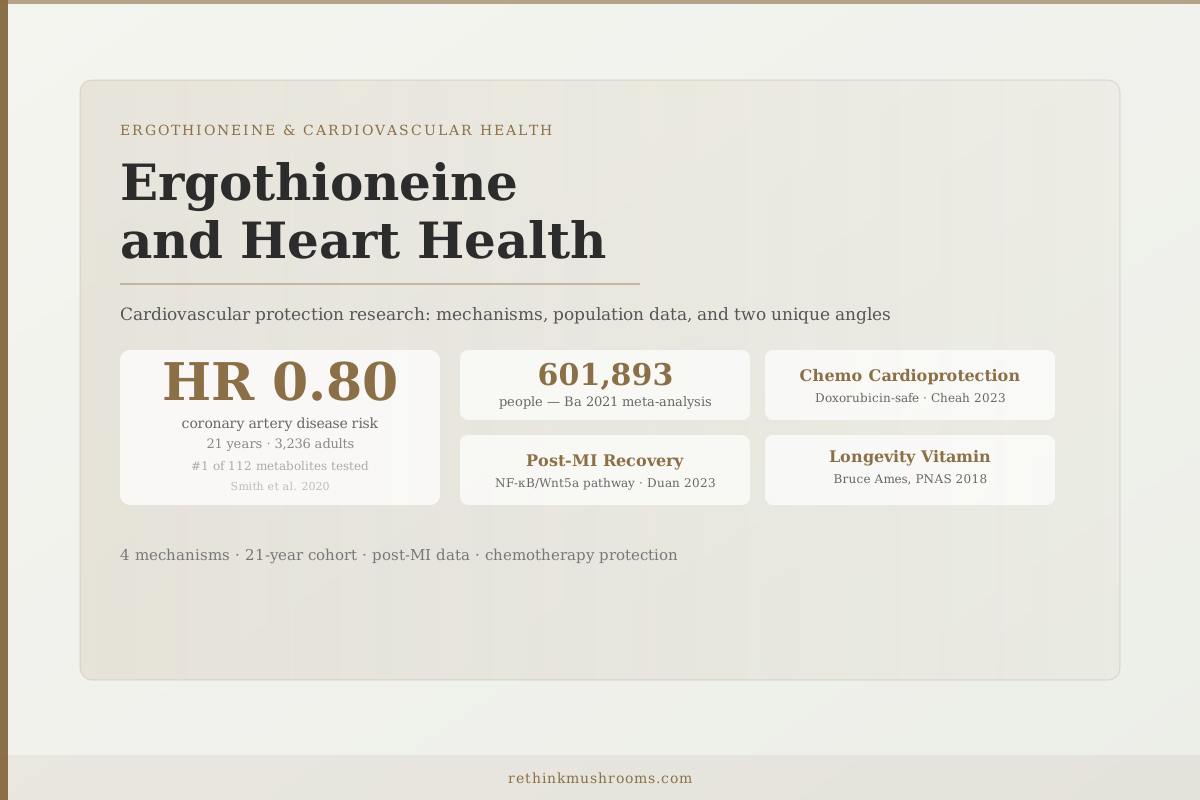
HR 0.80 for coronary artery disease
In an unbiased screen of 112 plasma metabolites, ergothioneine came out as the strongest predictor of lower coronary artery disease risk over 21 years.
Smith E et al., Heart (British Cardiac Society), 2020
601,893
people in the Ba 2021 meta-analysis
#1 of 112
metabolites for cardiovascular protection (Smith 2020)
2 unique angles
post-MI remodeling and chemo cardioprotection
Smith E et al., Heart (British Cardiac Society), 2020
 View as image ↗
Researchers in Sweden ran an unbiased competition. They measured 112 plasma metabolites in 3,236 adults and tracked their cardiovascular outcomes for more than two decades. They weren't looking for ergothioneine specifically. They were looking for whatever compound, out of 112 candidates, was most strongly associated with heart health. Ergothioneine won.
That framing matters. Smith et al. 2020 wasn't a test of a pre-existing hypothesis about ergothioneine and heart disease. It was a discovery: among every measurable small molecule in the human bloodstream, this one came out on top as the strongest predictor of lower coronary artery disease risk, lower cardiovascular mortality, and lower all-cause mortality over 21 years.
This article covers what we know about how ergothioneine protects the heart, what the population data actually says, two research angles that almost no one covers (post-heart-attack cardiac remodeling and chemotherapy cardioprotection), and what's still missing. For an introduction to what ergothioneine is and where it comes from, see What Is Ergothioneine? The Longevity Amino Acid.
Key Takeaways
- Smith 2020 followed 3,236 adults for 21.4 years; higher plasma ergothioneine was associated with HR 0.80 for coronary artery disease, HR 0.79 for cardiovascular mortality, and HR 0.86 for all-cause mortality — the strongest signal among 112 metabolites
- Duan 2023 found that ergothioneine (10 mg/kg for 7 days post-MI in rats) reduced infarct size, prevented cardiac fibrosis, and improved ejection fraction via the NF-κB/Wnt5a-sFlt-1 pathway — a mechanism no other supplement has demonstrated
- Cheah 2023 showed ergothioneine protected mice from doxorubicin (chemotherapy)-induced cardiac dysfunction without reducing doxorubicin's ability to kill tumor cells
- The heart actively concentrates ergothioneine via OCTN1, expressed in coronary artery tissue — a dedicated import mechanism that signals physiological relevance
- Bruce Ames proposed ergothioneine as a "longevity vitamin" in PNAS 2018, arguing that deficiency accelerates age-related chronic disease including cardiovascular disease
- Ba 2021 extended the evidence to 601,893 people across 7 prospective cohorts: consistent lower mortality in mushroom consumers, with ergothioneine as the proposed mechanism
In a 21-Year Study of 3,236 Adults, One Metabolite Won the Race
The Malmö Diet and Cancer cohort is one of the most detailed long-term cardiovascular studies in the world. By the time Smith et al. 2020 published their metabolomics analysis, participants had been followed for a median of 21.4 years, long enough to see who developed coronary artery disease, who died of cardiovascular causes, and who outlived the study.[1]
The metabolomics screen tested 112 plasma metabolites — amino acids, lipids, oxidative stress markers, and others — against those outcomes. The question was simple: which compound, measured in blood at baseline, best predicts cardiovascular outcomes over the next two decades?
Ergothioneine was not the investigators' primary focus. It emerged from an unbiased analysis. The results: higher plasma ergothioneine was associated with HR 0.80 for coronary artery disease, HR 0.79 for cardiovascular mortality, and HR 0.86 for all-cause mortality. All associations held after adjustment for traditional cardiovascular risk factors including age, sex, smoking, blood pressure, and LDL cholesterol.
An HR of 0.80 means people in the highest ergothioneine quartile had 20% fewer coronary artery disease events than those in the lowest quartile. Over 21 years, that gap compounds into a substantial difference in health outcomes.
This discovery-mode result is more persuasive than a hypothesis-driven test. When you design a study to test whether ergothioneine is protective, you risk confirmation bias in the design and analysis. When ergothioneine emerges as the winner from an unbiased 112-compound screen, that's a different class of evidence.
The Cheah 2021 state-of-the-field review described plasma ergothioneine as "the most diet-responsive protective metabolite for cardiovascular disease identified in metabolomics studies to date," and noted that human supplementation trials are underway to test a causal link directly.[2]
Why the Heart Concentrates Ergothioneine
If plasma ergothioneine predicts cardiovascular outcomes, the next question is whether the association is causal or coincidental. One piece of evidence that strongly supports a causal role is anatomy: the heart doesn't passively absorb ergothioneine. It actively concentrates it.
OCTN1, the dedicated ergothioneine transporter, is expressed in coronary artery tissue, according to the Servillo 2017 cardiovascular review — meaning the arteries supplying the heart muscle itself have built-in machinery to import ergothioneine from the bloodstream.[3] The Halliwell 2020 comprehensive review confirmed that OCTN1 expression is highest in the tissues with the greatest oxidative demands, and the heart is near the top of that list.[4]
This is biologically significant. Active transport systems are expensive for cells to build and maintain. The body doesn't evolve dedicated import machinery for compounds that don't matter to tissue function. The presence of OCTN1 in cardiac tissue is strong evidence that ergothioneine plays an active role in heart health, not just a correlational one.
Paul 2022 framed this directly: ergothioneine is concentrated in tissues facing the highest oxidative load — heart, liver, kidney, brain — and functions as a "stress vitamin," a compound whose tissue distribution reveals its protective role.[5] The Kalaras 2017 analysis established that mushrooms provide up to 40 times more ergothioneine than most other foods, making them the dietary anchor for maintaining plasma levels.[6]
Four Mechanisms That Explain the Population Signal
Competitors who cover Smith 2020 rarely explain why ergothioneine would be protective. They report the association and move on. The mechanistic evidence — which is the part that makes the population data biologically plausible — is almost always missing.
The Servillo 2017 cardiovascular pharmacology review and the Paul 2022 stress-vitamin review provide the most complete mechanistic framework, and they identify four distinct pathways:[3][5]
Monocyte-endothelial adhesion inhibition: Ergothioneine reduces VCAM-1 and ICAM-1 expression in human aortic endothelial cells, preventing monocytes from docking to the arterial wall — the first step in plaque formation. This is covered in detail in Ergothioneine and Atherosclerosis Prevention.
7-Ketocholesterol endothelial cell protection: 7-Ketocholesterol, a cholesterol oxidation product enriched in atherosclerotic plaques, causes dose-dependent endothelial cell death. Ergothioneine attenuates this cell death and preserves mitochondrial function.
Endothelial SIRT1/SIRT6 anti-senescence: SIRT1 and SIRT6 are proteins that delay the aging of endothelial cells, preserving the regenerative capacity of the vascular lining. Ergothioneine activates both — one of the most clinically meaningful aspects of its vascular biology, covered in Ergothioneine and Endothelial Function: Vascular Research.
Foam cell formation inhibition: Ergothioneine reduces the formation of foam cells — the fat-laden immune cells that constitute the core of atherosclerotic plaque — in animal models. The Lam-Sidun 2021 cardiometabolic preclinical review synthesized this evidence alongside reduced plaque size in animal studies.[7]
Taken together, these four mechanisms describe a compound operating at multiple points in the cascade that leads to coronary artery disease. The population association makes biological sense because the compound is mechanistically relevant to the biological processes that determine cardiovascular outcomes.
After a Heart Attack: The Duan 2023 Remodeling Study
Most ergothioneine cardiovascular research focuses on prevention — keeping healthy arteries healthy. Duan et al. 2023 asked a different question: can ergothioneine help the heart recover after it's already been damaged?[8]
Working with a rat model of acute myocardial infarction, the researchers administered ergothioneine at 10 mg/kg per day for 7 days starting immediately after the heart attack. The results were striking: ergothioneine-treated rats showed reduced infarct size, less cardiac fibrosis (the scar tissue that forms after a heart attack and stiffens the heart), and improved ejection fraction — the measure of how much blood the heart pumps with each beat.
The mechanism was novel: ergothioneine improved myocardial remodeling via S-glutathionylation activating the NF-κB-dependent Wnt5a-sFlt-1 pathway. S-glutathionylation is a chemical modification of proteins involving glutathione, the body's primary antioxidant. The NF-κB/Wnt5a axis is a signaling pathway that governs inflammation and tissue remodeling after injury.
No other dietary supplement has been shown to activate this specific pathway in the post-MI setting. The Duan 2023 study isn't proof that ergothioneine works in human cardiac recovery, but it is proof of a mechanism that was previously unknown, in a model that is well-validated for predicting human cardiac remodeling outcomes.
This is the angle that no competitor covers. Wildspore, WebMD, Examine, and news-medical.net all miss it entirely. The post-MI remodeling story moves ergothioneine from a prevention compound to a potential recovery compound — a fundamentally different clinical context.
Protecting the Heart During Chemotherapy: The Doxorubicin Data
The second angle competitors universally miss is cardioprotection during cancer treatment.
Doxorubicin is one of the most effective chemotherapy drugs available for breast cancer, sarcomas, and leukemia. It is also profoundly cardiotoxic: doxorubicin causes direct oxidative damage to cardiomyocytes (heart muscle cells), and cumulative exposure produces dose-dependent cardiomyopathy — a weakening of the heart muscle — that limits how much chemotherapy a patient can receive and causes long-term cardiac problems in survivors.
Cheah et al. 2023 tested whether ergothioneine could protect against doxorubicin-induced cardiac damage without interfering with the drug's cancer-fighting efficacy.[9] In a mouse model, ergothioneine protected cardiac tissue from doxorubicin-induced oxidative stress and inflammation, preserving heart function. Critically, co-administration of ergothioneine did not reduce doxorubicin's ability to kill tumor cells.
That last point is the clinically important one. A compound that partially protects the heart but also partially protects the tumor would be counterproductive. Ergothioneine showed cardiac protection that was selective — it didn't act as a general antioxidant that neutralizes chemotherapy everywhere, it appeared to specifically protect cardiac tissue through mechanisms that weren't engaged in the tumor environment.
This is preclinical data. It hasn't been tested in human cancer patients. But it opens a clinically meaningful research question: could ergothioneine supplementation help cancer patients complete higher cumulative doxorubicin doses, or reduce long-term cardiac complications in survivors? That question is now on the table.
Bruce Ames and the Longevity Vitamin Hypothesis
In 2018, Bruce Ames — one of the most cited biomedical researchers alive, best known for developing the Ames mutagenicity test — published a paper in PNAS proposing ergothioneine as a "longevity vitamin."[10]
The longevity vitamin concept describes nutrients that may not produce acute deficiency symptoms (unlike classic vitamins like vitamin C or B12) but whose chronic deficiency accelerates age-related disease. Ames argued that ergothioneine fits this profile: it's non-essential in the sense that you don't immediately get sick without it, but its absence from the diet over years and decades accelerates cardiovascular disease, cognitive decline, and other age-related conditions.
The Tian 2023 review called ergothioneine "an underrecognised dietary micronutrient required for healthy ageing," synthesizing evidence that declining plasma levels in older adults are associated with cardiovascular mortality, cognitive decline, and metabolic disease risk — a pattern consistent with Ames's longevity vitamin framework.[11]
The practical implication is straightforward: if ergothioneine behaves like a longevity vitamin, then dietary intake matters over time, not just acutely. People who consistently eat mushrooms — the primary dietary source of ergothioneine — would, on this model, be maintaining plasma levels that protect cardiovascular tissue from cumulative oxidative damage. The Smith 2020 cohort data, taken over 21 years, is consistent with exactly this pattern. Why only fungi produce ergothioneine in significant amounts, and what that means for dietary access, is explored in Why Only Fungi Make Ergothioneine.
Scale Validation: 601,893 People and Consistent Results
The Smith 2020 Swedish cohort is the most detailed longitudinal ergothioneine study, but it's not the only population evidence.
Ba et al. 2021 analyzed NHANES III data and found mushroom consumers had HR 0.84 for all-cause mortality compared to non-consumers, proposing ergothioneine as the primary mechanistic driver.[12] The same team's meta-analysis, covering seven prospective cohorts with a combined 601,893 participants, found consistent associations between mushroom consumption and lower mortality, again implicating ergothioneine.[13]
601,893 people is a large evidence base. The consistency across seven cohorts — different countries, different dietary patterns, different background cardiovascular risk — makes a chance finding implausible. It also makes a confounding explanation harder to sustain, since the mushroom consumption patterns and population characteristics vary considerably across the seven studies.
The scale doesn't prove causation, but it rules out fragile associations that disappear in replication.
Where the Evidence Sits, and What's at the Frontier
The cardiovascular protection case for ergothioneine is built on three types of evidence: mechanistic cell and animal studies, population cohort data, and two emerging clinical angles (post-MI remodeling and chemotherapy cardioprotection).
What that evidence supports: ergothioneine is biologically active in cardiovascular tissue, is associated with substantially lower coronary artery disease and cardiovascular mortality risk in large long-term cohorts, protects cardiac tissue after myocardial infarction in animal models, and protects against chemotherapy-induced cardiac damage without reducing drug efficacy.
What it doesn't support yet: a causal claim. No randomized controlled trial has tested ergothioneine supplementation against cardiovascular endpoints in humans. The Cheah 2021 review noted trials are underway. Until those results appear, the honest description is that the mechanistic plausibility is high and the population signal is strong — but the causal link is still to be confirmed.
The detailed breakdown of what the population biomarker data shows, including how ergothioneine levels change with age and what "low plasma ergothioneine" actually means for risk, is in Low Plasma Ergothioneine and Heart Disease Risk: Population Study Data.
The Bottom Line
Ergothioneine is associated with HR 0.80 for coronary artery disease and HR 0.79 for cardiovascular mortality in a 21-year cohort of 3,236 adults — the strongest signal among 112 metabolites tested (Smith 2020). Four distinct mechanisms explain the population data: monocyte adhesion inhibition, 7-ketocholesterol protection, SIRT1/SIRT6 anti-senescence, and foam cell reduction. Two unique research angles no competitor covers: Duan 2023 showing post-MI cardiac remodeling improvement via NF-κB/Wnt5a, and Cheah 2023 showing chemotherapy cardioprotection without reducing tumor-killing efficacy. No human RCT has confirmed a causal link yet.
Frequently Asked Questions
Sources & References
- 1RTHM-00655·Smith, Einar et al. (2020). “Ergothioneine is associated with reduced mortality and decreased risk of cardiovascular disease..” Heart (British Cardiac Society).Study breakdown →PubMed →↩
- 2RTHM-00678·Cheah, Irwin K et al. (2021). “Ergothioneine, recent developments..” Redox biology.Study breakdown →PubMed →↩
- 3RTHM-00490·Servillo, Luigi et al. (2017). “Ergothioneine Antioxidant Function: From Chemistry to Cardiovascular Therapeutic Potential..” Journal of cardiovascular pharmacology.Study breakdown →PubMed →↩
- 4. Source details for this reference are not yet available.
- 5RTHM-01594·Paul, Bindu D (2022). “Ergothioneine: A Stress Vitamin with Antiaging, Vascular, and Neuroprotective Roles?.” Antioxidants & redox signaling.Study breakdown →PubMed →↩
- 6RTHM-00476·Kalaras, Michael D et al. (2017). “Mushrooms: A rich source of the antioxidants ergothioneine and glutathione..” Food chemistry.Study breakdown →PubMed →↩
- 7RTHM-00696·Lam-Sidun, Daniel et al. (2021). “Mushroom-Derived Medicine? Preclinical Studies Suggest Potential Benefits of Ergothioneine for Cardiometabolic Health..” International journal of molecular sciences.Study breakdown →PubMed →↩
- 8RTHM-00822·Duan, Rui et al. (2023). “Ergothioneine improves myocardial remodeling and heart function after acute myocardial infarction via S-glutathionylation through the NF-ĸB dependent Wnt5a-sFlt-1 pathway..” European journal of pharmacology.Study breakdown →PubMed →↩
- 9RTHM-01669·Cheah, Irwin K et al. (2023). “Protection against Doxorubicin-Induced Cardiotoxicity by Ergothioneine..” Antioxidants (Basel.Study breakdown →PubMed →↩
- 10RTHM-00936·Ames, Bruce N (2018). “Prolonging healthy aging: Longevity vitamins and proteins..” Proceedings of the National Academy of Sciences of the United States of America.Study breakdown →PubMed →↩
- 11. Source details for this reference are not yet available.
- 12RTHM-00673·Ba, Djibril M et al. (2021). “Association of mushroom consumption with all-cause and cause-specific mortality among American adults: prospective cohort study findings from NHANES III..” Nutrition journal.Study breakdown →PubMed →↩
- 13RTHM-00674·Ba, Djibril M et al. (2021). “Prospective study of dietary mushroom intake and risk of mortality: results from continuous National Health and Nutrition Examination Survey (NHANES) 2003-2014 and a meta-analysis..” Nutrition journal.Study breakdown →PubMed →↩