Ergothioneine & Cardiovascular Health
0.79 HR cardiovascular mortality
In a 21.4-year follow-up of 3,236 adults, each standard deviation increase in plasma ergothioneine was associated with a 21% lower risk of cardiovascular death.
Smith et al., Heart, 2020
3,236
subjects in the largest cohort study
21.4 yr
median follow-up duration
Mushrooms
primary dietary source of ergothioneine
Smith et al., Heart, 2020
 View as image ↗
Ergothioneine is a sulfur-containing amino acid that humans cannot synthesize. It enters the body exclusively through diet, with mushrooms providing the highest concentrations of any food source: 0.4 to 2.0 mg per gram of dry weight depending on species, according to Kalaras et al. (2017).[1] Once absorbed, ergothioneine accumulates in tissues exposed to high oxidative stress, transported by a dedicated carrier protein called OCTN1 (SLC22A4) that is expressed in the heart, liver, kidneys, brain, and red blood cells.[2]
The question of whether blood ergothioneine levels predict heart disease risk was answered most directly by a 2020 population study from Sweden, which found that higher plasma ergothioneine was associated with lower coronary disease, cardiovascular mortality, and all-cause mortality over a 21.4-year follow-up.[3] This article examines that evidence, the biological mechanisms that could explain the association, and the limitations that prevent a causal conclusion. For a broader overview of ergothioneine's cardiovascular research, see ergothioneine and heart health: cardiovascular protection research.
Key Takeaways
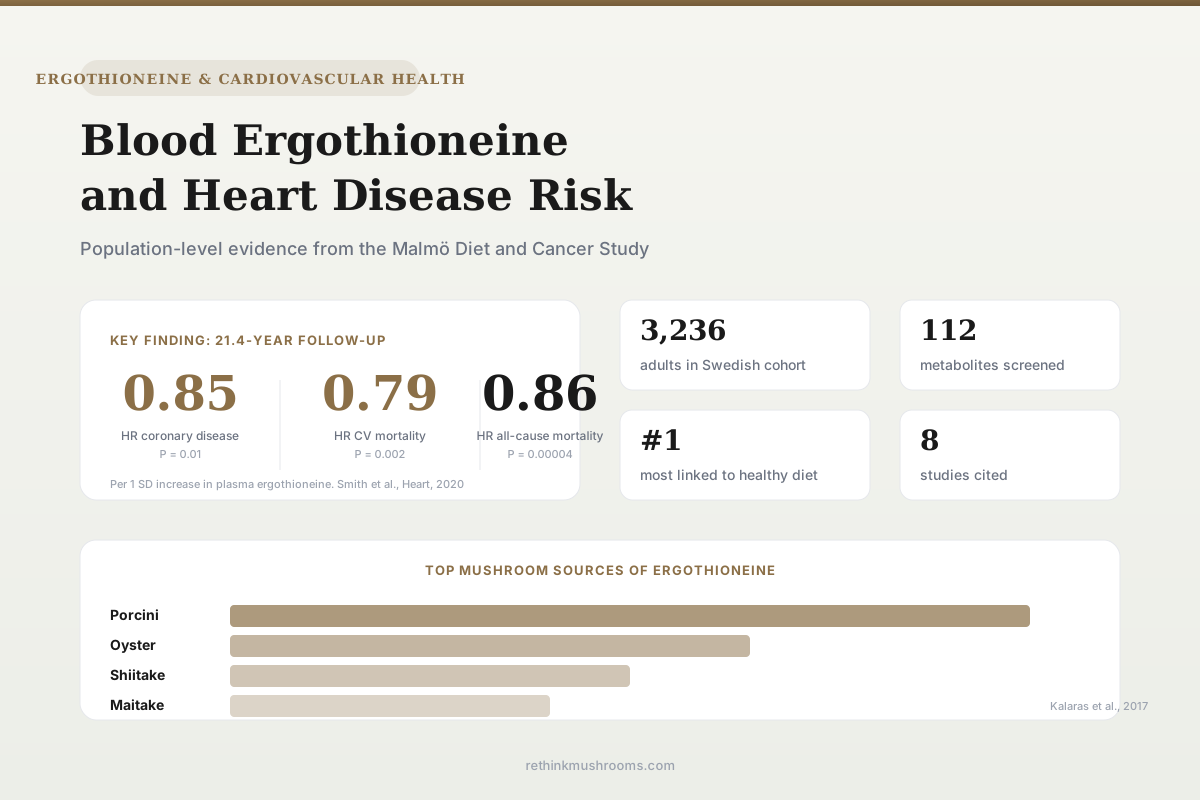
- In 3,236 Swedish adults followed for 21.4 years, each SD increase in plasma ergothioneine was associated with 15% lower coronary disease risk (HR=0.85), 21% lower cardiovascular mortality (HR=0.79), and 14% lower all-cause mortality (HR=0.86) (Smith et al., 2020)
- Ergothioneine was the metabolite most strongly connected to a health-conscious food pattern out of 112 plasma metabolites measured by liquid chromatography-mass spectrometry (Smith et al., 2020)
- Blood ergothioneine levels decline after age 60, with lower levels correlating with faster cognitive decline in a Singapore elderly cohort (Cheah et al., 2016)
- Ergothioneine from Agaricus bisporus mushrooms is bioavailable in humans, with red blood cell uptake detectable postprandially and an associated attenuation of the triglyceride response (Weigand-Heller et al., 2012)
- In a mouse myocardial infarction model, ergothioneine reduced infarct size and improved cardiac function through NF-kB-dependent Wnt5a-sFlt-1 signaling via S-glutathionylation (Duan et al., 2023)
- Mushrooms are the richest dietary source of ergothioneine, with porcini (Boletus edulis) containing the highest levels, followed by oyster, shiitake, and maitake species (Kalaras et al., 2017)
The Swedish Population Study: 21 Years of Follow-Up
Smith et al. (2020) conducted the landmark study linking blood ergothioneine to cardiovascular outcomes. Using liquid chromatography-mass spectrometry, the researchers measured 112 plasma metabolites in 3,236 participants without existing cardiovascular disease or diabetes from the Malmö Diet and Cancer Study, a population-based cohort in southern Sweden.[3]
Over a median follow-up of 21.4 years, 603 participants developed cardiovascular disease, 362 developed diabetes, and 843 died. The study first identified metabolites associated with a health-conscious food pattern (HCFP), then tested whether those metabolites independently predicted disease outcomes after adjusting for age, sex, BMI, smoking, systolic blood pressure, use of lipid-lowering and antihypertensive medications, and fasting glucose.
Ergothioneine emerged as the metabolite most strongly connected to the HCFP. Its associations with outcomes after multivariable adjustment were:
- Coronary disease: HR = 0.85 per SD increase (P = 0.01)
- Cardiovascular mortality: HR = 0.79 per SD increase (P = 0.002)
- All-cause mortality: HR = 0.86 per SD increase (P = 4 x 10⁻⁵)
The strength of the all-cause mortality association (P = 0.00004) is notable for a single dietary metabolite. No other metabolite from the 112 measured showed a comparable combination of dietary association strength and disease prediction. For additional population-level mortality data, see blood ergothioneine levels and all-cause mortality risk.
Observational Limitation: Association Is Not Causation
The Smith et al. study cannot determine whether ergothioneine directly protects the cardiovascular system or simply serves as a biomarker for healthy dietary patterns that include mushrooms and other ergothioneine-rich foods. Several confounders complicate interpretation.
People with higher ergothioneine levels eat differently. The health-conscious food pattern associated with ergothioneine included higher intake of whole grains, vegetables, fruit, fish, and fermented dairy. Any or all of these food groups could independently reduce cardiovascular risk. Ergothioneine might simply be the most accurately measurable marker of this overall dietary pattern rather than a causal protective agent.
Reverse causation is also possible. Individuals with early subclinical cardiovascular disease might absorb ergothioneine less efficiently or consume less varied diets, producing lower blood levels as a consequence of disease rather than a cause of reduced risk.
The study adjusted for standard cardiovascular risk factors but could not adjust for all dietary components simultaneously without collinearity problems. Residual confounding from unmeasured lifestyle factors (physical activity, stress, sleep quality) remains plausible.
Age-Related Decline in Blood Levels
Cheah et al. (2016) documented that whole blood ergothioneine levels decline in elderly populations, with the drop becoming measurable after age 60. In their Singapore cohort, lower ergothioneine levels correlated with incidence of cognitive decline, independent of other risk factors.[4]
This age-related decline has two possible explanations that are not mutually exclusive. First, dietary intake may decrease as food variety narrows with age. Second, OCTN1 transporter function may decline, reducing cellular uptake efficiency. The Cheah et al. data cannot distinguish between these mechanisms. Regardless of cause, the pattern means that older adults, who face the highest cardiovascular risk, also tend to have the lowest circulating ergothioneine. Whether restoring those levels through dietary intervention or supplementation would reduce cardiovascular events has not been tested in a randomized trial.
How Ergothioneine Reaches Cardiovascular Tissue
The OCTN1 transporter (SLC22A4) is the primary mechanism by which ergothioneine enters cells. Cheah and Halliwell (2021) reviewed OCTN1 expression patterns and found it present in the heart, kidneys, liver, brain, lungs, intestines, and erythrocytes.[2] The transporter is also concentrated in mitochondria, positioning ergothioneine to protect against the reactive oxygen species generated by the electron transport chain.
OCTN1 expression in cardiomyocytes means the heart actively imports and retains ergothioneine. Cells lacking functional OCTN1 show increased susceptibility to oxidative stress, with elevated mitochondrial DNA damage, protein oxidation, and lipid peroxidation. The body appears to concentrate ergothioneine at sites of tissue injury and high oxidative demand, a distribution pattern consistent with a protective function rather than passive accumulation.
The bioavailability question was addressed directly by Weigand-Heller et al. (2012), who demonstrated in a crossover study with 10 healthy men that ergothioneine from cooked Agaricus bisporus mushrooms was absorbed and taken up by red blood cells postprandially. The mushroom meal also attenuated the postprandial triglyceride response at both 8 g and 16 g doses, though antioxidant capacity measured by ORAC paradoxically decreased.[5]
Preclinical Cardiovascular Mechanisms
Servillo et al. (2017) reviewed the chemistry-to-pharmacology pipeline for ergothioneine's cardiovascular effects. The compound's antioxidant properties include scavenging of hydroxyl radicals, hypochlorous acid, and peroxynitrite; chelation of redox-active metal ions (copper and iron); and inhibition of heme protein-catalyzed oxidation reactions. In vascular tissue specifically, ergothioneine protected endothelial cells from oxidative damage and reduced markers of atherogenesis in cell culture models.[6]
Duan et al. (2023) moved from antioxidant chemistry to a disease-specific model. In mice subjected to acute myocardial infarction by left anterior descending artery ligation, ergothioneine treatment reduced infarct size and improved cardiac function. The mechanism involved S-glutathionylation of the NF-kB signaling pathway, which attenuated inflammatory responses through the Wnt5a-sFlt-1 axis. Ergothioneine-treated mice showed improved myocardial remodeling, with less fibrosis and better preserved ejection fraction compared to untreated controls.[7]
Lam-Sidun et al. (2021) conducted a systematic review of preclinical evidence for ergothioneine's cardiometabolic benefits. They identified consistent protective effects across models of atherosclerosis, ischemia-reperfusion injury, and metabolic syndrome, with mechanisms spanning antioxidant defense, anti-inflammatory signaling, and endothelial function preservation.[8] The review noted that while preclinical evidence was broadly supportive, no human intervention trial had tested ergothioneine supplementation for cardiovascular endpoints. For more on the endothelial protection data, see ergothioneine and endothelial function: vascular research.
Dietary Sources: Why Mushrooms Matter
Kalaras et al. (2017) quantified ergothioneine and glutathione content across 13 mushroom species. Porcini mushrooms (Boletus edulis) had the highest ergothioneine content, followed by oyster (Pleurotus ostreatus), shiitake (Lentinula edodes), maitake (Grifola frondosa), and king oyster (Pleurotus eryngii). Common white button mushrooms (Agaricus bisporus) had lower but still meaningful concentrations.[1]
The relevance to cardiovascular risk is that mushroom consumption is the most practical route to raising blood ergothioneine levels. Unlike most antioxidants that degrade with cooking, ergothioneine is thermally stable, so cooked mushrooms retain their content. The OCTN1 transporter system ensures efficient uptake, and erythrocyte half-life estimates suggest ergothioneine accumulates over weeks to months of regular dietary intake rather than requiring daily dosing.
This dietary context matters for interpreting the Smith et al. population data. Their health-conscious food pattern included but was not limited to mushrooms. Countries with higher per-capita mushroom consumption (Japan, Korea, China) have not been studied with the same metabolomics approach, leaving a gap in understanding whether the Swedish findings replicate across dietary cultures with different ergothioneine intake baselines.
Ergothioneine content also varies substantially within species depending on growing conditions. Substrate composition, UV exposure, and harvest timing all influence final concentrations. This means that even among people who eat mushrooms regularly, ergothioneine intake can vary several-fold depending on species selection and sourcing. The practical implication is that blood ergothioneine levels cannot be predicted from mushroom frequency alone without knowing which species and preparation methods are used. For discussion of how atherosclerosis-specific mechanisms relate to dietary ergothioneine, see ergothioneine and atherosclerosis prevention.
What the Evidence Does and Does Not Show
The evidence supports three conclusions with different confidence levels:
Strong evidence: Ergothioneine is a measurable blood biomarker that inversely correlates with cardiovascular disease and mortality in a large, long-duration population study. The association survives adjustment for standard cardiovascular risk factors.
Moderate evidence: Ergothioneine has plausible cardiovascular protective mechanisms. It scavenges reactive oxygen species in vascular tissue, reduces post-infarction damage in animal models, and is actively concentrated in heart tissue by a dedicated transporter.
Weak evidence: Raising blood ergothioneine levels through diet or supplementation reduces cardiovascular risk. No randomized controlled trial has tested this hypothesis. The population data could reflect confounding by overall dietary quality rather than a causal ergothioneine effect.
The gap between observational association and proven causation is the central limitation. Beta-carotene, vitamin E, and vitamin C all showed strong observational associations with cardiovascular protection, but randomized supplementation trials failed to confirm benefit and in some cases showed harm. Ergothioneine may follow this pattern, or it may differ because of its unique transporter-mediated tissue accumulation and mitochondrial concentration. The distinction matters: unlike most dietary antioxidants, ergothioneine is not passively distributed; it is actively imported and retained by specific tissues. Whether this targeted delivery translates to clinical protection remains the unanswered question. Until intervention studies are completed, the cardiovascular significance of blood ergothioneine levels remains an open question. For broader population-level data on ergothioneine and mortality, see low plasma ergothioneine and heart disease risk: population study data.
The Bottom Line
A 21.4-year Swedish population study found that higher plasma ergothioneine levels were associated with 15-21% lower risks of coronary disease, cardiovascular mortality, and all-cause mortality. Preclinical studies demonstrate plausible mechanisms through antioxidant defense, anti-inflammatory signaling, and dedicated cardiac tissue uptake via the OCTN1 transporter. Mushrooms are the richest dietary source. The critical gap is that no human trial has tested whether raising ergothioneine levels through diet or supplementation actually reduces cardiovascular events.
Frequently Asked Questions
Sources & References
- 1RTHM-00476·Kalaras, Michael D et al. (2017). “Mushrooms: A rich source of the antioxidants ergothioneine and glutathione..” Food chemistry.Study breakdown →PubMed →↩
- 2RTHM-00678·Cheah, Irwin K et al. (2021). “Ergothioneine, recent developments..” Redox biology.Study breakdown →PubMed →↩
- 3RTHM-00655·Smith, Einar et al. (2020). “Ergothioneine is associated with reduced mortality and decreased risk of cardiovascular disease..” Heart (British Cardiac Society).Study breakdown →PubMed →↩
- 4RTHM-00420·Cheah, Irwin K et al. (2016). “Ergothioneine levels in an elderly population decrease with age and incidence of cognitive decline; a risk factor for neurodegeneration?.” Biochemical and biophysical research communications.Study breakdown →PubMed →↩
- 5RTHM-00270·Weigand-Heller, AuBrei J et al. (2012). “The bioavailability of ergothioneine from mushrooms (Agaricus bisporus) and the acute effects on antioxidant capacity and biomarkers of inflammation..” Preventive medicine.Study breakdown →PubMed →↩
- 6RTHM-00490·Servillo, Luigi et al. (2017). “Ergothioneine Antioxidant Function: From Chemistry to Cardiovascular Therapeutic Potential..” Journal of cardiovascular pharmacology.Study breakdown →PubMed →↩
- 7RTHM-00822·Duan, Rui et al. (2023). “Ergothioneine improves myocardial remodeling and heart function after acute myocardial infarction via S-glutathionylation through the NF-ĸB dependent Wnt5a-sFlt-1 pathway..” European journal of pharmacology.Study breakdown →PubMed →↩
- 8RTHM-00696·Lam-Sidun, Daniel et al. (2021). “Mushroom-Derived Medicine? Preclinical Studies Suggest Potential Benefits of Ergothioneine for Cardiometabolic Health..” International journal of molecular sciences.Study breakdown →PubMed →↩