Ergothioneine & Longevity
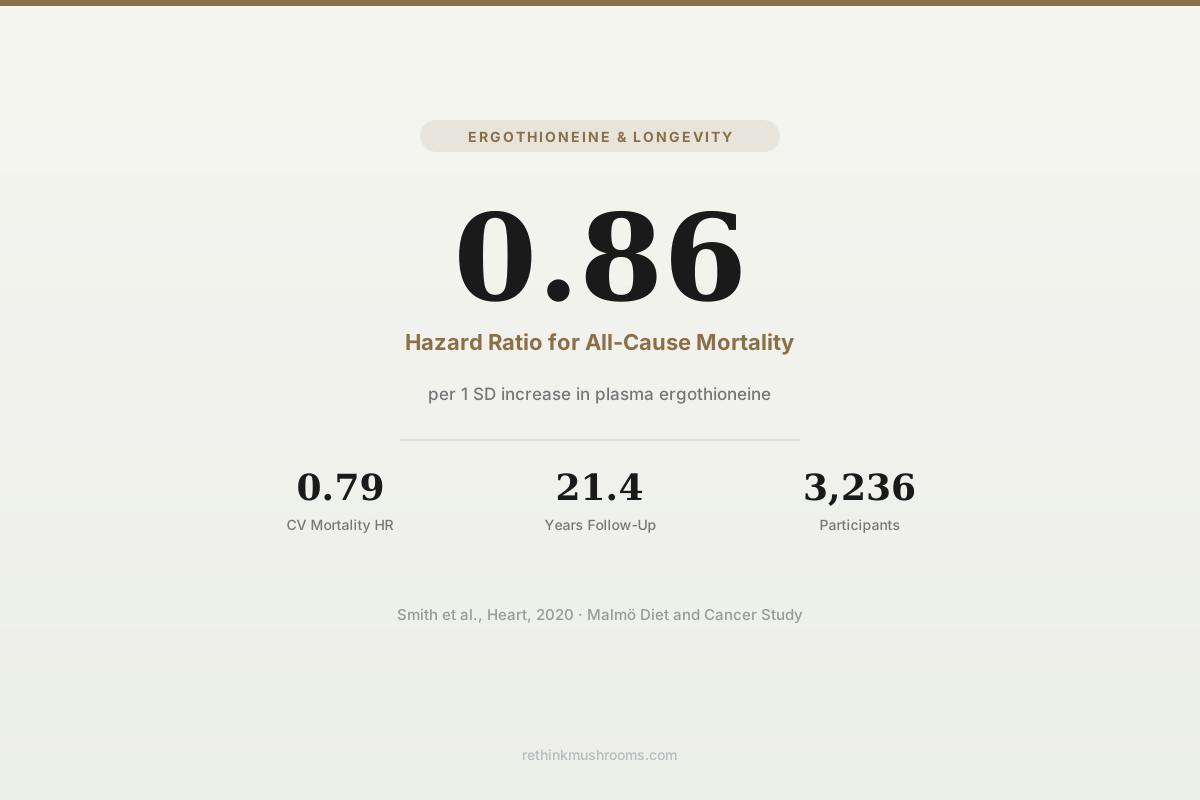
0.86 HR
Each one standard deviation increase in plasma ergothioneine was associated with a 14% lower risk of all-cause mortality over a median 21.4-year follow-up in 3,236 adults.
Smith et al., Heart, 2020
21.4 Years
median follow-up in the Malmö cohort
HR 0.79
cardiovascular mortality per 1 SD increase
3,236
participants without baseline CVD or diabetes
Smith et al., Heart, 2020
 View as image ↗
Ergothioneine is a sulfur-containing amino acid that humans cannot synthesize. It enters the body exclusively through diet, with mushrooms providing roughly 95% of typical dietary intake. Once absorbed through the intestinal transporter SLC22A4 (also called OCTN1), ergothioneine accumulates in tissues exposed to high oxidative stress: red blood cells, bone marrow, liver, kidney, and the lens of the eye. The question of whether people with higher blood ergothioneine levels live longer than those with lower levels was addressed directly in a 2020 prospective cohort study that tracked 3,236 Swedish adults for over two decades. For broader context on the longevity hypothesis, see Ergothioneine and longevity: the vitamin of longevity hypothesis.
Key Takeaways
- In 3,236 adults followed for a median of 21.4 years, each 1 SD increase in plasma ergothioneine was associated with 14% lower all-cause mortality (HR 0.86, p=4e-5) and 21% lower cardiovascular mortality (HR 0.79, p=0.002) (Smith et al., 2020)
- Ergothioneine was the metabolite most strongly connected to a health-conscious dietary pattern out of 112 plasma metabolites measured in the Malmö Diet and Cancer study (Smith et al., 2020)
- Blood ergothioneine levels decline after age 60 in elderly populations, and lower levels correlate with faster cognitive decline in memory, executive function, and attention (Cheah et al., 2016)
- Daily ergothioneine at 4-5 mg/kg extended lifespan in male mice, reduced frailty markers, and improved gut microbiota composition (Katsube et al., 2024)
- Mushrooms contain 0.4 to 2.0 mg/g dry weight of ergothioneine, with king oyster and maitake among the richest sources (Kalaras et al., 2017)
- Ergothioneine from Agaricus bisporus mushrooms is bioavailable in humans, with a single 16g serving producing measurable increases in plasma levels within hours (Weigand-Heller et al., 2012)
The Malmö Diet and Cancer Study: Core Evidence
Smith et al. (2020) published the foundational epidemiological evidence linking blood ergothioneine to mortality. The study measured 112 plasma metabolites in 3,236 participants from the population-based Malmö Diet and Cancer study in Sweden. All participants were free of cardiovascular disease and diabetes at baseline.[1]
Over a median follow-up of 21.4 years, 843 participants died, 603 developed cardiovascular disease, and 362 developed diabetes. The analysis tested which metabolites predicted these outcomes after adjusting for traditional risk factors including age, sex, body mass index, systolic blood pressure, LDL cholesterol, HDL cholesterol, smoking, use of lipid-lowering and antihypertensive medications, and fasting glucose.
Ergothioneine stood out. Each one standard deviation increase in plasma ergothioneine was associated with:
- All-cause mortality: HR 0.86 (p = 4 x 10^-5)
- Cardiovascular mortality: HR 0.79 (p = 0.002)
- Coronary artery disease: HR 0.85 (p = 0.01)
Among the 112 metabolites assessed, ergothioneine was the one most strongly associated with a health-conscious dietary pattern. The associations remained statistically significant after multivariable adjustment, meaning they were not fully explained by other known risk factors.
These are observational findings. They establish that people with higher plasma ergothioneine tend to die later and develop less cardiovascular disease, but they do not prove ergothioneine itself caused the protection. People who eat more mushrooms (the primary ergothioneine source) may share other health-promoting behaviors or dietary patterns. The authors explicitly noted this limitation.
Ergothioneine Declines with Age
Cheah et al. (2016) documented that blood ergothioneine levels decline in humans after age 60. In a Singaporean elderly cohort, whole blood ergothioneine was measured alongside cognitive assessments. Participants with lower ergothioneine levels showed faster rates of cognitive decline across multiple domains: memory, executive function, attention, visuomotor speed, and language.[3]
The decline could have multiple explanations. Dietary intake may decrease as people age and eat less. The intestinal transporter SLC22A4 may become less efficient. Oxidative stress increases with age, potentially consuming ergothioneine faster than it is replenished. Or some combination of all three.
The direction of causation is unclear. Lower ergothioneine may contribute to age-related decline, or age-related decline may reduce ergothioneine absorption. Both directions are biologically plausible. The observation that ergothioneine declines in the same period of life when mortality risk accelerates is consistent with the Malmö study findings but does not resolve whether the relationship is causal. For a deeper exploration of the age-related decline phenomenon, see Ergothioneine declines with age: what this means for health.
Animal Evidence: Lifespan Extension in Mice
Katsube et al. (2024) provided the first direct evidence that ergothioneine supplementation extends lifespan in mammals. Male mice receiving 4-5 mg/kg/day of ergothioneine throughout their lives showed extended lifespan compared to unsupplemented controls.[2]
Beyond raw lifespan, the supplemented mice showed reduced frailty markers and improved gut microbiota composition. The longevity effect was further supported by parallel experiments in Caenorhabditis elegans (a nematode used as a model organism for aging research), where ergothioneine increased both lifespan and the period of life spent without frailty markers.
The mouse data adds biological plausibility to the human observational findings. If ergothioneine can extend lifespan in a controlled animal experiment where diet, environment, and genetics are standardized, the human epidemiological associations are less likely to be entirely confounded by lifestyle factors. The limitation is species translation: mouse metabolism, lifespan, and disease trajectories differ substantially from humans. No randomized controlled trial has tested whether ergothioneine supplementation reduces mortality in humans.
Why Mushrooms Are the Primary Source
Ergothioneine is synthesized by fungi (including mushroom fruiting bodies) and certain soil bacteria, primarily actinobacteria. Plants and animals do not synthesize it. Humans acquire ergothioneine exclusively from diet, and mushrooms provide the overwhelming majority of dietary intake.
Kalaras et al. (2017) measured ergothioneine and glutathione concentrations across 13 mushroom species. Ergothioneine content ranged from 0.4 to 2.0 mg/g dry weight, with substantial variation between species. Porcini mushrooms (Boletus edulis) contained the highest concentrations among those tested, while white button mushrooms (Agaricus bisporus) contained lower but still meaningful amounts.[5]
The concentration differences between species matter because the Malmö study found ergothioneine was the metabolite most strongly linked to a health-conscious dietary pattern. If mushroom consumption is a marker for overall diet quality, then the mortality association could reflect the entire dietary pattern rather than ergothioneine specifically. This is the central confounding problem in nutritional epidemiology: isolating the effect of a single compound from the dietary and behavioral context in which it is consumed.
Liu et al. (2020) assessed the antioxidant properties and stability of ergothioneine extracted from culinary-medicinal mushrooms, confirming that the compound retains its radical-scavenging capacity through various cooking and storage conditions. This is relevant because it means dietary ergothioneine from cooked mushrooms should retain biological activity.[6] For related research on how mushroom consumption connects to the longevity question, see Can eating more mushrooms extend your lifespan? Ergothioneine evidence.
Absorption and the SLC22A4 Transporter
The fact that humans evolved a dedicated transporter for ergothioneine has been cited as evidence of its biological importance. SLC22A4 (also known as OCTN1) is a 551-amino-acid membrane protein expressed on the apical surface of intestinal epithelial cells, where it actively absorbs dietary ergothioneine into systemic circulation.
Weigand-Heller et al. (2012) demonstrated that ergothioneine from a single serving of Agaricus bisporus mushrooms (16g) produced measurable increases in plasma ergothioneine within hours. The study also measured acute effects on antioxidant capacity and inflammatory biomarkers, though these short-term measurements are less relevant to the long-term mortality question.[4]
SLC22A4 is expressed in tissues that face high oxidative loads: erythrocytes, liver, kidney, bone marrow, and the lens. The selective tissue distribution suggests that ergothioneine serves a protective function specifically in oxidatively stressed environments. Whether age-related changes in SLC22A4 expression or function contribute to the observed decline in blood ergothioneine after age 60 has not been established.
The existence of a dedicated transporter is unusual for a dietary compound and has been cited by Halliwell and others as grounds for proposing ergothioneine as a "longevity vitamin." The argument is that evolutionary conservation of SLC22A4 across mammals implies a fitness advantage from maintaining tissue ergothioneine levels. This reasoning is plausible but circumstantial; dedicated transporters exist for many compounds, and their evolutionary conservation does not automatically prove a causal role in longevity.
What the Data Does and Does Not Show
The evidence for a connection between blood ergothioneine and mortality is consistent across multiple study types:
| Evidence Type | Finding | Limitation |
|---|---|---|
| Epidemiology (Smith et al., 2020) | HR 0.86 for all-cause mortality per 1 SD increase in plasma ergothioneine | Observational; cannot establish causation; potential dietary confounding |
| Age decline (Cheah et al., 2016) | Blood levels drop after age 60; lower levels predict cognitive decline | Direction of causation unknown |
| Mouse lifespan (Katsube et al., 2024) | Direct supplementation extended lifespan in male mice | Species translation uncertain; effect in female mice not confirmed |
| Bioavailability (Weigand-Heller et al., 2012) | Mushroom-derived ergothioneine absorbed within hours | Single-dose study; long-term kinetics unclear |
| Dietary source (Kalaras et al., 2017) | Mushrooms contain 0.4-2.0 mg/g dry weight | Wide species variation; preparation method affects content |
The consistent direction of all findings (more ergothioneine associated with better outcomes) is suggestive. The absence of any randomized controlled trial in humans testing whether ergothioneine supplementation reduces mortality or cardiovascular disease is the gap that prevents causal conclusions.
The Malmö study's 21.4-year follow-up is unusually long for metabolomics research, which strengthens the finding. A single plasma measurement at baseline predicted mortality outcomes two decades later, suggesting either that ergothioneine levels are relatively stable over time or that a single measurement captures something meaningful about long-term dietary and biological status.
For context on how these findings relate to research on antioxidant mushroom compounds more broadly, see Antrodia and antioxidant activity: free radical protection.
How Ergothioneine Protects Cells
Ergothioneine's antioxidant mechanism differs from familiar antioxidants like vitamin C or vitamin E. Its thione group (a sulfur atom double-bonded to carbon in an imidazole ring) gives it a redox potential that makes it resistant to auto-oxidation. Unlike most thiol antioxidants (glutathione, cysteine), ergothioneine does not readily oxidize under physiological conditions. It reacts selectively with highly damaging species: hydroxyl radicals, peroxynitrite, and hypochlorous acid, while ignoring less reactive species that serve signaling functions.[6]
Liu et al. (2020) confirmed that ergothioneine from culinary-medicinal mushrooms retained its antioxidant properties and structural stability across various pH ranges, temperatures, and storage durations. The compound's chemical stability distinguishes it from other dietary antioxidants that degrade rapidly after extraction or cooking.[6]
In the context of the mortality data, this selectivity matters. Ergothioneine does not broadly suppress reactive oxygen species (which would interfere with cellular signaling). It targets the specific radical species that cause cumulative oxidative damage to DNA, lipids, and proteins, the same damage that accumulates with aging and drives the chronic diseases (cardiovascular disease, neurodegeneration, cancer) that account for most mortality in the Malmö cohort.
The Katsube et al. (2024) mouse study provided additional mechanistic detail. Ergothioneine-supplemented mice showed improved gut microbiota profiles alongside lifespan extension, suggesting the compound may influence longevity through gut-systemic axis effects in addition to direct antioxidant protection.[2]
The Confounding Problem
The central challenge in interpreting the Malmö data is distinguishing between three possibilities:
-
Ergothioneine itself protects against mortality. If this is true, increasing ergothioneine intake through mushroom consumption or supplementation would reduce death rates.
-
Mushroom consumption marks a healthy diet. Ergothioneine is a biomarker for mushroom intake, and the entire dietary pattern (more vegetables, more variety, less processed food) drives the mortality benefit. In this case, ergothioneine supplements without dietary change would have no effect.
-
Some combination of both. Ergothioneine provides direct protection, and the dietary context amplifies or enables that protection.
Smith et al. (2020) adjusted for known confounders but could not fully resolve this. The hazard ratios remained significant after adjustment, which argues against pure confounding, but residual confounding from unmeasured dietary and lifestyle factors always remains possible in observational studies.[1]
The mouse data from Katsube et al. (2024) supports possibility 1 because supplementation was given in a controlled setting where diet was standardized. But species differences mean the mouse result cannot be directly extrapolated to humans.
Resolving this question definitively requires a large, long-term randomized controlled trial of ergothioneine supplementation with mortality or cardiovascular disease as primary endpoints. Such a trial has not been conducted and would require thousands of participants followed for years, making it expensive and logistically challenging. For the broader dietary connection, see Ergothioneine and the Blue Zones: a dietary connection?.
The Bottom Line
A single population-based study with 21.4-year follow-up found that higher plasma ergothioneine was associated with 14% lower all-cause mortality and 21% lower cardiovascular mortality. Blood levels decline after age 60, and mouse studies show direct lifespan extension with supplementation. All human evidence is observational. No randomized trial has tested whether increasing ergothioneine intake reduces mortality risk.
Frequently Asked Questions
Sources & References
- 1RTHM-00655·Smith, Einar et al. (2020). “Ergothioneine is associated with reduced mortality and decreased risk of cardiovascular disease..” Heart (British Cardiac Society).Study breakdown →PubMed →↩
- 2RTHM-00884·Katsube, Makoto et al. (2024). “Ergothioneine promotes longevity and healthy aging in male mice..” GeroScience.Study breakdown →PubMed →↩
- 3RTHM-00420·Cheah, Irwin K et al. (2016). “Ergothioneine levels in an elderly population decrease with age and incidence of cognitive decline; a risk factor for neurodegeneration?.” Biochemical and biophysical research communications.Study breakdown →PubMed →↩
- 4RTHM-00270·Weigand-Heller, AuBrei J et al. (2012). “The bioavailability of ergothioneine from mushrooms (Agaricus bisporus) and the acute effects on antioxidant capacity and biomarkers of inflammation..” Preventive medicine.Study breakdown →PubMed →↩
- 5RTHM-00476·Kalaras, Michael D et al. (2017). “Mushrooms: A rich source of the antioxidants ergothioneine and glutathione..” Food chemistry.Study breakdown →PubMed →↩
- 6RTHM-00633·Liu, Xinqi et al. (2020). “A Study on the Antioxidant Properties and Stability of Ergothioneine from Culinary-Medicinal Mushrooms..” International journal of medicinal mushrooms.Study breakdown →PubMed →↩