Ergothioneine, Longevity, and Age-Related Decline
1,344 adults tracked
In the largest longitudinal study ever published on ergothioneine and cognitive aging, Japanese researchers found that older adults with the highest blood ergothioneine had significantly lower rates of dementia across all types over 11 years.
Meng et al., Psychiatry Clin Neurosci, 2025
11.2 years
median follow-up in the Hisayama cohort
21.4 years
median follow-up in the Swedish cardiovascular cohort
25 mg × 3/wk
dose tested in the first human supplementation trial
Meng et al., Psychiatry Clin Neurosci, 2025
 View as image ↗
In 2025, a Japanese research team published results from a study that had run for more than a decade. They had enrolled 1,344 older adults, measured their blood ergothioneine at baseline, and tracked them for a median of 11.2 years. The question was simple: do people who start with higher ergothioneine develop dementia less often? The answer was yes, significantly so, across every type of dementia they tracked: Alzheimer's, vascular dementia, and other forms included.[1]
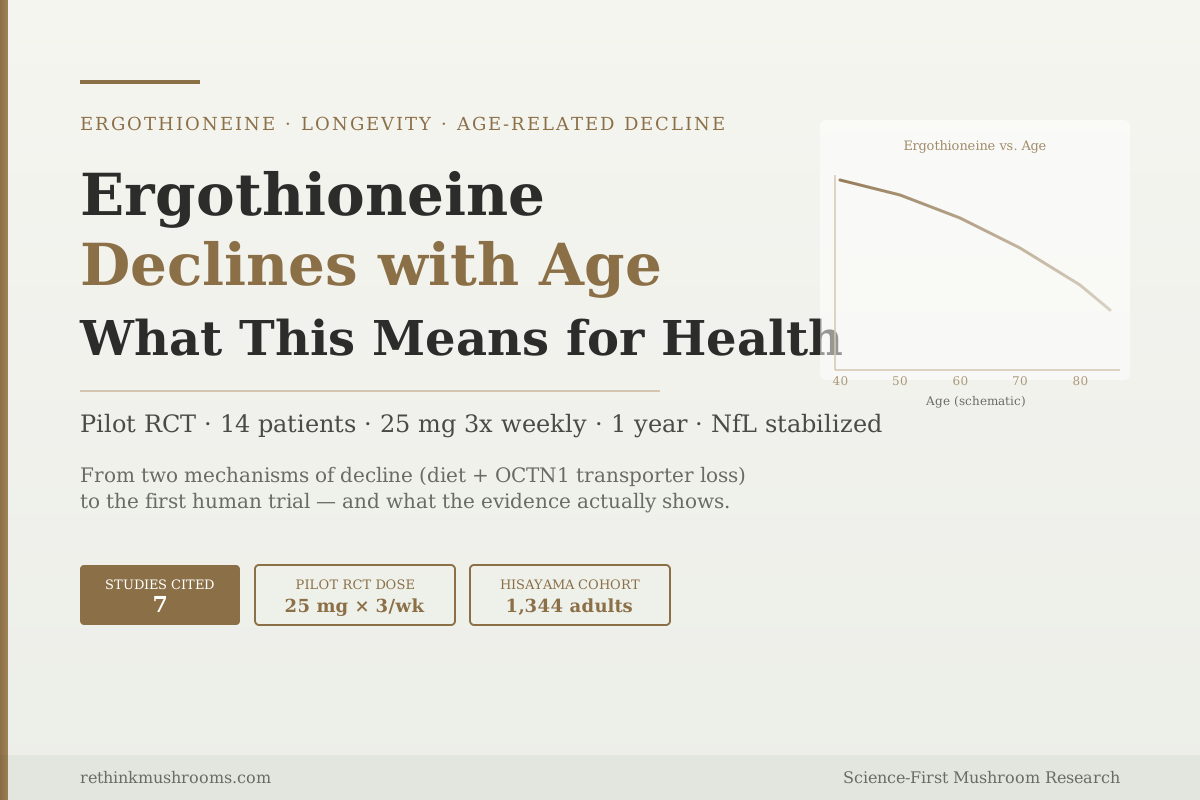
That finding carries more weight when you understand what happens to ergothioneine as people age. Ergothioneine declines with age; blood levels in older adults are consistently lower than in younger adults, a pattern documented across multiple populations and reviewed comprehensively by Cheah and Halliwell in 2021.[2] The people in the Hisayama Study with the lowest ergothioneine likely got there, at least partly, through that age-related decline. And they were the people with the highest dementia rates.
This article traces the mechanisms driving the decline, what the long-term cohort data says about its consequences, and what a 2024 pilot trial found when researchers first tested supplementation. For background on what ergothioneine is and why the human body handles it differently from any other dietary compound, see Ergothioneine: The Longevity Amino Acid.
Key Takeaways
- Blood ergothioneine levels decline measurably with age, with older adults consistently showing lower levels in cross-sectional data reviewed by Cheah and Halliwell in 2021
- The body's dedicated import protein for ergothioneine, called OCTN1, also declines in aging neurons, meaning the brain absorbs less ergothioneine even when blood levels are maintained
- In the 2025 Hisayama Study (1,344 Japanese adults, 11.2-year median follow-up), higher serum ergothioneine was significantly associated with lower risk of all-cause dementia, Alzheimer's disease, and other dementia types
- A Swedish cohort followed for a median 21.4 years found that higher plasma ergothioneine predicted significantly lower rates of coronary artery disease, cardiovascular mortality, and all-cause mortality
- Halliwell and Cheah proposed in 2024 that declining ergothioneine may be a contributing cause of neurodegenerative disease, not just a correlated marker; no major research group had previously made that directional claim explicitly
- A 2024 pilot RCT in 14 people with mild cognitive impairment found that ergothioneine at 25 mg three times per week for one year stabilized a neurodegeneration marker in the blood, with modest cognitive test improvements and no safety concerns
After 60, Blood Ergothioneine Begins to Fall
Ergothioneine cannot be made by the human body. Every molecule in the bloodstream came from food, and in practical terms, food means mushrooms. Meat from animals that graze near fungi contains trace amounts, but nothing that compares to mushrooms eaten directly.
Cheah and Halliwell's 2021 review in Redox Biology, the most comprehensive synthesis of ergothioneine biology published to that point, documented the age pattern consistently: older adults show lower plasma ergothioneine than younger adults in cross-sectional surveys across multiple populations.[2] The decline is gradual rather than a sharp threshold event, and it accumulates over decades.
Tian and colleagues' 2023 review in the British Journal of Nutrition made the implications direct: ergothioneine should be recognized as an essential dietary compound for aging populations specifically because older adults lose it and struggle to replace it.[3] Their review linked lower ergothioneine in elderly populations to associations with frailty and cognitive deterioration, and identified mushrooms as the critical source that aging populations most consistently under-consume. Older adults tend to simplify their diets over time, and mushroom consumption falls.
The dietary component is at least theoretically addressable. But the decline is not purely dietary, which is where the second mechanism becomes consequential.
The Brain's Double Problem: A Failing Transporter on Top of Falling Blood Levels
The body does not absorb ergothioneine through passive diffusion. It uses a specialized transport protein called OCTN1 to pull ergothioneine from the bloodstream into cells. Without functional OCTN1, ergothioneine cannot accumulate in tissues at meaningful concentrations. Neurons are entirely dependent on this transporter.
What Ishimoto and Kato documented in their 2022 review in FEBS Letters is that aging neurons produce progressively less OCTN1.[4] This creates a compounding situation. Blood ergothioneine is already declining because older adults eat fewer mushrooms. At the same time, the cellular machinery that moves ergothioneine from blood into brain cells is becoming less efficient. An older adult can face both lower circulating ergothioneine and reduced neuronal uptake capacity simultaneously.
That matters because neurons have an unusually high dependence on ergothioneine. They actively concentrate it to levels well above surrounding tissue, specifically because they use it to manage oxidative stress and inflammation: two processes that accelerate substantially in aging brain tissue. When both supply and uptake fall together, neurons lose a protective reserve they had been relying on for decades.
Halliwell and Cheah made this dual mechanism central to their 2024 hypothesis paper in Free Radical Biology and Medicine.[5] Their argument: the combination of declining OCTN1 and reduced dietary intake creates a functional ergothioneine deficiency in the aging brain, even without acute depletion visible in the bloodstream. And that brain-specific deficiency, they proposed, may not just accompany neurodegeneration but actively contribute to it.
For a deeper look at how OCTN1 works and why its age-related decline matters mechanistically, see OCTN1: The Dedicated Transporter That Proves Ergothioneine Matters.
What 11.2 Years of Japanese Data Reveals About Dementia Risk
The Hisayama Study is a long-running epidemiological project in Japan. Meng and colleagues published the ergothioneine results in Psychiatry and Clinical Neuroscience in 2025, marking the first large, long-term cohort study to directly examine serum ergothioneine and dementia incidence.[1]
The design was straightforward. The researchers enrolled 1,344 community-dwelling adults aged 65 and older, measured their serum ergothioneine at baseline, and followed them for a median of 11.2 years, recording new dementia diagnoses. Participants were divided into groups by their starting ergothioneine level.
Higher serum ergothioneine was significantly associated with lower risk of all-cause dementia. The association held for Alzheimer's disease specifically and for other dementia types as well. This is the largest and longest longitudinal human study ever published on ergothioneine and dementia risk.
The fact that the association covered all dementia types (not just Alzheimer's) is worth noting. Alzheimer's disease has a distinct pathology (amyloid plaques, tau tangles) from vascular dementia or other neurodegenerative forms. A protective association that holds across different dementia types with different underlying mechanisms is harder to explain through a single confounding variable and suggests something broad about brain health, rather than a narrow Alzheimer's-specific pathway.
The Japanese context adds useful perspective. Japan has substantially higher mushroom consumption than Western countries, which means Hisayama participants likely had higher baseline ergothioneine than a comparable American cohort. The fact that differences in ergothioneine level still predicted meaningfully different dementia outcomes within that higher-consumption population means the dose-response relationship extends into ranges above what most people in the US maintain.
The observational caveat applies as always: people with higher ergothioneine may differ in other dietary and lifestyle ways that account for the outcome difference. Ergothioneine could be a marker of a generally healthier diet rather than an independent protective factor. Establishing causation requires different study designs.
What 21 Years of Swedish Follow-Up Found About Heart Disease and Death
The Japanese cohort focused on cognitive outcomes. The Swedish cohort asked a different question and reached the same directional conclusion.
Smith and colleagues published findings from a large Swedish prospective cohort in Heart in 2020, with a median follow-up of 21.4 years.[6] Over more than two decades, participants with higher plasma ergothioneine at baseline showed significantly lower rates of coronary artery disease, cardiovascular mortality, and all-cause mortality. These are hard endpoints: actual deaths and disease events, not biomarker proxies.
Twenty-one years of follow-up is unusual in nutritional epidemiology, where most cohort studies last five to ten years. The longer the follow-up, the more biological noise gets filtered out, and the more confidence researchers can have that an early baseline measurement is genuinely predicting a later outcome rather than reflecting concurrent health status. The Smith cohort represents some of the strongest temporal evidence yet available for any ergothioneine-health association in humans.
The breadth of that finding matters equally. The ergothioneine association was not confined to one disease category. It appeared across coronary disease, heart-related death, and death from any cause. That range is harder to explain away as confounding than a single-endpoint association.
The convergence between the Swedish cardiovascular cohort and the Japanese cognitive cohort is worth noting separately. The confounders that explain the Swedish finding do not necessarily explain the Japanese finding. Different populations, different outcomes, different researchers: the same directional signal.
For more detail on what blood ergothioneine predicts for mortality outcomes specifically, see Blood Ergothioneine Levels and All-Cause Mortality Risk.
From Correlation to Cause? The Boldest Hypothesis in the Field
For most of ergothioneine's research history, the working assumption was that lower levels reflect worse health rather than cause it. People who are sick eat less, absorb nutrients poorly, and have compromised biology across many systems. Low ergothioneine could simply be one readout of that general decline.
Halliwell and Cheah's 2024 paper challenged that assumption directly.[5] They assembled the mechanistic case for why the decline might be causal rather than incidental. Ergothioneine concentrates in neurons because those cells have a specific biological need for it. The body developed and maintained a dedicated transporter for ergothioneine in neuronal tissue, a level of investment that reflects long-term functional dependence. The age-related loss of both circulating levels and neuronal uptake capacity lines up temporally with the onset of neurodegenerative conditions in ways that passive biomarker status struggles to explain.
The hypothesis generates a testable prediction: if declining ergothioneine contributes to neurodegeneration, then supplementation that restores levels should reduce neurodegeneration biomarkers and eventually reduce disease rates. That prediction is now being tested.
The honest state of the science: this is a hypothesis from researchers with deep expertise, not a proven mechanism. The epidemiological evidence that low ergothioneine correlates with worse neurological outcomes is now supported by large, long-duration cohort data. The evidence that restoring ergothioneine prevents those outcomes exists only at pilot scale. The gap between those two statements is wide, and it is the central unanswered question in the field.
Can Supplementation Counter the Decline? The First Human Trial
Yau and colleagues published a pilot double-blind randomized controlled trial in the Journal of Alzheimer's Disease in 2024, the first study to test ergothioneine supplementation for cognitive outcomes in humans.[7]
The population was 14 older adults with mild cognitive impairment (MCI), the condition that sits between normal aging-related memory changes and a formal dementia diagnosis. Participants received ergothioneine at 25 mg three times per week or placebo for one year. Fourteen participants is a pilot study, designed to assess safety and detect whether a signal exists, not to establish efficacy at a population level.
What the researchers found: modest improvements on cognitive tests in the ergothioneine group, and stable plasma neurofilament light chain (NfL). NfL is a protein released from damaged neurons into the bloodstream; rising NfL is one of the clearest biological signs that neurons are dying at an accelerating rate. In untreated MCI patients, NfL tends to climb over time. In the ergothioneine group, it did not.
Stable NfL in an MCI population is an encouraging signal. It does not mean cognition was dramatically restored. It suggests the rate of ongoing neuronal damage was not accelerating during the supplementation year. No safety concerns emerged at the dose tested.
The dose itself deserves notice. Twenty-five milligrams three times weekly is not large by supplement standards, but getting equivalent ergothioneine consistently from diet alone would require regular and substantial mushroom consumption, particularly from higher-ergothioneine species such as oyster, king oyster, and shiitake.
The Dietary Case: Why Aging Adults Face the Most Risk
The research on age-related ergothioneine decline consistently points to diet as the most addressable variable. Since the body cannot synthesize ergothioneine, and since mushrooms are its only practical dietary source, what older adults eat largely determines what circulates in their blood.
Tian and colleagues' 2023 review made this argument most forcefully.[3] Older adults face a structural disadvantage: they eat less overall, their dietary variety shrinks over time, and mushroom consumption specifically tends to fall. That review proposed mushroom intake should receive specific attention in dietary guidance for healthy aging, not as a vague wellness recommendation but because ergothioneine is a real nutrient with measurable associations when it is chronically low in aging populations.
The question of whether dietary ergothioneine alone can meaningfully counter the age-related decline, or whether supplementation is needed to reach relevant levels, is not yet answered by the current data. The Yau pilot trial used a supplement at a defined dose. The cohort studies measured serum levels without controlling for source. Both lines of evidence point the same direction: higher ergothioneine during aging is associated with better outcomes. Whether the source, the dose, or some interaction between them is what matters most is still being worked out.
For direct evidence on whether mushroom consumption predicts longer lifespan in population data, see Can Eating More Mushrooms Extend Your Lifespan? Ergothioneine Evidence.
For more on dementia-specific population studies beyond the Hisayama cohort, see Ergothioneine and Dementia Prevention: Population Studies.
The Bottom Line
Blood ergothioneine levels decline with age through two converging pathways: reduced dietary intake as older adults eat fewer mushrooms, and declining OCTN1 transporter expression in aging neurons that reduces cellular uptake even when blood levels are maintained. The longitudinal consequences documented in human cohorts include higher rates of dementia (2025 Hisayama Study, 1,344 adults, 11.2-year follow-up) and higher cardiovascular and all-cause mortality (2020 Swedish cohort, 21.4-year follow-up). Halliwell and Cheah proposed in 2024 that the decline may contribute causally to neurodegeneration, not merely correlate with it. A pilot RCT in 14 MCI patients found stabilized neurodegeneration biomarkers after one year of supplementation at 25 mg three times weekly, with the caveat that a 14-person pilot cannot establish efficacy and larger confirmatory trials have not been conducted.
Frequently Asked Questions
Sources & References
- 1RTHM-02144·Meng, Xiangyin et al. (2025). “Serum ergothioneine and risk of dementia in a general older Japanese population: the Hisayama Study..” Psychiatry and clinical neurosciences.Study breakdown →PubMed →↩
- 2RTHM-00678·Cheah, Irwin K et al. (2021). “Ergothioneine, recent developments..” Redox biology.Study breakdown →PubMed →↩
- 3RTHM-01805·Tian, Xiaoying et al. (2023). “Ergothioneine: an underrecognised dietary micronutrient required for healthy ageing?.” The British journal of nutrition.Study breakdown →PubMed →↩
- 4RTHM-01544·Ishimoto, Takahiro et al. (2022). “Ergothioneine in the brain..” FEBS letters.Study breakdown →PubMed →↩
- 5RTHM-01898·Halliwell, Barry et al. (2024). “Are age-related neurodegenerative diseases caused by a lack of the diet-derived compound ergothioneine?.” Free radical biology & medicine.Study breakdown →PubMed →↩
- 6RTHM-00655·Smith, Einar et al. (2020). “Ergothioneine is associated with reduced mortality and decreased risk of cardiovascular disease..” Heart (British Cardiac Society).Study breakdown →PubMed →↩
- 7RTHM-02029·Yau, Yu Fung et al. (2024). “Investigating the efficacy of ergothioneine to delay cognitive decline in mild cognitively impaired subjects: A pilot study..” Journal of Alzheimer's disease : JAD.Study breakdown →PubMed →↩