Ergothioneine & Dementia
1,344 adults
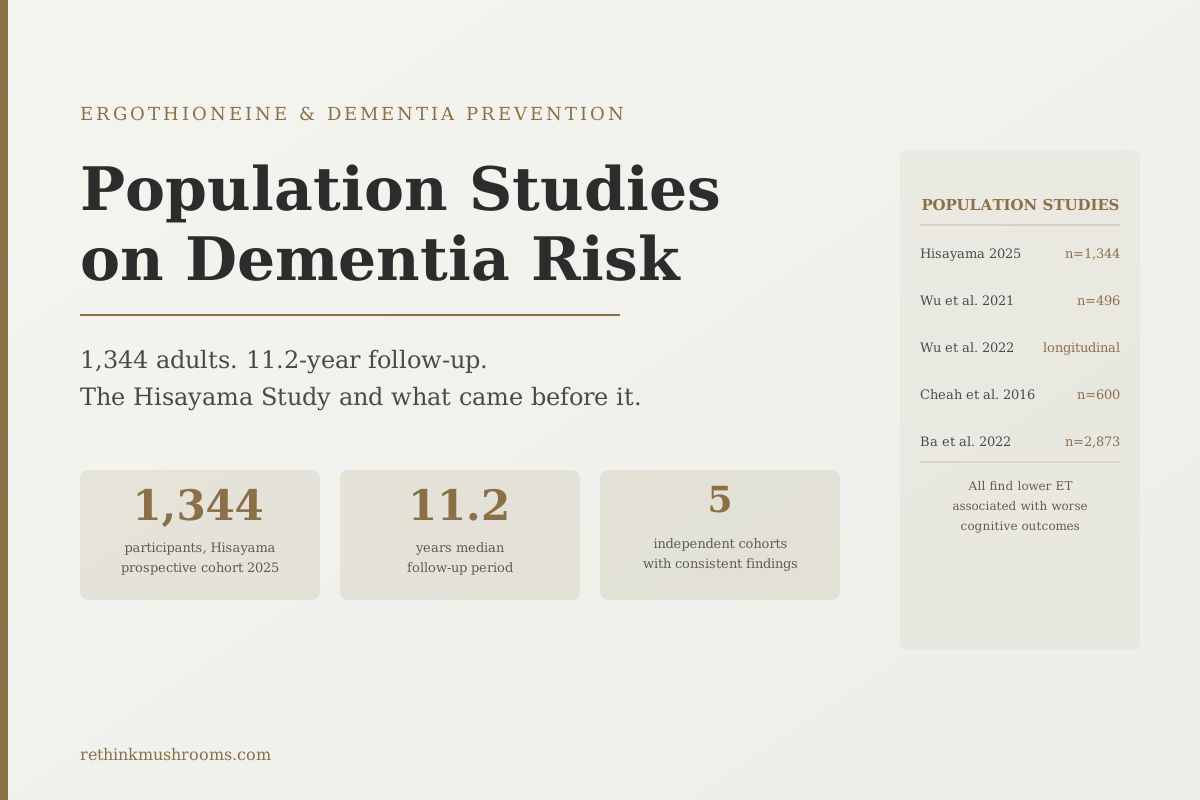
The Hisayama Study followed 1,344 community-dwelling adults for a median of 11.2 years and found higher baseline serum ergothioneine was associated with lower risk of all-cause dementia, Alzheimer's disease, and non-AD dementia.
Meng et al., Psychiatry Clin Neurosci, 2025
273 diagnoses
dementia cases recorded over a median 11.2 years of follow-up
496 participants
showed lower ET linked to smaller hippocampal volume (Wu et al., 2021)
19 adults
the entire completed randomized trial evidence base to date (Yau et al., 2024)
Meng et al., Psychiatry Clin Neurosci, 2025
 View as image ↗
In 2012, a team in Hisayama, Japan drew blood from 1,344 community-dwelling adults aged 65 and older, measured their ergothioneine levels, and then waited. Eleven years later, Meng and colleagues published what those years revealed: people with higher serum ergothioneine at baseline had lower risk of developing all-cause dementia, Alzheimer's disease, and non-AD dementia across the follow-up period. It is the strongest prospective epidemiological evidence on ergothioneine and dementia published to date.
This is not an isolated finding. A consistent pattern has emerged across multiple independent cohorts over nearly a decade: people with lower blood ergothioneine show more cognitive impairment, more structural brain damage, worse functional trajectories, and earlier cognitive decline. This article walks through all the major population studies, what they measured, and what they found — including the places where the evidence is thinner than the headlines suggest.
For a primer on what ergothioneine is and where it comes from, see Ergothioneine — The Longevity Amino Acid. For the mechanistic explanation of how ergothioneine protects brain tissue across five pathways, see Ergothioneine and Brain Health: Neuroprotective Research.
Key Takeaways
- In 1,344 community-dwelling Japanese adults followed for a median of 11.2 years, 273 developed dementia, and higher baseline serum ergothioneine was associated with lower risk of all-cause dementia, Alzheimer's disease, and non-AD dementia — an association that survived adjustment for daily vegetable intake (Meng et al., Psychiatry Clin Neurosci, 2025)
- In 496 participants spanning healthy cognition through dementia, lower plasma ergothioneine correlated with smaller hippocampal volumes, more white matter hyperintensities, and thinner cortex — not just cognitive test scores but measurable structural brain changes (Wu et al., Free Radic Biol Med, 2021)
- In 470 memory-clinic patients followed for up to five years, lower baseline ergothioneine predicted faster cognitive and functional decline — though mediation analysis suggested much of that effect ran through cerebrovascular disease and brain atrophy rather than around them (Wu et al., Antioxidants, 2022)
- Whole-blood ergothioneine declines significantly beyond age 60, and a subset of those adults with mild cognitive impairment had significantly lower plasma levels than age-matched peers (Cheah et al., Biochem Biophys Res Commun, 2016)
- The entire completed trial evidence is one pilot: 19 adults with MCI, randomized double-blind against placebo, 25 mg three times weekly for a year, showing improved verbal learning and stabilized neurofilament light chain while the placebo group's rose (Yau et al., J Alzheimers Dis, 2024)
- A roughly 600-person RCT giving mushroom powder over 24 months to at-risk adults aged 45–74 is registered and ongoing — no large-scale intervention result exists yet
The Hisayama Study: 11 Years, 1,344 People, the Strongest Evidence Yet
The Hisayama Study is one of Japan's longest-running community health cohorts, tracking cardiovascular and neurological outcomes in a general population since 1961. In 2025, Meng and colleagues published the first ergothioneine-specific dementia analysis from this cohort in Psychiatry and Clinical Neurosciences.
The analysis included 1,344 adults aged 65 and older who were dementia-free at enrollment in 2012. Serum ergothioneine was quantified by liquid chromatography–mass spectrometry and divided into quartiles. Over a median follow-up of 11.2 years (2012 to 2023), 273 participants developed all-cause dementia — 201 with Alzheimer's disease and 72 with non-AD dementia.
Age- and sex-adjusted hazard ratios for all three outcomes decreased progressively across increasing quartiles of serum ergothioneine, with all trend tests reaching significance.[1]
Inside the strongest study
Hisayama, 2012–2023: from 1,344 people to 273 dementia diagnoses
Prospective cohorts earn their weight from endpoints, not sample size alone. Here are the endpoints.
Cohort at baseline
1,344
Japanese community residents aged 65+, all free of dementia when their serum ergothioneine was measured.
Median follow-up
11.2 yrs
Exposure was measured first and outcomes accrued afterwards — the ordering that separates prediction from correlation.
Developed dementia
273
Roughly one in five participants received a dementia diagnosis over the follow-up window.
How the 273 diagnoses split
201 Alzheimer's disease — The large majority of endpoints
72 Non-Alzheimer’s dementia — Vascular and other subtypes
What the ergothioneine gradient survived
Age and sex
Hazard ratios fell progressively across rising ergothioneine quartiles for all-cause dementia, Alzheimer’s disease and non-AD dementia (all P for trend < 0.05).
Cardiovascular and lifestyle factors
The quartile gradient remained statistically significant after a wide range of cardiovascular and lifestyle adjustments.
Daily vegetable intake
The obvious rival explanation — that ergothioneine is just a marker for eating well. The association still held (P for trend < 0.05).
Stratified by vegetable consumption
Higher serum ergothioneine tracked lower dementia risk in both higher- and lower-vegetable subgroups alike.
A prospective association this durable is still an association. Hisayama measured what people already had in their blood; it did not assign anyone to take ergothioneine, so it cannot establish that raising intake lowers risk. Source: Meng et al., Psychiatry and Clinical Neurosciences, 2025 (Ref 1).
What makes this the strongest evidence available is the design. Prospective cohort studies measure exposure before the outcome develops, so the low ergothioneine predated the dementia diagnosis rather than following it. The 11-year window captures gradual decline rather than a point-in-time snapshot. The population is community-dwelling rather than clinical, which reduces the selection bias that can inflate associations in memory-clinic cohorts.
The most important detail is what the association survived. Ergothioneine comes from the diet, so the obvious objection is that it simply marks people who eat well. The researchers adjusted for a wide range of cardiovascular, lifestyle and dietary factors including daily vegetable intake, and the gradient held. In subgroup analyses stratified by vegetable consumption, higher ergothioneine tracked lower dementia risk in both higher- and lower-vegetable groups.
What Low Ergothioneine Does to Brain Structure: 496 Participants and an MRI
Knowing that low ergothioneine correlates with cognitive test scores is useful. Knowing that it correlates with visible changes in brain tissue is a different order of evidence.
Wu and colleagues examined this in a 2021 Free Radical Biology and Medicine study across 496 participants: 88 with no cognitive impairment, 201 with cognitive impairment but no dementia, and 207 with dementia — of whom 160 had Alzheimer's disease and 47 had vascular dementia. Plasma ergothioneine concentrations were lowest in the dementia group and intermediate in the cognitive-impairment group. Lower levels were also associated with white matter hyperintensities and with brain atrophy markers, specifically reduced global cortical thickness and smaller hippocampal volumes.[2]
Wu, Cheah, Chong, et al. (2021) · Free Radical Biology and Medicine
- Population
- 496 adults: 88 with no cognitive impairment, 201 with cognitive impairment without dementia, 207 with dementia (160 Alzheimer's, 47 vascular)
- Intervention
- No intervention — cross-sectional measurement of plasma ergothioneine by LC-MS/MS, with neuropsychological and MRI assessment
- Finding
- Plasma ergothioneine was lowest in dementia and intermediate in cognitive impairment without dementia. Lower levels were associated with white matter hyperintensities, reduced cortical thickness and smaller hippocampal volumes, after adjustment for demographic and vascular risk factors.
mixed A strong, consistently graded association — but cross-sectional, so it cannot establish whether low ergothioneine contributes to the damage or results from it.
Wu et al., Free Radic Biol Med, 2021 (Ref 2)
The gradient ran across the cognitive spectrum: participants without impairment had the highest ergothioneine, those with impairment but no dementia sat in between, and those with dementia had the lowest.
Five Cohort Studies Side by Side
The table below summarizes the major population studies linking ergothioneine levels to dementia and cognitive outcomes. Sample sizes are given as reported in each published abstract; where an abstract does not state a figure, the table says so rather than guessing.
| Study | n | Design | Follow-up | Key Finding |
|---|---|---|---|---|
| Meng et al., 2025 (Hisayama) | 1,344 | Prospective cohort | Median 11.2 years | Higher serum ET associated with lower all-cause dementia, AD and non-AD dementia risk; 273 dementia cases; held after adjustment for vegetable intake |
| Wu et al., 2021 | 496 | Cross-sectional (cognitive spectrum) | None | Lower ET correlated with smaller hippocampal volumes, white matter hyperintensities and thinner cortex |
| Wu et al., 2022 | 470 | Longitudinal memory-clinic cohort | Up to 5 years | Lower baseline ET predicted faster cognitive and functional decline, largely mediated by cerebrovascular disease and atrophy |
| Cheah et al., 2016 | Not stated in abstract | Cross-sectional elderly cohort | None | Whole-blood ET declined significantly beyond age 60; MCI subset had lower plasma ET than age-matched peers |
| Kondoh et al., 2022 | Not stated in abstract | Metabolomic analysis | None | ET correlated with cognitive decline but not skeletal muscle decline in frail elderly people |
Predicting Decline: ET as a Biomarker with Longitudinal Value
A biomarker that tracks current cognitive status is useful for diagnosis. A biomarker that predicts who will decline is useful for prevention — a meaningfully different clinical application.
Wu and colleagues tested this distinction in a 2022 Antioxidants paper following 470 elderly patients attending memory clinics in Singapore, with cognitive and functional assessments at baseline and follow-up visits for up to five years. Lower plasma ergothioneine was associated with poorer baseline cognitive performance and with faster rates of decline in function and across multiple cognitive domains including memory, executive function, attention, visuomotor speed and language.[3]
Two qualifications matter, and they are easy to lose. First, the longitudinal associations appeared only in participants who were not already demented — this is a pre-dementia signal, not a marker of established disease progression. Second, and more importantly, mediation analyses indicated that ergothioneine's apparent effect on cognition was largely explainable by the severity of accompanying cerebrovascular disease, particularly white matter hyperintensities, and brain atrophy. In other words, low ergothioneine did not appear to act as an independent parallel pathway so much as travel with vascular and structural damage.
That nuance cuts both ways. It weakens any claim that ergothioneine is a standalone causal driver of decline. It also strengthens the case for ergothioneine as a practical prognostic marker, since a single blood measurement appears to carry information about processes that otherwise require neuroimaging to see.
The Age Depletion Problem: ET Falls Precisely When the Brain Needs It Most
Cheah and colleagues at the National University of Singapore published the foundational population study in 2016 in Biochemical and Biophysical Research Communications. Working with elderly Singaporean adults, they found that whole-blood ergothioneine levels decline significantly beyond 60 years of age. A subset of those subjects with mild cognitive impairment had significantly lower plasma ergothioneine than age-matched comparison subjects.[4]
This finding established the age-depletion paradox: the years in which the brain faces the highest risk of neurodegenerative disease coincide with the years in which ergothioneine levels are lowest. It is not clear whether the depletion reflects reduced mushroom consumption in older adults, reduced transporter expression with age, altered absorption, or some combination — the mechanism remains open, but the pattern is consistent across cohorts.
Kondoh and colleagues added a metabolomic perspective in 2022 in FEBS Letters. Rather than testing one compound in isolation, metabolomics measures many metabolites simultaneously. In frail elderly people, ergothioneine levels correlated with cognitive decline but specifically not with skeletal muscle decline — a dissociation that argues the signal is neurological rather than a generic marker of frailty. In dementia patients, including those with Alzheimer's disease and hippocampal atrophy, deteriorating cognition tracked declining ergothioneine. Several related trimethyl-ammonium compounds fell alongside it, while indoxyl sulfate and quinolinic acid rose.[5]
For more on how and why ergothioneine levels decline with age, see Ergothioneine Declines with Age: What This Means for Health. The Singapore research group's parallel work on Parkinson's disease is covered in Ergothioneine and Parkinson's Disease: Epidemiological Evidence From Singapore.
2,840 Americans, No Blood Draws: The NHANES Mushroom Connection
Ba and colleagues took a different approach in a 2022 British Journal of Nutrition study. Rather than measuring blood ergothioneine, they analyzed dietary data from the National Health and Nutrition Examination Survey (NHANES) 2011–2014, a nationally representative sample of US adults. The analysis included 2,840 participants aged 60 and over with dietary recall data and cognitive test scores.
Comparing the highest category of mushroom intake against the lowest, two of four cognitive tests showed significant associations: the Digit Symbol Substitution Test and CERAD Word Learning. Animal Fluency and CERAD Delayed Recall did not. The models adjusted for socio-demographics, major lifestyle factors, self-reported chronic diseases and dietary factors including overall diet quality and total energy intake.[6]
Reading the NHANES result honestly
Four cognitive tests, two hits, two misses
2,840 US adults aged 60+, highest versus lowest mushroom intake (median 13.4 g per 1,000 kcal per day), adjusted for demographics, lifestyle, chronic disease and overall diet quality.
DSST
SignificantDigit Symbol Substitution Test
Processing speed and executive function
P for trend = 0.03
The clearest positive signal in the analysis.
CERAD-WL
SignificantCERAD Word Learning
Immediate word learning
P for trend = 0.04
Significant, but the interval’s lower bound is 0.0003 — a hair above no effect at all.
AF
No effectAnimal Fluency
Verbal fluency and semantic memory
P for trend = 0.92
No association. The interval straddles zero almost symmetrically.
CERAD-DR
No effectCERAD Delayed Recall
Delayed memory retrieval
—
No association reported — notable, since delayed recall is the domain dementia hits first.
Two caveats compound here. NHANES measured mushroom intake, not blood ergothioneine, so it cannot isolate ergothioneine from the rest of what a mushroom contains. And a cross-sectional design captures diet and cognition at the same moment, so it cannot say which came first. Source: Ba et al., British Journal of Nutrition, 2022 (Ref 6).
That split matters for how the study gets cited. It is frequently summarized as showing that mushroom eaters have better memory and executive function across the board. The published result is more specific and more mixed — and one of the two positive findings has a confidence interval whose lower bound sits at 0.0003, meaning it clears the significance threshold by the narrowest possible margin.
Mushroom intake also does not measure ergothioneine directly. Dietary recall cannot isolate ergothioneine from other mushroom constituents including beta-glucans, glutathione, vitamin D or polysaccharides — a point the authors themselves make in framing mushrooms as a source of several candidate compounds.
For the parallel Singapore dietary mushroom research covering similar outcomes, see Mushroom Consumption and Cognitive Decline: The Singapore Diet and Aging Study.
A Possible Mechanism: ET and Amyloid Clearance in a Mouse Model
Population associations and mechanistic studies operate at different explanatory levels. One mechanistic bridge came from a 2023 Frontiers in Neuroscience study by Wijesinghe and colleagues using 5xFAD mice, a genetic model of Alzheimer's that develops aggressive amyloid-beta accumulation.
Ergothioneine treatment improved amyloid-beta clearance in the neuroretina of these mice, assessed alongside markers for microglia and macrophages (IBA1) and astrocytes (GFAP), with uptake depending on the OCTN1 transporter.[10] This is a mouse model, and the retina is not the hippocampus. But the finding points at protein clearance pathways that extend beyond a simple antioxidant role.
Li and colleagues reviewed the broader mushroom bioactive literature for Alzheimer's in a 2023 Foods paper. They identified ergothioneine as one of several neuroprotective small molecules in mushrooms warranting dedicated scrutiny — alongside erinacine, flavonoids, alkaloids, ergosterol and melanin — rather than singling it out as the leading candidate.[11]
From Population Observation to Clinical Trial: 19 People and a Promising Signal
Yau and colleagues published the first clinical trial of ergothioneine in people with mild cognitive impairment in 2024 in the Journal of Alzheimer's Disease. Nineteen subjects aged 60 or above with MCI were recruited into a double-blinded, randomized, placebo-controlled study (ClinicalTrials.gov NCT03641404), receiving either 25 mg ergothioneine capsules or placebo three times a week for one year.
Participants taking ergothioneine showed improved performance on the Rey Auditory Verbal Learning Test, a standard measure of verbal learning and memory. The more striking result concerned neurofilament light chain (NfL), a protein released into blood when neurons are damaged. NfL remained stable in the ergothioneine group while rising significantly in the placebo group. Blood counts and kidney and liver function markers were unchanged throughout, and no toxicity was observed.[7]
Yau, Cheah, Mahendran, et al. (2024) · Journal of Alzheimer's Disease
- Population
- 19 adults aged 60+ with mild cognitive impairment (NCT03641404)
- Intervention
- 25 mg ergothioneine capsule, three times weekly for one year
- Comparator
- Matched placebo, double-blinded and randomized
- Finding
- Improved Rey Auditory Verbal Learning Test performance and stabilized plasma neurofilament light chain, while the placebo group showed no cognitive improvement and a significant rise in neurofilament light chain. No effect on safety markers.
preliminary Properly randomized and placebo-controlled, but far too small to support any clinical recommendation. This is a signal worth replicating, not a result to act on.
Yau et al., J Alzheimers Dis, 2024 (Ref 7)
Nineteen participants across two arms cannot separate a true effect from noise with the confidence a clinical recommendation requires. The NfL divergence is biologically plausible and the randomized, placebo-controlled design is a genuine strength — but a pilot is a pilot.
Halliwell and Cheah's 2024 hypothesis paper in Free Radical Biology and Medicine framed the larger question directly, asking whether age-related neurodegenerative diseases are caused in part by a lack of this diet-derived compound — a hypothesis they argue is worth testing seriously, not a conclusion they claim to have established.[13]
The Definitive Trial: What the 600-Person RCT Will Test
Shan and colleagues published the protocol for the field's most rigorous test to date in Frontiers in Aging Neuroscience in 2025. The programme has two components: a 10-year cognitive follow-up of the existing Diet and Healthy Aging (DaHA) cohort, which recruited over 1,000 older adults between 2010 and 2016, and a new randomized controlled trial in around 600 middle-aged adults and young-olds.
The trial's inclusion criteria are unusually well targeted. Participants are community-living adults aged 45 to 74 with a family history of dementia, an APOE ε4 allele, or subjective cognitive decline, who currently eat mushrooms no more than once a week. The intervention group will consume Pleurotus citrinopileatus (golden oyster mushroom) powder daily for 24 months, with compliance monitored using electronic diaries.[12]
- Cell and mechanistic workcompleted
Antioxidant, anti-inflammatory and anti-senescence pathways characterized; OCTN1 transporter maps ergothioneine to brain and eye tissue.
- Animal modelscompleted
Improved amyloid-beta clearance in 5xFAD mice; lifespan extension and rescued learning and memory in male mice at 4–5 mg/kg/day.
- Pilot human trialcompleted
One randomized, double-blind, placebo-controlled pilot in 19 adults with MCI: improved verbal learning, stabilized neurofilament light chain.
- Large randomized trialcurrent
A roughly 600-person, 24-month RCT in at-risk adults aged 45–74 is registered and ongoing. No results yet.
- Meta-analysis of trialsmissing
Impossible until multiple large trials report. A 2025 systematic review could pool only 19 studies of mixed design.
Observational evidence spanning Japan, Singapore and the US is unusually consistent, and the mechanistic case is built from several independent pathways. The interventional case rests on a single 19-person pilot. That gap — not the strength of the association — is what the ongoing trial exists to close.
Refs 1–14
This is the scale-up from pilot to definitive trial. If the Hisayama observational signal reflects causation and the Yau pilot signal generalizes, this trial should detect it. If it does not, the field will need to revisit whether the observational association reflects confounding by something ergothioneine merely travels with — which, given the Wu 2022 mediation findings, is a live possibility.
The 2025 systematic review by Takhor and Phan synthesized 19 studies drawn from PubMed, Scopus and Web of Science, assessing each for risk of bias. They concluded that ergothioneine influences cognition and age-related neurodegenerative disease through antioxidative, anti-inflammatory and anti-senescence properties alongside roles in neurotransmission and neuroprotection, and that it remains a compound to be explored rather than an established intervention.[8] The Shan trial's use of a whole-mushroom food source rather than an isolated supplement adds translational relevance, since most people encounter ergothioneine through food.
What the Evidence Can and Cannot Yet Tell Us
May-Zhang and colleagues' 2025 Proceedings of the Nutrition Society review summarized the position: observational data consistently associate low blood ergothioneine with cognitive impairment, neurodegenerative disease, cardiovascular disorders, frailty and mortality, while interventional trials in older adults suggest ergothioneine may improve cognition, memory and sleep quality and stabilise neurodegeneration biomarkers, with no safety concerns at doses up to 25 mg per day.[9] The hedging in that sentence is the authors' own, and it is load-bearing.
Katsube and colleagues' 2024 GeroScience study followed male mice given 4–5 mg/kg/day of ergothioneine in drinking water from 7 weeks of age until death. Lifespan was markedly extended, an effect corroborated in Caenorhabditis elegans. Treated mice showed smaller age-related declines in weight, fat mass and movement velocity, and oral ergothioneine rescued age-related impairments in learning and memory — associated with suppression of the age-related decline in hippocampal neurogenesis and of TDP-43 protein aggregation.[14] Lifespan rodent data is biologically informative but does not substitute for human interventional evidence.
Fact Check
Does eating mushrooms prevent dementia?
The claim
“Eating mushrooms prevents dementia — the research proves it.”
Headlines summarising the Hisayama cohort and NHANES analyses, which report associations between ergothioneine or mushroom intake and cognitive outcomes.
What research shows
OverstatedEvery population finding here is observational. Hisayama measured ergothioneine people already had and watched who developed dementia; it did not assign anyone to consume more. No completed trial has shown that increasing ergothioneine intake prevents dementia in humans.
The observational consistency is genuinely notable — the association survived adjustment for vegetable intake, and it appears across Japanese, Singaporean and US populations with structural brain imaging as a readout. But the one completed randomized trial enrolled 19 people, and mediation analysis in a separate cohort suggested the cognitive effect ran largely through cerebrovascular disease rather than independently of it.
Refs 1, 3, 6, 7 — Meng 2025, Wu 2022, Ba 2022, Yau 2024
The honest summary: the epidemiological association between low ergothioneine and dementia risk is one of the more consistent nutrient–disease relationships in the aging biology literature, spanning independent cohorts across Singapore, Japan and the US, with structural brain changes as a readout rather than test scores alone. The mechanistic case draws on several independent pathways. The interventional case rests on 19 subjects in a single pilot. The gap between those two levels of evidence is what the ongoing trial is designed to close.
Practical Caution
ModerateNo established preventive dose — and cognitive symptoms need a clinician, not a supplement
Concern
The gap between a consistent observational signal and proven prevention invites self-treatment. Someone noticing memory changes may reach for an ergothioneine supplement instead of seeking assessment, and treatable causes of cognitive decline — vascular disease, thyroid dysfunction, B12 deficiency, medication effects, depression, sleep apnoea — are missed when evaluation is delayed.
What the research says
No preventive dose has been established for ergothioneine. The single completed randomized trial used 25 mg three times weekly in 19 people, and a 2025 review reported no safety concerns at doses up to 25 mg per day — safety data, not efficacy data. New or worsening cognitive symptoms warrant medical assessment regardless of diet or supplementation.
Particularly relevant for: Adults concerned about memory or cognitive decline; anyone considering ergothioneine supplementation for brain health
What to do
Treat mushrooms as food rather than medicine, and take new cognitive symptoms to a clinician for evaluation. This article is research education, not medical advice — discuss any supplement with your physician, particularly alongside existing medication.
Refs 7, 9 — Yau 2024, May-Zhang 2025
The same Singapore research group has documented a parallel pattern for Parkinson's disease. For that evidence base, see Ergothioneine and Parkinson's Disease: Research Review and Ergothioneine and Parkinson's Disease: Epidemiological Evidence From Singapore.
The Bottom Line
The 2025 Hisayama Study — the largest and longest prospective ergothioneine cohort published to date — followed 1,344 adults for a median of 11.2 years, recorded 273 dementia diagnoses, and found higher baseline serum ergothioneine associated with lower risk of all-cause dementia, Alzheimer's disease and non-AD dementia, with the gradient surviving adjustment for daily vegetable intake. Earlier cross-sectional work links low ergothioneine to measurable structural brain changes including hippocampal shrinkage, white matter hyperintensities and cortical thinning, though a longitudinal analysis suggests much of the cognitive effect is mediated by cerebrovascular disease. The entire completed interventional evidence base is a randomized, double-blind pilot in 19 adults with mild cognitive impairment that improved verbal learning and stabilized a neuronal damage biomarker. A roughly 600-person RCT giving mushroom powder over 24 months to at-risk adults aged 45–74 is ongoing and represents the field's first rigorous test of whether intake actually prevents cognitive decline.
Frequently Asked Questions
Sources & References
- 1RTHM-02144·Meng, Xiangyin et al. (2025). “Serum ergothioneine and risk of dementia in a general older Japanese population: the Hisayama Study..” Psychiatry and clinical neurosciences.Study breakdown →PubMed →↩
- 2RTHM-01456·Wu, Liu-Yun et al. (2021). “Low plasma ergothioneine levels are associated with neurodegeneration and cerebrovascular disease in dementia..” Free radical biology & medicine.Study breakdown →PubMed →↩
- 3RTHM-01634·Wu, Liu-Yun et al. (2022). “Low Plasma Ergothioneine Predicts Cognitive and Functional Decline in an Elderly Cohort Attending Memory Clinics..” Antioxidants (Basel.Study breakdown →PubMed →↩
- 4RTHM-00420·Cheah, Irwin K et al. (2016). “Ergothioneine levels in an elderly population decrease with age and incidence of cognitive decline; a risk factor for neurodegeneration?.” Biochemical and biophysical research communications.Study breakdown →PubMed →↩
- 5RTHM-01553·Kondoh, Hiroshi et al. (2022). “Decline of ergothioneine in frailty and cognition impairment..” FEBS letters.Study breakdown →PubMed →↩
- 6RTHM-00741·Ba, Djibril M et al. (2022). “Mushroom intake and cognitive performance among US older adults: the National Health and Nutrition Examination Survey, 2011-2014..” The British journal of nutrition.Study breakdown →PubMed →↩
- 7RTHM-02029·Yau, Yu Fung et al. (2024). “Investigating the efficacy of ergothioneine to delay cognitive decline in mild cognitively impaired subjects: A pilot study..” Journal of Alzheimer's disease : JAD.Study breakdown →PubMed →↩
- 8RTHM-02193·Takhor, Nurfarah Hazwani et al. (2025). “The role of Ergothioneine in cognition and age-related neurodegenerative disease: a systematic review..” Inflammopharmacology.Study breakdown →PubMed →↩
- 9RTHM-02140·May-Zhang, Linda S et al. (2025). “Ergothioneine for cognitive health, longevity and healthy ageing: where are we now?.” The Proceedings of the Nutrition Society.Study breakdown →PubMed →↩
- 10RTHM-01819·Wijesinghe, Printha et al. (2023). “Ergothioneine, a dietary antioxidant improves amyloid beta clearance in the neuroretina of a mouse model of Alzheimer's disease..” Frontiers in neuroscience.Study breakdown →PubMed →↩
- 11RTHM-01728·Li, Na et al. (2023). “Unveiling the Therapeutic Potentials of Mushroom Bioactive Compounds in Alzheimer's Disease..” Foods (Basel.Study breakdown →PubMed →↩
- 12RTHM-02177·Shan, Jiatong et al. (2025). “Study protocol: The efficacy of mushroom to prevent cognitive decline in at-risk middle-aged adults and young-olds living in the community..” Frontiers in aging neuroscience.Study breakdown →PubMed →↩
- 13RTHM-01898·Halliwell, Barry et al. (2024). “Are age-related neurodegenerative diseases caused by a lack of the diet-derived compound ergothioneine?.” Free radical biology & medicine.Study breakdown →PubMed →↩
- 14RTHM-00884·Katsube, Makoto et al. (2024). “Ergothioneine promotes longevity and healthy aging in male mice..” GeroScience.Study breakdown →PubMed →↩