Ergothioneine & Brain / Neurological Health
10 years of research
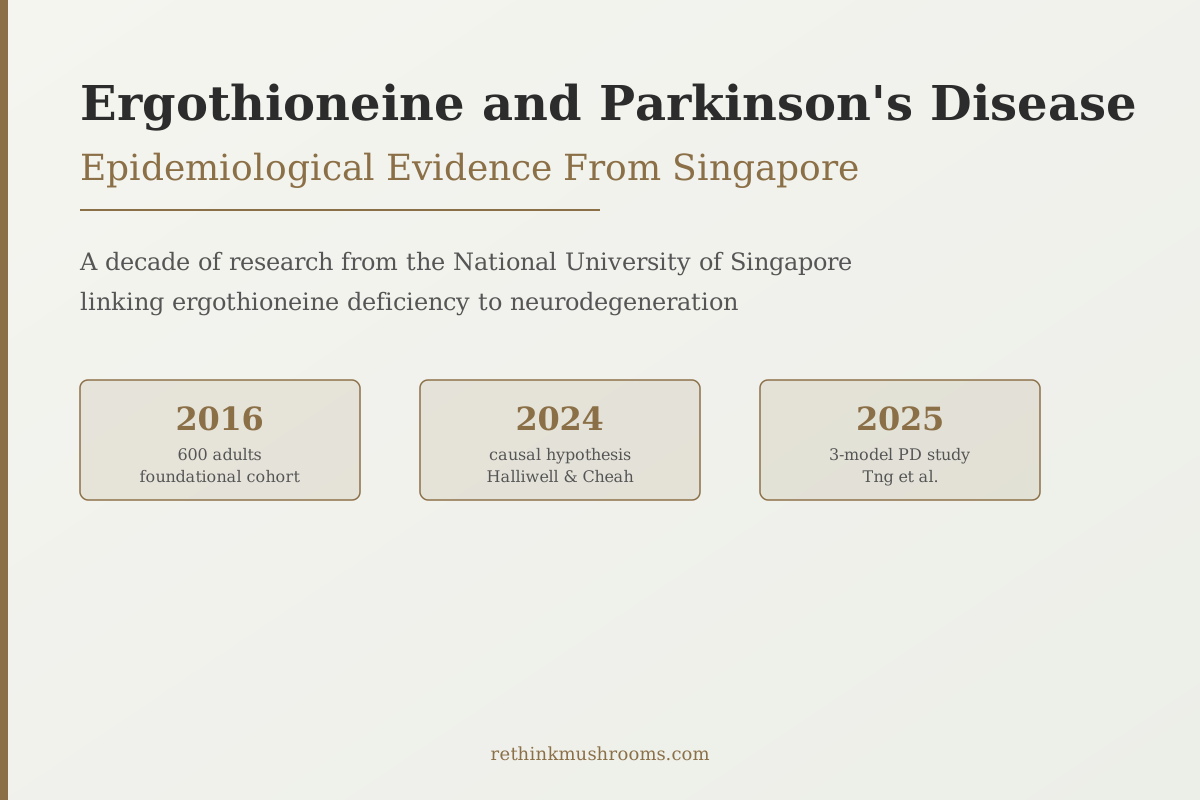
The National University of Singapore's Cheah and Halliwell group documented ergothioneine deficiency in neurodegeneration from 2016 through 2025 — building a strong human case in cognitive decline, and a strong preclinical case in Parkinson's disease.
Cheah et al., Biochem Biophys Res Commun, 2016 — Tng et al., J Neurochem, 2025
496 participants
Wu 2021: lower ET linked to hippocampal atrophy and white matter damage
19 adults
Yau 2024: first randomised placebo-controlled ET trial in MCI — 52 weeks, verbal learning improved
0 trials
interventional human evidence in Parkinson's disease specifically
Cheah et al., Biochem Biophys Res Commun, 2016 — Tng et al., J Neurochem, 2025
 View as image ↗
Blood ergothioneine is consistently lower in people with cognitive impairment and dementia than in healthy age-matched controls, and lower in Parkinson's disease patients too. The research group at the National University of Singapore, led by Irwin Cheah and Barry Halliwell, found ET levels decline with age; their 2024 hypothesis paper proposes that low body ET predisposes people to neurodegenerative disease.
That framing represents a decade of evidence accumulation from a single research program. What started as a cross-sectional observation in elderly Singaporeans grew into a body of work spanning population cohorts, MRI imaging data, a randomised clinical trial, cell experiments, animal models, and a formal causal hypothesis in a peer-reviewed journal.
There is an important distinction to hold onto throughout, because it is easy to lose. The Singapore group's human evidence is about cognitive impairment and dementia. Its Parkinson's evidence is preclinical — flies, mice, and cells. No Singapore cohort has measured ergothioneine in Parkinson's patients and tracked them over time, and no trial anywhere has given ergothioneine to people with Parkinson's and measured a Parkinson's outcome. This article follows the arc study by study and keeps those two streams visibly separate.
For background on what ergothioneine is and where it comes from, see Ergothioneine — The Longevity Amino Acid. For the mechanistic detail of how ET reaches Parkinson's-vulnerable brain regions, see OCTN1 in the Brain: Why the Blood-Brain Barrier Lets Ergothioneine Through.
Key Takeaways
- In 2016, Cheah et al. at the National University of Singapore found whole-blood ET declined significantly in elderly adults beyond age 60, and that a subset with mild cognitive impairment had significantly lower plasma ET than age-matched controls — the founding observation of this research program
- In 2021, Wu et al. extended this to structural brain damage: across 496 participants spanning the cognitive spectrum, lower ET correlated with smaller hippocampal volumes, more white matter lesions, and reduced cortical thickness
- In 2024, Halliwell and Cheah published a hypothesis paper proposing that low body ET predisposes humans to cognitive impairment, dementia and Parkinson's disease, suggesting ET and vitamin E may both act as "neuroprotective vitamins"
- Also in 2024, Leow et al. showed OCTN1-dependent protection of 6-OHDA-treated dopaminergic neurons — using healthy-donor iPSC lines, not patient-derived cells
- In 2025, Tng et al. tested ET across three PD model systems: parkin and LRRK2 mutant Drosophila, 6-OHDA-treated mice (protection abolished without OCTN1), and LRRK2-G2019S patient-derived neurons
- The clinical translation attempt — Yau et al.'s 2024 trial in 19 adults with MCI — was randomised, double-blinded and placebo-controlled, and produced positive verbal learning and neurofilament light chain signals, though the sample size limits conclusions
- Critically: every human study in this program measured cognition or dementia. Not one measured Parkinson's disease
Two evidence streams, one research program
The NUS ergothioneine arc, 2016–2025
The Singapore group’s human evidence measures cognitive impairment and dementia. Its Parkinson’s evidence is preclinical. Colour marks which stream each study belongs to — the two have not yet met in a human PD cohort.
- Human — cognitionRef 1
The founding observation
Whole-blood ergothioneine declined significantly in elderly individuals beyond age 60, and a subset with mild cognitive impairment had significantly lower plasma ET than age-matched subjects. The authors proposed ET deficiency as a possible risk factor for neurodegeneration.
Cheah et al., Biochem Biophys Res Commun, 2016
- Human — cognitionRef 2
Structural brain correlates (n=496)
Across 88 with no cognitive impairment, 201 with cognitive impairment but no dementia, and 207 with dementia, plasma ET was lowest in dementia and intermediate in CIND. Lower ET tracked with white matter hyperintensities, reduced cortical thickness and smaller hippocampal volumes.
Wu et al., Free Radic Biol Med, 2021
- Hypothesis / synthesisRef 3
The causal hypothesis
Halliwell and Cheah proposed that low body ET predisposes humans to significantly increased risk of cognitive impairment, dementia and Parkinson’s disease, arguing ET and vitamin E may both act as "neuroprotective vitamins".
Halliwell & Cheah, Free Radic Biol Med, 2024
- Preclinical — Parkinson'sRef 4
Dopaminergic cell protection
ET protected 6-OHDA-treated iPSC-derived dopaminergic neurons and SH-SY5Y cells — preserving mitochondrial membrane potential, lowering mitochondrial ROS and restoring ATP. Blocking the OCTN1 transporter with verapamil abolished the protection. The iPSC lines were from healthy donors, not PD patients.
Leow et al., Antioxidants, 2024
- Human — cognitionRef 6
First clinical test (n=19, RCT)
A double-blinded, randomised, placebo-controlled trial in 19 adults aged 60+ with MCI (25 mg, 3×/week, one year). The ET group improved on the Rey Auditory Verbal Learning Test and held neurofilament light chain steady; the placebo group did not improve and showed a significant NfL rise. No toxicity was observed.
Yau et al., J Alzheimers Dis, 2024
- Preclinical — Parkinson'sRef 5
Three PD models converge
ET improved climbing score and preserved dopaminergic neuron number and mitochondrial integrity in parkin and LRRK2 mutant Drosophila; rescued PD phenotypes in 6-OHDA-treated mice, an effect abolished in mice lacking OCTN1; and protected LRRK2-G2019S patient-derived dopaminergic neurons from rotenone, again OCTN1-dependently.
Tng et al., J Neurochem, 2025
- Human — cognitionRef 10
The scale-up (n=600, 24 months)
A randomised, double-blinded, placebo-controlled trial in Singapore of 600 at-risk adults (300 intervention, 300 control) over 24 months, using Pleurotus citrinopileatus mushroom powder extract delivering 10 mg ergothioneine daily. Cognitive decline is the endpoint — not Parkinson’s disease.
Shan et al., Front Aging Neurosci, 2025 (protocol)
Sources: refs 1–6 and 10. The 2016 paper reports no participant count in its abstract, so none is stated here. The ongoing 600-person trial measures cognitive decline, not Parkinson’s incidence.
How It Started: One Observation and a Decade of Questions
In 2016, Cheah and colleagues at the National University of Singapore published a paper in Biochemical and Biophysical Research Communications with a question in its subtitle: "a risk factor for neurodegeneration?"
The paper examined how ergothioneine levels change with age in an elderly population. Two findings stood out. First, whole-blood ET declined significantly in elderly individuals beyond 60 years of age. Second, a subset of those subjects who had mild cognitive impairment showed significantly lower plasma ET than age-matched subjects.[1]
That 2016 finding was correlational and cross-sectional. It could not establish whether low ET preceded cognitive impairment, accompanied it, or resulted from it. But the association was clean, and the proposal that ET deficiency might be a neurodegeneration risk factor was worth pursuing. The NUS group pursued it.
The Structural Escalation: Brain Scans Confirm the Pattern
By 2021, the question had moved from cognitive test scores to brain structure. Wu and colleagues ran a cross-sectional study on 496 participants spanning the full cognitive spectrum: 88 with no cognitive impairment, 201 with cognitive impairment but no dementia, and 207 with dementia — of whom 160 had Alzheimer's disease and 47 had vascular dementia.[2]
Wu et al. (2021) · Free Radical Biology and Medicine
- Population
- 496 participants: 88 no cognitive impairment, 201 cognitive impairment without dementia, 207 dementia (160 Alzheimer's, 47 vascular)
- Intervention
- None — cross-sectional measurement of plasma ET and l-hercynine by LC-MS/MS, with neuropsychological and neuroimaging assessment
- Finding
- Plasma ET was lowest in dementia (p < 0.001 vs both other groups) and intermediate in cognitive impairment without dementia (p < 0.001 vs unimpaired). The l-hercynine-to-ET ratio rose significantly in dementia (p < 0.01). In models adjusted for demographic and vascular risk factors, lower ET was associated with white matter hyperintensities, reduced global cortical thickness and smaller hippocampal volumes.
positive Cross-sectional, so it establishes association and a severity gradient — not causation, and not direction. It also measures cognitive impairment and dementia, not Parkinson's disease.
Wu et al., Free Radical Biology and Medicine, 2021; 177:201-211
The gradient ran clearly across the cognitive groups: unimpaired participants had the highest ET, those with cognitive impairment but no dementia sat in between, and dementia patients had the lowest. This pattern held after adjusting for demographic and vascular risk factors.
Finding structural correlates rather than just test-score correlates matters. White matter hyperintensities and hippocampal atrophy are not artifacts of how people feel or how they perform on a given day. They are physical changes visible in brain tissue. Low ET tracking with structural brain damage placed the research program on firmer ground.
The Intellectual Climax: A Causal Hypothesis in Peer-Reviewed Literature
In 2024, Halliwell and Cheah published a hypothesis paper in Free Radical Biology and Medicine with a title that made its argument explicit: "Are age-related neurodegenerative diseases caused by a lack of the diet-derived compound ergothioneine?"
Their proposal is that ergothioneine is an important nutrient for maintaining normal brain function, and that low body ET levels predispose humans to significantly increased risk of neurodegenerative disease — cognitive impairment, dementia and Parkinson's disease — and possibly other age-related conditions including frailty, cardiovascular disease and eye disease. Restoring ET levels, they argue, could help mitigate those risks. They place particular weight on prevention, noting that by the time dementia is usually diagnosed, brain damage is extensive and likely irreversible.[3]
One nuance of the paper is frequently dropped when it is summarised elsewhere: Halliwell and Cheah do not present ergothioneine as uniquely important. They suggest ET and dietary vitamin E may act in parallel, or even synergistically, protecting different parts of the brain — and that both may qualify as "neuroprotective vitamins."
Assembled, the evidence they review fits the profile of a causal relationship rather than a coincidental biomarker. But the authors present it as a proposal supported by a substantial scientific basis, not as an established fact — and the title is a question, not a claim.
The history of the Singapore research program that produced this hypothesis is covered in more detail in The History of Ergothioneine: From Discovery to 'Longevity Vitamin' Debate.
The Cell Evidence: Dopaminergic Neurons and the OCTN1 Dependency
The first direct link between the Singapore programme and Parkinson's disease specifically came from Leow and colleagues in 2024, publishing in Antioxidants. Their study used iPSC-derived dopaminergic neurons treated with 6-hydroxydopamine (6-OHDA), a neurotoxin widely used to simulate the degeneration of dopaminergic neurons in Parkinson's disease, with confirmation in 6-OHDA-treated human SH-SY5Y neuroblastoma cells.
In the 6-OHDA-treated cells, mitochondrial membrane potential fell, mitochondrial reactive oxygen species rose, cellular ATP dropped, protein carbonylation increased, and tyrosine hydroxylase — the enzyme that marks a functioning dopaminergic neuron — decreased significantly. Ergothioneine significantly reduced all of these effects. When verapamil, a non-specific inhibitor of the ET transporter OCTN1, was added, ET's protective effects were abolished, indicating the protection depends on ET actually getting inside the cell.[4]
One detail deserves care, because it is often reported incorrectly. The iPSC lines Leow's team used were from healthy donors — commercially sourced lines, not cells derived from Parkinson's patients. This study demonstrates that ergothioneine protects dopaminergic neurons against a Parkinson's-relevant toxin. It does not demonstrate protection in cells carrying a Parkinson's genetic background. That step came a year later, in different hands.
For the full mechanistic research review, see Ergothioneine and Parkinson's Disease: Research Review.
The Multi-Model Culmination: Tng 2025
The 2025 Journal of Neurochemistry study by Tng and colleagues tested ergothioneine across three independent PD model systems.
In Drosophila carrying parkin and LRRK2 PD mutations, ET treatment improved climbing score — a standard measure of motor function in flies — and preserved both dopaminergic neuron number and mitochondrial integrity. In mice treated with the Parkinsonian neurotoxin 6-OHDA, ET rescued PD phenotypes; critically, that protective effect was abolished in mice lacking OCTN1. And in human LRRK2-G2019S patient-derived dopaminergic neurons — cells carrying the most common genetic cause of familial Parkinson's disease — ET protected against rotenone-induced neurotoxicity, again OCTN1-dependently.[5]
Tng et al. (2025) · Journal of Neurochemistry
- Population
- Three preclinical systems: parkin and LRRK2 mutant Drosophila; 6-OHDA-treated mice (including OCTN1-null mice); human LRRK2-G2019S patient-derived dopaminergic neurons
- Intervention
- Ergothioneine treatment
- Finding
- Ameliorated pathological phenotypes in mutant flies (improved climbing score, preserved dopaminergic neuron number and mitochondrial integrity); rescued PD phenotypes in 6-OHDA mice, with protection abolished in mice lacking OCTN1; and protected LRRK2-G2019S patient-derived dopaminergic neurons from rotenone toxicity, also OCTN1-dependently.
positive Preclinical only. Convergence across three systems with a consistent OCTN1 dependency is a genuinely strong mechanistic result — but flies, mice and cultured neurons are not people with Parkinson's disease.
Tng et al., Journal of Neurochemistry, 2025; 169(7):e70168
The convergence across all three systems, at different levels of biological complexity, is the strongest mechanistic case yet produced for ergothioneine in Parkinson's disease. The OCTN1 dependency held throughout: block the transporter, lose the protection.
For the biological reason this matters specifically to Parkinson's disease — why dopaminergic neurons are more vulnerable to mitochondrial stress than other neuron types — see OCTN1 in the Brain: Why the Blood-Brain Barrier Lets Ergothioneine Through.
The Clinical Translation Attempt: 19 Adults, 52 Weeks
Yau and colleagues conducted the first clinical trial of ergothioneine supplementation in people with mild cognitive impairment, publishing in the Journal of Alzheimer's Disease in 2024. Nineteen subjects aged 60 or above with MCI were recruited into a double-blinded, randomised, placebo-controlled study registered as NCT03641404. Participants received either ergothioneine at 25 mg per capsule or a placebo, taken three times a week for one year.
Ergothioneine intake did not alter clinical safety markers — blood counts, kidney function or liver function — across the study. On the efficacy side, the ET group showed improved performance on the Rey Auditory Verbal Learning Test and stabilised plasma neurofilament light chain. The comparison is what gives the result its weight: the placebo group saw no improvement on cognitive assessment and a significant increase in neurofilament light chain, a protein that rises in blood when neurons are being damaged.[6]
Nineteen people is too small to support clinical conclusions. Randomisation and blinding raise the quality of the evidence considerably above an open-label pilot, but they cannot compensate for a sample this size. The study also did not test Parkinson's disease outcomes — the population was people with mild cognitive impairment.
Read correctly, it is a proof of concept for a larger interventional study, not evidence that ET prevents cognitive decline, and certainly not evidence that it prevents Parkinson's. That larger study is now underway: a randomised, double-blinded, placebo-controlled trial in Singapore enrolling 600 at-risk middle-aged and older adults, split evenly between intervention and control, over 24 months. The intervention is mushroom-derived rather than synthetic — two 500 mg capsules per day of Pleurotus citrinopileatus powder extract, delivering 10 mg of ergothioneine daily. Its endpoint is cognitive decline.[10]
Reading This Evidence Responsibly
ModerateNo trial has tested ergothioneine in people with Parkinson's disease
Concern
The preclinical Parkinson's results are strong and consistent, which makes it tempting to treat ergothioneine as a proven neuroprotective option for Parkinson's. It has not been tested that way. The only completed randomised trial enrolled 19 people with mild cognitive impairment, and the 600-person trial now running measures cognitive decline — neither studies Parkinson's disease.
What the research says
The honest summary is that ergothioneine has strong preclinical Parkinson's evidence, indirect observational human evidence, and zero interventional human evidence in Parkinson's. Supplementation has looked safe at the doses studied, but safety is not efficacy.
Particularly relevant for: Anyone with Parkinson's disease, a family history of it, or an existing Parkinson's diagnosis considering supplementation
What to do
Do not substitute ergothioneine for prescribed Parkinson's treatment or change any medication regimen based on this research. Discuss supplementation with your neurologist or physician first.
Refs 4, 5, 6, 10 — and the absence of any Parkinson's interventional trial
The Mechanistic Framework the Singapore Work Sits Within
Nakamichi and colleagues' 2022 Neurochemical Research review summarised the broader context: ergothioneine concentrations in blood components are lower in patients with cognitive impairment, Parkinson's disease, and frailty than in healthy subjects. In animal models, ET protects against various neurotoxins and improves symptoms of cognitive impairment, depression and epilepsy. Alongside its antioxidant and anti-inflammatory effects, the review points to promotion of neurogenesis and induction of neurotrophic factors as likely contributors to its neuroprotective action.[7]
That review is the source of the widely repeated claim that Parkinson's patients have lower ergothioneine. It is worth being precise about what that means: the observation comes from the broader international literature, not from a Singapore Parkinson's cohort. The Singapore group's own human data is about cognition and dementia.
Ishimoto and Kato's 2022 FEBS Letters review added the transport detail. Despite being extremely hydrophilic, ergothioneine is readily absorbed from the gut and distributed to organs including the brain, because entry into brain cells is mediated by the ET-specific transporter OCTN1/SLC22A4. Octn1 knockout mice have no ergothioneine in the brain at all, owing to the absence of OCTN1 in neurons, neural stem cells and microglia — confirming that the transporter is not optional but essential for any brain ET to exist.[8]
The 2025 systematic review by Takhor and Phan in Inflammopharmacology screened three databases and included 19 studies across cellular, animal and human levels, assessing each for risk of bias. It concluded that ET's mechanisms in improving cognition and preventing age-related neurodegenerative disease operate through antioxidative, anti-inflammatory and antisenescence properties, with additional contributions from its roles in neurotransmission and neuroprotection.[9]
Notably, none of the reviews above identifies a completed interventional trial in Parkinson's disease — because there isn't one.
Where the evidence actually sits
Cognition vs Parkinson’s, tier by tier
Read down the Parkinson’s column: the case is strong in cells and animals, indirect in human observation, and empty where it would matter most.
Interventional human
Randomised controlled trials
One completed RCT in 19 adults with MCI (improved verbal learning, stabilised neurofilament light chain). A 600-person, 24-month trial is underway.
No trial has given ergothioneine to people with, or at risk of, Parkinson’s disease and measured a Parkinson’s outcome. This is the missing rung.
Observational human
Cohorts and cross-sectional studies
Singapore data: ET falls with age and is lower in mild cognitive impairment; across 496 participants ET tracked dementia severity, white matter lesions, cortical thinning and hippocampal volume.
Blood ergothioneine is reported lower in Parkinson’s patients than healthy subjects — but via a review of non-Singapore cohorts, not a Singapore Parkinson’s cohort.
Animal
Whole-organism models
Oral ergothioneine enhances memory, shows antidepressant activity, and protects against amyloid-β-induced neuronal injury in rodents.
Rescued parkin and LRRK2 mutant Drosophila (climbing score, dopaminergic neuron number, mitochondrial integrity) and 6-OHDA-treated mice — protection abolished in mice lacking OCTN1.
Cell
In vitro and iPSC models
In vitro work suggests ergothioneine supports brain function through antioxidant activity plus promotion of neurogenesis and neuronal maturation.
Protected 6-OHDA-treated dopaminergic neurons and SH-SY5Y cells (healthy-donor iPSC lines), and LRRK2-G2019S patient-derived neurons against rotenone — both OCTN1-dependent.
Tiers ascend from cell work at the bottom to randomised human trials at the top. A compound can look convincing at every lower tier and still fail the top one — which is precisely why the empty cell matters.
For the parallel evidence on dementia prevention from the same population data, see Ergothioneine and Dementia Prevention: Population Studies. For the broader brain health mechanistic picture, see Ergothioneine and Brain Health: Neuroprotective Research.
Ergothioneine and Parkinson's Disease: The Honest State of the Evidence
- Cell and iPSC modelscompleted
ET protected 6-OHDA-treated dopaminergic neurons and SH-SY5Y cells, and LRRK2-G2019S patient-derived neurons against rotenone. Protection was OCTN1-dependent in both. Refs 4, 5.
- Animal modelscompleted
ET rescued parkin and LRRK2 mutant Drosophila and 6-OHDA-treated mice, with protection abolished in mice lacking OCTN1 — a clean mechanistic control. Ref 5.
- Human observational signalcurrent
Blood ET is reported lower in Parkinson's patients than healthy subjects, but via review of non-Singapore cohorts rather than a dedicated Parkinson's cohort study. The Singapore cohorts measured cognition and dementia. Refs 2, 7.
- Small trial with a Parkinson's endpointmissing
None exists. The one completed RCT (n=19) enrolled people with mild cognitive impairment and measured verbal learning and neurofilament light chain. Ref 6.
- Large RCT with a Parkinson's endpointmissing
None. The 600-person, 24-month Singapore trial now running uses mushroom-derived ET and measures cognitive decline, not Parkinson's incidence. Ref 10.
- Meta-analysismissing
Not possible without the trials above. The existing reviews synthesise mechanism and observational data, not pooled human Parkinson's outcomes. Refs 7, 8, 9.
The preclinical rungs are genuinely well built, and the OCTN1 dependency gives the mechanism a coherent shape. But the ladder stops at human observation. Every claim that ergothioneine helps Parkinson's disease in people currently rests on inference from flies, mice, cultured neurons, and a cognition trial in a different patient population.
Refs 2, 4, 5, 6, 7, 8, 9, 10
The Singapore research program has built one of the more coherent scientific cases for a dietary compound as a neurodegeneration risk factor. The evidence runs in one consistent direction across populations, biomarkers, imaging data, cell experiments, and animal models.
The honest tension is that the question in the title of Halliwell and Cheah's 2024 paper — are age-related neurodegenerative diseases caused by a lack of ergothioneine? — is still a question. The trial that would confirm causation, raising ET levels in at-risk humans and measuring disease incidence over years, has not completed.
A 19-person MCI trial is not that trial. It is a well-designed proof of concept demonstrating that the approach is safe and worth studying at scale. That scale-up is the ongoing 600-person, 24-month study. Even that study, though, will answer a question about cognitive decline — not about Parkinson's disease.
For Parkinson's specifically, the state of the evidence is this: strong and mechanistically coherent in cells and animals, indirect in human observation, and untested in human intervention. The Singapore program's contribution has been to make the case compelling enough that such trials are justified. Whether they confirm the causal hypothesis is the question that will determine this program's legacy.
For the broader debate about whether ergothioneine qualifies as a vitamin of longevity, see Ergothioneine and Longevity: The Vitamin of Longevity Hypothesis.
The Bottom Line
The National University of Singapore's Cheah and Halliwell research group spent a decade building the case for ergothioneine deficiency as a driver of neurodegeneration. From the foundational 2016 observation that blood ET falls with age and is lower in mild cognitive impairment, through Wu 2021's MRI-linked structural data in 496 participants, Leow 2024's OCTN1-dependent protection of dopaminergic neurons, and Tng 2025's convergent evidence across flies, mice and LRRK2-G2019S patient-derived neurons, the program has constructed a mechanistic and epidemiological case culminating in a peer-reviewed causal hypothesis. A randomised, placebo-controlled trial in 19 adults with MCI provided the first clinical signal, and a 600-participant, 24-month trial of mushroom-derived ET is now underway. Every human study in this body of work, however, measures cognition or dementia — the Parkinson's evidence remains preclinical.
Frequently Asked Questions
Sources & References
- 1RTHM-00420·Cheah, Irwin K et al. (2016). “Ergothioneine levels in an elderly population decrease with age and incidence of cognitive decline; a risk factor for neurodegeneration?.” Biochemical and biophysical research communications.Study breakdown →PubMed →↩
- 2RTHM-01456·Wu, Liu-Yun et al. (2021). “Low plasma ergothioneine levels are associated with neurodegeneration and cerebrovascular disease in dementia..” Free radical biology & medicine.Study breakdown →PubMed →↩
- 3RTHM-01898·Halliwell, Barry et al. (2024). “Are age-related neurodegenerative diseases caused by a lack of the diet-derived compound ergothioneine?.” Free radical biology & medicine.Study breakdown →PubMed →↩
- 4RTHM-01925·Leow, Damien Meng-Kiat et al. (2024). “Ergothioneine-Mediated Neuroprotection of Human iPSC-Derived Dopaminergic Neurons..” Antioxidants (Basel.Study breakdown →PubMed →↩
- 5RTHM-02195·Tng, Teddy J W et al. (2025). “Ergothioneine Treatment Ameliorates the Pathological Phenotypes of Parkinson's Disease Models..” Journal of neurochemistry.Study breakdown →PubMed →↩
- 6RTHM-02029·Yau, Yu Fung et al. (2024). “Investigating the efficacy of ergothioneine to delay cognitive decline in mild cognitively impaired subjects: A pilot study..” Journal of Alzheimer's disease : JAD.Study breakdown →PubMed →↩
- 7RTHM-01589·Nakamichi, Noritaka et al. (2022). “Ergothioneine and central nervous system diseases..” Neurochemical research.Study breakdown →PubMed →↩
- 8RTHM-01544·Ishimoto, Takahiro et al. (2022). “Ergothioneine in the brain..” FEBS letters.Study breakdown →PubMed →↩
- 9RTHM-02193·Takhor, Nurfarah Hazwani et al. (2025). “The role of Ergothioneine in cognition and age-related neurodegenerative disease: a systematic review..” Inflammopharmacology.Study breakdown →PubMed →↩
- 10RTHM-02177·Shan, Jiatong et al. (2025). “Study protocol: The efficacy of mushroom to prevent cognitive decline in at-risk middle-aged adults and young-olds living in the community..” Frontiers in aging neuroscience.Study breakdown →PubMed →↩