Ergothioneine & Brain Health
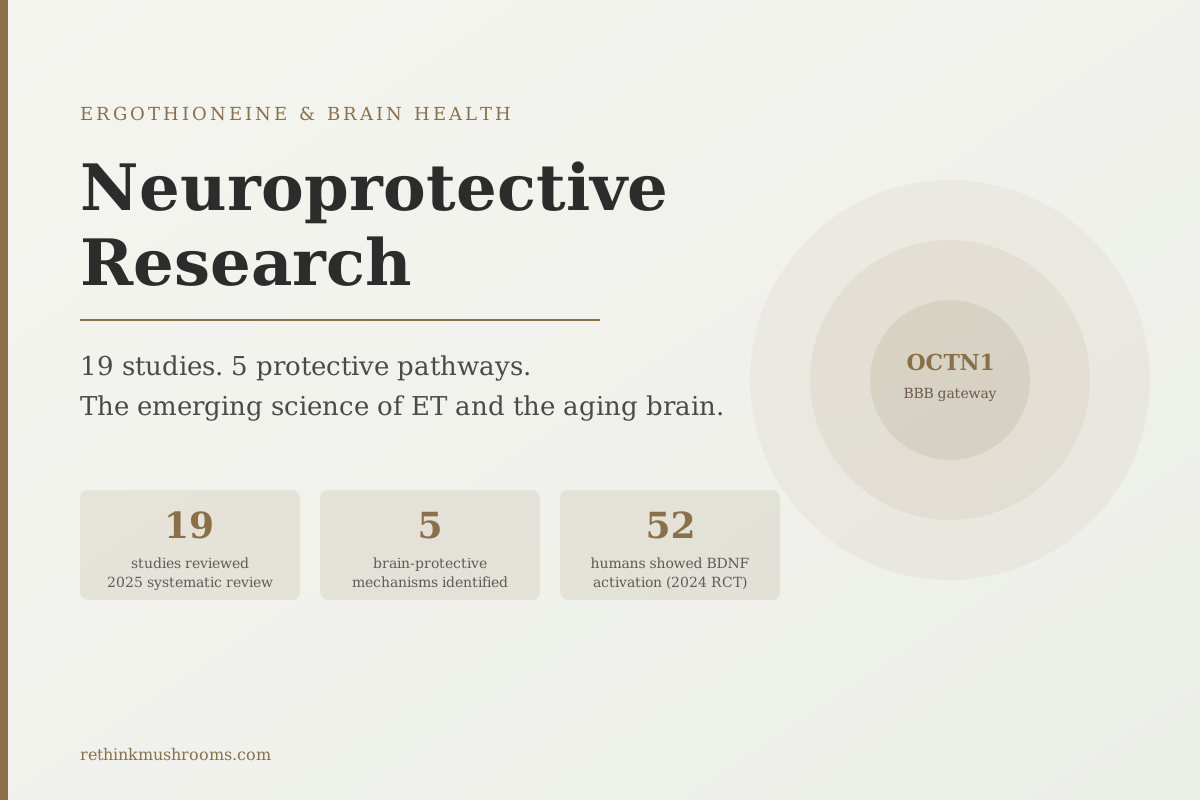
19 studies
A 2025 systematic review analyzed 19 cellular, animal, and human studies and found ergothioneine plays roles in neuroprotection across antioxidant, anti-inflammatory, and neurogenesis pathways.
Takhor & Phan, Inflammopharmacology, 2025
5 mechanisms
by which ET protects brain tissue
52 volunteers
showed BDNF receptor activation after 12 weeks ET (2024 RCT)
600 people
in the original ET-cognition Singapore cohort, 2016
Takhor & Phan, Inflammopharmacology, 2025
 View as image ↗
A compound found almost exclusively in mushrooms crosses the blood-brain barrier through a dedicated molecular gate, accumulates selectively in the cerebellum and midbrain, and a 2024 hypothesis paper from the National University of Singapore now proposes that running short of it may directly cause the brain diseases we call aging. That compound is ergothioneine, and the evidence trail runs through nearly a decade of human cohort studies, animal lifespan experiments, and a 12-week clinical experiment showing it activates the brain's main growth-factor system in measurable ways.
This article covers what ergothioneine does in the brain, the five protective pathways the research has identified, and where the human evidence currently stands. For a primer on what ergothioneine is and how it works, see Ergothioneine — The Longevity Amino Acid. For a deeper look at its dedicated transporter, see What Is Ergothioneine? The Only Amino Acid With a Dedicated Human Transporter.
Key Takeaways
- A 2025 systematic review of 19 studies found ergothioneine protects the brain via antioxidant, anti-inflammatory, mitochondrial, neurogenesis, and senescent-cell-clearance pathways (Takhor & Phan, Inflammopharmacology, 2025)
- Ergothioneine reaches the brain via OCTN1 in blood-brain barrier endothelial cells; knockout mice without OCTN1 have zero brain ergothioneine, proving the transporter is the only entry route (Ishimoto & Kato, FEBS Lett, 2022)
- In 52 volunteers taking 5 mg per day for 12 weeks, BDNF receptor (TrkB) phosphorylation in blood was significantly higher than placebo and correlated with scores across multiple cognitive domains (Ishimoto et al., NPJ Sci Food, 2024)
- In aging mice, ergothioneine improved spatial memory, restored hippocampal ATP, and reduced pro-inflammatory cytokines IL-1β, TNF-α, and IL-6 (Chen et al., Food Funct, 2024)
- In a Singapore cohort of 600 elderly adults, plasma ergothioneine declined significantly with age and was lower in people with cognitive impairment (Cheah et al., Biochem Biophys Res Commun, 2016)
- Most human data is still observational; the best available intervention trial for cognitive decline had 14 MCI subjects and the largest RCT (n=600, 24 months) is currently ongoing
What Ergothioneine Does for the Brain: Five Protective Pathways
Ergothioneine is a sulfur-containing amino acid that the human body cannot synthesize. It enters the body entirely from food, primarily mushrooms, and gets ferried into cells by a transporter called OCTN1 (gene: SLC22A4). For the brain specifically, OCTN1 is expressed in the blood-brain barrier's endothelial cells, neurons, neural stem cells, and microglia.[5] Once inside brain tissue, ergothioneine operates through five documented mechanisms:
- Antioxidant scavenging. Ergothioneine neutralizes reactive oxygen species and chelates redox-active metal ions without itself becoming a damaging radical, a chemical property that most dietary antioxidants lack.[7]
- Anti-neuroinflammation. Ergothioneine suppresses inflammatory signaling in microglia and neurons, reducing the chronic low-grade brain inflammation that accelerates cognitive decline.[6]
- Mitochondrial protection. Ergothioneine preserves the energy-generating machinery inside neurons, maintaining ATP output and reducing mitochondrial oxidative damage under aging and stress conditions.[9]
- BDNF and neurogenesis. Ergothioneine activates the brain's main growth-factor pathway through TrkB receptor phosphorylation, promoting new neuron formation in the hippocampus, the memory-critical region of the brain.[8]
- Senescent-neuron clearance. Ergothioneine selectively targets neurons that have permanently stopped dividing but remain metabolically active and leak pro-inflammatory signals, clearing them via OCTN1-mediated uptake.[10]
For a mechanistic deep-dive into how ergothioneine physically enters the brain through the blood-brain barrier, see OCTN1 in the Brain: Why the Blood-Brain Barrier Lets Ergothioneine Through.
19 Studies Analyzed: What the 2025 Systematic Review Concluded
In 2025, Takhor and Phan published a systematic review of 19 ergothioneine studies in Inflammopharmacology, covering cellular experiments, animal models, and human trials. Their conclusion: ergothioneine plays roles in neurotransmission and neuroprotection through multiple converging pathways, and its antioxidative, anti-inflammatory, and antisenescence properties each contribute to slowing the markers of age-related neurodegeneration.[1]
The review also flagged the field's most important gap: optimal dosing is not established, and most human evidence remains observational. That is worth holding alongside the mechanistic results.
A separate 2025 narrative review by May-Zhang and colleagues, published in the Proceedings of the Nutrition Society, reached a consistent conclusion: observational data across multiple cohorts consistently associate low blood ergothioneine with mild cognitive impairment and dementia, interventional trials have shown cognitive improvements with no safety concerns emerging at up to 25 mg per day, and the field now awaits properly powered randomized trials to confirm the causal direction.[3]
Syahputra and colleagues contributed a 2025 mechanistic review in the Journal of Nutritional Biochemistry detailing the intracellular targets: Nrf2 pathway activation, Sirtuin engagement, KEAP1 suppression, cellular senescence inhibition, mitochondrial protection, and BDNF/TrkB upregulation.[4] The list makes ergothioneine one of the few dietary compounds with documented interactions across this many longevity-associated molecular targets simultaneously.
The Deficiency Hypothesis: Could Low Ergothioneine Cause Neurodegeneration?
In 2024, Halliwell and Cheah published a hypothesis paper in Free Radical Biology and Medicine with a pointed title: "Are age-related neurodegenerative diseases caused by a lack of the diet-derived compound ergothioneine?"
Their argument rests on a chain of observations. Ergothioneine is not produced by the body. It declines with age and with the onset of neurodegeneration. Animals lacking the OCTN1 transporter have zero ergothioneine in their brains and show accelerated neurological deterioration. Every time a researcher has blocked OCTN1 pharmacologically in a cell experiment, the neuroprotective effect of ergothioneine disappears entirely.[2]
Halliwell and Cheah stopped well short of claiming causation is proven; they are presenting a testable scientific hypothesis. But the framing is notable: ergothioneine is now the first diet-derived compound for which a serious case has been made in a peer-reviewed hypothesis paper that its deficiency may be a direct driver of the most feared diseases of aging. Whether that case holds up to prospective interventional testing is the defining open question in the field.
Tian and colleagues, in a 2023 British Journal of Nutrition review, argued the nutritional classification case: ergothioneine meets the criteria for a conditionally essential micronutrient given its dedicated transporter, tissue accumulation, age-related depletion, and consistent disease associations across independent cohorts.[13]
The Mitochondria Connection: When Neurons Run Out of Energy First
Chen and colleagues tested ergothioneine in D-galactose-induced aging mice, published in Food Function in 2024. D-galactose-induced aging is a standard model where chronic high-dose galactose drives accelerated aging markers including mitochondrial dysfunction, oxidative stress, and cognitive decline. Mice supplemented with ergothioneine performed significantly better on the Morris Water Maze, a spatial memory test.
The mechanistic readout was granular. Ergothioneine-treated animals showed restored hippocampal ATP levels and measurably reduced mitochondrial reactive oxygen species production. Pro-inflammatory cytokines dropped significantly: IL-1β, TNF-α, and IL-6 were all lower in the hippocampi of ergothioneine-treated mice.[9]
The dual mechanism matters. Mitochondrial failure and neuroinflammation tend to compound each other in aging brains: failing energy production triggers inflammatory responses, which further impair mitochondria. A compound that addresses both simultaneously represents a mechanistically distinct profile from supplements that target only one pathway.
Katsube and colleagues extended this picture to a longer lifespan study in 2024, published in GeroScience. Ergothioneine supplementation extended lifespan and preserved cognitive function across aging in male mice. Brain sections from older ergothioneine-treated animals showed reduced neuroinflammation markers and preserved hippocampal neuron density compared to controls. OCTN1-mediated brain accumulation was confirmed as the mechanism of delivery.[11] Longer lifespan studies are not a direct predictor of human outcomes, but they add to the picture of sustained rather than acute neuroprotective action.
The BDNF Experiment: 52 People, 12 Weeks, a Measurable Signal in Humans
The most clinically relevant mechanistic experiment to date was published in 2024 by Ishimoto and colleagues in NPJ Science of Food. The study enrolled 52 volunteers who received ergothioneine-containing tablets at 5 mg per day for 12 weeks in a randomized controlled design.
The researchers measured a specific biomarker: phosphorylated TrkB in serum extracellular vesicles. TrkB is the primary receptor for BDNF, the protein that drives hippocampal neurogenesis and synaptic plasticity. When TrkB is phosphorylated, it indicates that BDNF is actively signaling. After 12 weeks, TrkB phosphorylation was significantly higher in the ergothioneine group than in placebo, and the increase correlated positively with serum ergothioneine levels and scores across multiple cognitive domains.[8]
The same study included a mechanistic mouse component. Ergothioneine-deficient mice showed impaired hippocampal neurogenesis; supplementing ergothioneine rescued new neuron formation. Blocking TrkB pharmacologically abolished that rescue, confirming BDNF/TrkB as the operative pathway rather than a correlate of some other change.
The trial had 52 subjects and used a surrogate biomarker rather than a direct cognitive outcome measure at scale. Those are real limitations. But TrkB phosphorylation is a biologically meaningful marker of neurotrophin signaling, not a distant proxy, and the correlation with cognitive scores adds clinical plausibility to the mechanism.
Clearing Out Zombie Neurons: A Fifth Pathway the Competition Misses
Apparoo and colleagues published an in-vitro study in Brain Research in 2024 testing what may be the least-known of ergothioneine's brain mechanisms. Senescent neurons, cells that have permanently stopped dividing but haven't died, are increasingly recognized as a driver of brain aging. They remain metabolically active, leak pro-inflammatory cytokines through what researchers call the senescence-associated secretory phenotype (SASP), and contribute to the neuroinflammatory environment that accelerates degeneration.
Ergothioneine-rich mushroom extract selectively eliminated these senescent neurons in cell culture. The clearance was OCTN1-dependent: when OCTN1 was pharmacologically blocked, senescent-neuron elimination stopped, confirming the effect required ergothioneine to enter the cell rather than act at the surface.[10]
This mechanism is distinct from antioxidation, inflammation suppression, or neurogenesis promotion. Selectively clearing dysfunctional neurons without harming healthy tissue is a goal of much aging biology research. If OCTN1-dependent ergothioneine uptake facilitates this process naturally in the aging brain, it would partially explain why ergothioneine accumulates specifically in tissues most prone to age-related damage.
What Human Population Data Shows
The mechanistic picture sketched above rests primarily on cell and animal experiments. The human evidence is mostly epidemiological.
Cheah and colleagues published the foundational study in 2016 in Biochemical and Biophysical Research Communications. In a Singapore elderly cohort of 600 people, plasma ergothioneine levels declined significantly with age and were measurably lower in individuals with cognitive impairment. Cheah proposed ergothioneine deficiency as a neurodegeneration risk factor and framed the observation as the opening hypothesis for what became the Singapore group's decade-long research program.[12]
Nakamichi and colleagues captured the state of the field in a 2022 Neurochemical Research review: blood ergothioneine is consistently lower in cognitive impairment, Parkinson's disease, and frailty than in healthy controls across independent cohorts. The mechanistic coverage spans ROS scavenging, anti-neuroinflammation, and mitochondrial protection.[6]
Ba and colleagues added a US population perspective in 2022, analyzing NHANES 2011-2014 data from 2,873 adults over 60. Mushroom consumption was independently associated with better learning, working memory, and executive function, consistent with ergothioneine as the active cognitive component in mushroom-eating populations.[14]
For the full analysis of prospective population studies on ergothioneine and dementia risk, including the 2025 Hisayama cohort (n=1,344, 11-year follow-up, strongest prospective evidence published to date), see Ergothioneine and Dementia Prevention: Population Studies.
Where the Evidence Stands: What It Can and Cannot Yet Prove
Ishimoto and Kato's 2022 FEBS Letters review mapped the brain's OCTN1 landscape precisely: highest expression in the cerebellum, followed by midbrain, medulla, and hypothalamus. Knockout mice with no OCTN1 have zero brain ergothioneine, establishing OCTN1 as the exclusive entry route and proving that the neuroprotective effects documented in cell experiments require functional transporter expression.[5]
Paul's 2022 review in Antioxidants and Redox Signaling noted that rodent models of NMDA excitotoxicity, cisplatin neurotoxicity, and amyloid-β-induced memory deficits all respond to ergothioneine, and both Nrf2 and BDNF pathway activation are documented across multiple experimental systems.[7]
What the evidence cannot yet prove is that raising ergothioneine in humans prevents or reverses cognitive decline. Cross-sectional studies show that low ergothioneine and cognitive impairment tend to co-occur; they do not tell us whether the low ergothioneine came first. Prospective data exists and is consistent, but the best available intervention trial for cognitive decline enrolled 14 MCI subjects over 52 weeks. The 600-person RCT testing mushroom-derived ergothioneine for 24 months in at-risk adults is ongoing, not yet reported. That is the study that will or won't close the evidentiary gap.
For the Parkinson's-specific mechanistic evidence, including the 2025 multi-model study across Drosophila, mice, and patient-derived neurons, see Ergothioneine and Parkinson's Disease: Research Review.
The Bottom Line
A 2025 systematic review of 19 studies established that ergothioneine protects brain tissue via five converging pathways: antioxidant action, neuroinflammation suppression, mitochondrial protection, BDNF-driven neurogenesis, and senescent-neuron clearance. A 2024 randomized trial in 52 volunteers showed measurable BDNF receptor activation after 12 weeks of 5 mg per day. Population data consistently find lower blood ergothioneine in people with cognitive impairment, and a 2024 hypothesis paper from the National University of Singapore argues ET deficiency may directly cause age-related neurodegeneration. The field still awaits a large-scale intervention trial before that hypothesis can be confirmed.
Frequently Asked Questions
Sources & References
- 1. Source details for this reference are not yet available.
- 2. Source details for this reference are not yet available.
- 3. Source details for this reference are not yet available.
- 4. Source details for this reference are not yet available.
- 5RTHM-01544·Ishimoto, Takahiro et al. (2022). “Ergothioneine in the brain..” FEBS letters.Study breakdown →PubMed →↩
- 6RTHM-01589·Nakamichi, Noritaka et al. (2022). “Ergothioneine and central nervous system diseases..” Neurochemical research.Study breakdown →PubMed →↩
- 7. Source details for this reference are not yet available.
- 8. Source details for this reference are not yet available.
- 9. Source details for this reference are not yet available.
- 10. Source details for this reference are not yet available.
- 11. Source details for this reference are not yet available.
- 12RTHM-00420·Cheah, Irwin K et al. (2016). “Ergothioneine levels in an elderly population decrease with age and incidence of cognitive decline; a risk factor for neurodegeneration?.” Biochemical and biophysical research communications.Study breakdown →PubMed →↩
- 13. Source details for this reference are not yet available.
- 14RTHM-00741·Ba, Djibril M et al. (2022). “Mushroom intake and cognitive performance among US older adults: the National Health and Nutrition Examination Survey, 2011-2014..” The British journal of nutrition.Study breakdown →PubMed →↩