Mushrooms & Cognitive Aging
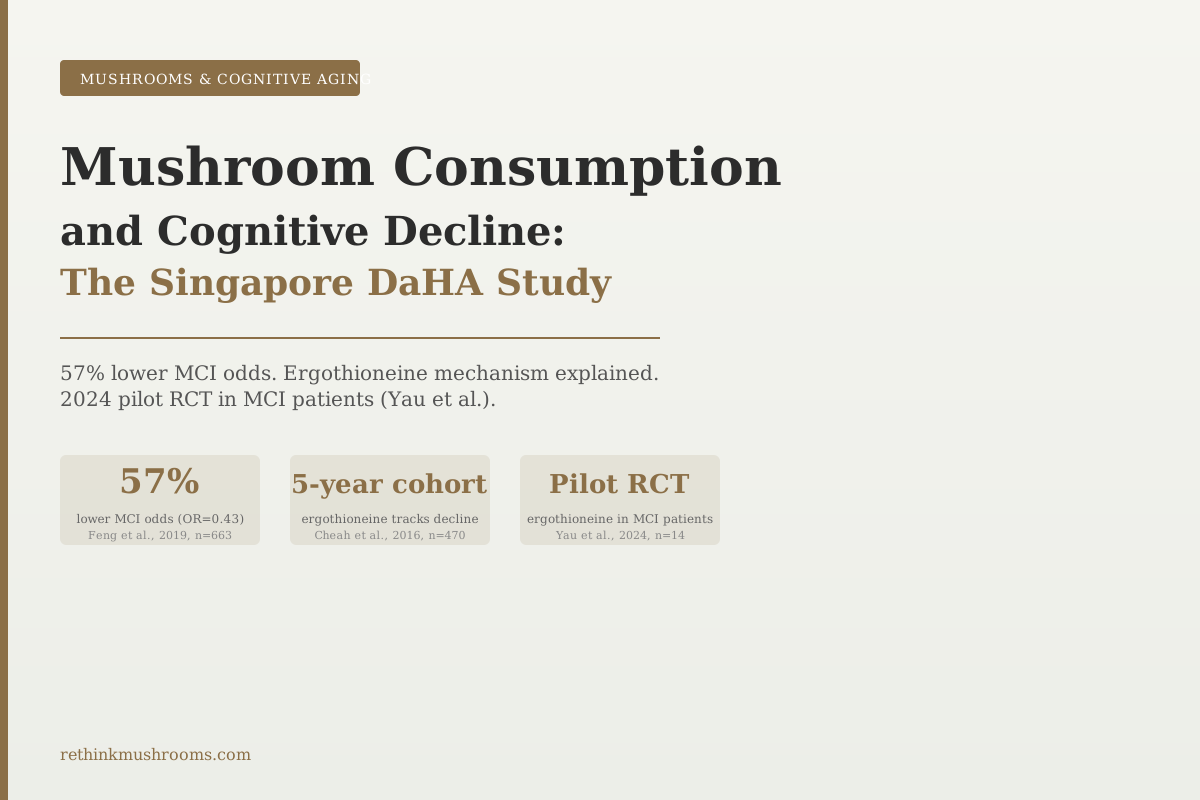
57% lower MCI odds
In 663 Singaporean adults over 60, eating mushrooms more than twice a week was associated with 57% reduced odds of mild cognitive impairment, across six common mushroom types.
Feng et al., J Alzheimer's Disease, 2019
OR = 0.43
adjusted odds ratio, mushroom consumers >2×/week
n=19 RCT
double-blind pilot trial, 1 year ergothioneine vs. placebo
n=1,344
Hisayama prospective cohort, 11.2-year follow-up, 2025
Feng et al., J Alzheimer's Disease, 2019
 View as image ↗
Key Takeaways
- In 663 Singaporean adults aged 60 and older, eating mushrooms more than twice a week was associated with 57% reduced odds of mild cognitive impairment, independent of age, sex, education, and cardiovascular risk factors (Feng et al., J Alzheimer's Disease, 2019).
- A companion Singapore cohort study found that lower blood ergothioneine levels were significantly associated with worse cognitive test scores and faster cognitive decline, suggesting ergothioneine is a biomarker — and possibly a mediator — of the mushroom–cognition relationship (Cheah et al., Biochem Biophys Res Commun, 2016).
- Ergothioneine is found almost exclusively in fungi and certain soil bacteria; humans cannot synthesize it and must obtain it through diet; it concentrates in the brain and other high-metabolic tissues via a dedicated transporter protein (OCTN1).
- A 2024 hypothesis paper by Halliwell and Cheah proposes that declining dietary ergothioneine, driven by reduced mushroom consumption in modern diets, is a direct causal contributor to age-related neurodegeneration.
- A 2024 review by Apparoo et al. proposes a senolytic mechanism: ergothioneine may help clear or suppress senescent neurons (aging, dysfunctional brain cells that accumulate with age and drive neuroinflammation).
- A 2024 double-blind pilot RCT (Yau et al., n=19 MCI patients) found modest verbal memory improvements and stabilization of a neurodegeneration blood biomarker after one year of ergothioneine supplementation.
- A 2025 prospective study in 1,344 Japanese adults (Hisayama Study) followed for 11.2 years found that higher serum ergothioneine independently predicted lower risk of all-cause dementia, Alzheimer's disease, and non-AD dementia.
In 2019, a research team in Singapore published a finding that stood out from the usual diet-and-brain literature: older adults who ate mushrooms more than twice a week were 57% less likely to have mild cognitive impairment (MCI, a memory and thinking decline that often precedes dementia) compared to those who rarely ate them. The mushroom types did not matter. Golden mushrooms, oyster mushrooms, shiitake, white button, dried, and canned varieties all showed similar associations. This was part of the Diet and Healthy Aging (DaHA) study, one data point in the broader field of mushrooms and cognitive aging. What makes this particular paper unusual is what came next: the same Singapore research group spent the following five years building a mechanism, running a pilot trial, and publishing a formal causal hypothesis. A 2025 independent replication in Japan then confirmed the core association in a much larger cohort. This article focuses on that chain of evidence.
The DaHA Study: What 663 Adults in Singapore Revealed
The Diet and Healthy Aging (DaHA) study is a community-based cohort launched in Singapore to track the relationships between diet, lifestyle, and health outcomes in older adults. The 2019 mushroom-cognition analysis by Feng et al. drew on cross-sectional data from 663 DaHA participants aged 60 and older.[1]
The researchers divided participants into three groups based on how often they ate mushrooms: less than once per week (the reference group), once a week, and more than twice a week. Mild cognitive impairment was assessed through standardized neuropsychological testing. People who ate mushrooms more than twice a week had an odds ratio of 0.43 for MCI. That means their odds of having the condition were less than half of those in the comparison group. The p-value was 0.006, well below the standard significance threshold.
The analysis controlled for age, sex, education level, physical activity, smoking, alcohol consumption, hypertension, diabetes, cardiovascular disease, and overall diet quality. The association with mushroom intake held up across all of these adjustments.
All six mushroom types tracked by the study showed similar protective associations. This detail matters because it suggests the effect is not specific to one species or to fresh mushrooms only. Canned and dried mushrooms counted just as much as fresh shiitake or oyster mushrooms.
The study's main limitation is its design. Cross-sectional studies capture a single point in time. They show that two things are associated, but cannot prove that eating mushrooms caused the lower MCI rates. People with early cognitive decline may simply eat less, including fewer mushrooms. That reverse-causation possibility is why the story does not end with the 2019 paper. The full narrative arc of how the Singapore team advanced from this finding to a clinical trial is traced in the Singapore mushroom study and cognitive decline.
Ergothioneine: The Compound Almost Exclusive to Fungi
After the DaHA finding, the immediate question was: what in mushrooms might explain this? Mushrooms contain several bioactive compounds, but one candidate attracted particular attention from the Singapore research group: ergothioneine.
Ergothioneine is a sulfur-containing amino acid derivative. Almost nothing in the human diet contains meaningful amounts of it except fungi, certain fungi-fermented foods, and a narrow group of soil bacteria called actinobacteria. Black beans, oat bran, and some organ meats contain trace amounts, but mushrooms are the practical dietary source for most people.
The human body has no pathway for making ergothioneine. It must come from the diet. Once consumed, it is absorbed and transported into cells by a dedicated carrier protein called OCTN1 (also known as SLC22A4), which is expressed in multiple tissues including the brain. Ergothioneine concentrates in tissues with high metabolic demand: red blood cells, liver, kidneys, eyes, and brain. This concentration pattern matters because high-metabolic tissues generate more oxidative stress and are often the sites of age-related disease.
In neural tissue, ergothioneine acts as an antioxidant, scavenging reactive oxygen species, the unstable molecules that damage cells and are implicated in neurodegenerative disease. Unlike many antioxidants, it is stable in aqueous environments and does not readily convert to a toxic oxidized form. Its selective concentration in the brain prompted researchers to ask whether maintaining adequate ergothioneine levels over a lifetime is part of what dietary mushroom consumption accomplishes.
Chain of Evidence
Singapore’s Ergothioneine Research Program: 2016–2025
Six interconnected studies — from a 2016 biomarker cohort to a 2025 prospective study in 1,344 adults — form one of the most methodologically complete arguments in the mushroom-cognition literature.
- 2016Cohort Study
Singapore Ergothioneine Cohort
Older adults with lower blood ergothioneine levels had significantly lower cognitive test scores at baseline and faster decline over follow-up — establishing ergothioneine as a biomarker of cognitive trajectory.
Cheah et al., Biochem Biophys Res Commun, 2016
- 2019Cohort Study
Singapore DaHA Study (n=663)
Eating mushrooms more than twice a week was associated with 57% lower odds of mild cognitive impairment (OR=0.43, p=0.006), independent of age, sex, education, and cardiovascular risk factors. Effect was consistent across all six mushroom types studied.
Feng et al., J Alzheimer's Disease, 2019
- 2024Hypothesis Paper
Ergothioneine Deficiency Hypothesis
Halliwell et al. formally propose that declining dietary ergothioneine — driven by reduced mushroom consumption in Western diets — is a direct causal contributor to age-related neurodegeneration. The hypothesis is testable: correct the deficiency, mitigate the risk.
Halliwell & Cheah, Free Radical Biol Med, 2024
- 2024Mechanism Review
Senolytic Mechanism Proposed
Apparoo et al. review preclinical evidence that ergothioneine may act as a senolytic in the brain — helping to eliminate senescent (aging, dysfunctional) neurons that accumulate with age and drive neuroinflammation.
Apparoo et al., Brain Research, 2024
- 2024Clinical Trial
Pilot RCT in MCI (n=19)
First double-blind, placebo-controlled trial of ergothioneine supplementation (25mg 3×/week, 1 year) in 19 older adults with MCI: improved verbal memory (RAVLT) and stabilized plasma neurofilament light chain vs. placebo. Safety confirmed.
Yau et al., J Alzheimer's Disease, 2024
- 2025Cohort Study
Hisayama Prospective Study (n=1,344)
In 1,344 Japanese adults aged 65+ followed for a median of 11.2 years, higher serum ergothioneine predicted significantly lower risk of all-cause dementia, Alzheimer's disease, and non-AD dementia — independent of vegetable intake and cardiovascular factors.
Hisayama Study, 2025
All studies originate from or connect to the Singapore DaHA research program led by Halliwell, Cheah, and Feng at the National University of Singapore. The 2025 Hisayama Study independently replicates the ergothioneine–dementia association in a Japanese cohort, providing cross-population validation.
The Biomarker Evidence: Lower Ergothioneine, Worse Cognition
Cheah et al. examined the ergothioneine-cognition connection using a separate DaHA dataset: a group of older Singaporean adults with measured blood ergothioneine levels.[2]
At baseline, the researchers measured whole blood ergothioneine levels. They found that levels declined significantly in elderly individuals beyond 60 years of age. Critically, a subset of participants with mild cognitive impairment had significantly lower plasma ergothioneine levels compared to age-matched subjects without cognitive impairment. This cross-sectional correlation — lower ergothioneine tracking with cognitive decline — was the first direct biological link between the compound and cognitive status in humans.
The question this study raises: is low ergothioneine itself contributing to cognitive decline, or is it a marker for something else, such as diet quality, intestinal absorption capacity, or overall metabolic function? Cheah et al. documented the correlation. Answering the causal question required a different kind of paper. For a broader view of the population studies linking mushroom intake to cognitive outcomes across multiple countries, ergothioneine and dementia prevention population studies covers the multi-cohort picture.
From Correlation to Cause: Halliwell's 2024 Hypothesis
In 2024, Barry Halliwell and Irwin Cheah published a formal hypothesis paper asking whether age-related neurodegenerative diseases are caused by a deficiency of ergothioneine obtained from the diet.[3]
The argument runs as follows. Dietary ergothioneine levels in Western populations have been declining for decades, driven by a reduction in mushroom consumption relative to traditional diets. At the same time, the burden of age-related neurodegenerative diseases has been rising. Ergothioneine deficiency may be one contributing factor.
The case rests on several observations. First, ergothioneine levels decline with age in healthy humans regardless of diet; aging reduces intestinal absorption capacity. Second, the brain regions most vulnerable to Alzheimer's disease, particularly the hippocampus and entorhinal cortex, have relatively high ergothioneine concentrations in healthy adults, suggesting the compound actively protects those specific areas. Third, the epidemiological data from Singapore and other cohorts shows consistent associations between mushroom intake and cognitive outcomes across populations.
Halliwell and Cheah 2024 is a hypothesis paper, not a clinical trial. The authors propose an explanatory framework; they do not prove causation. The paper is significant because it makes the biological mechanism explicit and testable: if the hypothesis is correct, then correcting ergothioneine deficiency through diet or supplementation should produce measurable cognitive protection. That is exactly what the Yau 2024 trial attempted to test.
The Senolytic Angle: How Ergothioneine May Clear Aging Brain Cells
Apparoo et al. (2024) proposed a specific cellular mechanism that may underlie ergothioneine's brain-protective effects.[4]
To understand the mechanism, it helps to know what senescent cells are. Cellular senescence is the process by which cells stop dividing but remain alive and metabolically active. These cells accumulate with age in most tissues. In the brain, senescent neurons and supporting cells produce a persistent inflammatory signal called the senescence-associated secretory phenotype, which damages neighboring healthy cells. Neuroinflammation driven by senescent cells is increasingly recognized as a contributor to Alzheimer's disease progression.
Senolytics are compounds that selectively target and eliminate senescent cells or suppress their inflammatory activity. Apparoo et al. reviewed evidence that ergothioneine functions as a senolytic in the brain: specifically, that it can help clear senescent neurons and reduce the neuroinflammation they generate. The proposed mechanism involves ergothioneine pushing senescent neurons toward programmed cell death (apoptosis) rather than allowing them to persist and cause ongoing damage to surrounding tissue.
The Apparoo 2024 paper is a review of preclinical and mechanistic evidence; it is not a clinical trial. But the senolytic hypothesis adds a specific molecular-level explanation for the epidemiological pattern. For a deeper exploration of how ergothioneine interacts with neural tissue at the cellular level, see ergothioneine and brain health: neuroprotective research.
The 2024 Pilot Trial: Ergothioneine in People With MCI
The most direct human evidence comes from Yau et al. (2024), a double-blind, placebo-controlled pilot trial of ergothioneine supplementation in older adults with mild cognitive impairment.[5]
Nineteen participants with MCI received either ergothioneine (25mg, three times weekly) or a matching placebo for one year. The primary cognitive outcome was the Rey Auditory Verbal Learning Test (RAVLT), a standard measure of verbal memory that asks participants to learn and recall a list of 15 words across multiple trials. The ergothioneine group showed modest improvements on the RAVLT over the course of the trial, while the placebo group did not.
The study also measured plasma neurofilament light chain (NfL), a protein released into the bloodstream when neurons are damaged. Elevated NfL is a recognized marker of active neurodegeneration that rises over time in people with MCI and dementia. In the ergothioneine group, NfL levels remained stable over the year. In the placebo group, they rose. When a marker of neuronal damage stops rising in a progressive condition, that is a meaningful signal, even in a small sample.
The critical limitation is the sample size. Nineteen participants is far too small to draw firm conclusions about efficacy. Pilot trials are designed to test feasibility, safety, and whether the signals are large enough to justify a full-scale study. Yau 2024 passes those tests: ergothioneine was well-tolerated and the effects moved in the expected direction. A larger confirmatory trial would be needed to establish efficacy with confidence.
Animal data from the same period adds supporting context. Katsube et al. (2024, GeroScience) found that ergothioneine supplementation extended both lifespan and markers of healthy aging in male mice.[6] Lifespan extension in a rodent model is among the more striking preclinical signals available. It cannot be translated directly to human outcomes, but it adds another data point to the same directional story.
2025: Independent Replication in Japan
A 2025 prospective cohort study independent of the Singapore group added a crucial piece of validation.[7]
The Hisayama Study, a long-running community-based cohort in Japan, followed 1,344 adults aged 65 and older without dementia at baseline for a median of 11.2 years (2012–2023). Serum ergothioneine levels were measured at enrollment using liquid chromatography-mass spectrometry and divided into quartiles. During the follow-up period, 273 participants developed all-cause dementia — 201 with Alzheimer's disease and 72 with non-AD dementia.
The key finding: higher serum ergothioneine was associated with progressively lower risk of all-cause dementia across quartiles, with a significant trend (P for trend <0.05). This protective association held after adjustment for age, sex, cardiovascular risk factors, lifestyle, and — critically — daily vegetable intake. The fact that ergothioneine's protective association remained even after controlling for overall vegetable consumption suggests the effect is not simply a proxy for healthy diet quality generally. It held across both Alzheimer's disease and non-AD dementia subtypes.
The Hisayama Study is prospective rather than cross-sectional, has a long follow-up, and comes from an independent research group in a different country and dietary context than the Singapore studies. Its confirmation of the ergothioneine–dementia risk association across more than a decade of follow-up in 1,344 adults substantially strengthens the case that the Singapore findings are not population-specific.
This study does not prove causation; it is observational. People with naturally higher ergothioneine could differ from lower-ergothioneine individuals in ways that aren't fully captured by the covariates measured. But the biological plausibility (transporter-mediated brain uptake, antioxidant function, senolytic activity) makes a causal interpretation increasingly credible.
Where the Evidence Stands: A Clear-Eyed Summary
The Singapore DaHA research program, now independently replicated in Japan, has produced a coherent chain of evidence. A cross-sectional study found that mushroom eaters had substantially lower rates of MCI. A biomarker study showed that blood ergothioneine levels track with cognitive status. A formal hypothesis paper proposed that ergothioneine deficiency is causally involved in neurodegeneration. Mechanistic research identified senolytic activity as a plausible pathway. A pilot RCT found encouraging signals when MCI patients received ergothioneine for a year. And a large independent prospective cohort in Japan confirmed the association across 11 years of follow-up.
Each step is genuine. Each step also has limits. The epidemiology is observational and cannot prove causation. The hypothesis paper proposes a causal framework without proving it. The pilot trial enrolled 19 participants. The Hisayama Study is prospective but still observational. The mice data cannot be extrapolated directly to humans.
What the evidence supports: regular mushroom consumption is consistently associated with lower rates of cognitive decline; ergothioneine levels in the blood are associated with cognitive performance; the biological mechanisms for how ergothioneine protects the brain are plausible and increasingly specific; and the association has now been observed independently in Singapore and Japan. The case for a causal relationship is building. The definitive large-scale ergothioneine RCT in MCI patients has not yet been completed. For a practical look at what the dosage data across major cohort studies suggests about how much mushroom consumption matters, see how much mushroom do you need to protect cognition.
This article is for educational purposes only. It does not constitute medical advice. Individuals experiencing memory problems or cognitive changes should consult a qualified healthcare provider. Ergothioneine supplementation is not approved for the prevention or treatment of any neurological condition.
The Bottom Line
Singapore's DaHA research program has produced one of the most methodologically layered arguments for mushroom consumption and cognitive protection in the literature: starting with a 57% MCI risk reduction in a cross-sectional cohort, tracing through an ergothioneine biomarker study, proposing a formal causal deficiency hypothesis, identifying a senolytic cellular mechanism, and reaching a small but encouraging pilot RCT (n=19). A 2025 prospective study in Japan (n=1,344, 11.2-year follow-up) independently confirmed the ergothioneine–dementia risk association across both Alzheimer's and non-AD subtypes. The evidence is consistent across all of these levels and across two national populations. The missing piece is a large-scale, long-duration randomized trial using ergothioneine supplementation in MCI patients.
Frequently Asked Questions
Sources & References
- 1RTHM-00554·Feng, Lei et al. (2019). “The Association between Mushroom Consumption and Mild Cognitive Impairment: A Community-Based Cross-Sectional Study in Singapore..” Journal of Alzheimer's disease : JAD.Study breakdown →PubMed →↩
- 2RTHM-00420·Cheah, Irwin K et al. (2016). “Ergothioneine levels in an elderly population decrease with age and incidence of cognitive decline; a risk factor for neurodegeneration?.” Biochemical and biophysical research communications.Study breakdown →PubMed →↩
- 3RTHM-01898·Halliwell, Barry et al. (2024). “Are age-related neurodegenerative diseases caused by a lack of the diet-derived compound ergothioneine?.” Free radical biology & medicine.Study breakdown →PubMed →↩
- 4RTHM-01850·Apparoo, Yasaaswini et al. (2024). “Potential role of ergothioneine rich mushroom as anti-aging candidate through elimination of neuronal senescent cells..” Brain research.Study breakdown →PubMed →↩
- 5RTHM-02029·Yau, Yu Fung et al. (2024). “Investigating the efficacy of ergothioneine to delay cognitive decline in mild cognitively impaired subjects: A pilot study..” Journal of Alzheimer's disease : JAD.Study breakdown →PubMed →↩
- 6RTHM-00884·Katsube, Makoto et al. (2024). “Ergothioneine promotes longevity and healthy aging in male mice..” GeroScience.Study breakdown →PubMed →↩
- 7. Source details for this reference are not yet available.