Mushrooms & Brain Health / Cognition
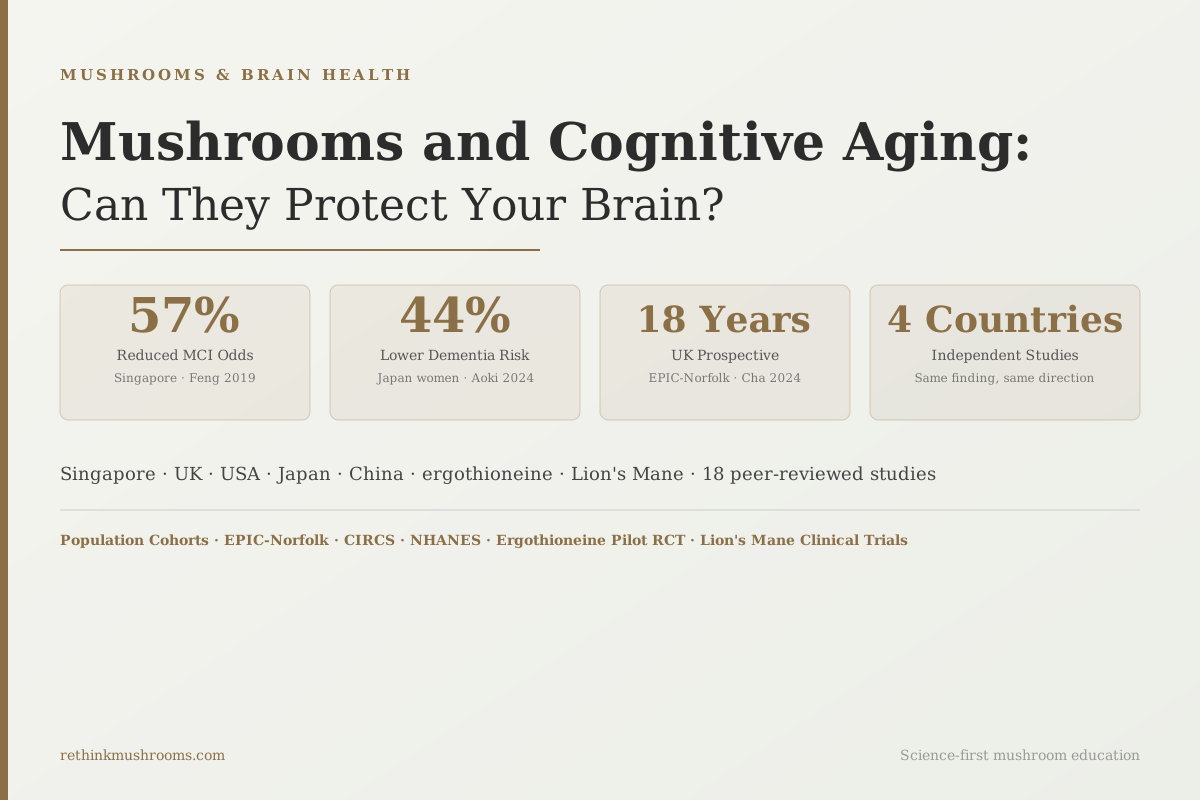
57% Reduced MCI Odds
Adults eating mushrooms more than twice a week had 57% lower odds of mild cognitive impairment in a Singapore cohort of 663 adults over 60 — a finding independently replicated in the UK, US, Japan, and China.
Feng et al., J Alzheimer's Disease, 2019
4 countries
Singapore, UK, US, and Japan independently found the same mushroom-cognition association
44%
lower disabling dementia risk in Japanese women eating ≥15g/day mushrooms over a 16-year follow-up (CIRCS)
18 years
UK EPIC-Norfolk prospective cohort showing dose-dependent cognitive benefit with mushroom consumption
Feng et al., J Alzheimer's Disease, 2019
 View as image ↗
In 2019, researchers in Singapore published a study that got attention for a striking headline: eating mushrooms more than twice a week was associated with 57% lower odds of mild cognitive impairment in adults over 60.[1] It was a single study from one city. Interesting, but not conclusive.
Then came a 2022 American study using national dietary data. A 2024 British study following participants for 18 years. A 2024 Japanese study following 3,739 people for 16 years. A 2023 Chinese study adding a fifth data point. Each used different populations, different methods, different follow-up periods, and different measures of cognitive health. They all found the same thing: people who eat more mushrooms show better cognitive outcomes.
This article synthesizes the full evidence base for mushrooms, cognitive aging, and brain protection — the population data, the proposed mechanism, the intervention trials, and the parts that remain genuinely unresolved.
Key Takeaways
- In a Singapore cohort of 663 adults over 60, eating mushrooms more than twice a week was associated with 57% reduced odds of mild cognitive impairment (Feng et al., 2019)
- The UK EPIC-Norfolk study followed participants for 18 years and found a dose-dependent relationship — mushroom consumers consistently outperformed non-consumers on word recall, executive function, and memory (Cha et al., Nutrients, 2024)
- Japan's CIRCS study (n=3,739, 16 years) found women eating ≥15g/day mushrooms had 44% lower risk of disabling dementia; no significant association was found in men
- Four independent population studies in Singapore, US, UK, Japan, and China all show the same mushroom-cognition association across different designs and populations
- The leading mechanistic candidate is ergothioneine: a compound found almost exclusively in mushrooms that concentrates in the brain and may protect neurons from age-related damage
- A 2024 pilot RCT (n=14 adults with mild cognitive impairment) found ergothioneine supplementation stabilized a blood marker of neurodegeneration over one year
The Verdict, Briefly: What Four Independent Studies Found
Multiple population studies across Singapore, the US, the UK, and Japan consistently show that people who eat more mushrooms score better on cognitive tests and are less likely to develop mild cognitive impairment or dementia. The strongest dietary finding: consuming mushrooms more than twice a week is associated with 50 to 57% reduced odds of mild cognitive impairment in community-dwelling older adults.
This is correlational evidence from observational studies, not proof of cause and effect. People who eat more mushrooms may differ from non-consumers in many ways that also influence brain health. Researchers have controlled for age, sex, education, physical activity, smoking, cardiovascular risk factors, and overall diet quality, and the association persists. But observational associations — even strong ones from large, long-running cohorts — do not establish causation. The honest framing is that the evidence is consistent and suggestive, and a plausible biological mechanism exists, but confirmation from large randomized trials is still ahead.
That said, the convergence across independent datasets from different countries is unusual in nutritional epidemiology. When a Singapore cross-sectional study, a US dietary survey, an 18-year British prospective cohort, and a 16-year Japanese prospective cohort all point the same direction, the signal is worth taking seriously.
The 57% Finding: What the Singapore Study Actually Said
The Singapore study that kicked off this research stream was published by Feng and colleagues in the Journal of Alzheimer's Disease in 2019.[1]
The study enrolled 663 community-dwelling adults aged 60 and older in Singapore and asked about their mushroom consumption habits. Six mushroom types were covered: golden, oyster, shiitake, white button, dried, and canned mushrooms. Cognitive impairment was assessed using a battery of standardized tests, and participants were classified as having mild cognitive impairment (MCI) or normal cognition.
The finding: people who ate mushrooms more than twice a week had 57% lower odds of developing MCI compared to those eating mushrooms less than once a week (odds ratio 0.43). After adjusting for age, sex, education, physical activity, smoking, alcohol, hypertension, diabetes, and overall diet quality, that association held at statistical significance (p=0.006). No specific mushroom type drove the result — all six types were independently associated with lower MCI odds.
This was a cross-sectional study, meaning it captured one moment in time rather than tracking participants forward. Cross-sectional designs cannot establish whether mushroom eating prevents cognitive decline or whether cognitively healthier people happen to eat more mushrooms. But the strength of the association and the independence from other confounders made it worth investigating further.
For the full story of the Singapore research program — and how the same research team went on to test ergothioneine in a clinical trial — see The Singapore Mushroom Study: Mushroom Intake and Cognitive Decline.
Three Continents, Same Finding: UK, Japan, US, and China
The Singapore result was not a fluke. Four independent research groups using entirely different study designs found the same pattern.
Japan (CIRCS): The longest follow-up with the hardest endpoint.
Aoki and colleagues published results from the Circulatory Risk in Communities Study in the British Journal of Nutrition in 2024.[2] This prospective cohort tracked 3,739 Japanese adults aged 40 to 64 for a mean of 16 years, recording 670 cases of disabling dementia. Women who consumed 15 grams or more of mushrooms per day had a hazard ratio of 0.56 (95% CI 0.42 to 0.75) for disabling dementia — a 44% risk reduction compared to lower consumers. In men, no significant association was found.
The gender difference is unexplained and is a genuine finding, not a limitation to minimize. The CIRCS authors discussed possible hormonal differences in ergothioneine metabolism, but no mechanistic explanation is established. The sex-specific result means "mushrooms protect against dementia" is a more qualified statement in men than in women.
UK (EPIC-Norfolk): Eighteen years of follow-up, dose-dependent effect.
Cha and colleagues published an analysis of the European Prospective Investigation of Cancer — Norfolk cohort in Nutrients in 2024.[3] The EPIC-Norfolk study followed UK participants for 18 years, making it the longest prospective follow-up in this literature. Mushroom consumers showed better performance than non-consumers on word recall, executive function tasks, and prospective memory. The relationship was dose-dependent: higher mushroom intake was associated with better scores across cognitive domains. The median intake associated with peak performance was 13.4 grams per 1,000 kilocalories of total diet.
United States (NHANES): A nationally representative snapshot.
Ba and colleagues analyzed data from the National Health and Nutrition Examination Survey (NHANES) 2011 to 2014, a nationally representative US dietary dataset, in the British Journal of Nutrition in 2022.[4] Mushroom intake was associated with better cognitive performance in older adults after controlling for overall diet quality and other confounders. As a cross-sectional survey, it does not establish causation, but it adds a US general-population data point consistent with the other studies.
China (Yan 2023): A fifth country adds to the convergence.
Yan and colleagues, publishing in Food and Function in 2023, found mushroom consumption independently associated with better cognitive performance in Chinese middle-aged and older adults, adding a fifth distinct population to the evidence base.[5]
The convergence across Singapore, Japan, the UK, the United States, and China — using cross-sectional surveys, dietary recall data, and multi-decade prospective cohorts — strengthens the signal considerably. These are not reanalyses of the same dataset. They are independent studies with independent designs arriving at the same general conclusion.
Why Mushrooms? The Ergothioneine Trail
Consistent associations in epidemiology are more convincing when a plausible mechanism exists. For the mushroom-cognition finding, researchers have converged on a strong candidate: ergothioneine.
Ergothioneine is an amino acid that humans cannot synthesize. The only meaningful dietary sources are mushrooms and certain bacteria. Because humans cannot make it, dietary intake is the only way to obtain it — and it accumulates preferentially in tissues with high metabolic demand, including the liver, kidneys, bone marrow, and brain.
The crucial human evidence came from the same Singapore research group behind the Feng 2019 cross-sectional study. Cheah and colleagues published a 5-year prospective analysis of 470 older Singaporeans in Biochemical and Biophysical Research Communications in 2016.[6] Lower blood ergothioneine levels at baseline were associated with poorer cognitive performance and faster rates of cognitive decline across multiple domains over five years. This was not a study about mushroom eating — it measured ergothioneine directly in blood, and the relationship held independent of other dietary factors.
That finding prompted a bolder hypothesis. Halliwell and colleagues, publishing in 2024, proposed that declining dietary ergothioneine may be a direct causal contributor to age-related neurodegeneration, not just a correlate.[7] Their argument: Western diets consume dramatically fewer mushrooms than traditional Asian diets; ergothioneine blood levels decline with age even in people who eat mushrooms; and the neurodegenerative diseases most associated with aging (Alzheimer's disease, Parkinson's disease) are most prevalent in populations with low mushroom consumption. Halliwell's team argued this is not coincidence but biology — and that ergothioneine deficiency should be understood as a genuine risk factor for age-related neurological decline.
This is a hypothesis paper, not a clinical trial. Its evidence level is explicitly lower than the population cohorts. But it provides the mechanistic framework that makes the 4-country dietary association more interpretable.
A 2024 review by Apparoo and colleagues proposed a more specific mechanism: ergothioneine may function as a senolytic agent in the brain, meaning it helps clear senescent neurons — cells that have stopped dividing but remain metabolically active and promote chronic inflammation in surrounding tissue.[8] Neuroinflammation driven by senescent cells is increasingly understood as a driver of age-related cognitive decline. If ergothioneine reduces the burden of senescent neurons, that would explain a neuroprotective effect operating over years and decades of dietary intake.
Animal longevity data offers supporting context. Katsube and colleagues, publishing in GeroScience in 2024, found that ergothioneine supplementation extended lifespan and improved markers of healthy aging in male mice.[9] Mouse studies do not translate automatically to humans, but the preclinical longevity evidence is consistent with the direction of the human epidemiological data.
For the deeper mechanistic picture of how ergothioneine interacts with the aging brain, see Ergothioneine and Brain Health: Neuroprotective Research. For population studies specifically on ergothioneine and dementia prevention, see Ergothioneine and Dementia Prevention: Population Studies.
Testing the Hypothesis: The First Ergothioneine Trial in MCI
If ergothioneine deficiency contributes to cognitive decline, supplementing with ergothioneine in people already showing early cognitive impairment should slow that decline. Yau and colleagues ran the first human test of this idea in 2024.[10]
The trial was small: 14 older adults with mild cognitive impairment received ergothioneine at 25 milligrams three times per week for one year, in a double-blind, placebo-controlled design. Over the year, the ergothioneine group showed modest improvements on the Rey Auditory Verbal Learning Test, a standard measure of verbal memory. More notable was what happened to plasma neurofilament light chain — a protein released into the blood when neurons are damaged or dying, and one of the most sensitive available biomarkers of neurodegeneration. In the ergothioneine group, neurofilament light chain levels stabilized. In the placebo group, they continued to rise.
Stabilizing a neurodegeneration biomarker over one year in a group with MCI is a meaningful signal. But with 14 participants, this is a pilot study. It establishes proof-of-concept and informs dose selection for larger trials. It is not yet the randomized evidence needed to draw clinical conclusions.
The trajectory of this research — from dietary association (Feng 2019) to mechanistic evidence (Cheah 2016) to causal hypothesis (Halliwell 2024) to a positive pilot trial (Yau 2024) — represents the most coherent research program in the mushroom-cognition literature.
Lion's Mane Has Its Own Evidence Track
Separate from the dietary-ergothioneine research stream, Lion's Mane mushroom (Hericium erinaceus) has accumulated its own clinical evidence. This line of research focuses on two specific bioactive compounds found in Lion's Mane mycelium: hericenones and erinacines, which can pass through the protective membrane separating the bloodstream from the brain (the blood-brain barrier) and stimulate production of nerve growth factor (NGF), a protein the brain uses to maintain and repair existing neurons.
The landmark human trial was published by Mori and colleagues in Phytotherapy Research in 2009.[11] Participants with mild cognitive impairment received four tablets containing 250 milligrams of Lion's Mane powder each for 16 weeks in a double-blind, placebo-controlled design. Cognitive function scores improved significantly in the treatment group during the supplementation period. When the trial ended and participants stopped taking Lion's Mane, scores declined. The dose-dependent and reversible nature of the effect was interpreted as consistent with an NGF-mediated mechanism.
In early Alzheimer's disease, Li and colleagues published a pilot double-blind RCT in Frontiers in Aging Neuroscience in 2020, using erinacine A-enriched Lion's Mane mycelium rather than the fruit body.[12] Participants in the treatment group showed cognitive improvements compared to placebo — direct evidence in a clinical Alzheimer's population, albeit in a small pilot.
More recently, Surendran and colleagues published a 2025 double-blind RCT in Frontiers in Nutrition testing standardized Lion's Mane extract in healthy younger adults.[13] Acute cognitive and mood improvements were observed in the treatment group, extending the evidence for Lion's Mane beyond elderly participants with cognitive impairment.
Two 2025 reviews synthesized the Lion's Mane evidence. Cornford and Charnley, reviewing for Nutrition Research Reviews, concluded that the evidence for Hericium erinaceus in Alzheimer's prevention was promising across NGF stimulation, anti-amyloid effects, and anti-neuroinflammatory mechanisms.[14] Menon and colleagues, publishing a systematic review in Frontiers in Nutrition, confirmed cognitive benefits with an acceptable safety profile as the most comprehensive 2025 synthesis of the human supplementation literature.[15]
For Alzheimer's-specific mushroom research across multiple species, see Cross-Species Mushroom Research in Alzheimer's: Lion's Mane, Reishi, and Cordyceps.
Why Dietary Studies Say Yes but Supplement Trials Are Mixed
Here is the intellectual tension at the center of this field, and it deserves an honest accounting.
Cha and colleagues, reviewing the field in Neuroscience and Biobehavioral Reviews in 2024, synthesized 34 human studies on mushrooms and cognition.[16] The results split sharply by study type. Of 24 epidemiological studies (dietary surveys and cohort studies), the significant majority found benefit associated with mushroom consumption. Of 10 intervention studies (randomized trials of mushroom supplements), the results were mixed. Several showed cognitive benefits; others showed no significant effect.
Why the discrepancy?
The most plausible explanation involves both time and dose. Population studies capture decades of dietary behavior — people who habitually eat mushrooms may have been building ergothioneine levels and a neuroprotective environment over years or decades before the study measured them. A 12-week supplement trial, by contrast, may simply not be long enough to shift biological processes that developed over a lifetime. The intervention timeline and the biology's timeline may be mismatched.
A second explanation is that dietary mushroom intake provides multiple bioactive compounds simultaneously — ergothioneine alongside beta-glucans, hericenones, antioxidants, and anti-inflammatory compounds. Isolating one compound or species in a supplement removes that combinatorial effect. Onaolapo and colleagues, reviewing food-based nootropics in Current Aging Science in 2019, argued that the most consistent cognitive benefits from dietary interventions appear when food is consumed as a whole rather than as isolated extracts.[18]
This does not mean supplement trials are useless. The Lion's Mane trials (Mori 2009, Li 2020, Surendran 2025) show real, consistent effects in human participants — particularly in populations with existing cognitive impairment and in trials using specific bioactive-enriched preparations. But the dietary epidemiology evidence is broader, more consistent, and points toward habitual consumption of ordinary culinary mushrooms rather than any specific supplement preparation.
Phan and colleagues, in a comprehensive 2015 review in Critical Reviews in Biotechnology, mapped specific mushroom species to the neurodegenerative disease mechanisms they appear to affect, identifying erinacines, hericenones, ganoderic acids, and ergothioneine as the primary bioactive candidates across multiple species.[17] The mechanistic diversity across species may explain why the dietary data (capturing any and all mushroom consumption) is more consistent than trials of any single species or compound.
How Much Mushroom? What the Dosage Data Shows
The four major population studies provide enough data to synthesize what amounts of mushroom consumption are associated with cognitive protection.
The Singapore Feng 2019 study found the threshold effect at more than two portions per week compared to less than one portion per week. In Singaporean dietary terms, a portion is roughly 150 grams of fresh mushrooms.
The UK EPIC-Norfolk study found dose-dependent benefits with peak cognitive performance at a median intake of 13.4 grams per 1,000 kilocalories of total diet, with one or more portions per week showing the highest scores.
Japan's CIRCS study found significant protection in women at 15 grams or more per day — a higher threshold than the other studies, though this may reflect the harder endpoint (disabling dementia requiring hospitalization or nursing care) versus MCI or cognitive test scores.
The US NHANES analysis found benefit across any mushroom consumption compared to none, without identifying a minimum effective threshold.
Across these studies, the consistent message is that one to two portions per week (roughly 150 to 300 grams) appears to be the threshold range associated with meaningful cognitive benefit. Higher consumption may provide additional protection based on dose-response data from EPIC-Norfolk, though evidence above two portions per week is not well characterized.
Importantly: the Singapore study found all six mushroom types tested (golden, oyster, shiitake, white button, dried, canned) associated with lower MCI odds. No specific species dominated. This is dietary evidence for ordinary culinary mushrooms eaten in normal quantities, not for exotic medicinal species or concentrated supplements.
For a detailed synthesis of dosage data across all four studies with a comparison table, see How Much Mushroom Do You Need to Protect Cognition? Dietary Evidence.
For the mechanism-focused deep dive into how ergothioneine from dietary mushrooms accumulates in the brain and what it does there, see Mushroom Consumption and Cognitive Decline: The Singapore Diet and Aging Study.
What We Can Say Confidently vs. What Remains Open
The evidence supports several statements with reasonable confidence:
People who habitually eat more mushrooms score better on cognitive tests and are less likely to meet criteria for mild cognitive impairment or disabling dementia across multiple independent cohort studies. This association is robust to statistical adjustment for most major confounders.
The most plausible biological mechanism is ergothioneine, which accumulates in the brain, declines with age, and lower levels predict faster cognitive decline. The causal direction of this relationship is a reasonable hypothesis but not yet established by human experimental evidence.
Lion's Mane specifically has produced positive results in randomized controlled trials in populations with mild cognitive impairment and early Alzheimer's disease, with the NGF stimulation mechanism providing a biologically coherent explanation for those effects.
What remains genuinely unresolved:
Whether the dietary mushroom association in population studies will be confirmed in large, long-duration randomized trials is unknown. The only human intervention evidence for mushrooms and cognitive aging comes from small pilot studies.
Why the protective association is significant in women in the CIRCS study but not in men is unexplained. If this is a real difference rather than a statistical artifact, its mechanism has not been characterized.
Whether specific mushroom types matter more than others for cognitive protection is unresolved by the population data, which generally found all common types to be associated with benefit. But the Lion's Mane supplement literature focuses on species-specific compounds not present in other mushrooms.
The long-term safety of ergothioneine supplementation at doses above what dietary intake provides is not yet characterized in large human trials.
The Bottom Line
Four independent population studies across Singapore, the UK, the US, and Japan consistently show that people who eat more mushrooms have better cognitive aging outcomes and lower rates of mild cognitive impairment and dementia. The leading biological candidate is ergothioneine, a compound found almost exclusively in mushrooms that accumulates in the brain and protects neurons. A first pilot RCT of ergothioneine in MCI patients stabilized a neurodegeneration biomarker over one year. Lion's Mane has its own clinical evidence track via NGF stimulation in small but positive RCTs. Large randomized trials confirming the dietary association are still needed, but the convergence of epidemiology, mechanism, and early intervention data is the most coherent evidence base in mushroom-brain research.
Frequently Asked Questions
Sources & References
- 1RTHM-00554·Feng, Lei et al. (2019). “The Association between Mushroom Consumption and Mild Cognitive Impairment: A Community-Based Cross-Sectional Study in Singapore..” Journal of Alzheimer's disease : JAD.Study breakdown →PubMed →↩
- 2RTHM-01849·Aoki, Shoko et al. (2024). “Mushroom intake and risk of incident disabling dementia: the Circulatory Risk in Communities Study (CIRCS)..” The British journal of nutrition.Study breakdown →PubMed →↩
- 3RTHM-01865·Cha, Sara et al. (2024). “The Relationship between Mushroom Intake and Cognitive Performance: An Epidemiological Study in the European Investigation of Cancer-Norfolk Cohort (EPIC-Norfolk)..” Nutrients.Study breakdown →PubMed →↩
- 4RTHM-00741·Ba, Djibril M et al. (2022). “Mushroom intake and cognitive performance among US older adults: the National Health and Nutrition Examination Survey, 2011-2014..” The British journal of nutrition.Study breakdown →PubMed →↩
- 5RTHM-00858·Yan, Yaqiong et al. (2023). “The relationship between mushroom consumption and cognitive performance among middle-aged and older adults: a cross-sectional study..” Food & function.Study breakdown →PubMed →↩
- 6RTHM-00420·Cheah, Irwin K et al. (2016). “Ergothioneine levels in an elderly population decrease with age and incidence of cognitive decline; a risk factor for neurodegeneration?.” Biochemical and biophysical research communications.Study breakdown →PubMed →↩
- 7RTHM-01898·Halliwell, Barry et al. (2024). “Are age-related neurodegenerative diseases caused by a lack of the diet-derived compound ergothioneine?.” Free radical biology & medicine.Study breakdown →PubMed →↩
- 8RTHM-01850·Apparoo, Yasaaswini et al. (2024). “Potential role of ergothioneine rich mushroom as anti-aging candidate through elimination of neuronal senescent cells..” Brain research.Study breakdown →PubMed →↩
- 9RTHM-00884·Katsube, Makoto et al. (2024). “Ergothioneine promotes longevity and healthy aging in male mice..” GeroScience.Study breakdown →PubMed →↩
- 10RTHM-02029·Yau, Yu Fung et al. (2024). “Investigating the efficacy of ergothioneine to delay cognitive decline in mild cognitively impaired subjects: A pilot study..” Journal of Alzheimer's disease : JAD.Study breakdown →PubMed →↩
- 11. Source details for this reference are not yet available.
- 12RTHM-00631·Li, I-Chen et al. (2020). “Prevention of Early Alzheimer's Disease by Erinacine A-Enriched Hericium erinaceus Mycelia Pilot Double-Blind Placebo-Controlled Study..” Frontiers in aging neuroscience.Study breakdown →PubMed →↩
- 13RTHM-00952·Surendran, Geyan et al. (2025). “Acute effects of a standardised extract of Hericium erinaceus (Lion's Mane mushroom) on cognition and mood in healthy younger adults: a double-blind randomised placebo-controlled study..” Frontiers in nutrition.Study breakdown →PubMed →↩
- 14RTHM-00922·Cornford, Nisha et al. (2025). “Hericium erinaceus: A possible future therapeutic treatment for the prevention and delayed progression of Alzheimer's disease? - A narrative review..” Nutrition research reviews.Study breakdown →PubMed →↩
- 15RTHM-00943·Menon, Arya et al. (2025). “Benefits, side effects, and uses of Hericium erinaceus as a supplement: a systematic review..” Frontiers in nutrition.Study breakdown →PubMed →↩
- 16RTHM-00868·Cha, Sara et al. (2024). “A review of the effects of mushrooms on mood and neurocognitive health across the lifespan..” Neuroscience and biobehavioral reviews.Study breakdown →PubMed →↩
- 17RTHM-00397·Phan, Chia-Wei et al. (2015). “Therapeutic potential of culinary-medicinal mushrooms for the management of neurodegenerative diseases: diversity, metabolite, and mechanism..” Critical reviews in biotechnology.Study breakdown →PubMed →↩
- 18RTHM-00583·Onaolapo, Adejoke Yetunde et al. (2019). “Brain Ageing, Cognition and Diet: A Review of the Emerging Roles of Food-Based Nootropics in Mitigating Age-related Memory Decline..” Current aging science.Study breakdown →PubMed →↩