Mushrooms & Brain Health / Cognition
3 small RCTs in MCI/early AD
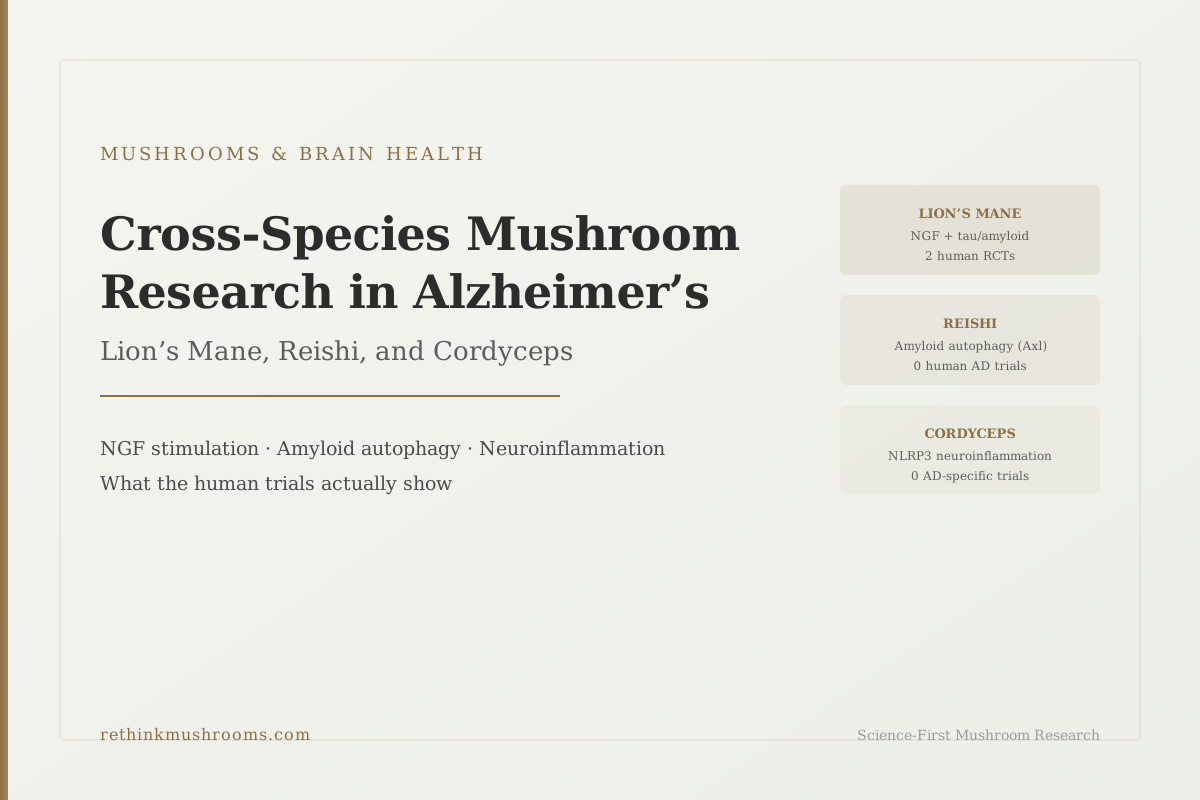
Lion's mane (Hericium erinaceus) is the only one of the three mushrooms with human trial data in cognitively impaired populations: three small RCTs (Mori 2009, Saitsu 2019, Li 2020) showed cognitive improvement on different scales. Reishi and cordyceps have preclinical evidence only.
Mori et al., Phytotherapy Research, 2009
3 small RCTs
of lion's mane in mild cognitive impairment or early Alzheimer's; zero RCTs of reishi or cordyceps in either
Anxiolytic, not memory
lion's mane in a tau (rTg4510) mouse model improved anxiety behavior but did not rescue spatial memory (Rodriguez & Lippi, 2022)
3 distinct mechanisms
lion's mane (NGF stimulation), reishi (amyloid autophagy via Axl), cordyceps (preclinical neuroinflammation suppression)
Mori et al., Phytotherapy Research, 2009
 View as image ↗
The question most articles answer ("which mushroom is best for Alzheimer's?") is less useful than the question underneath it: what does each mushroom actually do to the brain, and what has been tested in humans? The honest answer is that lion's mane, reishi, and cordyceps each work through a different mechanism on a different facet of Alzheimer's pathology, and only lion's mane has human trial data in actual cognitive-impairment populations.
Alzheimer's disease involves multiple pathological processes simultaneously: amyloid-β plaque accumulation, tau protein tangling, chronic neuroinflammation, oxidative damage, and the loss of growth signals that maintain neurons. No single compound addresses all of these. A 2015 cross-species review by Phan and colleagues mapped the mushroom literature relevant to neurodegeneration and identified more than 80 bioactive secondary metabolites across 20+ culinary-medicinal species, with neuroprotective, antioxidant, and anti-(neuro)inflammatory activity in cell and animal models — and an explicit note that human trials remained limited.[9]
For the broader evidence base connecting mushroom consumption to brain health across the lifespan, see Mushrooms and Cognitive Aging: Can They Protect Your Brain?. This article focuses on what each major medicinal species contributes specifically to Alzheimer's research and what the clinical evidence actually shows.
Key Takeaways
- Lion's mane (Hericium erinaceus) has the deepest evidence base for Alzheimer's research among the three species, including three small randomized human trials (Mori 2009; Saitsu 2019; Li 2020)
- The 2020 pilot trial of erinacine A-enriched lion's mane in early Alzheimer's patients reported significant improvement on the Mini-Mental State Examination (MMSE), Cognitive Abilities Screening Instrument (CASI), and Instrumental Activities of Daily Living (IADL) scores in the treatment group versus placebo (Li et al., Frontiers in Aging Neuroscience, 2020)
- A tau-transgenic (rTg4510) mouse study found lion's mane reduced anxiety behavior but did NOT rescue spatial memory in Morris water maze testing, suggesting the cognitive benefits seen in amyloid-leaning models may not extend to tau pathology (Rodriguez & Lippi, Behavioral Sciences, 2022)
- Reishi (Ganoderma lucidum) works through a mechanistically distinct pathway: ganoderic acid A promotes amyloid-β clearance via autophagy through the Axl receptor / Pak1 pathway in cell and APP/PS1 mouse models, but no human Alzheimer's trial exists (Qi et al., International Journal of Molecular Sciences, 2021)
- Cordyceps has preclinical anti-neuroinflammatory data through cordycepin, but no Alzheimer's-specific human trials and no Alzheimer's-specific animal-model data
- A preclinical study of erinacine A and erinacine S in APP/PS1 transgenic mice found reduced cerebral plaque burden, decreased glial activation, increased hippocampal neurogenesis, and improved Morris water maze performance with long-term erinacine A treatment (Tzeng et al., International Journal of Molecular Sciences, 2018)
Lion's Mane: The Species with the Deepest Alzheimer's Evidence Base
Lion's mane (Hericium erinaceus) has more directly relevant research for Alzheimer's than any other medicinal mushroom. The evidence spans cell-culture neurotrophic studies, animal Alzheimer's-model work, and small human clinical trials.
The mechanism starts with two groups of bioactive compounds.
Hericenones are found in the fruiting body. Aqueous extracts of H. erinaceus have demonstrated neurite-outgrowth promotion in neural cell models — for example, a 2013 Lai et al. study reported a 60.6% increase in neurite outgrowth when 1 μg/mL mushroom extract was combined with 10 ng/mL nerve growth factor (NGF) in vitro.[2] NGF is critical for cholinergic neurons, the population preferentially affected in Alzheimer's disease.
Erinacines are diterpenoid compounds from the mycelium. They are the more pharmacologically promising class for neurological applications because they appear to reach the brain after oral dosing. A 2018 Tzeng study tested erinacine A and erinacine S in APP/PS1 transgenic mice, a standard Alzheimer's model.[3] Long-term erinacine A reduced cerebral plaque burden and insoluble amyloid-β, decreased glial activation (microglia and astrocytes), promoted hippocampal neurogenesis, raised insulin-degrading enzyme levels, and improved performance on burrowing, nesting, and Morris water maze tasks. Erinacine S showed a partly overlapping but weaker profile.
The fruiting-body vs mycelium distinction matters for product selection: a hericenone-rich fruiting-body extract and an erinacine-rich mycelium extract are delivering different compounds with different absorption and CNS-access profiles, even though both are sold as "lion's mane."
For the population-level evidence linking mushroom consumption to reduced dementia risk, see The Singapore Mushroom Study: Mushroom Intake and Cognitive Decline. For the full mechanistic picture of mushroom compounds and Alzheimer's pathology, see Mushroom Compounds and Tau Protein: Alzheimer's Mechanisms.
What the Human Trials Actually Showed
The clinical evidence is real but small.
Mori 2009 ran a 16-week double-blind, placebo-controlled trial in 30 Japanese adults aged 50–80 with mild cognitive impairment (MCI). Participants received four 250 mg tablets per day of H. erinaceus or placebo. Cognitive Function Scale scores improved significantly in the treatment group at weeks 8, 12, and 16 versus placebo, and scores declined again after supplementation ended.[1]
Saitsu 2019 published a separate randomized, double-blind, placebo-controlled trial of oral H. erinaceus over 12 weeks in older adults using three cognitive assessments.[4] Oral H. erinaceus significantly improved MMSE scores compared with placebo. The authors hypothesized hericenones as the active class. (This trial is sometimes mis-attributed to "Nagano 2019" in secondary sources; the lead author is Saitsu.)
Li 2020 is the most directly Alzheimer-relevant trial. A 49-week pilot double-blind RCT enrolled 49 patients with mild Alzheimer's disease (a confirmed AD diagnosis, not just MCI) and randomized them to erinacine A-enriched H. erinaceus mycelia (EAHE) or placebo.[5] The treatment group showed:
- A significant improvement in MMSE score versus placebo
- Maintained CASI score (the placebo group showed a significant CASI decline; the EAHE group did not)
- A significant IADL difference favoring EAHE
- Significantly better contrast sensitivity (a visual-function endpoint)
- Diffusion tensor imaging changes: the placebo group showed elevated apparent diffusion coefficient values in the arcuate fasciculus (a white-matter degeneration signal); EAHE participants showed preserved or favorable parahippocampal changes
This is a small pilot (n = 49) and the per-arm sample is roughly 25, but on its primary cognitive endpoint it is positive: erinacine A-enriched lion's mane improved MMSE in early Alzheimer's patients over 49 weeks. Larger replicating trials are needed before strong clinical conclusions can be drawn.
Rodriguez & Lippi 2022 is the most important cautionary preclinical finding. Mice engineered to develop tau pathology (the rTg4510 line) received lion's mane supplementation for 4.5 months.[7] The result was specific: significantly shorter latencies to enter the open-field center and more time in the open arms of the elevated zero maze (anxiolytic effect), but no improvement in spatial memory (Morris water maze) or activities of daily living. The authors framed lion's mane as "a therapeutic for anxiety in AD" rather than a memory-rescuing intervention in tau pathology.
This matters because Alzheimer's disease involves both amyloid and tau pathology, and individuals carry different ratios of the two. The amyloid-leaning APP/PS1 mouse data (Tzeng 2018) shows cognitive rescue; the tau-leaning rTg4510 data (Rodriguez 2022) does not. The human trials so far are positive on cognitive scales but small.
Docherty 2023 sits outside the dementia literature but is worth noting. A double-blind pilot RCT in 41 healthy adults aged 18–45 found that participants performed faster on the Stroop task after a single dose of H. erinaceus and showed a trend toward reduced subjective stress after 28 days.[8] The sample size is small and the population is healthy young adults rather than older or cognitively impaired ones.
Reishi: Amyloid Clearance via a Different Mechanism — but No Human Data
Reishi (Ganoderma lucidum) has a mechanistically interesting Alzheimer's signal but no human clinical trials in any AD or MCI population.
The key compound is ganoderic acid A (GAA), one of the triterpenoids in reishi. The 2021 Qi et al. study showed that GAA stimulates autophagosome formation in microglial cells via the Axl receptor tyrosine kinase / Pak1 pathway, reducing intracellular amyloid-β.[6] In an APP/PS1 mouse model, GAA reduced Aβ42 levels and improved performance on object recognition and Morris water maze testing. Blocking the Axl receptor with the inhibitor R428 abolished the benefit, which establishes the Axl/Pak1 pathway as mechanistically necessary for the effect.
Autophagy activation is mechanistically different from NGF stimulation. Lion's mane helps neurons survive and form connections by boosting growth signals. Reishi (in this preclinical work) helps clear amyloid deposits by activating the cell's own protein-disposal machinery. These are complementary preclinical approaches.
The limitation is large: the entire reishi Alzheimer's evidence base is preclinical. No human MCI or AD trial of reishi has been published, and many compounds that clear amyloid in mice have failed in human Alzheimer's trials. Reishi sits in the "promising preclinical, no human evidence yet" category for Alzheimer's specifically.
Cordyceps: Preclinical Anti-Inflammation, No Alzheimer's-Specific Trials
Cordyceps (primarily Cordyceps militaris, source of cordycepin) has anti-neuroinflammatory data in cell and general neuroinflammation models, but no Alzheimer's-specific human or animal trials.
Cordycepin has been investigated for general anti-inflammatory and immunomodulatory activity in microglial and other inflammatory models. Chronic neuroinflammation is a known driver of Alzheimer's pathology, which makes cordyceps mechanistically plausible as an adjunct, but the evidence has not been collected in AD-specific models the way the lion's mane and reishi work has.
The honest status: anti-inflammatory preclinical mechanism of plausibility, no directed AD research base, no human trials in cognitive impairment populations.
The Species Comparison at a Glance
| Species | Key compound | Preclinical AD mechanism | Human AD/MCI evidence |
|---|---|---|---|
| Lion's mane | Hericenones (fruiting body), erinacines (mycelium) | NGF stimulation; reduced amyloid plaque, glial activation, and improved spatial memory in APP/PS1 mice | 3 small RCTs in MCI / early AD with cognitive-scale improvement; tau-mouse evidence is anxiolytic only |
| Reishi | Ganoderic acid A | Amyloid clearance via Axl-mediated autophagy in cells and APP/PS1 mice | Zero human trials in AD or MCI |
| Cordyceps | Cordycepin | General anti-neuroinflammatory activity in non-AD models | Zero AD/MCI-specific trials |
For practical guidance on dietary mushroom amounts and cognition, see How Much Mushroom Do You Need to Protect Cognition? Dietary Evidence.
Where the Evidence Stands
Lion's mane is the only one of the three species with positive human trial data in cognitively impaired populations, and the three trials (Mori 2009 in MCI, Saitsu 2019 in older adults, Li 2020 in early AD) are all small and short relative to the standards typically applied to dementia drug development. The most rigorous of them, Li 2020, was a 49-participant pilot RCT lasting 49 weeks; on its primary cognitive endpoint (MMSE) it showed a significant treatment effect, alongside CASI maintenance and IADL improvement. Larger confirmatory RCTs are still needed.
Reishi has a clean preclinical mechanism (ganoderic acid A → Axl → autophagy → amyloid clearance) and APP/PS1 mouse cognitive rescue, but zero human Alzheimer's data. Cordyceps has anti-inflammatory plausibility and no AD-specific data of either kind.
Two cautions sit on top of the lion's mane story. First, the rTg4510 tau-mouse data (Rodriguez 2022) suggests the cognitive benefit may not extend evenly to tau-dominant pathology — only the anxiety phenotype improved in that model. Second, all three lion's mane RCTs were conducted in East Asian populations using specific extracts (notably erinacine A-enriched mycelium for Li 2020); generalizing to arbitrary supplement-grade lion's mane products is not directly supported.
The Bottom Line
Lion's mane is the only one of the three species with human trial data in cognitively impaired populations: Mori 2009 (n = 30 MCI, 16 weeks, cognitive scale improved), Saitsu 2019 (older adults, 12 weeks, MMSE improved), and Li 2020 (n = 49 early Alzheimer's, 49 weeks, MMSE / CASI / IADL improvements with erinacine A-enriched mycelium). A 2022 tau-mouse study showed anxiolytic but not memory effects, an important caveat for tau-dominant pathology. Reishi has a clean preclinical autophagy/amyloid-clearance mechanism via ganoderic acid A and the Axl receptor (Qi 2021), but no human AD trials. Cordyceps has general anti-neuroinflammatory plausibility but no Alzheimer's-specific data.
Frequently Asked Questions
Sources & References
- 1RTHM-00165·Mori, Koichiro et al. (2009). “Improving effects of the mushroom Yamabushitake (Hericium erinaceus) on mild cognitive impairment: a double-blind placebo-controlled clinical trial..” Phytotherapy research : PTR.Study breakdown →PubMed →↩
- 2RTHM-00295·Lai, Puei-Lene et al. (2013). “Neurotrophic properties of the Lion's mane medicinal mushroom, Hericium erinaceus (Higher Basidiomycetes) from Malaysia..” International journal of medicinal mushrooms.Study breakdown →PubMed →↩
- 3. Source details for this reference are not yet available.
- 4RTHM-00585·Saitsu, Yuusuke et al. (2019). “Improvement of cognitive functions by oral intake of Hericium erinaceus..” Biomedical research (Tokyo.Study breakdown →PubMed →↩
- 5RTHM-00631·Li, I-Chen et al. (2020). “Prevention of Early Alzheimer's Disease by Erinacine A-Enriched Hericium erinaceus Mycelia Pilot Double-Blind Placebo-Controlled Study..” Frontiers in aging neuroscience.Study breakdown →PubMed →↩
- 6RTHM-00712·Qi, Li-Feng-Rong et al. (2021). “Ganoderic Acid A Promotes Amyloid-β Clearance (In Vitro) and Ameliorates Cognitive Deficiency in Alzheimer's Disease (Mouse Model) through Autophagy Induced by Activating Axl..” International journal of molecular sciences.Study breakdown →PubMed →↩
- 7RTHM-01610·Rodriguez, Mya N et al. (2022). “Lion's Mane (Hericium erinaceus) Exerts Anxiolytic Effects in the rTg4510 Tau Mouse Model..” Behavioral sciences (Basel.Study breakdown →PubMed →↩
- 8RTHM-00821·Docherty, Sarah et al. (2023). “The Acute and Chronic Effects of Lion's Mane Mushroom Supplementation on Cognitive Function, Stress and Mood in Young Adults: A Double-Blind, Parallel Groups, Pilot Study..” Nutrients.Study breakdown →PubMed →↩
- 9RTHM-00397·Phan, Chia-Wei et al. (2015). “Therapeutic potential of culinary-medicinal mushrooms for the management of neurodegenerative diseases: diversity, metabolite, and mechanism..” Critical reviews in biotechnology.Study breakdown →PubMed →↩