Mushrooms & Brain Health
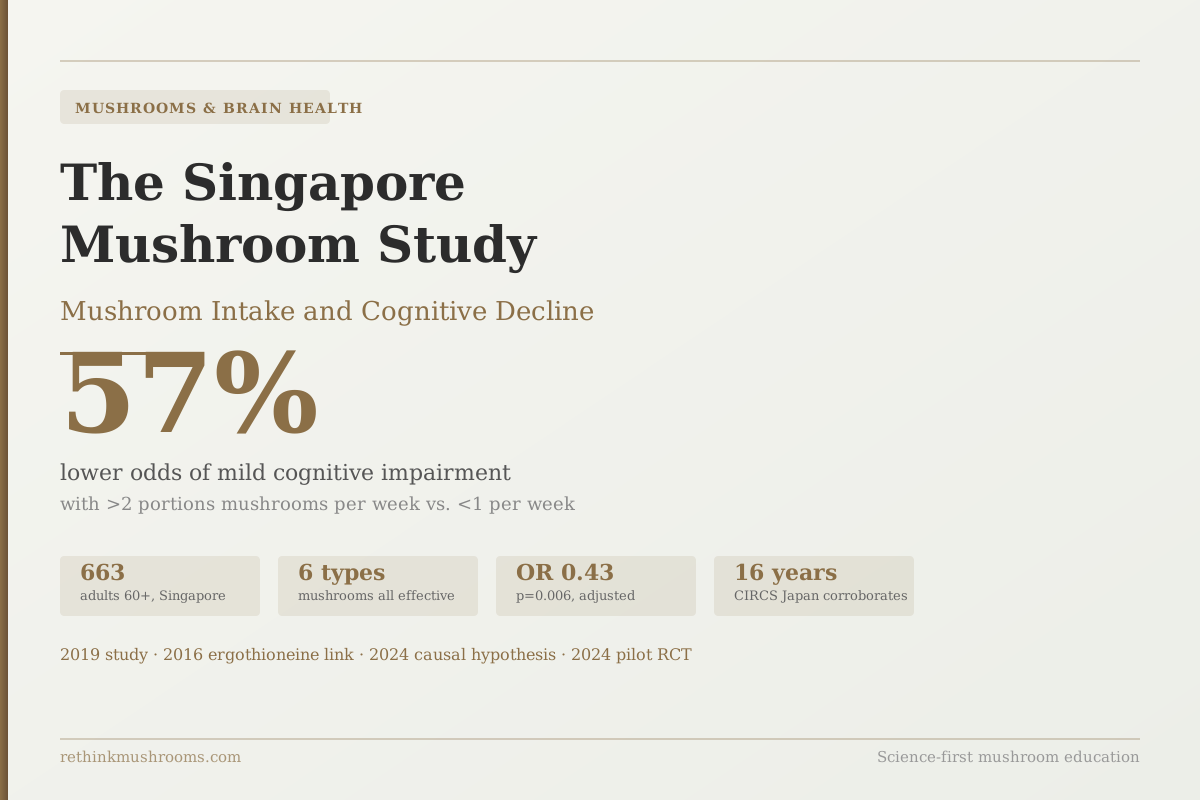
57% lower odds
Older adults eating mushrooms more than twice per week had 57% lower odds of mild cognitive impairment compared to those eating less than once per week, in a community-based study of 663 Singaporeans aged 60 and older.
Feng et al., Journal of Alzheimer's Disease, 2019
663
adults aged 60+ in the Singapore DaHA cross-sectional study
6 types
of mushrooms all showed the same protective association
OR 0.43
the odds ratio for MCI at >2 portions/week versus less than once per week
Feng et al., Journal of Alzheimer's Disease, 2019
 View as image ↗
In 2019, a research team at the National University of Singapore published a community study that drew unusual attention. They surveyed 663 older adults about their mushroom intake, tested their cognitive function, and found that those who ate mushrooms more than twice a week had 57% lower odds of mild cognitive impairment compared to those who ate mushrooms less than once a week.[1]
The finding was striking enough that major science publications picked it up. But most coverage stopped there. The 57% number is interesting. The story behind that number is more interesting.
The same research group had already spent years studying a specific compound found almost exclusively in mushrooms. They had reason to believe the association was not random. And in the five years since the 2019 paper, they have built a research program testing whether that compound, given directly to patients with early cognitive decline, slows the process. This article tells that story.
For the broader picture of what dietary mushroom studies show across populations, see Mushrooms and Cognitive Aging: Can They Protect Your Brain?.
Key Takeaways
- The 2019 Singapore DaHA study (n=663, adults 60+) found eating mushrooms more than twice per week was associated with 57% lower odds of mild cognitive impairment (OR=0.43, p=0.006), independent of age, sex, education, lifestyle, and cardiovascular factors (Feng et al., 2019)
- All six mushroom types tested (golden, oyster, shiitake, white button, dried, canned) showed the same protective association; the effect was not species-specific
- A 2016 follow-up from the same Singapore cohort found that lower blood levels of ergothioneine (a compound found primarily in mushrooms) independently predicted faster cognitive decline over five years in 470 older adults (Cheah et al., 2016)
- A 2024 hypothesis paper by Halliwell and colleagues proposes that declining dietary ergothioneine is a direct causal contributor to age-related neurodegeneration, upgrading the Singapore observation from correlation to a plausible causal mechanism
- The first ergothioneine MCI pilot trial (n=14, double-blind, 1 year) found modest verbal memory improvement and stabilization of a neurodegeneration blood biomarker in the ergothioneine group (Yau et al., 2024)
- A 16-year Japanese prospective cohort of 3,739 adults independently found women eating 15g or more mushrooms daily had 44% lower dementia risk, corroborating the Singapore association across populations (Aoki et al., 2024)
The DaHA Study: What Feng and Colleagues Actually Found
The 2019 paper by Feng and colleagues was based on the Diet and Healthy Aging (DaHA) study, a community-based initiative tracking health and dietary patterns in older Singaporeans. The analysis used cross-sectional data from 663 participants aged 60 and older, all community-dwelling adults without known dementia.[1]
Mild cognitive impairment, or MCI, is a clinically defined state between normal aging and dementia. People with MCI have measurable cognitive deficits that exceed what is expected for their age, but not severe enough to disrupt daily functioning. It is an important endpoint because MCI is a significant risk factor for progression to Alzheimer's disease.
The researchers asked participants how often they ate six specific mushroom types: golden mushrooms (enoki), oyster mushrooms, shiitake, white button mushrooms, dried mushrooms, and canned mushrooms. They then grouped participants by frequency: less than once per week, once per week, or more than twice per week.
The result: participants eating mushrooms more than twice a week had an odds ratio of 0.43 for MCI compared to those eating mushrooms less than once a week. In plain terms, an odds ratio of 0.43 means the mushroom group had roughly 57% lower odds of having MCI. The result was statistically significant (p=0.006) and remained significant after adjusting for age, sex, education, smoking, physical activity, diabetes, hypertension, and overall diet quality.
Three points about the design are worth noting. First, this is a cross-sectional study, meaning data from one point in time. It cannot prove that mushroom eating caused the lower MCI rate. People with better diets generally do better on cognitive tests, and higher mushroom consumption could be a marker of overall dietary quality. The researchers adjusted for diet quality, but residual confounding is possible. Second, all six mushroom types, including canned and dried forms, showed the same association. There was no evidence that a specific species or fresh-only format was responsible. Third, the study population was Singaporean, with dietary and health patterns that differ from Western populations. Replication in other populations was needed.
Replication came.
Why This Number Was Taken Seriously, and Where the Mechanism Came From
The 57% reduction was large by the standards of dietary epidemiology. For context, the association between Mediterranean diet adherence and dementia risk reduction in most studies is in the 20-35% range. A single dietary component showing a 57% association triggered justified scepticism and curiosity in roughly equal measure.
Part of why the Singapore researchers took the finding seriously is that they already had a specific compound in mind. Barry Halliwell's group at the National University of Singapore had been studying ergothioneine for years before the Feng paper. Ergothioneine is an antioxidant amino acid produced by fungi and some soil bacteria. Humans cannot synthesize it. The only meaningful dietary sources are mushrooms. When people eat mushrooms regularly, their blood ergothioneine levels rise; when they eat fewer mushrooms, levels fall. And the compound accumulates in high-demand tissues: the liver, kidneys, bone marrow, eyes, and brain.
The reason this matters: Cheah and colleagues, from the same Singapore group, had already published in 2016 that lower baseline ergothioneine blood levels predicted faster cognitive decline over five years in a sample of 470 older adults.[2] Participants with lower ergothioneine at the start of the study scored worse on multiple cognitive domains and declined faster over follow-up. The association was independent of other dietary factors. Ergothioneine levels specifically tracked with cognitive trajectory.
The Feng 2019 paper therefore had a candidate mechanism before it was even published. Mushrooms are the primary dietary source of ergothioneine. Eating more mushrooms raises ergothioneine. Higher ergothioneine is associated with slower cognitive decline. The chain of reasoning was in place.
The 2024 Hypothesis: From Association to Potential Cause
In 2024, Halliwell and colleagues published a formal hypothesis paper that made the causal argument explicit.[3] The paper's title poses the question directly: are age-related neurodegenerative diseases caused by a lack of the diet-derived compound ergothioneine?
The paper argues the following: ergothioneine levels decline naturally with age in human blood. Western diets have shifted away from mushroom consumption over recent decades. Lower mushroom intake means lower ergothioneine intake. Declining ergothioneine in aging adults, who already have lower baseline levels, may fall below a threshold needed to protect the brain against oxidative stress and inflammation. The result, over years and decades, is accelerated neurodegeneration.
This would explain why the dietary epidemiology is so consistent across populations: every population study that looks at mushroom consumption finds the same protective signal. Singapore, the United States, the United Kingdom, Japan, China: all point the same direction. If ergothioneine deficiency is a genuine causal contributor to neurodegeneration, the signal should appear wherever mushroom intake is measured, regardless of local cuisine patterns.
The 2024 paper also details a senolytic mechanism proposed by Apparoo and colleagues: ergothioneine may clear senescent neurons from the brain.[5] Senescent cells are cells that have stopped dividing normally but remain metabolically active, secreting inflammatory compounds that damage surrounding tissue. In the brain, accumulation of senescent neurons contributes to neuroinflammation and cognitive decline. Ergothioneine, the proposal goes, helps eliminate these cells, reducing the chronic inflammation that drives brain aging.
This remains a hypothesis, supported by mechanistic arguments and converging epidemiology, not yet proven by the standards of a large controlled trial.
The First Human Trial: Ergothioneine in MCI Patients
The research program that began with cross-sectional observation and moved through longitudinal biomarker data eventually reached a human intervention trial. In 2024, Yau and colleagues published results of a pilot double-blind, placebo-controlled trial in which older adults with mild cognitive impairment received ergothioneine supplementation for one year.[4]
The trial enrolled 14 participants. That sample size makes it a pilot, not a definitive study. Its purpose was to test whether the intervention showed any signal before committing resources to a larger trial. Participants in the ergothioneine group received 25mg three times per week. The duration was 12 months.
The primary cognitive outcome was the Rey Auditory Verbal Learning Test, a standardized measure of verbal memory. The ergothioneine group showed modest improvements on this test. The placebo group did not. The researchers also measured neurofilament light chain, a protein that leaks into the bloodstream when neurons are damaged and is used as a biomarker of ongoing neurodegeneration. In the ergothioneine group, neurofilament light chain levels stabilized. In the placebo group, they continued to rise at a rate consistent with progressing MCI.
These are small effects in a very small sample. They need replication in a larger trial before conclusions can be drawn. But the direction is consistent with the epidemiological findings and the proposed mechanism: ergothioneine supplementation in people with existing cognitive impairment showed some signal of protection at both the cognitive and the neurodegeneration-biomarker level.
Japan Corroborates: A 16-Year Prospective Study
The most methodologically robust corroboration of the Singapore findings came in 2024 from the Circulatory Risk in Communities Study (CIRCS) in Japan, published in the British Journal of Nutrition by Aoki and colleagues.[6]
CIRCS enrolled 3,739 Japanese adults between 40 and 64 years old and followed them for a mean of 16 years, tracking diet at baseline and monitoring for incident disabling dementia. The study documented 670 dementia cases over follow-up.
The finding in women: those consuming 15 grams or more of mushrooms per day had a hazard ratio of 0.56 for disabling dementia compared to those consuming less. That translates to approximately 44% lower risk over 16 years. The association was dose-dependent in women.
The finding in men: no significant association. The researchers could not explain the sex-specific pattern. Possible explanations include hormonal differences affecting ergothioneine metabolism, different baseline dietary patterns, or statistical power limitations for the male subgroup. The gender gap is a genuine unknown that the authors acknowledged.
A 16-year prospective cohort study is considerably stronger evidence than a cross-sectional analysis. The CIRCS result is not just corroborating the direction of the Singapore finding; it is corroborating it with a study design that can speak more directly to risk rather than association.
For an analysis of how much mushroom intake the population studies collectively suggest is beneficial, see How Much Mushroom Do You Need to Protect Cognition?. For the deeper dive on what ergothioneine does in the brain and body, see Ergothioneine and Brain Health: Neuroprotective Research.
What the Singapore Story Tells Us
The Singapore mushroom study was not a standalone observation. It was the cross-sectional phase of a research program that had already identified a plausible mechanism, had already shown the mechanism correlated with cognitive outcomes in a five-year longitudinal study, and has since run a pilot RCT and proposed a formal causal hypothesis.
What the program establishes with reasonable confidence: people who eat more mushrooms regularly tend to have lower rates of mild cognitive impairment in population studies. This association holds across multiple populations and is independent of general dietary quality. Ergothioneine is the most biologically plausible candidate mechanism, and declining ergothioneine levels correlate with declining cognition in the same population.
What remains uncertain: whether the association is causal, whether ergothioneine supplementation can prevent or slow progression in larger trials, and what specific dose or form produces optimal effects. The Yau 2024 pilot RCT is the first human interventional data, and it is encouraging but not conclusive at 14 participants.
For the methodology and mechanism detail behind the DaHA study and the ergothioneine hypothesis, see Mushroom Consumption and Cognitive Decline: The Singapore Diet and Aging Study. For the full picture of ergothioneine in dementia prevention research, see Ergothioneine and Dementia Prevention: Population Studies.
The Bottom Line
The 2019 Singapore DaHA study found eating mushrooms more than twice per week was associated with 57% lower odds of mild cognitive impairment in 663 older adults. The same research group later showed ergothioneine levels predict cognitive trajectory, proposed a causal hypothesis in 2024, and ran a pilot RCT showing signal for cognitive protection with ergothioneine supplementation. A 16-year Japanese prospective cohort independently found 44% lower dementia risk in women eating mushrooms regularly. The evidence is converging: not yet causal proof, but a coherent, multi-study case building in a consistent direction.
Frequently Asked Questions
Sources & References
- 1RTHM-00554·Feng, Lei et al. (2019). “The Association between Mushroom Consumption and Mild Cognitive Impairment: A Community-Based Cross-Sectional Study in Singapore..” Journal of Alzheimer's disease : JAD.Study breakdown →PubMed →↩
- 2RTHM-00420·Cheah, Irwin K et al. (2016). “Ergothioneine levels in an elderly population decrease with age and incidence of cognitive decline; a risk factor for neurodegeneration?.” Biochemical and biophysical research communications.Study breakdown →PubMed →↩
- 3RTHM-01898·Halliwell, Barry et al. (2024). “Are age-related neurodegenerative diseases caused by a lack of the diet-derived compound ergothioneine?.” Free radical biology & medicine.Study breakdown →PubMed →↩
- 4RTHM-02029·Yau, Yu Fung et al. (2024). “Investigating the efficacy of ergothioneine to delay cognitive decline in mild cognitively impaired subjects: A pilot study..” Journal of Alzheimer's disease : JAD.Study breakdown →PubMed →↩
- 5RTHM-01850·Apparoo, Yasaaswini et al. (2024). “Potential role of ergothioneine rich mushroom as anti-aging candidate through elimination of neuronal senescent cells..” Brain research.Study breakdown →PubMed →↩
- 6RTHM-01849·Aoki, Shoko et al. (2024). “Mushroom intake and risk of incident disabling dementia: the Circulatory Risk in Communities Study (CIRCS)..” The British journal of nutrition.Study breakdown →PubMed →↩