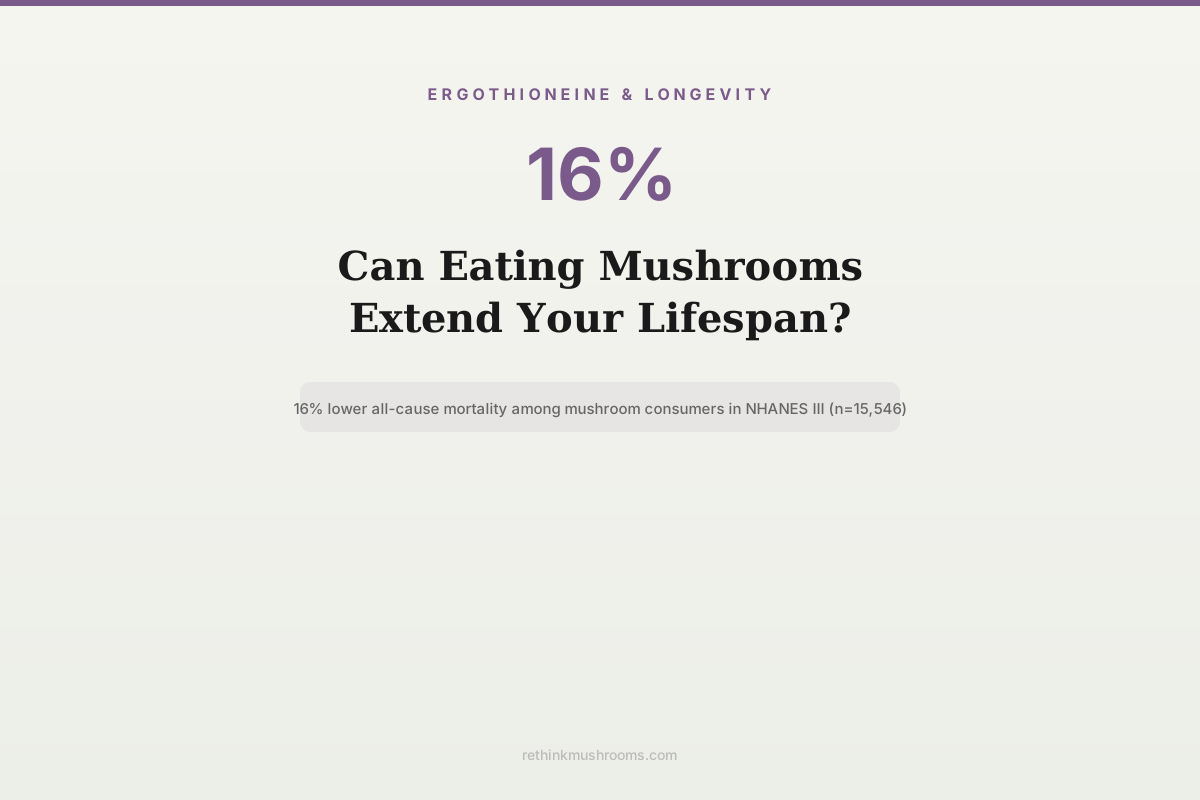
Ergothioneine & Longevity
0.84 HR
In a nationally representative sample of 15,546 US adults tracked for a mean 19.5 years, mushroom eaters had a 16% lower risk of death from any cause than non-consumers after full adjustment.
Ba et al., Nutrition Journal, 2021
601,893
adults pooled across five cohorts in the meta-analysis
HR 0.65
when mushrooms replaced a daily serving of red or processed meat
~95%
of dietary ergothioneine comes from mushrooms
Ba et al., Nutrition Journal, 2021
 View as image ↗
Do mushrooms extend lifespan? The question sits at the intersection of an unusual dietary compound and decades of population data. Mushrooms are the dominant source of ergothioneine, a sulfur-containing antioxidant that humans cannot synthesize and that the body actively transports into tissues under oxidative stress. Five prospective cohort studies have now tracked mushroom intake against mortality, covering more than 600,000 adults across the United States, Sweden, South Korea, and internationally pooled samples. The direction of findings is consistent enough to take seriously, and inconsistent enough that no one should claim the case is closed. For the parallel evidence on blood ergothioneine levels themselves, see blood ergothioneine levels and all-cause mortality risk.
Key Takeaways
- In NHANES III, 15,546 US adults followed a mean of 19.5 years showed 16% lower all-cause mortality among mushroom consumers compared to non-consumers (HR 0.84, 95% CI 0.73-0.98), with a significant dose-response trend (P=0.03) (Ba et al., 2021)
- A meta-analysis pooling 601,893 adults across five prospective cohorts found a 6% lower all-cause mortality risk associated with mushroom consumption (pooled RR 0.94, 95% CI 0.91-0.98) (Ba et al., 2021)
- In the Korean KoGES cohort of 152,828 adults followed 11.6 years, men eating 1-3 servings per week had 24% lower cardiovascular mortality (HR 0.76) than non-consumers (Jung et al., 2023)
- Substituting one daily serving of mushrooms for one serving of processed or red meat was associated with 35% lower all-cause mortality in NHANES III (HR 0.65, 95% CI 0.50-0.84) (Ba et al., 2021)
- A null finding exists: 110,680 US health professionals followed 26 years showed no association between mushroom intake and cardiovascular disease or type 2 diabetes (Lee et al., 2019)
- Mice given 4-5 mg/kg/day of ergothioneine lived longer than controls with reduced frailty markers, providing the only direct mammalian lifespan evidence (Katsube et al., 2024)
What Five Cohort Studies Actually Found
The strongest single-study evidence comes from Ba et al. (2021), who analyzed 15,546 adults enrolled in the Third National Health and Nutrition Examination Survey (NHANES III) between 1988 and 1994 and linked them to National Death Index records through 2015.[1] Mushroom intake was assessed with a 24-hour dietary recall. Over a mean 19.5-year follow-up, 5,826 participants died.
After adjustment for age, sex, race, education, smoking, physical activity, body mass index, total energy intake, overall diet quality, and other dietary factors, participants who reported any mushroom consumption had a 16% lower risk of all-cause mortality than non-consumers (HR 0.84, 95% CI 0.73-0.98). The dose-response trend across intake categories was statistically significant (P-trend = 0.03). The cause-specific analyses (cardiovascular, cancer) trended in the same direction but did not reach statistical significance individually, likely because the all-cause signal was spread across multiple death categories rather than concentrated in one.
The substitution analysis is the most striking number in the paper. Replacing one daily serving of red or processed meat with one daily serving of mushrooms was associated with a 35% lower all-cause mortality risk (HR 0.65, 95% CI 0.50-0.84). Substitution models capture what happens when a food displaces another food in the diet, which is closer to the real-world question than simply comparing high and low consumers.
The Meta-Analysis: Pooling 601,893 Adults
A companion paper by the same group analyzed the continuous NHANES cohort (2003-2014, 30,378 participants) separately and then conducted a meta-analysis combining their new data with four earlier prospective cohort studies.[2]
In the continuous NHANES sample alone, the all-cause mortality association was smaller and not statistically significant (HR 0.84, 95% CI 0.67-1.06), a result the authors attributed partly to the shorter 6.7-year follow-up and smaller number of deaths (2,855). The meta-analysis of five prospective cohorts pooling 601,893 individuals found a significant but modest inverse association: pooled risk ratio 0.94 (95% CI 0.91-0.98). That translates to a roughly 6% lower mortality risk for mushroom consumers compared to non-consumers across the pooled dataset.
A 6% pooled effect is smaller than the headline 16% from NHANES III. Both numbers are consistent with the same underlying reality: mushroom consumption in the general population is associated with modestly lower mortality, with larger effects sometimes appearing in individual cohorts due to longer follow-up, different populations, or residual variation. Neither number proves that eating more mushrooms will make an individual person live longer.
Korean KoGES Cohort: 152,828 Adults Over 11.6 Years
The Korean Genome and Epidemiology Study (KoGES) analyzed mushroom intake in 152,828 Korean adults aged 40 and older, followed for a mean 11.6 years with 7,085 deaths recorded through 2020.[3] Mushroom intake was assessed with a food frequency questionnaire and categorized as none, fewer than one serving per week, one to three servings per week, or three or more servings per week.
In men, consumers of fewer than one serving per week (HR 0.858, 95% CI 0.793-0.929) and one to three servings per week (HR 0.902, 95% CI 0.819-0.993) had lower all-cause mortality than non-consumers. Cardiovascular mortality showed the strongest signal: HR 0.767 (95% CI 0.632-0.930) for the low-intake group and 0.762 (95% CI 0.601-0.967) for the 1-3 servings per week group. In women, 1-3 servings per week was associated with 13% lower all-cause mortality (HR 0.869) compared to non-consumers.
Two features of the KoGES results deserve attention. First, the benefit plateaued or reversed at the highest intake level (3 or more servings per week), which did not show a statistically significant protective effect in the fully adjusted models. This non-linear pattern appears in several mushroom studies and suggests that moderate consumption may capture most of the association. Second, the cardiovascular signal was male-specific in this cohort. Whether that reflects biological differences, baseline risk differences, or statistical noise is unclear from a single study.
The Null Finding: Nurses' Health Study and Health Professionals Follow-Up
Not every cohort has found a mushroom-mortality link. Lee et al. (2019) analyzed 67,139 women from the Nurses' Health Study (1986-2012) and 43,541 men from the Health Professionals Follow-Up Study (1986-2012) for cardiovascular disease, type 2 diabetes, and plasma biomarkers.[4] Over more than 2 million person-years of follow-up, they identified 11,894 cardiovascular disease cases (7,616 coronary heart disease, 4,278 stroke) and 10,206 type 2 diabetes cases.
The result was flat. Participants consuming 5 or more servings of mushrooms per week had essentially identical risks compared to those consuming fewer than one serving per month: HR 1.02 for total cardiovascular disease, 1.00 for coronary heart disease, 1.05 for stroke, and 1.04 for type 2 diabetes. None of these point estimates was statistically significant, and plasma biomarkers of lipids, insulin, and inflammation showed no association either.
This is important. Lee et al. did not study all-cause mortality directly, so it is not a head-to-head test against the Ba et al. findings. But it did test cardiovascular disease incidence in two of the largest and best-characterized US cohorts, and it found nothing. The Nurses' Health Study participants ate relatively few mushrooms on average, and the baseline diet was already high quality (health professionals tend to eat well), so the signal may have been harder to detect against a healthier background. Or the effect may simply not exist for cardiovascular disease in this population.
The combination of positive findings in Ba et al., Jung et al., and the pooled meta-analysis alongside the null finding in Lee et al. illustrates why single studies rarely settle nutritional questions. Reality likely sits somewhere in the middle: a modest, population-level association that is not large enough or consistent enough to be detected in every cohort.
Why Ergothioneine Is the Suspected Mechanism
Among nutritional biomarkers, ergothioneine has one of the strongest and most consistent mortality associations in the published literature. Smith et al. (2020) measured 112 plasma metabolites in 3,236 adults from the Malmö Diet and Cancer study in Sweden and followed them a median of 21.4 years. Ergothioneine was the metabolite most strongly linked to a health-conscious dietary pattern, and each one standard deviation increase in plasma ergothioneine was associated with 14% lower all-cause mortality (HR 0.86, P = 4 × 10^-5) and 21% lower cardiovascular mortality (HR 0.79, P = 0.002).[5]
Ergothioneine reaches human tissue through diet. Kalaras et al. (2017) measured concentrations across 13 mushroom species and found ergothioneine content of 0.4 to 2.0 mg/g dry weight, with porcini (Boletus edulis) the richest of those tested. Agaricus bisporus (white button and crimini) contained lower but meaningful amounts.[6] Mushrooms are the dominant dietary source in most populations because fungi and certain soil actinobacteria are the only known organisms that synthesize ergothioneine. Plants acquire trace amounts through soil bacteria, and animals acquire it from plants and fungi; almost no route bypasses mushrooms for any meaningful dose.
Weigand-Heller et al. (2012) confirmed that ergothioneine from a 16-gram serving of Agaricus bisporus is absorbed and produces measurable plasma increases within hours via the dedicated SLC22A4 (OCTN1) transporter.[7] The existence of a conserved transporter is part of why Halliwell and others have proposed classifying ergothioneine as a "longevity vitamin." For the theoretical framing of that proposal, see ergothioneine and longevity: the vitamin of longevity hypothesis.
Ergothioneine's antioxidant chemistry differs from vitamin C, vitamin E, or glutathione. Its thione group gives it unusual stability, and Servillo et al. (2017) documented its selective reactivity with peroxynitrite, hypochlorous acid, and hydroxyl radicals, the damaging species that drive cumulative oxidative injury in cardiovascular tissue.[8] Cheah et al. (2021) reviewed the growing literature on ergothioneine and noted its accumulation in organs facing high oxidative load: red blood cells, liver, kidney, lens, and seminal fluid.[9]
The Mouse Experiment
The only direct mammalian lifespan evidence comes from Katsube et al. (2024), who gave male C57BL/6 mice 4-5 mg/kg/day of ergothioneine throughout life and compared them to unsupplemented controls.[10] Supplemented mice lived longer, showed reduced frailty markers, and had altered gut microbiota composition. Parallel experiments in Caenorhabditis elegans nematodes produced similar lifespan extension.
The mouse data matters because diet, environment, and genetics are controlled in a way that human epidemiology cannot match. A supplementation experiment where the compound itself is the only variable addresses the confounding problem that plagues observational studies. The limitations are the usual ones for animal research: mouse metabolism differs from human metabolism, male mice may respond differently than female mice or mice of other strains, and translation to human lifespan is not automatic.
Lam-Sidun et al. (2021) summarized the preclinical landscape across cell and animal studies, concluding that ergothioneine shows consistent protective effects against oxidative stress, inflammation, and mitochondrial dysfunction in models relevant to cardiovascular disease, neurodegeneration, and aging.[11] What is missing is a randomized controlled trial of ergothioneine supplementation in humans with mortality or disease incidence as primary endpoints. No such trial has been completed.
The Confounding Problem: Mushroom Eaters vs. Mushroom Effects
The cohort data face an unavoidable challenge. People who eat mushrooms regularly are not a random subset of the population. They tend to eat more vegetables, cook at home more, follow Mediterranean or Asian dietary patterns, and differ in other measured and unmeasured ways from people who never eat mushrooms. Ba et al. (2021) adjusted for overall diet quality using the Healthy Eating Index and for smoking, physical activity, body mass index, education, and income, and the mortality association survived that adjustment, which is evidence against pure confounding.[1]
Residual confounding always remains possible. Three scenarios are consistent with the data:
- Ergothioneine and other mushroom compounds directly protect against mortality. The biological mechanism is plausible, the blood biomarker data are supportive, and the mouse supplementation experiment shows a lifespan effect in isolation.
- Mushrooms are a marker of healthy dietary patterns, and the entire pattern drives the benefit. In this case, ergothioneine is a biomarker of healthy eating rather than an independent cause.
- Both are true in varying proportions. Ergothioneine provides a real but small direct effect, and the dietary context amplifies it.
The Smith et al. (2020) finding that ergothioneine was the single metabolite most strongly tied to a health-conscious dietary pattern out of 112 measured argues that confounding cannot be fully ruled out.[5] The mouse data argue that some direct effect exists. The honest answer is that the human data cannot currently distinguish between these scenarios. For how this question plays out in long-lived populations specifically, see ergothioneine and the blue zones: a dietary connection?.
How Much Mushroom Appears Linked to the Associations
The cohort data are not uniform on dose. In NHANES III, the benefit appeared in any mushroom consumption with a significant dose-response trend, suggesting more may be better up to the range observed in that population.[1] In the Korean KoGES cohort, the strongest associations appeared at fewer than one serving per week and at 1-3 servings per week, with no additional benefit at 3 or more servings per week.[3] In the Lee et al. Nurses' Health analysis, even 5 or more servings per week showed no cardiovascular association.[4]
One interpretation is that the mortality-relevant dose is modest. A single 16-gram serving of Agaricus bisporus measurably raises plasma ergothioneine,[7] and most Western diets contain very little ergothioneine outside mushrooms. Going from zero to any regular intake may capture most of the biomarker change, with diminishing returns at higher intakes. This pattern would explain why benefits appear at low thresholds in KoGES and trail off, and why the NHANES III substitution analysis showed a large effect when mushrooms replaced red and processed meat rather than adding to an already diverse diet.
The same pattern also limits what supplementation might add. If a small dietary dose already saturates the biological effect, large supplementation doses may produce diminishing returns. For the parallel question of how ergothioneine levels decline with age regardless of intake, see ergothioneine declines with age: what this means for health.
What the Evidence Supports and What It Does Not
| Question | What the data show | Confidence |
|---|---|---|
| Do mushroom eaters have lower mortality than non-eaters? | Yes, in four of five cohorts covering 601,893 adults | Moderate |
| Is the effect large enough to matter clinically? | Pooled 6%, single-cohort up to 16% lower mortality | Moderate |
| Is ergothioneine the cause? | Plausible mechanism, strong biomarker correlation, mouse lifespan data | Low to moderate |
| Will adding mushrooms to your diet extend your life? | No randomized evidence; observational data cannot answer this directly | Low |
| Does ergothioneine supplementation extend human lifespan? | No trial has tested this | None |
For how this evidence compares to other antioxidant mushroom research, see antrodia and antioxidant activity: free radical protection, and for the broader context of mushroom nutrition, see button mushroom health benefits: more than just a salad topping.
The Bottom Line
Five prospective cohort studies covering more than 600,000 adults link mushroom consumption to modestly lower all-cause mortality, with pooled estimates of 6% and single-cohort estimates as high as 16%. Ergothioneine is the suspected mechanism, supported by blood biomarker studies and a mouse lifespan experiment. One large US cohort found no association with cardiovascular disease. No randomized trial has tested whether mushroom or ergothioneine supplementation extends human lifespan.
Frequently Asked Questions
Sources & References
- 1RTHM-00673·Ba, Djibril M et al. (2021). “Association of mushroom consumption with all-cause and cause-specific mortality among American adults: prospective cohort study findings from NHANES III..” Nutrition journal.Study breakdown →PubMed →↩
- 2RTHM-00674·Ba, Djibril M et al. (2021). “Prospective study of dietary mushroom intake and risk of mortality: results from continuous National Health and Nutrition Examination Survey (NHANES) 2003-2014 and a meta-analysis..” Nutrition journal.Study breakdown →PubMed →↩
- 3RTHM-00833·Jung, Hyein et al. (2023). “Edible mushroom intake and risk of all-cause and cause-specific mortality: results from the Korean Genome and Epidemiology Study (KoGES) Cohort..” Food & function.Study breakdown →PubMed →↩
- 4RTHM-00567·Lee, Dong Hoon et al. (2019). “Mushroom consumption, biomarkers, and risk of cardiovascular disease and type 2 diabetes: a prospective cohort study of US women and men..” The American journal of clinical nutrition.Study breakdown →PubMed →↩
- 5RTHM-00655·Smith, Einar et al. (2020). “Ergothioneine is associated with reduced mortality and decreased risk of cardiovascular disease..” Heart (British Cardiac Society).Study breakdown →PubMed →↩
- 6RTHM-00476·Kalaras, Michael D et al. (2017). “Mushrooms: A rich source of the antioxidants ergothioneine and glutathione..” Food chemistry.Study breakdown →PubMed →↩
- 7RTHM-00270·Weigand-Heller, AuBrei J et al. (2012). “The bioavailability of ergothioneine from mushrooms (Agaricus bisporus) and the acute effects on antioxidant capacity and biomarkers of inflammation..” Preventive medicine.Study breakdown →PubMed →↩
- 8RTHM-00490·Servillo, Luigi et al. (2017). “Ergothioneine Antioxidant Function: From Chemistry to Cardiovascular Therapeutic Potential..” Journal of cardiovascular pharmacology.Study breakdown →PubMed →↩
- 9RTHM-00678·Cheah, Irwin K et al. (2021). “Ergothioneine, recent developments..” Redox biology.Study breakdown →PubMed →↩
- 10RTHM-00884·Katsube, Makoto et al. (2024). “Ergothioneine promotes longevity and healthy aging in male mice..” GeroScience.Study breakdown →PubMed →↩
- 11RTHM-00696·Lam-Sidun, Daniel et al. (2021). “Mushroom-Derived Medicine? Preclinical Studies Suggest Potential Benefits of Ergothioneine for Cardiometabolic Health..” International journal of molecular sciences.Study breakdown →PubMed →↩