Maitake (Grifola frondosa)
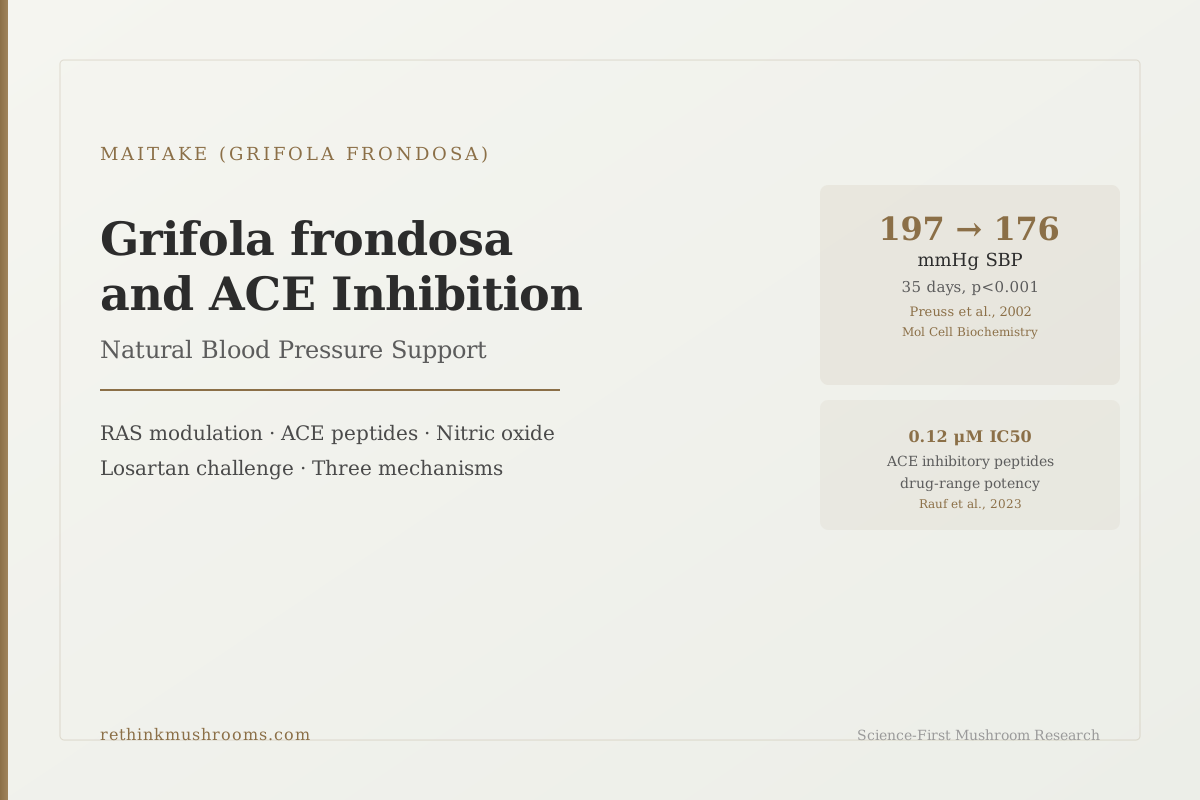
197 to 176 mmHg
Whole Grifola frondosa powder reduced systolic blood pressure from 197 to 176 mm Hg over 35 days in spontaneously hypertensive rats (p<0.001), with the ether-soluble fraction identified as the active component and renin-angiotensin system suppression confirmed as the mechanism.
Preuss et al., Molecular and Cellular Biochemistry, 2002
Two mechanisms
Grifola frondosa reduces blood pressure both by lowering systemic ACE activity throughout the body AND through purified peptides that directly block the ACE enzyme
Losartan test
Preuss 2010: maitake-treated rats responded less to the blood pressure drug losartan, proving maitake had already suppressed the renin-angiotensin system before the drug was given
Third pathway
The SX-fraction of maitake also enhances nitric oxide production in blood vessel walls, a blood pressure mechanism that operates independently of ACE inhibition
Preuss et al., Molecular and Cellular Biochemistry, 2002
 View as image ↗
ACE inhibitor drugs are among the most-prescribed medications in the world. They block a single enzyme that, when overactive, keeps blood pressure elevated by constricting blood vessels. Grifola frondosa, the fungus sold as maitake mushroom, contains compounds that appear to work through the same biochemical target, through two distinct molecular routes that pharmaceutical ACE inhibitors don't replicate.
That comparison doesn't mean maitake is a drug substitute. The evidence is animal data, not human clinical trials. But the mechanistic specificity of that evidence is considerably more sophisticated than the general "may support blood pressure" claims that appear on most supplement sites.
This article covers what researchers have actually shown: which fractions of maitake are active, what the renin-angiotensin system is and why it matters, what the losartan challenge experiment revealed about the mechanism, and where the evidence base sits in 2026.
For a broader introduction to what maitake is and its full range of studied effects, see what is maitake mushroom?.
Key Takeaways
- Grifola frondosa contains compounds in its ether-soluble fraction that reduce systemic ACE activity; this was confirmed by a 2010 study where maitake-treated animals responded less to the ACE inhibitor drug losartan, indicating the renin-angiotensin system had already been suppressed
- A 2002 animal study found whole maitake powder reduced systolic blood pressure from 197 to 176 mm Hg over 35 days (p<0.001), with the ether-soluble fraction specifically identified as the active antihypertensive component
- Purified maitake peptides have shown direct ACE inhibitory activity in laboratory assays, with IC50 values as low as 0.12 μM, a potency range documented in the 2023 Rauf systematic review of mushrooms and hypertension
- The SX-fraction of maitake reduces blood pressure through a separate pathway: enhancing nitric oxide production in blood vessel walls, which causes vessels to relax and widen independently of ACE activity
- The SX-fraction also lowers blood glucose simultaneously, making it potentially relevant to metabolic syndrome where high blood pressure and high blood sugar occur together
- No human randomized controlled trial has tested maitake for blood pressure; all mechanistic and efficacy evidence is from animal models or laboratory assays
What ACE Is and Why Blocking It Lowers Blood Pressure
ACE stands for angiotensin-converting enzyme. It is an enzyme that circulates in the blood and converts an inactive precursor protein (angiotensin I) into an active molecule (angiotensin II).
Angiotensin II is the problem. It acts directly on blood vessel walls to cause constriction, narrowing the space blood flows through and raising pressure. It also triggers the adrenal glands to release aldosterone, a hormone that causes the kidneys to retain sodium and water, adding volume to the blood and pushing pressure higher still.
ACE inhibitor drugs like lisinopril, ramipril, and enalapril block this enzyme. With less ACE activity, less angiotensin II is produced. Blood vessels relax. The adrenal signal weakens. Blood pressure drops. ACE inhibitors have been shown to reduce cardiovascular mortality and are a first-line treatment for essential hypertension in most major guidelines.
A compound can interfere with this system through two different points: (1) by directly blocking the ACE enzyme so it cannot convert angiotensin I to angiotensin II, or (2) by suppressing the upstream renin-angiotensin system more broadly, reducing how much angiotensin I is even available to be converted.
Grifola frondosa appears to do both, through distinct compound classes.
For a full breakdown of the compound classes in maitake and how they interact with biological systems, see the pharmacology of Grifola frondosa: how maitake works.
1988: The First Discovery of Active Fractions in Maitake Fruit Body
The foundational experiment for maitake and blood pressure was published by Adachi and colleagues in 1988.[1]
Adachi systematically isolated different chemical fractions from Grifola frondosa fruit body and tested each one for blood pressure-lowering activity in hypertensive animals. The primary finding was that the ether-soluble fraction of the fruit body contained the active antihypertensive components. The ether-soluble fraction contains lipophilic (fat-soluble) compounds, distinct from the water-soluble polysaccharides like beta-glucans that receive more attention in the mushroom supplement literature.
This finding established a mechanistic starting point. Maitake's blood pressure effects weren't a general property of the whole mushroom; they were concentrated in a specific chemical fraction. That specificity allowed subsequent researchers to design targeted experiments to identify which compounds within that fraction were doing what, and how.
Mechanism 1: Suppressing ACE Activity Throughout the Body
The most mechanistically important experiment in the maitake-ACE literature is a 2010 study by Preuss and colleagues, conducted in aging female rats with progressive hypertension.[3]
The study ran for four months. Rats receiving maitake extracts stopped accumulating hypertension over that period while control rats continued developing age-related high blood pressure. At the end, the maitake-treated group showed measurably reduced serum ACE activity; their blood had less circulating ACE enzyme.
This finding had an important implication: if maitake were blocking ACE at the enzyme level, adding more ACE blockade via a drug should produce an additional blood pressure drop. So the researchers ran the losartan challenge.
Losartan is an angiotensin receptor blocker (ARB). It works one step downstream of ACE: instead of blocking ACE from producing angiotensin II, it blocks the receptors that angiotensin II binds to in blood vessel walls. If a rat has a fully active renin-angiotensin system, giving losartan should dramatically drop blood pressure because all that blocked angiotensin II can no longer signal. If the renin-angiotensin system has already been suppressed, losartan has less to work with and produces a smaller drop.
The maitake-treated rats showed less blood pressure reduction after losartan than the control rats.[3]
This is as direct as in vivo evidence gets for mechanism. The experiment didn't just show that maitake lowered blood pressure and guess that it involved the RAS. It used a pharmacological probe to demonstrate that the RAS was already suppressed in maitake-treated animals before the drug was given. The mechanism is not coincidental.
The 2002 Preuss study provides the most-cited efficacy numbers: whole maitake powder reduced systolic blood pressure from 197 to 176 mm Hg over 35 days (p<0.001) in spontaneously hypertensive rats.[2] The ether-soluble fraction showed comparable activity to the whole powder, confirming that this fraction carries the primary antihypertensive effect. The other major fractions (polysaccharide-rich D-fraction, SX-fraction) showed blood pressure activity through different mechanisms, discussed below.
For a detailed look at how this evidence was accumulated across multiple animal models and what a blood pressure evidence pyramid for maitake looks like, see maitake for hypertension: clinical and preclinical evidence.
Mechanism 2: Purified Peptides That Directly Block the ACE Enzyme
Beyond the ether-soluble fraction's systemic RAS suppression, Grifola frondosa also contains protein-derived peptides that directly inhibit the ACE enzyme at the molecular level.
The 2023 Rauf systematic review, which assessed edible mushrooms as functional foods for hypertension management, documented maitake ACE inhibitory peptide sequences with IC50 values as low as 0.12 μM.[4] IC50 is the concentration required to inhibit 50% of enzyme activity. The lower the IC50, the more potent the inhibitor.
For context: IC50 values in the low micromolar range overlap with the potency of some pharmaceutical ACE inhibitors in in vitro assays. This doesn't mean the peptides would produce equivalent clinical effects in humans, because in vitro potency and in vivo efficacy are separated by absorption, distribution, metabolism, excretion, and the complex biology of the whole organism. But it establishes that the molecular interaction is real and meaningful, not a weak or marginal effect.
The distinction between mechanism 1 (systemic ACE activity reduction) and mechanism 2 (direct ACE peptide inhibition) matters because they are different biological events. Systemic ACE activity reduction reflects broader changes in the renin-angiotensin system, possibly involving gene expression, enzyme production, or feedback regulation. Direct ACE inhibitory peptides produce their effect by physically binding to the enzyme's active site and blocking substrate access. A 2021 review of Grifola frondosa bioactive ingredients by Deng and colleagues confirmed ACE inhibitory activity from the mushroom's protein hydrolysates as a documented pharmacological property.[7]
Mechanism 3: Nitric Oxide (Independent of ACE)
The SX-fraction of maitake, which is distinct from the ether-soluble fraction, reduces blood pressure through a different mechanism entirely: enhancing nitric oxide production in blood vessel walls.
Talpur and colleagues tested D-fraction and SX-fraction in Zucker fatty rats, a model for obesity-related hypertension, in 2002.[5] Both fractions lowered blood pressure. The study identified nitric oxide system enhancement as the mechanism for the SX-fraction specifically.
Nitric oxide is a signaling molecule produced by the cells lining blood vessel walls. When those cells release nitric oxide into the surrounding vessel, the smooth muscle cells in the vessel wall relax, widening the vessel and reducing the pressure blood must flow against. This is a separate mechanism from ACE inhibition entirely; it doesn't require any interaction with the renin-angiotensin system.
The existence of a nitric oxide pathway alongside two ACE-related mechanisms means maitake's antihypertensive activity is not a single-target effect. Different compound classes in the mushroom act through different points in blood pressure regulation.
For context on how nitric oxide production relates to endothelial function and cardiovascular protection more broadly, see ergothioneine and endothelial function: vascular research.
When High Blood Pressure Comes With High Blood Sugar: The SX-Fraction and Metabolic Syndrome
One of the more practically relevant findings in the maitake-blood pressure literature is that the SX-fraction has simultaneous effects on both blood pressure and blood glucose.
A 2012 study by Preuss and colleagues tested the SX-fraction in a diabetic rat model induced by streptozotocin.[6] The fraction significantly lowered both blood glucose and blood pressure. The nitric oxide system was again identified as a mechanism.
The significance is that hypertension and insulin resistance frequently occur together. Metabolic syndrome, which combines high blood pressure, high blood glucose, excess abdominal fat, low HDL cholesterol, and elevated triglycerides, is diagnosed in an estimated one in three US adults. A compound that addresses multiple components simultaneously is pharmacologically more interesting than one that acts on blood pressure alone.
The animal model doesn't establish that the SX-fraction would produce the same dual effect in humans with metabolic syndrome. But the finding exists in the published literature and is not covered by any major competitor in maitake content. It adds a dimension to maitake's cardiovascular relevance beyond blood pressure alone.
For the full picture of maitake's cardiovascular risk reduction evidence, including cholesterol-lowering and anti-atherosclerotic data, see maitake and cardiovascular risk reduction.
What the 2023 Systematic Review Concluded
A 2023 systematic review in Phytotherapy Research by Rauf and colleagues examined edible mushrooms as functional foods for hypertension management.[4]
The review identified five mechanisms through which edible mushrooms, including maitake specifically, may reduce blood pressure: ACE inhibition, broader renin-angiotensin system modulation, potassium content contributing to vasodilation, antioxidant activity reducing oxidative stress-driven vascular damage, and anti-inflammatory pathways reducing blood vessel inflammation.
The ACE inhibition and RAS modulation angles confirm what the Preuss 2002 and 2010 studies established experimentally. The antioxidant and anti-inflammatory contributions add context for how the blood pressure effects may interact with broader cardiovascular protection.
The review does not change the fundamental limitation of the evidence base: every efficacy data point for maitake and blood pressure comes from animal studies or laboratory assays. No randomized controlled trial in humans has tested Grifola frondosa specifically for blood pressure reduction. For a structured review of what evidence tier exists at each level, see maitake and blood pressure: antihypertensive research.
The Honest Picture: What the Evidence Actually Establishes
The ACE inhibition research on Grifola frondosa establishes three things with reasonable confidence, given that all of it is animal and in vitro data:
First, the effect is real in animal models: systolic blood pressure reductions of 10 to 20 mm Hg in multiple rat models, across independent research groups, using different maitake fractions and different rat strains.
Second, the mechanism is the RAS, not something else: the losartan challenge from the 2010 Preuss study provides pharmacological confirmation that maitake had already suppressed renin-angiotensin activity before the drug was given.
Third, there are at least three distinct molecular mechanisms by which maitake compounds act on blood pressure: systemic ACE activity reduction, direct ACE inhibitory peptides, and nitric oxide system enhancement.
What the evidence does not establish is that any of this translates to humans at the doses and forms available in supplements. Animal models of hypertension, particularly spontaneously hypertensive rats, are useful for studying mechanisms but do not have a reliable track record of predicting human drug responses at the quantitative level. The gap between "maitake lowered blood pressure in rats by 10-20 mm Hg" and "maitake will lower blood pressure by 10-20 mm Hg in people" is real, and no clinical trial currently bridges it.
The mechanism research is sophisticated. The human efficacy question is open.
The Bottom Line
Grifola frondosa reduces blood pressure in animal models through at least three mechanisms: systemic reduction of ACE enzyme activity (confirmed by losartan challenge in 2010), direct ACE inhibitory peptides with low-micromolar IC50 potency, and nitric oxide enhancement from the SX-fraction. The best efficacy number is a 197 to 176 mm Hg systolic reduction at 35 days in spontaneously hypertensive rats (Preuss 2002). The losartan challenge experiment provides direct pharmacological confirmation that the renin-angiotensin system is the operative target, not a coincidental effect. No human randomized controlled trial exists; the evidence is mechanistically detailed but species-limited.
Frequently Asked Questions
Sources & References
- 1. Source details for this reference are not yet available.
- 2. Source details for this reference are not yet available.
- 3. Source details for this reference are not yet available.
- 4. Source details for this reference are not yet available.
- 5. Source details for this reference are not yet available.
- 6. Source details for this reference are not yet available.
- 7. Source details for this reference are not yet available.