Maitake & PCOS
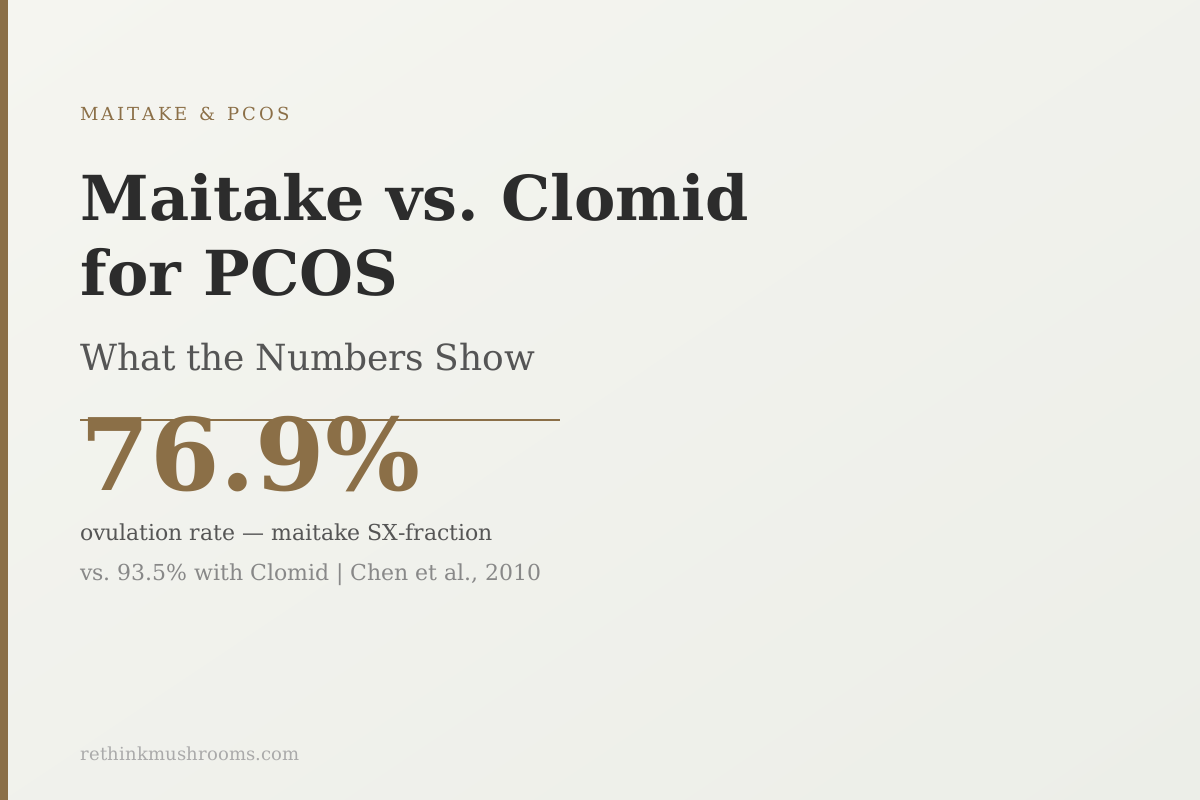
76.9% ovulation rate
Maitake SX-fraction achieved a 76.9% ovulation rate as standalone therapy in 80 PCOS patients, and rescued 75% of those who had already failed Clomid.
Chen et al., Journal of Alternative and Complementary Medicine, 2010
93.5%
ovulation rate with Clomid in the same trial
75%
of Clomid-resistant patients ovulated after maitake was added
80
PCOS patients across 3 Japanese clinics
Chen et al., Journal of Alternative and Complementary Medicine, 2010
 View as image ↗
The drug most commonly used to treat PCOS-related infertility, clomiphene citrate (sold as Clomid), fails outright in 15 to 40 percent of patients. For that group, clinicians either increase the dose, switch to injectable hormones, or consider IVF. In 2010, a team of researchers at three Japanese clinics asked a different question: could a specific maitake mushroom extract close that gap? Their trial, published in the Journal of Alternative and Complementary Medicine, put maitake SX-fraction directly against Clomid in 80 PCOS patients and tracked what happened when each treatment failed.[1] This is a cluster article in the maitake mushroom guide. What follows is a detailed maitake vs. Clomid PCOS comparison: what the trial found, what it means, and what an honest reading of the evidence looks like.
Key Takeaways
- In the only head-to-head trial, Clomid outperformed maitake as standalone treatment: 93.5% vs. 76.9% ovulation rate by patient (Chen et al., 2010)
- Maitake's strongest result was as rescue therapy: 75% of women who had already failed Clomid ovulated when maitake SX-fraction was added to their protocol
- Clomid and maitake work through entirely different mechanisms. Clomid acts at the hypothalamus; maitake improves insulin sensitivity. That difference explains the additive rescue effect
- Side-effect profiles differ substantially: Clomid causes hot flashes, mood changes, and uterine lining thinning; maitake reported no serious adverse events in the Chen 2010 trial
- A 2023 update to international PCOS guidelines named letrozole, not Clomid, the preferred first-line ovulation agent. The comparison now involves the former standard
- The entire evidence base for maitake in PCOS rests on one open-label trial; no independent replication has been published
What Clomid Actually Does and Why It Fails Up to 40% of PCOS Patients
Clomiphene citrate is a selective estrogen receptor modulator, or SERM. It works by binding to estrogen receptors in the hypothalamus, the brain region that controls the hormone cycle, and blocking them. The hypothalamus interprets this block as a signal that estrogen is low. It responds by releasing more follicle-stimulating hormone (FSH) and luteinizing hormone (LH), which push the ovaries to develop follicles and trigger ovulation.
The drug has been standard for PCOS-related anovulatory infertility since the 1960s. For most patients, it works. For 15 to 40 percent of patients, it does not. Their ovaries don't respond adequately despite the hormonal push. This is called clomiphene resistance, and it isn't simply a treatment failure. The hypothalamic signal is working; the problem is further downstream.
The reason often involves the metabolic side of PCOS. In insulin-resistant PCOS patients, elevated insulin signals the ovaries to produce excess testosterone. That androgen excess disrupts the follicular development process at a point that Clomid's mechanism doesn't reach. Clomid pushes harder at the top of the hormonal cascade. Insulin-driven androgen excess creates a block further down. If that block is strong enough, pushing harder at the top doesn't help.
This is the mechanistic context for why an insulin sensitizer, one that works at a completely different point in the system, was a logical candidate to test alongside Clomid.
One other update worth knowing before reading the Chen 2010 data: in 2023, international PCOS guidelines shifted away from Clomid as the preferred first-line agent. Letrozole, an aromatase inhibitor, now has that position. It achieves comparable or better pregnancy rates with fewer side effects, particularly less uterine lining thinning. Clomid remains in use but is no longer the default. Any comparison to Clomid is therefore a comparison to the former gold standard, not the current one.
The Head-to-Head: 76.9% vs. 93.5% Ovulation Rate
The Chen 2010 trial enrolled 80 PCOS patients across three clinics in Japan and randomized them to one of two monotherapy arms for up to 12 weeks: maitake SX-fraction extract (MSX) or clomiphene citrate (CC).[1]
The maitake formulation was specific. Each tablet contained 18mg of SX-fraction plus 250mg of dried maitake powder. SX-fraction is a water-soluble glycoprotein isolated from maitake; it is a separate compound from maitake D-fraction, which targets immune function. The distinction matters for anyone looking at supplement labels: most maitake products do not specify SX-fraction content. The SX-fraction research overview covers this in detail.
The primary results, by patient:
- Maitake SX-fraction: 76.9% (20 of 26 patients ovulated)
- Clomid (clomiphene citrate): 93.5% (29 of 31 patients ovulated)
Per-cycle ovulation rates were lower for both, because not every cycle within the treatment period resulted in ovulation even among eventual responders:
- Maitake: 41.7%
- Clomid: 69.9%
The per-patient rate measures whether a woman ovulated at any point during treatment. The per-cycle rate measures what fraction of individual menstrual cycles produced ovulation. Both measures show Clomid outperforming maitake.
The honest read: Clomid is the more effective standalone treatment. This is not a controversial conclusion. Clomid was specifically developed to induce ovulation through a direct hormonal pathway and has been optimized over decades for exactly this application. A mushroom extract achieving 76.9% in the same trial is genuinely notable, but Clomid's higher rate is the expected result.
The trial had one significant design limitation: it was open-label, meaning neither patients nor clinicians were blinded to which treatment was assigned. Ovulation is measured objectively via ultrasound, which limits the impact of this on the primary endpoint. Still, the open-label design is a meaningful caveat, and the trial has not been independently replicated.
Where Maitake Pulled Ahead: The Clomid-Resistance Finding
After the monotherapy phase, patients who had not responded to their assigned treatment entered a combination rescue phase. Those who had failed Clomid had maitake SX-fraction added to their protocol. Those who had failed maitake had Clomid added.
The rescue results:
- Women who had failed Clomid, then added maitake: 75% ovulated
- Women who had failed maitake, then added Clomid: 100% ovulated
These two numbers should be read carefully.
The 100% rate in the failed-maitake group is expected. Clomid is a potent ovulation inducer, and the patients who had failed maitake had not yet been exposed to a hypothalamic-acting drug. Adding Clomid to their protocol essentially gave them Clomid for the first time, in a population not selected for Clomid resistance.
The 75% rate in the failed-Clomid group is different. These were women who had already not responded to Clomid, a drug that works in roughly 85% of PCOS patients. They were, by definition, a harder-to-treat group. Adding maitake SX-fraction to their Clomid protocol achieved ovulation in three out of four of them.[1]
This is the data point that is almost entirely absent from consumer health content. It does not frame maitake as a Clomid replacement. It frames maitake as an adjunct therapy for the specific population where Clomid alone is not enough. For the 15-40% of PCOS patients who are Clomid-resistant, that is a meaningful distinction.
The full trial data breakdown, including design details, patient populations, and statistical context, is covered in the Chen 2010 clinical trial article.
Two Different Mechanisms That Explain the Additive Effect
The rescue finding makes more sense once you understand that Clomid and maitake act on the PCOS problem at completely different points.
Clomid's mechanism is hypothalamic. It blocks estrogen receptors in the hypothalamus, triggering elevated FSH and LH release from the pituitary, which drives follicle development in the ovaries. It is a top-down hormonal push. If the ovaries are unresponsive because of androgen excess, and that androgen excess is driven by insulin resistance, Clomid is pushing on a system that has a blockage further downstream.
Maitake SX-fraction's mechanism is metabolic. The SX-fraction glycoprotein acts as an insulin sensitizer: it improves the body's response to insulin, reducing the abnormally high circulating insulin levels common in PCOS patients.[3] Lower insulin means less stimulation of the ovaries to produce testosterone. Less testosterone means less disruption to follicular development. The downstream result, in principle, is that follicles blocked by androgen excess can now develop normally.
Put simply: Clomid tells the ovaries to work harder. Maitake tries to remove a metabolic obstacle that was preventing them from working at all.
For a patient who is Clomid-resistant because insulin-driven androgen excess is overriding Clomid's hormonal push, adding an insulin sensitizer addresses the root problem that Clomid was not reaching. This is why the combination therapy makes biological sense, and why a 75% rescue rate in Clomid-resistant patients fits the mechanism.
This also places maitake in a broader category of approaches to PCOS: address the insulin resistance, and the downstream hormonal problem may follow. Metformin, the pharmaceutical insulin sensitizer often prescribed for PCOS, works by a different biochemical pathway than maitake SX-fraction, but the upstream intent is similar. Neither is interchangeable with the other; the point is that the category of insulin-sensitizing intervention has a coherent biological rationale in PCOS.
The full mechanism chain, from insulin resistance through androgen excess to anovulation, is covered in the maitake and insulin-driven hormonal imbalance article.
Side Effects: Where the Comparison Gets Clinically Interesting
Clomid's side-effect profile is well established after six decades of use.
Hot flashes: Reported in roughly 10 percent of patients, caused by Clomid's anti-estrogenic effect in peripheral tissues.
Mood changes: Irritability, depression, and anxiety are reported at meaningful rates, though separating drug effects from the emotional weight of fertility treatment is difficult.
Uterine lining thinning: This is the most clinically significant Clomid side effect. Clomid's anti-estrogenic action thins the endometrium (the uterine lining that must support implantation). Some patients ovulate successfully on Clomid but do not become pregnant because the lining is too thin to support embryo implantation. This is a recognized clinical problem with Clomid, and it partially explains why letrozole, which does not have this effect, now holds the preferred-treatment designation.
Visual disturbances: Rare, but may include blurred vision or light sensitivity. Patients experiencing these are typically advised to stop the drug.
Ovarian hyperstimulation syndrome (OHSS): More common with injectable gonadotropins than with Clomid, but OHSS can occur. It involves ovarian swelling and, in severe cases, fluid accumulation in the abdomen.
Multiple gestation: Clomid modestly increases the risk of twins by sometimes stimulating multiple follicles simultaneously.
In the Chen 2010 trial, the maitake SX-fraction group reported no serious adverse events.[1] This is encouraging data, but it should be read carefully. The trial was not designed with safety as a primary endpoint, and 26 patients over 12 weeks is insufficient to detect rare adverse events. Maitake has a strong general safety record across culinary use and other research applications, but PCOS-specific safety data comes only from this one small trial.
For patients facing Clomid resistance who are evaluating whether to push to higher doses or explore an adjunct approach, the side-effect difference is practically relevant. A therapy with maitake's mechanism has no known effect on uterine lining thickness, for example. That is one of Clomid's more clinically awkward tradeoffs.
One Complication: Letrozole Has Replaced Clomid as the Standard
International PCOS guidelines revised their first-line treatment recommendation in 2023. Letrozole, an aromatase inhibitor, is now the preferred ovulation induction agent over Clomid. It achieves comparable or higher pregnancy rates, causes less uterine lining thinning, and has a cleaner side-effect profile in most patients.
Clomid remains available and continues to be used, particularly in settings where letrozole access or cost is a barrier. But it is no longer the default.
This update creates two complications for interpreting the Chen 2010 data.
First, the maitake comparison is against the former gold standard. No equivalent trial against letrozole exists. We do not know how maitake would compare to letrozole in a head-to-head trial, or whether maitake SX-fraction would show a similar rescue effect in letrozole-resistant patients.
Second, letrozole resistance also occurs, though it is less well characterized than Clomid resistance. The biological logic of adding an insulin sensitizer to letrozole for resistant patients would follow the same rationale as the maitake plus Clomid combination. Both Clomid and letrozole work at the top of the hormonal cascade; neither addresses insulin-driven androgen excess. A maitake plus letrozole combination trial would be a logical extension of Chen 2010's findings. No such trial has been published.
What a 2025 Systematic Review Added
In 2025, Wani and Shaikh published the first systematic review to formally include maitake among natural treatments evaluated for PCOS.[2] Their review examined maitake's immune properties, the D-fraction compound, the Chen 2010 ovulation data, and maitake's broader metabolic effects, including blood glucose reduction, blood pressure effects, and lipid profile modifications, as context for PCOS's systemic metabolic burden.
The 2025 review adds two meaningful things to the evidence picture.
First, independent validation: a systematic review team evaluating the maitake PCOS literature formally endorsed Chen 2010 as the primary clinical evidence and situated it within a broader metabolic rationale. This is meaningfully different from a single trial existing in isolation.
Second, the metabolic framing: the review highlights that PCOS is not only a reproductive condition. Many patients have elevated blood glucose, dyslipidemia, and cardiovascular risk. Maitake's metabolic effects, documented across multiple preclinical studies, are relevant to that broader profile, not just to ovulation.
What the 2025 systematic review does not add is new trial data. The evidence base for maitake in human PCOS remains one open-label clinical trial from 2010, confirmed by a review that analyzed the same trial. The trial count has not grown. The gap in the evidence is now formally acknowledged in the medical literature, but it has not been filled.
For readers who want to start with the ovulation evidence and work back to the mechanism, the maitake PCOS overview is the broader entry point for this cluster.
The Bottom Line
The only head-to-head trial of maitake vs. Clomid for PCOS showed that Clomid outperforms maitake as standalone treatment (93.5% vs. 76.9% ovulation rate). The more important finding was in the rescue phase: maitake SX-fraction restored ovulation in 75% of women who had already failed Clomid. The two compounds work through entirely different mechanisms: Clomid via hypothalamic signaling, maitake via insulin sensitivity. That difference explains why combining them shows additive benefit in resistant patients. The comparison now involves the former first-line standard; letrozole replaced Clomid in 2023 guidelines. The full evidence base rests on one open-label trial from 2010 with no independent replication.
Frequently Asked Questions
Sources & References
- 1RTHM-00330·Chen, Jui-Tung et al. (2010). “Maitake mushroom (Grifola frondosa) extract induces ovulation in patients with polycystic ovary syndrome: a possible monotherapy and a combination therapy after failure with first-line clomiphene citrate..” Journal of alternative and complementary medicine (New York.Study breakdown →PubMed →↩
- 2RTHM-02208·Wani, Rashmi et al. (2025). “Healing with Herbs: A Systematic Review of Natural Treatments for Polycystic Ovary Syndrome..” JBRA assisted reproduction.Study breakdown →PubMed →↩
- 3RTHM-00229·Preuss, Harry G et al. (2007). “Enhanced insulin-hypoglycemic activity in rats consuming a specific glycoprotein extracted from maitake mushroom..” Molecular and cellular biochemistry.Study breakdown →PubMed →↩