Agaricus blazei Supplements
1.5g-5.4g/day
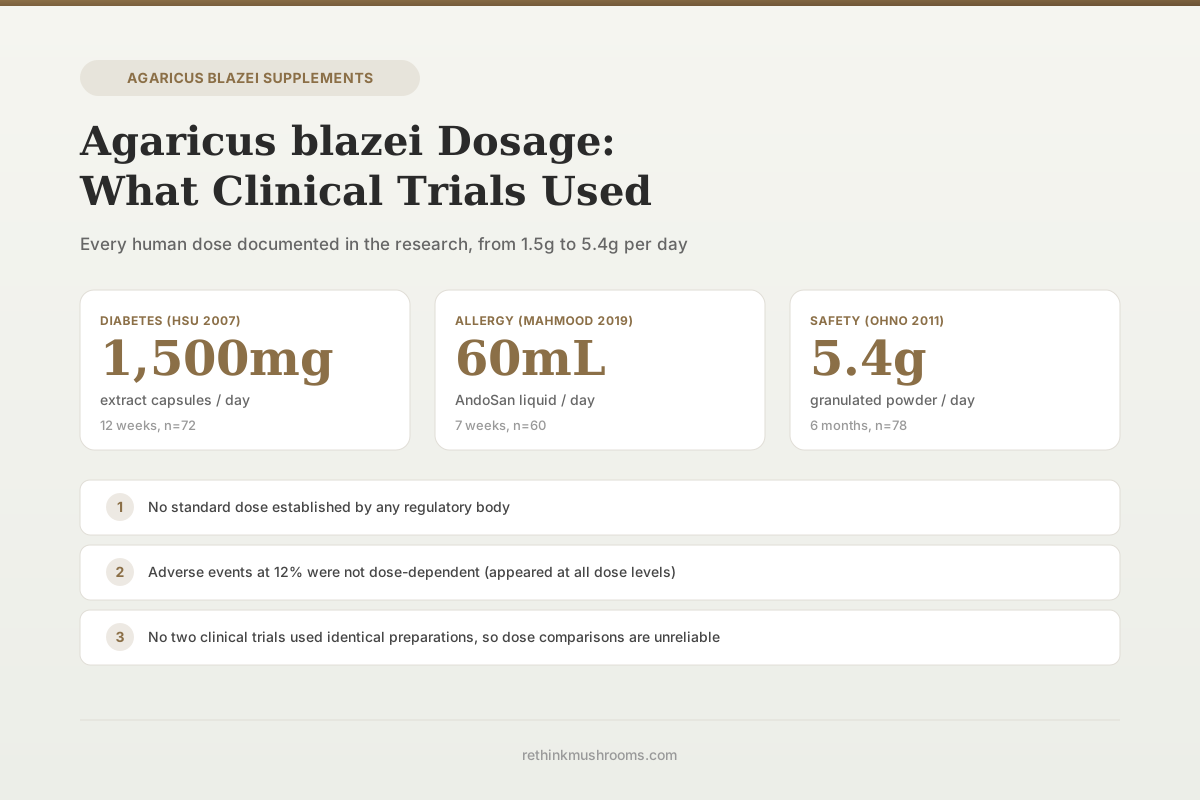
Human clinical trials have tested Agaricus blazei at doses ranging from 1.5g extract to 5.4g granulated powder per day, with durations from 12 days to 6 months. No standard dose has been established.
Ohno et al., Evidence-Based Complementary and Alternative Medicine, 2011
7 Human Trials
with documented dosing protocols
No Standard Dose
each trial used a different preparation
12% Adverse Events
at the highest dose tested (5.4g/day)
Ohno et al., Evidence-Based Complementary and Alternative Medicine, 2011
 View as image ↗
There is no established therapeutic dose for Agaricus blazei Murill (ABM). No regulatory body has set a recommended intake. No dose-response study has systematically compared multiple doses against a single endpoint. What exists instead is a collection of clinical trials, each using a different ABM preparation at a different dose for a different duration in a different patient population. Extracting dosage guidance from this patchwork requires examining every trial individually and understanding that comparing doses across different extract types is not straightforward.
This article catalogs every dose tested in human research. For safety data and side effects, drug interaction concerns, and the difference between extract types and supplement forms, those topics have dedicated articles.
Key Takeaways
- The only Phase I dose-escalation study tested 1.8g, 3.6g, and 5.4g of ABM granulated powder daily for 6 months in 78 cancer survivors, with adverse events in 12% that were not dose-dependent (Ohno et al., Evidence-Based Complementary and Alternative Medicine, 2011)
- A diabetes RCT used 1,500mg of ABM extract daily for 12 weeks, producing significant improvements in insulin resistance (HOMA-IR 3.6 vs. 6.6, p=0.04) and a 20% increase in adiponectin (Hsu et al., Journal of Alternative and Complementary Medicine, 2007)
- The birch allergy RCT used 60mL/day of AndoSan liquid extract (82% ABM) for 7 weeks pre-seasonally, with significant reductions in allergy symptoms, asthma symptoms, and specific IgE (Mahmood et al., Nutrients, 2019)
- In 8 healthy volunteers, 60mL/day of AndoSan for 12 days reduced TNF-alpha by 84% and IL-1beta by 97% in vivo (Johnson et al., Scandinavian Journal of Immunology, 2009)
- The multiple myeloma RCT used 30mL of AndoSan twice daily for approximately 7 weeks during chemotherapy, producing immunomodulatory changes but no survival differences (Tangen et al., BioMed Research International, 2015)
- A 2017 systematic review found that across 17 clinical studies, no two used identical ABM preparations, making direct dose comparisons impossible (da Silva de Souza et al., Current Pharmaceutical Design, 2017)
Every Dose Tested in Human Clinical Trials
The table below summarizes all documented human dosing protocols.
| Study | Dose | Form | Duration | Population | N |
|---|---|---|---|---|---|
| Ahn 2004 | Not specified (ABMK extract) | Oral extract | During chemo cycles | Gynecological cancer | 100 |
| Hsu 2007 | 1,500mg/day | ABM extract capsules | 12 weeks | Type 2 diabetes | 72 |
| Johnson 2009 | 60mL/day | AndoSan liquid | 12 days | Healthy volunteers | 8 |
| Forland 2011 | 60mL/day (30mL x2) | AndoSan liquid | 12 days | IBD patients | 21 |
| Ohno 2011 | 1.8g, 3.6g, or 5.4g/day | Granulated powder | 6 months | Cancer survivors | 78 |
| Tangen 2015 | 60mL/day (30mL x2) | AndoSan liquid | ~7 weeks | Multiple myeloma | 40 |
| Therkelsen 2016 | Daily AndoSan | AndoSan liquid | 21 days | Crohn's disease | 50 |
| Mahmood 2019 | 60mL/day | AndoSan liquid | 7 weeks | Birch pollen allergy | 60 |
The Phase I Dose-Escalation Study
Ohno et al. (2011) is the closest thing to a formal dosing study that exists for ABM.[1] Seventy-eight cancer patients in remission were assigned to three dose levels of ABM granulated powder: 1.8g/day (one pack, n=30), 3.6g/day (two packs, n=24), or 5.4g/day (three packs, n=24). They took the supplement for 6 months with regular laboratory monitoring.
Adverse events occurred in 9 patients (12%), primarily nausea and diarrhea. One patient developed liver dysfunction attributed to food allergy. The critical finding for dosing: adverse events were not dose-dependent. They occurred at similar rates across all three dose levels. Laboratory parameters remained normal at all doses.
This establishes an upper bound of 5.4g/day of ABM granulated powder as tolerable for 6 months in cancer survivors. It does not establish an effective dose for any condition because the study was designed for safety assessment, not efficacy.
Dried Extract Doses: 1,500mg for Diabetes
Hsu et al. (2007) used 1,500mg/day of ABM extract (not specified as hot-water or ethanol) in capsule form for 12 weeks alongside standard diabetes medication (metformin and gliclazide).[2]
At this dose, insulin resistance (HOMA-IR) was significantly lower in the ABM group compared to placebo (3.6 vs. 6.6, p=0.04). Adiponectin, a hormone that improves insulin sensitivity, increased by 20% in the ABM group while decreasing by 12% in the placebo group (p<0.001).
This is a meaningful clinical result at a moderate dose. However, the extract preparation is not well-characterized in the paper, making it difficult to know exactly what 1,500mg contained in terms of active compounds like beta-glucans.
Liquid Extract Doses: AndoSan at 60mL/day
Most clinical trials from Hetland's research group in Norway used AndoSan, a commercial mushroom extract containing 82% Agaricus blazei Murill, 15% Hericium erinaceus, and 3% Grifola frondosa. The standard dose was 60mL/day, typically split into two 30mL doses.
Healthy Volunteers (Johnson 2009)
Eight healthy volunteers consumed 60mL/day for 12 days.[3] This produced striking anti-inflammatory effects in vivo: IL-1beta decreased by 97% and TNF-alpha by 84%. The short duration and small sample provide pharmacological evidence that 60mL/day is biologically active, but the practical significance of these cytokine changes is unclear.
IBD Patients (Forland 2011)
Twenty-one patients with ulcerative colitis or Crohn's disease consumed 30mL of AndoSan twice daily (60mL total) for 12 days before collection of blood and fecal samples.[4] The extract reduced pro-inflammatory cytokines and fecal calprotectin (an intestinal inflammation marker) in these patients, suggesting the 60mL/day dose has anti-inflammatory activity in an active disease population over a short treatment window.
Multiple Myeloma (Tangen 2015)
Forty myeloma patients received 30mL of AndoSan twice daily during approximately 7 weeks of chemotherapy and stem cell transplantation.[5] At this dose, immunomodulatory changes were detectable (increased T-regulatory cells, plasmacytoid dendritic cells, and several cytokines). Treatment response and survival showed no significant differences, though the study was likely underpowered for those endpoints.
Crohn's Disease (Therkelsen 2016)
Fifty Crohn's disease patients were randomized to daily AndoSan or placebo for 21 days.[6] Symptoms improved significantly within the AndoSan group from baseline to days 14 and 21. However, the difference between AndoSan and placebo groups did not reach statistical significance (p=0.106), with only a marginal effect in men (p=0.054). This was the largest IBD trial and suggests the 21-day, 60mL/day protocol may be insufficient to produce clinically meaningful differences over placebo in Crohn's.
Birch Pollen Allergy (Mahmood 2019)
Sixty birch-allergic blood donors received 60mL/day of AndoSan for 7 weeks pre-seasonally.[7] This produced the most clearly positive results of any AndoSan trial: significantly reduced allergy symptoms, asthma symptoms, medication use, and specific IgE. The 7-week pre-seasonal timing appears to have been sufficient for immune modulation that carried through the pollen season.
The Comparability Problem
A 2017 systematic review identified this as the field's central methodological issue: across 17 clinical studies, no two used identical ABM preparations.[8] The reasons this matters:
Extract type affects composition. Hot-water extracts are rich in polysaccharides (beta-glucans) but contain few lipophilic compounds. Ethanol extracts capture ergosterol and other lipids but miss the polysaccharides. The Ohno study used granulated whole mushroom powder. The Hsu study used an unspecified extract. AndoSan is a hot-water extract blend.
Active compound content varies. Beta-glucan content differs between ABM strains, growing conditions, extraction methods, and product batches. A gram of one ABM extract may contain a fundamentally different complement of bioactive compounds than a gram of another.
The 60mL liquid vs. gram powder comparison is misleading. 60mL of AndoSan liquid extract is not equivalent to 5.4g of granulated powder. The concentration of active compounds in a liquid extract depends on the extraction ratio, which is not always reported. Without standardization to a specific marker compound (like beta-glucan content measured by a validated assay), cross-study dose comparisons are unreliable.
Hetland et al. (2020) acknowledged this limitation in their comprehensive review, noting that the lack of standardized preparations across studies makes it difficult to establish optimal dosing.[9]
What Commercial Supplements Typically Contain
Most ABM supplements available to consumers fall into three categories:
Dried mushroom powder: Typically 500mg-1,000mg per capsule, with suggested daily intake of 1-3 capsules (500mg-3,000mg/day). These contain whole mushroom material with varying beta-glucan content depending on growing substrate and processing.
Hot-water extract capsules: Usually standardized to a polysaccharide percentage (often 30-50%), with typical daily doses of 500mg-1,500mg. These are more concentrated than whole mushroom powder and closer to what clinical trials have used.
Liquid extracts: Vary widely in concentration. AndoSan (used in Norwegian clinical trials) is commercially available in some markets at the trial dose of 60mL/day, but most consumer liquid extracts have different concentrations.
None of these commercial products have undergone the same quality controls or testing protocols as the preparations used in clinical trials. The gap between research-grade ABM preparations and consumer supplements is substantial and largely unregulated. Third-party testing for beta-glucan content, heavy metals (particularly arsenic, which has been found in some ABM products), and microbial contamination is available but not required in most markets. Without independent verification, a consumer cannot know whether their supplement matches the composition of any clinical trial preparation.
Duration: How Long Before Effects Appear
The human evidence suggests different timelines for different effects:
- Anti-inflammatory cytokine changes: 12 days at 60mL/day AndoSan (Johnson 2009)
- Insulin resistance improvement: 12 weeks at 1,500mg/day extract (Hsu 2007)
- Allergy symptom reduction: 7 weeks pre-seasonal at 60mL/day AndoSan (Mahmood 2019)
- Immunomodulatory changes in cancer: ~7 weeks at 60mL/day AndoSan (Tangen 2015)
- IBD symptom improvement: 14-21 days at 60mL/day AndoSan, though not significantly different from placebo (Therkelsen 2016)
- Safety over long-term use: Confirmed safe at 5.4g/day for 6 months (Ohno 2011)
The fastest documented effects are the cytokine changes at 12 days. The metabolic effects (insulin resistance) required 12 weeks. No study has examined whether longer treatment durations produce greater benefits.
The Bottom Line
No standard Agaricus blazei dose has been established. Seven human clinical trials have tested doses ranging from 1,500mg dried extract to 5.4g granulated powder per day, and 60mL/day of liquid extract (AndoSan), with treatment durations from 12 days to 6 months. The only Phase I study confirmed safety up to 5.4g/day for 6 months without dose-dependent adverse events. Effective doses have been demonstrated for insulin resistance (1,500mg/day for 12 weeks) and birch pollen allergy (60mL/day AndoSan for 7 weeks), but cross-study dose comparisons are unreliable because each trial used a different preparation with unknown relative potency.
Frequently Asked Questions
Sources & References
- 1RTHM-00229·Ohno, Satoshi et al. (2011). “Phase I Clinical Study of the Dietary Supplement, Agaricus blazei Murill, in Cancer Patients in Remission..” Evidence-based complementary and alternative medicine : eCAM.Study breakdown →PubMed →↩
- 2RTHM-00114·Hsu, Chung-Hua et al. (2007). “The mushroom Agaricus Blazei Murill in combination with metformin and gliclazide improves insulin resistance in type 2 diabetes: a randomized, double-blinded, and placebo-controlled clinical trial..” Journal of alternative and complementary medicine (New York.Study breakdown →PubMed →↩
- 3RTHM-00157·Johnson, E et al. (2009). “Effect of an extract based on the medicinal mushroom Agaricus blazei murill on release of cytokines, chemokines and leukocyte growth factors in human blood ex vivo and in vivo..” Scandinavian journal of immunology.Study breakdown →PubMed →↩
- 4RTHM-00213·Førland, D T et al. (2011). “Effect of an extract based on the medicinal mushroom Agaricus blazei Murill on expression of cytokines and calprotectin in patients with ulcerative colitis and Crohn's disease..” Scandinavian journal of immunology.Study breakdown →PubMed →↩
- 5RTHM-00404·Tangen, Jon-Magnus et al. (2015). “Immunomodulatory effects of the Agaricus blazei Murrill-based mushroom extract AndoSan in patients with multiple myeloma undergoing high dose chemotherapy and autologous stem cell transplantation: a randomized, double blinded clinical study..” BioMed research international.Study breakdown →PubMed →↩
- 6RTHM-00451·Therkelsen, Stig Palm et al. (2016). “Effect of the Medicinal Agaricus blazei Murill-Based Mushroom Extract, AndoSanTM, on Symptoms, Fatigue and Quality of Life in Patients with Crohn's Disease in a Randomized Single-Blinded Placebo Controlled Study..” PloS one.Study breakdown →PubMed →↩
- 7RTHM-00579·Mahmood, Faiza et al. (2019). “Agaricus blazei-Based Mushroom Extract Supplementation to Birch Allergic Blood Donors: A Randomized Clinical Trial..” Nutrients.Study breakdown →PubMed →↩
- 8RTHM-00468·da Silva de Souza, Aline Cristine et al. (2017). “Agaricus blazei Bioactive Compounds and their Effects on Human Health: Benefits and Controversies..” Current pharmaceutical design.Study breakdown →PubMed →↩
- 9RTHM-00620·Hetland, Geir et al. (2020). “Antitumor, Anti-Inflammatory and Antiallergic Effects of Agaricus blazei Mushroom Extract and the Related Medicinal Basidiomycetes Mushrooms, Hericium erinaceus and Grifola frondosa: A Review of Preclinical and Clinical Studies..” Nutrients.Study breakdown →PubMed →↩