Agaricus blazei Practical Guide
88% plaque reduction
Ethanol extract of Agaricus brasiliensis reduced poliovirus plaques by 88% versus 50% for the aqueous extract in the same concentration-dependent assay.
Faccin et al., Letters in Applied Microbiology, 2007
Beta-glucans in water
polysaccharides require hot water to solubilize
Ergosterol in ethanol
fat-soluble sterols need alcohol, not water
NK cells diverge
crude water extract inert; ethanol-soluble fraction activates
Faccin et al., Letters in Applied Microbiology, 2007
 View as image ↗
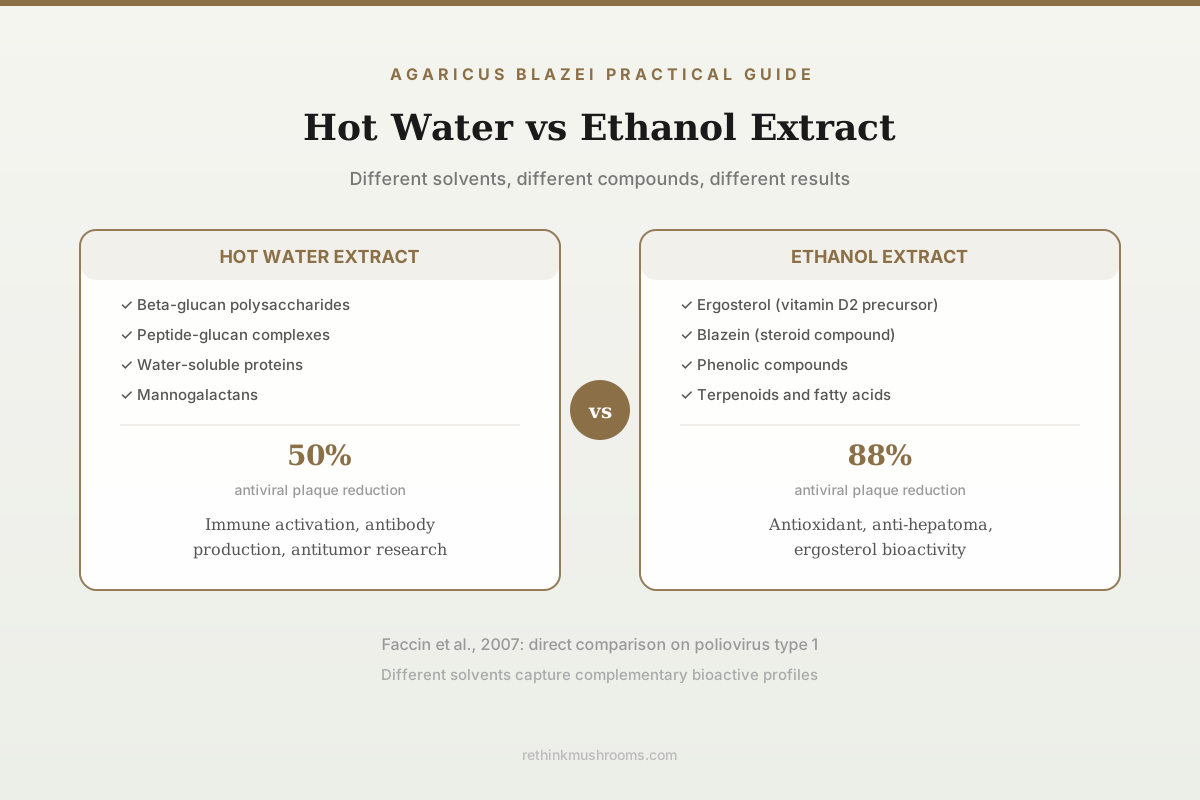
The extraction solvent used on Agaricus blazei determines which bioactive compounds end up in the final product. Hot water dissolves beta-glucan polysaccharides and water-soluble proteins. Ethanol dissolves ergosterol, blazein, phenolic compounds, and other lipophilic molecules. These two compound classes produce different biological effects in laboratory studies, and in at least two direct comparisons, the extracts performed differently on the same assay.[1] For broader context on these compound classes, see our overview of Agaricus blazei bioactive compounds.
This distinction matters because most commercially available Agaricus blazei supplement forms use only one extraction method. A hot water extract and an ethanol extract of the same mushroom are functionally different products with different chemical profiles. The research summarized here covers what each method captures and where the two extracts diverge in measured biological activity.
Key Takeaways
- Ethanol extract of A. brasiliensis reduced poliovirus plaques by 88% with a selectivity index of 12.3, versus 50% and 5.4 for the aqueous extract (Faccin et al., 2007)
- A 30% ethanol-soluble fraction from hot water extract produced the strongest NK cell augmentation in murine splenocytes, while the original aqueous extract failed to stimulate NK activity (Zhong et al., 2005)
- Hot water extraction of A. blazei fruiting bodies yielded beta-glucans with a (1,6)-linked backbone and (1,3)-linked branches, confirmed by NMR (Dong et al., 2002)
- Ethanol dissolves the fat-soluble ergosterol that water leaves behind; Correa et al. (2018) obtained an ergosterol-rich extract from A. blazei with antioxidant and antimicrobial activity and no hepatotoxicity (Correa et al., 2018)
- Sequential hot water, cold NaOH, and hot NaOH extraction of A. blazei yielded three (1,6)-beta-glucan fractions; the NaOH extracts showed antitumor activity against Sarcoma 180 in mice, with a branched (1,3)-beta-glucan segment as the active center (Ohno et al., 2001)
- Hot-water-extracted, ethanol-precipitated (1,6)-beta-glucans from A. brasiliensis induced interferon-gamma in human immune cells and showed strong antioxidant activity against hydroxyl and superoxide radicals (Kozarski et al., 2014)
What Hot Water Extraction Captures
Hot water is the standard solvent for pulling polysaccharides from mushroom cell walls. When Agaricus blazei fruiting bodies are boiled or pressure-extracted in water at 80 to 100 degrees Celsius, the heat breaks hydrogen bonds holding beta-glucan chains in the insoluble cell wall matrix, releasing them into solution.[1]
Dong et al. (2002) isolated and structurally characterized a water-soluble beta-D-glucan (designated Ab2-2N) from the hot water extract of A. blazei fruiting bodies. Using methylation analysis and NMR spectroscopy, they identified a backbone of (1,6)-linked beta-D-glucopyranosyl residues with side chains of terminal and 3-substituted beta-D-glucopyranosyl residues.[2] This (1,3)/(1,6) branching pattern is the structural feature recognized by Dectin-1 receptors on innate immune cells.
Ohno et al. (2001) used sequential extraction to separate A. blazei polysaccharides into three fractions: a hot water extract (AgHWE), a cold alkali (NaOH) extract (AgCA), and a hot alkali (NaOH) extract (AgHA). The primary structures were all mainly composed of (1,6)-beta-glucan, confirmed by chemical, enzymic, and NMR analysis. Among the fractions, the NaOH extracts showed antitumor activity against the solid form of Sarcoma 180 in ICR mice, and further chemical treatments identified a highly branched (1,3)-beta-glucan segment as the active center of that activity.[3]
Beyond polysaccharides, aqueous extraction of A. blazei also yields water-soluble proteins and protein-bound polysaccharide fractions with antitumor activity. Ebina and Fujimoto (1998) tested fractions of A. blazei fruiting bodies in a double-grafted Meth-A tumor system in mice. Intratumoral injection of an ammonium oxalate-soluble fraction produced the strongest effect: regression of the injected tumor plus growth inhibition of the distant, non-injected tumor. The authors attributed this systemic (abscopal) response to an immune reaction, including induction of cytotoxic spleen cells and release of macrophage chemotactic factors, rather than direct cytotoxicity.[4]
Hot water extract from A. blazei also boosts antibody production in mice. Nakajima et al. (2002) found that intraperitoneal administration of a boiled water-soluble extract (25 mg/kg) significantly increased the number of antibody (plaque)-forming spleen cells against a sheep red blood cell antigen, alongside augmented IL-1beta and IL-6 expression in peritoneal macrophages and spleen cells, indicating the polysaccharide-rich extract stimulates humoral as well as cellular immunity.[5]
What Hot Water Misses
Hot water does not efficiently extract non-polar compounds. Ergosterol, the primary sterol in A. blazei (which converts to vitamin D2 under UV light), is poorly soluble in water. The same is true for blazein (an androgen-like steroid), agarol (a lipid), and many phenolic compounds that partition more readily into organic solvents.[1] Water-insoluble fractions of A. blazei fruiting bodies contain their own bioactive compounds: Kawagishi et al. (1989) fractionated the water-insoluble residue of A. blazei fruiting bodies and found antitumor activity in it, with the most active fraction composed of protein and a (1,6)-beta-D-glucan.[6]
What Ethanol Extraction Captures
Ethanol dissolves a different set of molecules. The key targets are sterols (ergosterol and its derivatives), phenolic compounds, terpenoids, and fatty acids. These are the compounds trapped in lipid membranes and hydrophobic cell wall compartments that water cannot reach.
Correa et al. (2018) used Soxhlet extraction to recover an ergosterol-rich extract from A. blazei fruiting bodies, reaching the highest ergosterol yield by the fifth extraction cycle. The extract showed notable antioxidant and antimicrobial activity with no hepatotoxicity, and it enhanced the antioxidant properties of yogurt when used as a fortifier ingredient, demonstrating that organic-solvent extraction recovers the fat-soluble sterol fraction that water leaves behind.[7]
Tung et al. (2012) tested an ethanolic extract of A. blazei fermentation product on human hepatoma cell lines (HA22T/VGH and SK-Hep-1). The ethanolic extract inhibited cell growth (IC50 values of roughly 27 to 29 micrograms per milliliter) and invasion in a dose-dependent manner, driving the cells toward apoptosis. The activity is consistent with lipophilic compounds captured by ethanol rather than polysaccharides, since the extraction solvent would not efficiently recover beta-glucans.[8]
Huang et al. (2022) catalogued the full range of A. blazei bioactives in their comprehensive review and divided them into three categories: hydrophilic small molecules (phenolics, amino acids), lipophilic or partially lipophilic small molecules (ergosterol, blazein, agarol, agaritine), and macromolecules (beta-glucans, proteoglycans). Ethanol extraction captures the first two categories. Hot water extraction captures mainly the third.[1]
What Ethanol Misses
Ethanol is a poor solvent for high-molecular-weight polysaccharides. In fact, ethanol is routinely used to precipitate beta-glucans out of aqueous solution during purification procedures. Adding ethanol to a water extract causes the polysaccharides to crash out of solution and form a pellet. This means that an ethanol-only extract will contain few if any of the immunomodulatory beta-glucans that account for most of the published immune research on A. blazei.[4]
Head-to-Head: Where the Two Extracts Diverge
Two studies directly compared aqueous and ethanol extracts of A. blazei on the same biological assay, allowing a controlled look at how extraction solvent changes outcomes.
Antiviral Activity
Faccin et al. (2007) tested aqueous extract, an isolated polysaccharide fraction, and an ethanol extract of A. brasiliensis (synonym for A. blazei) against poliovirus type 1 in HEp-2 cells. When added immediately after virus inoculation, the ethanol extract reduced viral plaques by up to 88% in a concentration-dependent manner, with a selectivity index of 12.3. The aqueous extract achieved 50% reduction with a selectivity index of 5.4. The isolated polysaccharide sat between the two at 67% reduction and a selectivity index of 9.9.[9]
The ethanol extract outperformed the aqueous extract in this assay. Because poliovirus is non-enveloped, a membrane-disrupting mechanism is unlikely; the authors reported little effect on viral adsorption and no direct virucidal action, and suggested the extracts act at an early stage of viral replication. They did not identify the specific active compound in the ethanol fraction.
Head-to-Head: Antiviral Activity
Poliovirus plaque reduction by extract type (HEp-2 cells)
Aqueous (hot water) extract
Beta-glucan-rich fraction
Isolated polysaccharide
Purified from the aqueous extract
Ethanol extract
Lipophilic / sterol-rich fraction
When added immediately after viral inoculation, all three preparations reduced poliovirus plaques in a concentration-dependent way, but the ethanol extract was the most active and the most selective (higher selectivity index = greater antiviral effect relative to toxicity). The purified polysaccharide fell between the crude aqueous and ethanol extracts.
Source: Faccin et al. (2007), Letters in Applied Microbiology 45(1):24–28.
NK Cell Activity
Zhong et al. (2005) fractionated A. blazei aqueous extract by ethanol precipitation at various ethanol concentrations. The original unfractionated aqueous extract failed to stimulate natural killer (NK) cell activity in murine spleen cells in vitro. After fractionation, a fraction that was soluble in 30% ethanol but insoluble in 50% ethanol (fraction A-50, prepared from the extract at 40 degrees Celsius) showed the strongest augmentation of NK cell activity and interferon-gamma production.[10]
This result is counterintuitive. The crude hot water extract, which contains the full range of water-soluble compounds including beta-glucans, did not activate NK cells, yet a specific subfraction of that extract, isolated by ethanol solubility, did. A plausible explanation is that high-molecular-weight polysaccharides in the crude extract mask or dilute the activity of a smaller, more potent molecule that ethanol fractionation concentrates.
Hot Water Polysaccharides: Immune and Antioxidant Activity
Kozarski et al. (2014) prepared A. brasiliensis polysaccharides by hot water extraction and ethanol precipitation, then purified them further by dialysis and pronase digestion into a protein- and polyphenol-free (1,6)-beta-glucan preparation. These polysaccharides induced interferon-gamma in human peripheral blood mononuclear cells, and enzymatic degradation into smaller fragments increased that interferon-gamma activity roughly fourfold. The extracts also showed strong antioxidant activity against hydroxyl and superoxide radicals, acting through radical scavenging and iron chelation.[11]
This shows that a single hot water extraction followed by ethanol precipitation delivers a beta-glucan fraction that is both immunomodulatory and antioxidant. Notably, the immunostimulatory activity did not depend on keeping the polysaccharides large and intact: breaking them into smaller fragments increased interferon-gamma induction, and even the fully purified, polyphenol-free fraction retained antioxidant capacity. Extraction solvent still sets the ceiling on what is available, because ethanol alone would precipitate these beta-glucans out of solution rather than dissolve them.
Hot Water Extract in Anti-Infection Research
Sokovic et al. (2014) demonstrated that A. blazei hot water extract inhibits quorum sensing in Pseudomonas aeruginosa PAO1, a nosocomial pathogen. At sub-inhibitory concentrations that neither killed the bacteria nor slowed its growth, the extract significantly reduced quorum-sensing-controlled virulence factors, including pyocyanin production, twitching and swimming motility, and biofilm formation. This anti-virulence effect is distinct from direct antimicrobial killing.[12]
The immunomodulatory properties of hot water extracts have also been characterized in structural terms. Smiderle et al. (2011) showed that semi-purified polysaccharides from A. brasiliensis hot water extract, containing (1,6)-linked beta-glucan and mannogalactan, stimulated TNF-alpha, IL-1beta, and COX-2 expression in human monocytic THP-1 cells. The closely related A. bisporus (common button mushroom) contained the same polysaccharide types but in different proportions (more mannogalactan, less beta-glucan), and the A. brasiliensis extract also reduced LPS-induced cytokine production, suggesting these polysaccharides can modulate immune signaling in both directions.[13]
Dual Extraction: The Case for Both Solvents
The compound profiles of hot water and ethanol extracts are complementary, not overlapping. Hot water captures beta-glucans and protein-polysaccharide complexes responsible for immune cell activation. Ethanol captures ergosterol, phenolics, and lipophilic molecules with antioxidant and direct cytotoxic properties. A single-solvent extract misses roughly half the documented bioactive profile of A. blazei.[1]
Dual extraction (also called double extraction) applies hot water first to capture polysaccharides, then uses ethanol on the same material to capture lipophilic compounds. The two extracts are combined into a single product. This approach is common in commercial tinctures for reishi, chaga, and lion's mane, but less standardized for A. blazei supplements. For an explanation of how extract ratios like 10:1 relate to extraction method, see our dedicated guide.
Extraction method also matters for safety: the documented drug interactions for Agaricus blazei were observed with hot water extracts specifically, and the compound profile of an ethanol extract could produce different interaction risks. No published study has directly compared a dual-extracted A. blazei product against single-solvent extracts on the same biological endpoints. The argument for dual extraction is compositional: it captures more compound classes. Whether that translates to greater biological effect in a given assay is assumption, not data.
Which Extract Fits Which Research Area
| Research Area | Stronger Extract | Key Evidence |
|---|---|---|
| Immune cell activation (macrophage, monocyte) | Hot water | Nakajima et al., 2002; Smiderle et al., 2011 |
| Antitumor polysaccharide fractions | Hot water / alkali | Ohno et al., 2001; Ebina and Fujimoto, 1998 |
| Antiviral activity | Ethanol | Faccin et al., 2007 (88% vs 50% plaque reduction) |
| Anti-hepatoma activity | Ethanol | Tung et al., 2012 |
| Ergosterol and vitamin D2 precursor | Ethanol | Correa et al., 2018 |
| Antioxidant capacity | Hot water beta-glucan | Kozarski et al., 2014 |
| Anti-quorum sensing | Hot water | Sokovic et al., 2014 |
| Antibody production | Hot water | Nakajima et al., 2002 |
This table reflects the current state of published comparisons. For endpoints where only one extract type has been tested, the comparison is against no data rather than against an inferior result. The full safety profile and dosing evidence apply to both extract types, but most safety trials used hot water extracts specifically.
This article is educational and is not medical advice. Nearly all of the findings above come from laboratory and animal studies, not human clinical trials. Talk to a qualified clinician before using any Agaricus blazei extract, especially if you take prescription medication or have a liver condition.
The Bottom Line
Hot water and ethanol extracts of Agaricus blazei contain different bioactive compounds and produce different biological effects. Hot water captures beta-glucans responsible for immune cell activation and antitumor activity in animal models. Ethanol captures ergosterol, phenolics, and lipophilic compounds with antioxidant and direct cytotoxic properties. In two direct comparisons, ethanol extract outperformed aqueous extract for antiviral activity (88% vs 50% plaque reduction) and a specific ethanol-soluble fraction activated NK cells where the crude aqueous extract did not. No human clinical trial has compared the two extraction methods head-to-head for any health outcome.
Frequently Asked Questions
Sources & References
- 1RTHM-00765·Huang, Kaiyuan et al. (2022). “Critical review on chemical compositions and health-promoting effects of mushroom Agaricus blazei Murill..” Current research in food science.Study breakdown →PubMed →↩
- 2RTHM-00044·Dong, Qun et al. (2002). “Structural characterization of a water-soluble beta-D-glucan from fruiting bodies of Agaricus blazei Murr..” Carbohydrate research.Study breakdown →PubMed →↩
- 3RTHM-00038·Ohno, N et al. (2001). “Antitumor beta glucan from the cultured fruit body of Agaricus blazei..” Biological & pharmaceutical bulletin.Study breakdown →PubMed →↩
- 4RTHM-00024·Ebina, T et al. (1998). “Antitumor effect of a peptide-glucan preparation extracted from Agaricus blazei in a double-grafted tumor system in mice..” Biotherapy (Dordrecht.Study breakdown →PubMed →↩
- 5RTHM-00048·Nakajima, A et al. (2002). “Effect of hot water extract from Agaricus blazei Murill on antibody-producing cells in mice..” International immunopharmacology.Study breakdown →PubMed →↩
- 6RTHM-00010·Kawagishi, H et al. (1989). “Fractionation and antitumor activity of the water-insoluble residue of Agaricus blazei fruiting bodies..” Carbohydrate research.Study breakdown →PubMed →↩
- 7RTHM-00506·Corrêa, Rúbia C G et al. (2018). “A natural food ingredient based on ergosterol: optimization of the extraction from Agaricus blazei, evaluation of bioactive properties and incorporation in yogurts..” Food & function.Study breakdown →PubMed →↩
- 8RTHM-00268·Tung, Yen-Chen et al. (2012). “Ethanolic Extract of Agaricus blazei Fermentation Product Inhibits the Growth and Invasion of Human Hepatoma HA22T/VGH and SK-Hep-1 Cells..” Journal of traditional and complementary medicine.Study breakdown →PubMed →↩
- 9RTHM-00112·Faccin, L C et al. (2007). “Antiviral activity of aqueous and ethanol extracts and of an isolated polysaccharide from Agaricus brasiliensis against poliovirus type 1..” Letters in applied microbiology.Study breakdown →PubMed →↩
- 10RTHM-00089·Zhong, Ming et al. (2005). “In vitro augmentation of natural killer activity and interferon-gamma production in murine spleen cells with Agaricus blazei fruiting body fractions..” Bioscience.Study breakdown →PubMed →↩
- 11RTHM-00330·Kozarski, Maja et al. (2014). “Dietary polysaccharide extracts of Agaricus brasiliensis fruiting bodies: chemical characterization and bioactivities at different levels of purification..” Food research international (Ottawa.Study breakdown →PubMed →↩
- 12RTHM-00348·Soković, Marina et al. (2014). “Agaricus blazei hot water extract shows anti quorum sensing activity in the nosocomial human pathogen Pseudomonas aeruginosa..” Molecules (Basel.Study breakdown →PubMed →↩
- 13RTHM-00234·Smiderle, Fhernanda R et al. (2011). “Polysaccharides from Agaricus bisporus and Agaricus brasiliensis show similarities in their structures and their immunomodulatory effects on human monocytic THP-1 cells..” BMC complementary and alternative medicine.Study breakdown →PubMed →↩